|
|
Solitaire Ever
wanted to challenge yourself to a Magic Duel? Here’s how! All you need
is a deck (either a deck you use all the time or a sealed deck), the rules
below, and a slightly different way of approaching the game. Solitaire
Magic won’t improve your timing skills or the menacing glare that
intimidates opponents. It will, however, improve your card memory skills,
including your ability to estimate how likely you are to draw a card based
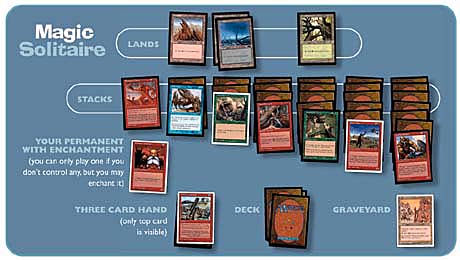
on how many cards you’ve seen. Setting up the Table Take your deck, shuffle, and deal out seven traditional solitaire stacks – the first has one card, the second two, and so on. As long as a stack contains any cards, the top one is always turned face up. The remaining cards are you deck. You start with no hand and an empty graveyard. There are no life totals, so don’t worry about that. The goal of the game is to eliminate all the cards in these seven stacks before cycling through your deck three times.
Mandatory Plays Lands
must be moved up above the stacks, where the aces would go in standard
solitaire. Each different land type is placed in its own pile. If more
than one copy of a card is ever face up or in your hand, move it to a
stack with that card on top. In other words, if two stacks both have Hurloon
Minotaurs on top, you must move one Minotaur on top of the other
one. The Seven Stack (And How to Get Rid of Them) The
cards on top of each stack have many uses. If the card is a permanent,
it’s considered in play, unless it’s a local enchantment. If there’s
more than one card face up on a stack (which cold happen if you’ve drawn
multiple copies of a card), all those cards are in play. For the purposes
of card text, you don’t control any of these cards. However, you may
play these cards by paying their cost as described below. A
card on top of a stack may be targeted as if it were in play, in a
player’s hand, or even as if it were being cast. For example, AEther
Flash is on top of a stack, and you’d like to get rid of it. You
could play Disenchant, Power
Sink, or Duress – from your hand or
from another stack. Because those cards could target AEther
Flash either in play, while being cast, or in hand, you could use any
of them to remove it from the stack. Creatures
on the stacks can also be destroyed in combat. In Solitaire Magic, attacks
are declared against stack, not a player. The Magic creature-combat rules
apply. Your creature is considered to be attacking, and all the creatures
in the pile are considered to be blocking. Since there are no turns,
creatures do not suffer from summoning sickness. Remember, this will
usually just be one creature – unless you’re facing a stack of
identical creatures like the Hurloon Minotaurs
above. Sacrifice Your Lands Instead
of playing lands and tapping then for mana, you sacrifice lands to
generate mana (and the sacrificed lands go from the top row to the
graveyard). In order to play a card or ability, you must sacrifice a land
that produces at least one colored mana of the card you’re playing. All
other costs are ignored. If a source provides more then one mana, the
extra is lost. For instance, sacrificing a swamp to play Dark
Ritual will only allow you to play one spell or ability requiring at
least B. if a spell or ability has X in its cost, X is 1, plus 1 for each
additional land you sacrifice or mana source you play. Three Trips through the Library As
in normal Magic, you draw cards from your library. But in Solitaire, you
draw three at a time and look only at the top one. Also, you don’t lose
the first time you’ve drawn all your cards. Instead, you can go through
the deck three before you lose. Place the cards you’ve gone through into
a discard pile. When your library is empty, the discard pile becomes the
library (unless you’ve gone through the library three times already).
Library-searching effects can still be played. Harrow,
for example, would allow you to search your library for two basic lands
and put them into play. In this case, the lands would go directly into the
appropriate land stacks above the seven stacks. One Permanent at a Time You
can never control more than one permanent, except for local enchantments.
Play that permanent below your seven stacks. Whenever you use a
permanent’s ability – or attack with it if it’s a creature – you
sacrifice it when the action is completed. You may use abilities that play
as fast effects multiple times before sacrificing the permanent, such as Knight
of Dusk’s “BB: Destroy target creature blocking Knight
of Dusk.” You can play a local enchantment on that permanent (or
several enchantments), and any enchantments get sacrificed when the
creature does. Your Hand – A Precious Resource Of
the three cards you draw at one time, only the top card is revealed, and
that card is considered your hand. If your hand matches a card on top of a
stack, it must be moved to that stack. If
you have to discard your hand (if you play Apocalypse,
for example), place the top card from your hand in the discard pile. If an
effect directs you to draw, take the top card from your library and make
it the top card of your hand. Effects that return cards to your hand put
those cards on top of your hand in any order you chose. Capsize,
for instance, can move a permanent from the top of a pile to the top of
your hand. Evacuation, likewise, would put
all face-up creatures – plus your permanent if it’s a creature – on
top of your hand in any order you choose. Aim for the Graveyard This
works the same as the Magic graveyard. All destroyed cards are placed in
the graveyard, including lands sacrificed to pay for spells and abilities.
Remember, your goal is to eliminate the seven stacks, so you want to put a
lot of cards in the graveyard. The Rest of the Rules Because
there are no turns, anything that happens at the beginning or end of any
phase is ignored. Abilities that are played during a phase can be used at
any time. As always, one you use an ability, the permanent is sacrificed.
Since there are no life totals, damage is of no consequence to you, though
it still gets rid of creatures. If an ability requires you to pay life,
you must discard a card from your library for each life you wish to pay. Some Helpful Hints
History This
variant was taken from Duelist Issue 34. It was written by Michael
Mikaelian. |