
Hello and welcome to the unofficial Brian De Palma website.
Here is the latest news:

De Palma a la Mod

E-mail
Geoffsongs@aol.com

De Palma Discussion
Forum

-------------

Recent Headlines
a la Mod:

Domino is
a "disarmingly
straight-forward"
work that "pushes
us to reexamine our
relationship to images
and their consumption,
not only ethically
but metaphysically"
-Collin Brinkman

De Palma on Domino
"It was not recut.
I was not involved
in the ADR, the
musical recording
sessions, the final
mix or the color
timing of the
final print."

Listen to
Donaggio's full score
for Domino online

De Palma/Lehman
rapport at work
in Snakes

De Palma/Lehman
next novel is Terry

De Palma developing
Catch And Kill,
"a horror movie
based on real things
that have happened
in the news"

Supercut video
of De Palma's films
edited by Carl Rodrigue

Washington Post
review of Keesey book

-------------

Exclusive Passion
Interviews:

Brian De Palma
Karoline Herfurth
Leila Rozario

------------

AV Club Review
of Dumas book

------------

« August 2025 »
S M T W T F S
1 2
3 4 5 6 7 8 9
10 11 12 13 14 15 16
17 18 19 20 21 22 23
24 25 26 27 28 29 30
31

Interviews...

De Palma interviewed
in Paris 2002

De Palma discusses
The Black Dahlia 2006


Enthusiasms...

De Palma Community

The Virtuoso
of the 7th Art

The De Palma Touch

The Swan Archives

Carrie...A Fan's Site

Phantompalooza

No Harm In Charm

Paul Schrader

Alfred Hitchcock
The Master Of Suspense

Alfred Hitchcock Films

Snake Eyes
a la Mod

Mission To Mars
a la Mod

Sergio Leone
and the Infield
Fly Rule

Movie Mags

Directorama

The Filmmaker Who
Came In From The Cold

Jim Emerson on
Greetings & Hi, Mom!

Scarface: Make Way
For The Bad Guy

The Big Dive
(Blow Out)

Carrie: The Movie

Deborah Shelton
Official Web Site

The Phantom Project

Welcome to the
Offices of Death Records

The Carlito's Way
Fan Page

The House Next Door

Kubrick on the
Guillotine

FilmLand Empire

Astigmia Cinema

LOLA

Cultural Weekly

A Lonely Place

The Film Doctor

italkyoubored

Icebox Movies

Medfly Quarantine

Not Just Movies

Hope Lies at
24 Frames Per Second

Motion Pictures Comics

Diary of a
Country Cinephile

So Why This Movie?

Obsessive Movie Nerd

Nothing Is Written

Ferdy on Films

Cashiers De Cinema

This Recording

Mike's Movie Guide

Every '70s Movie

Dangerous Minds

EatSleepLiveFilm

No Time For
Love, Dr. Jones!

The former
De Palma a la Mod
site

Entries by Topic
A note about topics: Some blog posts have more than one topic, in which case only one main topic can be chosen to represent that post. This means that some topics may have been discussed in posts labeled otherwise. For instance, a post that discusses both The Boston Stranglers and The Demolished Man may only be labeled one or the other. Please keep this in mind as you navigate this list.
All topics  «
Ambrose Chapel
Are Snakes Necessary?
BAMcinématek
Bart De Palma
Beaune Thriller Fest
Becoming Visionary
Betty Buckley
Bill Pankow
Black Dahlia
Blow Out
Blue Afternoon
Body Double
Bonfire Of The Vanities
Books
Boston Stranglers
Bruce Springsteen
Cannes
Capone Rising
Carlito's Way
Carrie
Casualties Of War
Catch And Kill
Cinema Studies
Clarksville 1861
Columbia University
Columbo - Shooting Script
Congo
Conversation, The
Cop-Out
Cruising
Daft Punk
Dancing In The Dark
David Koepp
De Niro
De Palma & Donaggio
De Palma (doc)
De Palma Blog-A-Thon
De Palma Discussion
Demolished Man
Dick Vorisek
Dionysus In '69
Domino
Dressed To Kill
Edward R. Pressman
Eric Schwab
Fatal Attraction
Femme Fatale
Film Series
Fire
Frankie Goes To Hollywood
Fury, The
Genius of Love
George Litto
Get To Know Your Rabbit
Ghost & The Darkness
Greetings
Happy Valley
Havana Film Fest
Heat
Hi, Mom!
Hitchcock
Home Movies
Icarus
Inspired by De Palma
Iraq, etc.
Jack Fisk
Jared Martin
Jerry Greenberg
Keith Gordon
Key Man, The
Laurent Bouzereau
Lights Out
Lithgow
Magic Hour
Magnificent Seven
Mission To Mars
Mission: Impossible
Mod
Montreal World Film Fest
Morricone
Mr. Hughes
Murder a la Mod
Nancy Allen
Nazi Gold
Newton 1861
Noah Baumbach
NYFF
Obsession
Oliver Stone
Palmetto
Paranormal Activity 2
Parker
Parties & Premieres
Passion
Paul Hirsch
Paul Schrader
Pauline Kael
Peet Gelderblom
Phantom Of The Paradise
Pimento
Pino Donaggio
Predator
Prince Of The City
Print The Legend
Raggedy Ann
Raising Cain
Red Shoes, The
Redacted
Responsive Eye
Retribution
Rie Rasmussen
Robert De Niro
Rotwang muß weg!
Sakamoto
Scarface
Scorsese
Sean Penn
Sensuous Woman, The
Sisters
Snake Eyes
Sound Mixer
Spielberg
Star Wars
Stepford Wives
Stephen H Burum
Sweet Vengeance
Tabloid
Tarantino
Taxi Driver
Terry
The Tale
To Bridge This Gap
Toronto Film Fest
Toyer
Travolta
Treasure Sierra Madre
Tru Blu
Truth And Other Lies
TV Appearances
Untitled Ashton Kutcher
Untitled Hollywood Horror
Untitled Industry-Abuse M
Untouchables
Venice Beach
Vilmos Zsigmond
Wedding Party
William Finley
Wise Guys
Woton's Wake
Blog Tools
Edit your Blog
Build a Blog
RSS Feed
View Profile
You are not logged in. Log in
Sunday, August 17, 2025
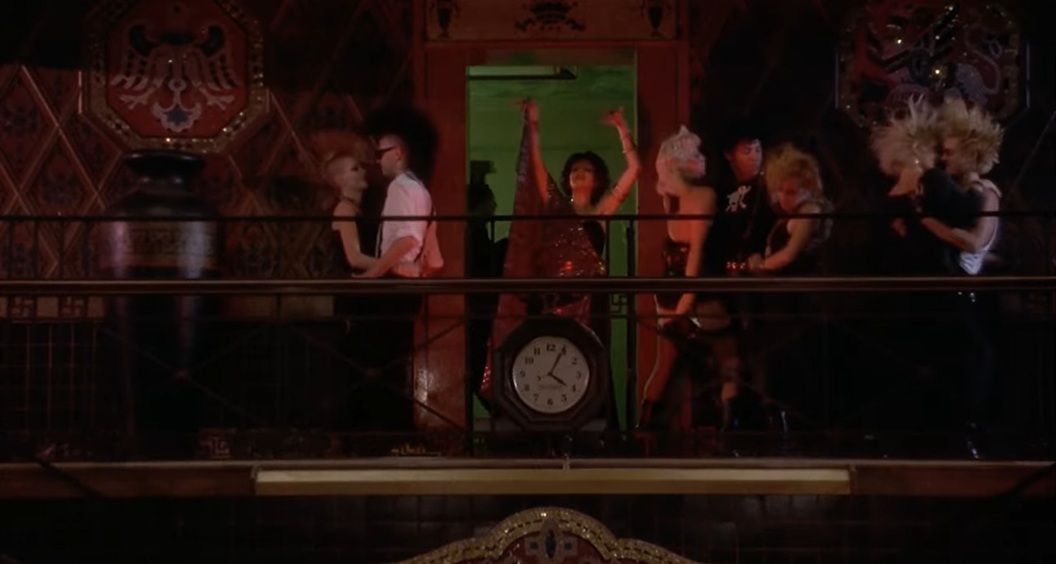
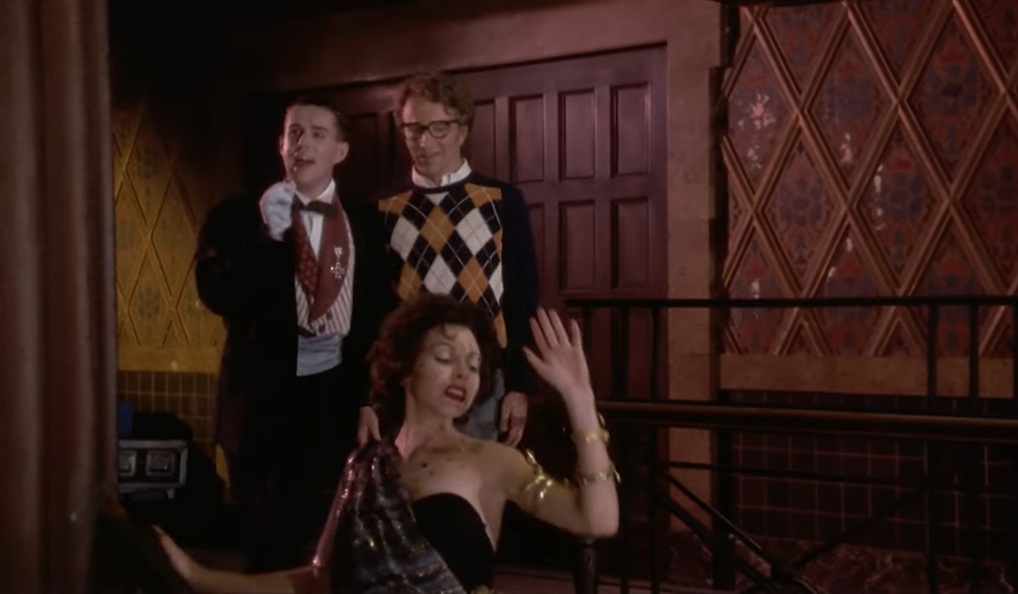
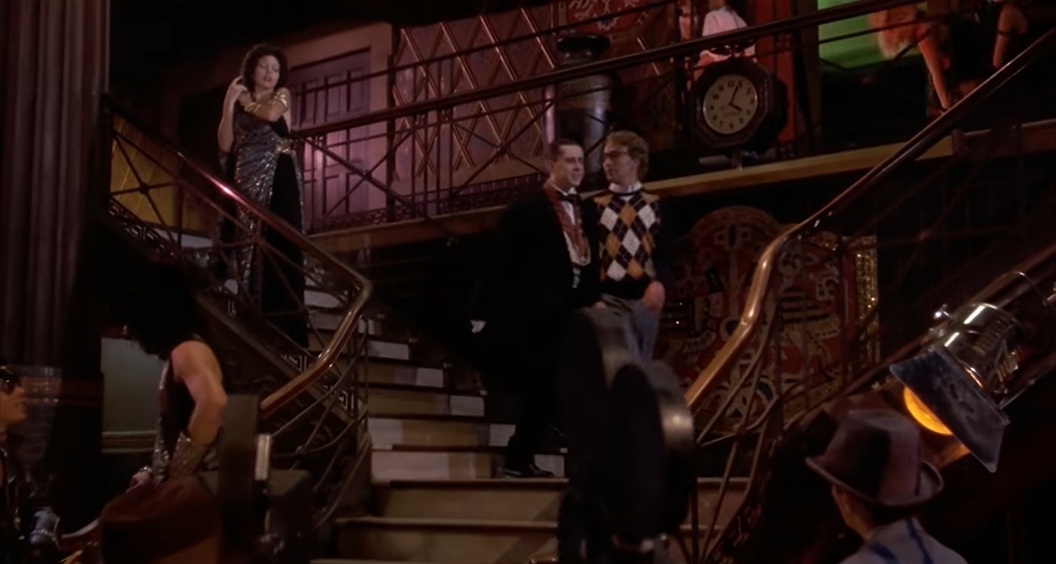
'I COULDN'T GET PHANTOM AND WOUND UP WITH ROCKY HORROR'
HOW A MOVIE THEATER IN PORTAND, OREGON STARTED WEEKLY SCREENINGS OF ROCKY HORROR THAT CONTINUE TO THIS DAY
https://www.angelfire.com/de/palma/phantom9375.jpg

The Independent's Sab Astley posted an article today with the headline, "Rocky Horror forever: How a tiny US cinema helped turn a flop movie into a phenomenon" - here's an excerpt:
Fifty years after its initial release, Rocky Horror has amassed global adoration, particularly on the midnight movie circuit. And no cinema in the world is more steeped in Rocky Horror’s rituals and traditions than the Clinton Street Theater in Portland, Oregon, which has shown the film every week without fail since 1978. “We’re certainly not a standard movie theatre,” co-owner Aaron Colter tells me.

Currently managed by a collective of six co-owners, including Colter, the 300-capacity Clinton Street Theater stands as one of the oldest continually operating cinemas in the United States. Since its opening in 1915, it has flirted with being a cinema block-booked by specific film studios and, later, an adults-only cinema. It was in 1975 that it began operating through shared ownership, with five free-spirited and like-minded film fans buying the space together, one of whom was Lenny Dee. “I thought people needed a model of a different kind of business to the one we currently had, and the ideas and passions media contains can be an important thing to present to people,” he remembers. “Those were my two driving forces.”

Dee was the original booker of Rocky Horror, and thus technically the originator of the tradition. He first watched it as part of a programmed double bill with Phantom of the Paradise, Brian De Palma’s 1974 comedy-horror musical. “I actually liked that better than Rocky Horror, but I couldn’t get Phantom and wound up with Rocky Horror,” he remembers. “Then the fans kept coming.” That’s not to say Dee isn’t a fan of the movie; he estimates he’s seen it more than 300 times during his eight years of projecting it throughout the Seventies and Eighties.

It took time for Rocky Horror to take hold. The film initially sank like a stone upon release in 1975, with the critic Roger Ebert noting that “it was pretty much ignored by everyone”. Less than a year later, however, New York’s Waverly Theater decided to programme the film as a “midnight movie”, and it was there that schoolteachers Louis Farese Jr, Theresa Krakauskas and Amy Lazarus originated the props and audience interaction that would come to define the Rocky Horror cinema experience.

Posted by Geoff at 3:51 PM CDT
Post Comment | Permalink | Share This Post
Thursday, August 14, 2025
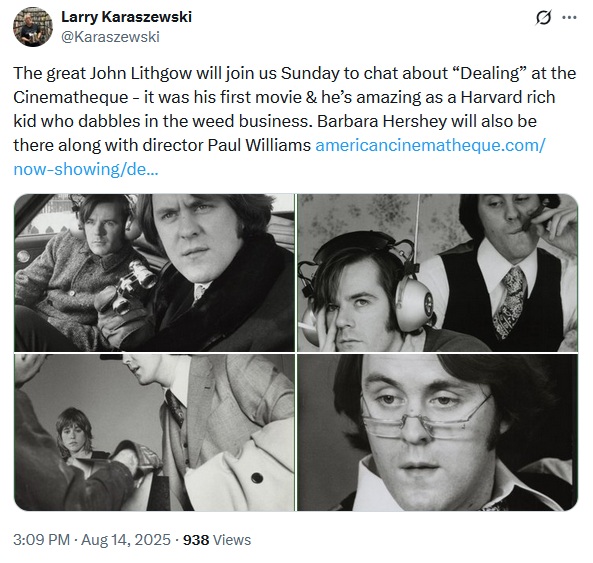
LITHGOW IN PERSON SUNDAY FOR SCREENING OF HIS FIRST FILM
DE PALMA HAD SUGGESTED LITHGOW TO DIRECTOR PAUL WILLIAMS FOR DEALING
https://www.angelfire.com/de/palma/dealingtweet.jpg

In his 2011 book Drama: An Actor's Education, John Lithgow recalls the first time he met Brian De Palma, who could be heard cackling wildly during a Lithgow performance on stage in Princeton, New Jersey in the summer of 1966. Lithgow writes that De Palma "was effusive in his praise" after the show, and years later, De Palma suggested Lithgow to the filmmaker Paul Williams, who was looking for someone to play "a patrician Harvard undergraduate dope dealer" in a film titled, Dealing: Or The Berkeley-to-Boston Forty-Brick Lost-Bag Blues.

Dealing, which was based on a novel by Michael Crichton, will screen at the Aero Theatre in Santa Monica at 3pm this Sunday, August 17th. This American Cinematheque event will include a Q&A with filmmaker Paul Williams and actors Barbara Hershey and John Lithgow. Moderated by Larry Karaszewski.


Posted by Geoff at 11:11 PM CDT
Post Comment | Permalink | Share This Post
Wednesday, August 13, 2025
THE REVEAL'S KEITH PHIPPS REVISITS THE SCARFACE OF THE 80s
AND ITS ECHOES OF THE HOWARD HAWKS FILM FROM THE 1930s
https://www.angelfire.com/de/palma/scarfacehawksdepalma1.jpg

As the latest entry in a series titled "The ‘80s in 40," The Reveal's Keith Phipps revisits Brian De Palma's Scarface. Here are the first couple of paragraphs:
The first time I watched Brian De Palma’s Scarface, I chuckled when the dedication to Howard Hawks and Ben Hecht appeared on screen over the carnage of the climax’s final moments. Because of Scarface’s notoriety, this, like so many first-time viewings of R-rated films, was at the end of a surreptitious late-night, post-parental bedtime watch after renting the film’s two-tape VHS version from a local video store. At the time, I didn’t know Hecht’s name, only Hawks’. And though I’d seen and loved some of his films, like Bringing Up Baby and His Girl Friday, I mostly associated Hawks with my vague notions of Hollywood’s classy Golden Age. I could only assume that the garish, provocative, grotesquely violent spectacle I’d just watched—the one that had stirred up such controversy a few years earlier—had virtually nothing to do with the original film. It would be years before I learned how wrong I was.

It’s not just that the 1983 Scarface, directed by De Palma from a script by Oliver Stone, shares the same overarching rise-and-fall plot with the 1932 film, written by Hecht with a handful of other writers, adapted from a novel by Armitage Trail that itself was inspired by the life of Al Capone. It’s not even that De Palma’s Scarface borrows numerous elements and story beats from the original, including a protagonist who’s uncomfortably fixated on his kid sister and who sees a vision of his own future in an advertising slogan reading “The World Is Yours.” Though never as explicitly violent (and 100% chainsaw free), Hawks’ film is just as savage in its way as Scarface’s later incarnation. Both tell the stories of men who see America as a place where fortunes are to be taken and of the country that allows them to thrive, at least for a little while.


Posted by Geoff at 9:41 PM CDT
Post Comment | View Comments (2) | Permalink | Share This Post
Tuesday, August 12, 2025
VIDEO - 'MR. SCORSESE' 5-PART DOC TRAILER INCLUDES DE PALMA
DIRECTED BY REBECCA MILLER - PREMIERES OCT 17 ON APPLE TV+

(Thanks to Matt!)

Posted by Geoff at 5:10 PM CDT
Post Comment | View Comments (2) | Permalink | Share This Post
Monday, August 11, 2025
VIDEO - TIM BURTON LOVES 'PHANTOM OF THE PARADISE'
"IT WAS QUITE EMOTIONAL AND FUNNY AND WEIRD AND BEAUTIFUL"


(Thanks to Jochen!)

Posted by Geoff at 10:48 PM CDT
Post Comment | Permalink | Share This Post
Sunday, August 10, 2025
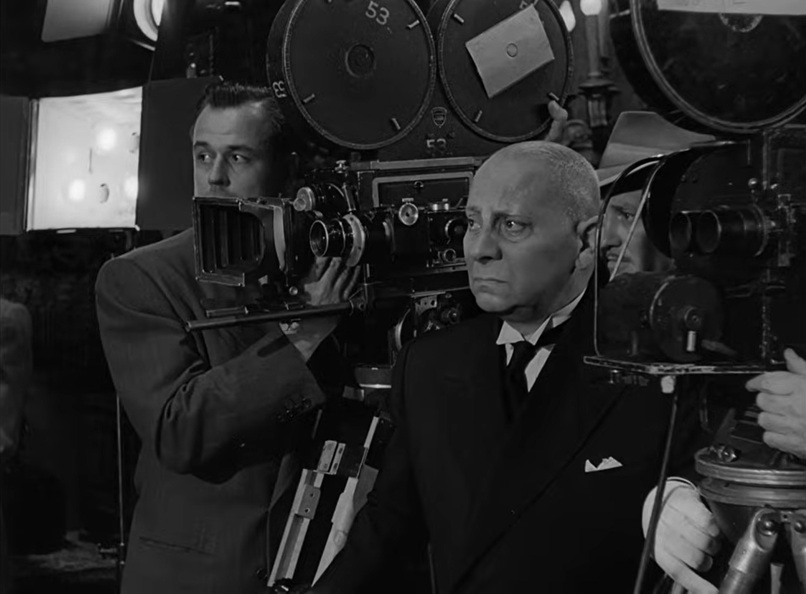
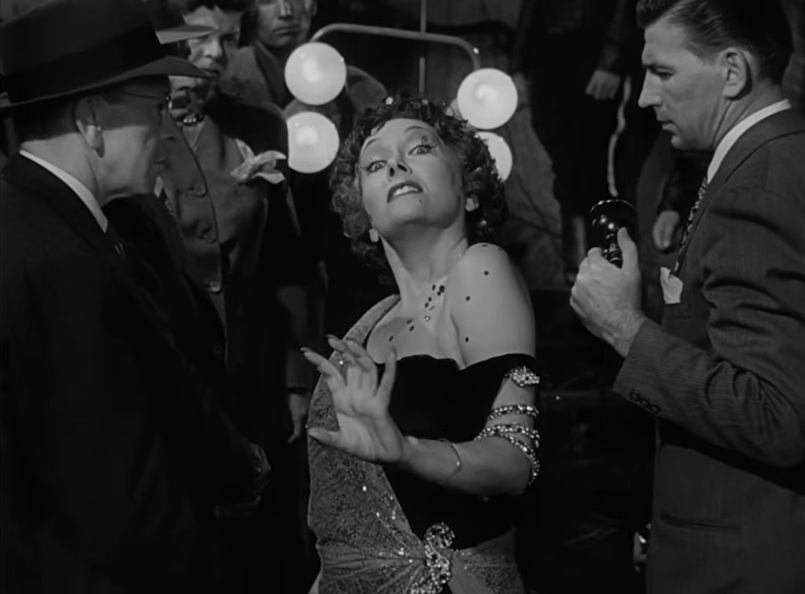
'SUNSET BOULEVARD' PREMIERED 75 YEARS AGO TODAY
DE PALMA: "IT'S PERFECT - CINEMA DOESN"T GET ANY BETTER"
https://www.angelfire.com/de/palma/sunsetboulevard255.jpg

"Is there a better film than Sunset Boulevard?" asks Brian De Palma, rhetorically, in the Samuel Blumenfeld and Laurent Vachaud book De Palma on De Palma. "It's perfect," he continues. "Cinema doesn't get any better."

Elsewhere in De Palma on De Palma, De Palma brings up Billy Wilder while discussing Carlito's Way:

Al [Pacino] and his friend, producer Martin Bregman, had been looking to do Carlito's Way for years. They worked with Edwin Torres, the author of the two books on which the film is based, and kept telling me that it was very different from Scarface. When I read the script I could see that it was indeed very different. The tone was more fatalistic, the story took place in the Seventies, and there was this agonising voiceover that reminded me of Billy Wilder’s Sunset Boulevard or Double Indemnity. I was immediately hooked.


Posted by Geoff at 10:52 PM CDT
Post Comment | View Comments (1) | Permalink | Share This Post
Saturday, August 9, 2025
HOWARD S. BERGER DISCUSSES DE PALMA AT THE HORROR XPRESS
INTERVIEWED BY KURT SAYENGA
https://www.angelfire.com/de/palma/dressedtokillend39.jpg

Under the headline, "Brian De Palma vs. The Audience," The Horror Xpress' Kurt Sayenga interviews Howard S. Berger about Brian De Palma. Here's an excerpt from the discussion:
KURT: After The Fury comes the ultimate De Palma film: Dressed to Kill.

HOWARD: Dressed to Kill is important because thematically De Palma is at the height of his focus with ideas of femininity, masculinity, religion – in other words, things that in modern society have been made to cripple individuality and dwarf identity and sometimes remove identity, things that just shouldn’t belong in society for a successful society or for successful mental and physical health. And Dressed to Kill in 1980, we’re going out of the ‘70s now into a new era. And he just takes all this along with a slightly more self conscious wink to his own work. So in Dressed to Kill, sure, he’s making some very sophisticated jokes about psychology – obviously jokes, again, but look where he came from. He’s a satirist. He’s not going to let you forget this. So even though there’s this wonderful tricky story about who performed this horrible vivisection with a razor blade in an elevator, he starts to stack up the thought process of the mainstream commercial critics and the audience at the time. The whole point of Carrie was to provoke, provoke, provoke, then explode when your audience and your studio is just not getting it. This is going a little bit farther now. There are scenes in Dressed to Kill where he shows that. You could call it a wink or a spoof – I hate using that word, but it’s just to make you laugh: the very last scene is this dream that Michael Caine is coming for revenge on the woman who put him away, the prostitute played by Nancy Allen. It looks like Halloween! – this subjective camera moving outside the house. In the very next film that he made, Blow Out, he spoofs the spoof. He’s taking that and he’s making it obvious: “This is how you make that scene.” And he replicates the scene that he staged and shot as the dream in the climax of Dressed to Kill, and now he’s using that as an example of how a low-budget director makes a film. So the success of Dressed to Kill as a thriller, because it was shot so elegantly and poetically by Ralf Bode, when he moves on to Blow Out just a year later, it’s all self examination, self reflection, and everything is out in the open. “This is what I have to think about when I make something like this. I need a good scream. I need a good scream. How do I get that scream?” Of course that’s a play on Vertigo with Jimmy Stewart trying to figure out he’s going to get rid of his vertigo, and he has this whole contrived psychological horror thriller he has to put himself through just for the punch line – “Okay, I don’t have vertigo anymore.” And the end of Blow Out, it’s, “Okay, I got my scream.”

It's all connected. The language is all connected. I hate to say they’re jokes, but they are. They’re amusements to him, because this is why you do it. Dressed to Kill is important because once again, like Carrie, his ability to hone emotional capital from these characters was profound for that time. Movies that made you care about horror movies, that made you care about women – not putting them in distress porn horror, that’s not what he’s doing. He’s creating characters that you, the audience, are to identify with. Are you identifying with aspects of someone with transgender passion and an inability to break through that? Michael Caine’s character ultimately is quite a poignant character, especially the use of mirrors in that movie. Mirrors from the very opening scene are very important. What’s obscured? What’s hazed over by condensation? What’s visible? Michael Caine looking at himself in a mirror is so much more indicative of a pain that his character is dealing with which causes a schizophrenia, a violent combination of parts of your mind working against each other, ultimately trying to reconcile. But like Carrie’s mother did to Carrie, your upbringing is dwarfing your ability to process life naturally.

The end of that movie once again reiterates that the nightmare will stay with you if you’re someone who has compassion and who understands why you’re a human being, how you interrelate with other people, how you look at yourself and how you can be healthy or how you can be aberrant. This is not just a moral director but a voice of honest humanitarian concern. People overlook that completely. And Dressed to Kill is a phenomenally emotional film if you look at it even on the superficial level and you don’t look at the Hitchcock winks and jokes and nods.


Read the full discussion at The Horror Xpress.

Posted by Geoff at 9:59 PM CDT
Post Comment | Permalink | Share This Post
Tuesday, August 5, 2025
ALEX ROSS PERRY INTERVIEW DISCUSSES 'VIDEOHEAVEN'
AND THE CHANGES IN DEPICTIONS OF VIDEO STORES IN MOVIES & TELEVISION OVER THE YEARS
https://www.angelfire.com/de/palma/videoheaveninsta.jpg

At The Brooklyn Rail, Jim McDermott interviews Alex Ross Perry about his new movie, Videoheaven:
For filmmaker Alex Ross Perry, whose new documentary Videoheaven (2025) considers the lifespan of video stores through their depiction in films and TV shows, trying to understand what happened to the video store was not simply an academic concern. Born in 1984, just a few months before Brian de Palma’s Body Double depicted a video store in a film for the first time, Perry spent his whole early adult life working in video stores. “My first job was at Suncoast video,” he told me in an interview on Zoom. “The whole time I was in college at NYU and then for a year and a half after, I worked at Kim’s Video on St. Mark’s between 2nd and 3rd Avenue.”

Kim’s, which opened in 1987 and stayed open until 2008, was an extraordinary place, known for the size of its collection and the knowledge of its staff (a number of whom, like Perry, went on to become filmmakers). “Go to any film school, and you can draw a line around the thousand most canonical films,” Perry explains. “That’s what you’re getting. And that’s a lot. Kim’s had fifty thousand movies. And the idea that you came to one physical room to access these things was very special. It’s how I grew up.”

Over the years Perry, who has written and/or directed more than a dozen films, has pitched any number of stories involving video stores without success. Then he read Daniel Herbert’s 2014 book Videoland: Movie Culture at the American Video Store. In subsequent conversation with Herbert, he came up with the idea to document the depiction of video stores in film and TV shows, from their earliest portrayal in the eighties through to their collapse in the 2000s.

The more Perry dug into the project, the more he discovered a possible solution to this mystery he had been struggling with for so long. He acknowledges most believed there was no real mystery to solve: just as streaming is now cannibalizing cinema, it previously devoured the video rental business. But he was not fully convinced. “Yes, streaming started roughly the time stores went away, but so does music streaming—even earlier actually, and you can’t go to a small-town Main Street and not still find a credible music store.”

“Streaming didn’t end music sales—though it brought it very low. E-books didn’t end book stores.” So again, why was it different for video?

What he discovered in his research is that as the years went on, films and TV shows took a more and more hostile view of video stores. After initially portraying them as places where people are exposed to danger—David Cronenberg’s 1983 film Videodrome, though it doesn’t show a store, treats the video tape itself as a sort of monster we let into our houses—for a time video stores were imagined as spaces of discovery, even adventure. These were places where visitors had the chance to have richly curated cultural experiences, and also perhaps to experience for themselves the kinds of stories they watched. Clerks found themselves thrown into action movies. Customers looking for a romcom had their own meet-cutes. “This video space was advertised as a portal to a world of experience that was transportive,” Perry explains. “At Kim’s, you had fifty thousand futures waiting for you.”

But then other, darker ideas started to creep in. Video stores started to be presented as places where your own private desires were on public display, and as such, sites of potentially uncomfortable revelation. How many times have we watched scenes where someone hides the movie they want to rent because they’ve run into a friend or family member? Suddenly visiting a video store was like buying condoms or a pregnancy test at the pharmacy. “Being in public at the video store,” the film explains, “was a cause for concern.”

Likewise the knowledge and good taste that had been ascribed to clerks early on started to metastasize in movies and TV shows into characters who were condescending, belligerent, and at the same time, pathetic. They were, Perry writes in the film, “the modern equivalent of the eternally shushing fuddy duddy librarian,” but for some reason movies and TV shows made them a thousand times more intrusive and demeaning. Who would want to deal with people or places like that?

As video stores became a staple of modern life, Perry notes how movies and TV shows went one step even further, treating them as banal, brightly-lit, cookie-cutter purgatories, each with the same basic set of movies. Perry opens the film with a clip of Ethan Hawke in Hamlet wandering the aisles of a video store. Could there be any more fitting place to ask, “To be, or not to be?”


Read more at The Brooklyn Rail

Posted by Geoff at 10:45 PM CDT
Post Comment | Permalink | Share This Post
Monday, August 4, 2025
THE FILM STAGE - NEW FILM BOOK RECOMMENDATIONS
INCLUDING RECENT BOOKS BY DE PALMA & WALTER MURCH
https://www.angelfire.com/de/palma/ambrosechapelbook785.jpg

Posted earlier today, The Film Stage's Christopher Schobert recommends new film-related books, including Ambrose Chapel: A Screenplay by Brian De Palma and Russian Poland by David Mamet (Sticking Place Books) -
Let us give thanks for the good people at Sticking Place Books, a publishing company that has released everything from studies of Casualties of War to the poems of Abbas Kiarostami. Two of the latest releases are unreleased 1990s scripts from Brian De Palma (yay!) and David Mamet (boo—oh wait, this is a David Mamet work from three decades earlier—yay!) Russian Poland is the strange, compelling story of two Jewish World War II veterans on a mission into late 1940s Israel. De Palma’s Ambrose Chapel is the more enticing of the two scripts, and its release is, I think, very noteworthy. As James Kenney explains in his introduction, “Ambrose Chapel adopts the sleek posture of a geopolitical thriller, all international intrigue and stealthy rescues. But before we’ve even found our footing, games are underway.” Kenney says the script’s DNA is “deeply De Palma, but the tone is surprisingly giddy, even liberatory.” Actors whose names had been bandied about for starring roles include Brad Pitt, Liam Neeson, Tea Leoni, and even Madonna. What a shame Ambrose never took flight, but thank goodness we can ponder what might have been.

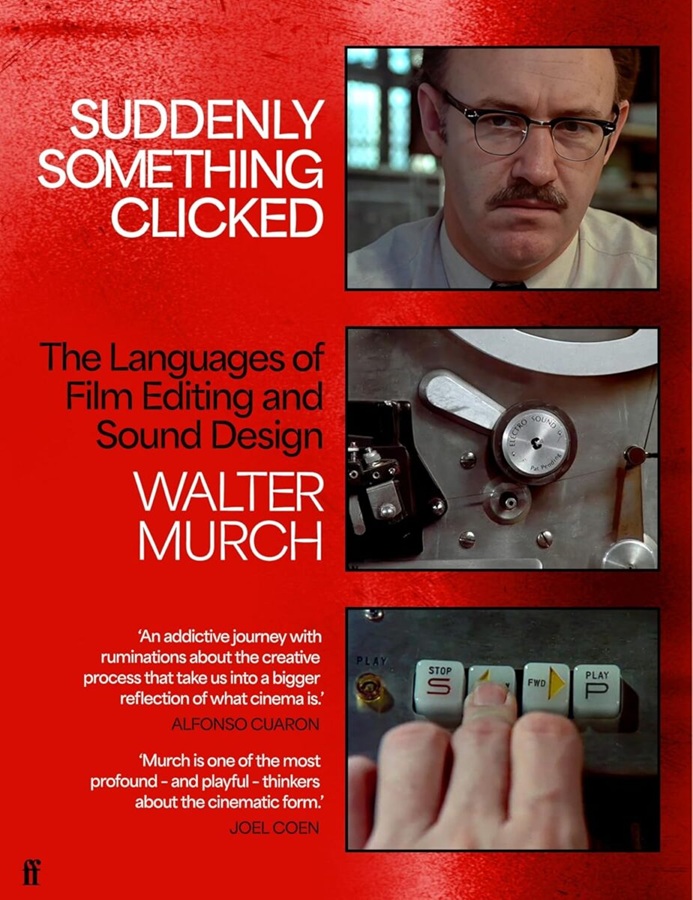
In the same column, Schobert also recommends Suddenly Something Clicked: The Languages of Film Editing and Sound Design by Walter Murch (Faber & Faber) -

There is no one better suited to discuss film editing and sound design than Oscar-winner Walter Murch, the editor of a litany of greats: The Conversation, Apocalypse Now, The Godfather. His first book, 1992’s In the Blink of an Eye: A Perspective on Film Editing, is a classic. “Much has happened in those years,” Murch writes, “but the most significant development was the two-decades-long (1990-2010) transformation of cinema from an analogue to a digital medium. As I suggested in Blink, it is a shift whose closest analogy in the history of European art might be when oil painting began to displace fresco in the fifteenth century.” Suddenly Something Clicked goes to great lengths to not repeat details from Murch’s earlier book. Rather, it is a worthy companion. The chapters covering his work on The Conversation and the restoration of Welles’ Touch of Evil are riveting.


Posted by Geoff at 10:14 PM CDT
Post Comment | Permalink | Share This Post
Sunday, August 3, 2025
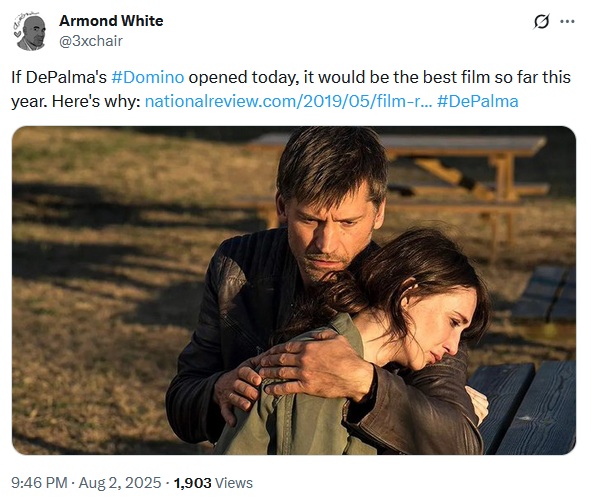
'IT'S TOTAL ILLUMINATION OF OUR DIGITAL-AGE CRISIS'
https://www.angelfire.com/de/palma/armonddominotweet.jpg

Posted by Geoff at 10:14 PM CDT
Post Comment | View Comments (6) | Permalink | Share This Post

Newer | Latest | Older