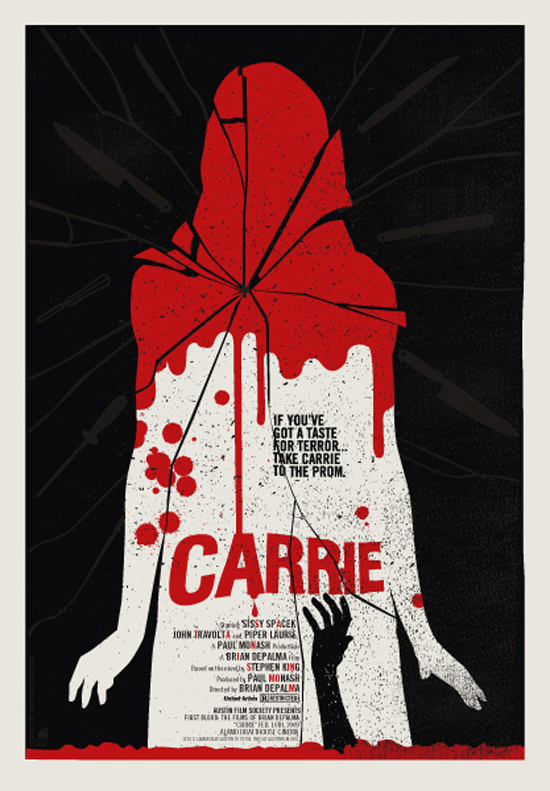
A poster designed by Methane Studios for the upcoming Austin Film Society screening of Carrie...

Updated: Monday, January 19, 2009 11:38 PM CST
Post Comment | Permalink | Share This Post
![]() Hello and welcome to the unofficial Brian De Palma website. Here is the latest news: |
|---|
E-mail
Geoffsongs@aol.com
-------------
Recent Headlines
a la Mod:
Listen to
Donaggio's full score
for Domino online
De Palma/Lehman
rapport at work
in Snakes
De Palma/Lehman
next novel is Terry
De Palma developing
Catch And Kill,
"a horror movie
based on real things
that have happened
in the news"
Supercut video
of De Palma's films
edited by Carl Rodrigue
Washington Post
review of Keesey book
-------------
Exclusive Passion
Interviews:
Brian De Palma
Karoline Herfurth
Leila Rozario
------------
------------
| « | January 2009 | » | ||||
| S | M | T | W | T | F | S |
| 1 | 2 | 3 | ||||
| 4 | 5 | 6 | 7 | 8 | 9 | 10 |
| 11 | 12 | 13 | 14 | 15 | 16 | 17 |
| 18 | 19 | 20 | 21 | 22 | 23 | 24 |
| 25 | 26 | 27 | 28 | 29 | 30 | 31 |
De Palma interviewed
in Paris 2002
De Palma discusses
The Black Dahlia 2006

Enthusiasms...
Alfred Hitchcock
The Master Of Suspense
Sergio Leone
and the Infield
Fly Rule
The Filmmaker Who
Came In From The Cold
Jim Emerson on
Greetings & Hi, Mom!
Scarface: Make Way
For The Bad Guy
Deborah Shelton
Official Web Site
Welcome to the
Offices of Death Records

(Thanks to Adam!)
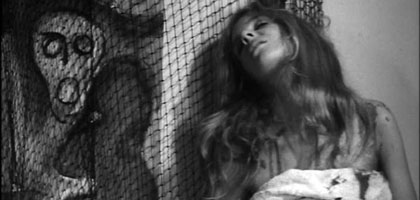
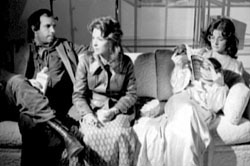
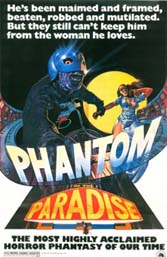
The Austin Film Society is running a program this month called First Blood: The Early Films Of Brian De Palma. The program kicks off this Tuesday, January 13, with a screening of the DVD of Murder a la Mod (the 7pm screening is already sold out, but there are still tickets left for the 9pm screening). The 7pm screening of Greetings (also from a DVD) on January 17th is also sold out, as is the 7pm screening of Dionysus In '69 (from a DVD) on January 24th. The 9pms are still available in both cases. The other films being screened are Hi, Mom! (35mm print from the MGM archive screens January 20th), Sisters (35mm print from the Academy archives screens January 27th), Phantom Of The Paradise (digital version from Criterion Pictures to be screened via DVCam February 3rd), and Carrie (35mm print from the MGM archive screens February 10th). See the website for specific screening locations, but also to read the terrific summaries provided by the Austin Film Society's Guest Curator Bryan Poyser, who writes the following as part of an introduction to the program: The seven films presented here display a provocative, free-wheeling, politically subversive sensibility, rich with sarcasm and gleeful satire, bent on jolting the audience into thinking about what they’re seeing rather than lulling them with fantasy or romanticism. Undoubtedly, it is this rigorous and contrarian agenda that keeps most audiences and critics from fully embracing De Palma, but perhaps also makes him both the most frustrating and addictively watchable filmmaker of his generation.
The Virtuoso of the 7th Art's Romain Desbiens has posted a new summary of Brian De Palma's early works on a page titled, Les Debuts New-Yorkais 1961-1971. The page, which is currently only available in French, features Romain's usual array of well-chosen and well-layed-out images from De Palma's films, as well as those of his influences. Meanwhile, David Greven has written an essay called "Medusa in the Mirror: The Split World of Brian De Palma's Carrie." You can read it at the Australian online journal Refractory. Greven's essay is part of a special issue devoted to split and double screens.

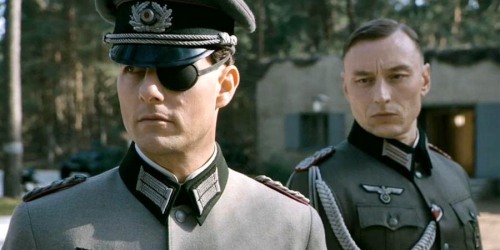
I saw Valkyrie recently, and found it a solid work of suspense that could be considered something like Mission: Impossible goes to World War II. The film moves quite rapidly, demanding the viewer's attention to keep up with the mechanics of the characters' plot to kill Hitler, and throwing us into moments of suspense that are deliciously fun to watch. It all leads to some pretty powerful scenes near the end as the coup plot comes undone.
Schwab was trusted by De Palma in 2007 to shoot all of the faux "French documentary" footage for De Palma's Redacted himself. In 2001, Schwab wrote and directed his own feature, The Learning Curve.
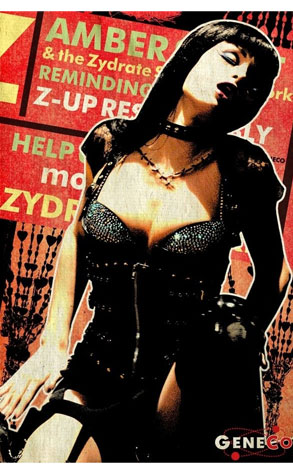
The Baltimore Sun's Michael Sragow today discusses Repo! The Genetic Opera. Sragow writes:
The clotting of pop opera and carnage, as well as the trash-icon appearance of [Paris] Hilton and the daring casting of Sarah Brightman as GeneCo's singing spokesperson, Blind Mag, comprise this film's bid for pop chic. Hilton is passable (I presume audiences cheer when her face peels off ), and Brightman summons the bracing delivery and regal presence of an authentic operetta star. But there's no zest or imagination to the slaughter, as there is in a [Tim] Burton or De Palma movie. After a while, all you see during the worst mayhem are thrown-together piles of imitation guts.
Chris Hicks writes in today's Salt Lake City Deseret News:
I learned something while watching Quantum of Solace for the second time recently: Quick-cut edits can have the same effect as shaky-cam.That is to say, when the camera's point of view or angle changes in rapid succession, it has essentially the same effect as a hand-held camera that rapidly bounces up and down.
This is not a good thing.
During this second viewing of the latest 007 movie, I found myself counting the seconds between cuts. And I decided that there are two apparent rules: The seven-second rule applies to character or dialogue scenes, and the three-second rule applies to action.
I'm not kidding.
I don't think a single shot in an exposition scene lasts more than seven seconds, and no single shot in a chase scene lasts more than three.
This is a strange evolution . . . or devolution . . . of filmmaking technique, since there was a time — not so long ago, really — when directors took great pride in long takes, those single "tracking" shots that could last from 30 seconds to a few minutes, and which required a great deal of rehearsal, of both the players and the camera.
Hicks goes on to discuss the use of long takes by Hitchcock, Welles, and De Palma, contrasting their intricately planned and rehearsed takes with Baz Luhrmann's current Australia, where, according to Hicks, "an emotional moment leads to an overhead shot that travels from the top of a water tower to the farmland below to the desolate landscape in the far distance. It makes for touching, sweeping symbolism. But it's perhaps 15 seconds in length — and it may be the lengthiest shot in the film." Hicks concludes:
The point is, movies seem to be in such a hurry these days that they often feel like theme-park rides. Quantum of Solace, though enjoyable on its own terms, is much more of a mindless thrill ride than its character-driven predecessor, Casino Royale. But the ride is getting a little too bumpy. Quantum of Solace is also occasionally headache-inducing. Not to mention incomprehensible. Who's driving which car? Who's slugging whom? Where the heck are we now? Are these really the questions you want your audience asking?
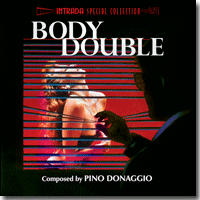
Intrada has just released a limited edition soundtrack of Pino Donaggio's score from Brian De Palma's Body Double. The complete soundtrack has never, to my knowledge, been officially released before. Selected tracks have shown up here and there on various collections, but this is the real deal. The Intrada web site states that this is the "complete score presented in brilliant stereo from original 30 i.p.s. multi-track session masters vaulted at Sony Pictures." The release marks volume 86 in the Intrada Special Collection, and is limited to 3000 copies. The CD has 21 tracks totaling over 68-minutes, and sells from the Intrada web site for $19.99. The web site describes Donaggio's Body Double score like this: Pino Donaggio creates what might be his greatest masterpiece, compliments Hitchcock style visual set-pieces with massive musical set-pieces of his own. Signature display of Herrmann-ish strings, layers of bold over-the-top brass (particularly French horn) for claustrophobia sequences, sinous & sexy themes for sleaze elements, throbbing synths for graphic drill murder, dynamic orchestral action for final confrontation, you name it! At heart is primary love theme plus gentle secondary idea for high violins that lingers throughout... Savor every note, from smallest keyboard cues and intricate synth overlays through porno-film source pieces to framing vampire movie music and grandiose orchestral fireworks! Natale Massara conducts.
Movie Geeks United! paid tribute to the 25th anniversary of Scarface last Sunday by interviewing Ken Tucker, author of the recent Scarface Nation. The show also featured clips of the Geeks' previous interviews with Brian De Palma and Steven Bauer, as well as trivia and discussion of the film. Click here to listen to the Scarface show. On last Wednesday's show, the Movie Geeks interviewed Mark Margolis, who played Alberto the Shadow, the assassin whose lack of morals leads Tony Montana to draw a violent line in the sand. Discussing the filming of that scene with the Geeks last night, Margolis said that in between takes, Al Pacino did a lot of "lame" talking about locker room-type subjects. Margolis was wondering for an hour and a half what he was doing there listening to such uninteresting and uninspired machismo, and then suddenly came to the realization that Pacino was in fact talking in character-- it wasn't Pacino talking, but Tony Montana, 24-7. STONE RESPECTS DE PALMA FOR CHOOSING HIS OWN APPROACH
Oliver Stone was interviewed by Tucker for Scarface Nation. We all know that Stone was at odds with De Palma for slowing down Stone's fast-paced narrative and excising dialogue scenes in favor of elaborate camera shots and long takes. Stone tells Tucker that had he been directing the film himself, he would have made it more "realistic and fast-paced, because it was more like, let's get to know this world. [But] Brian chose another approach, and I respect him for that."
In Tucker's book, Stone discusses some of the real life inspirations for his Scarface screenplay, and how De Palma added a oft-"excessive" operatic framework over the material that took liberty with logic. Stone is quoted as saying that certain things about De Palma's edits were sticking in his craw. "To me," Stone told Tucker, "what was being sacrificed was narrative sense and atmosphere."
OPERATIC FRAMEWORK, BUT LOGIC IS "REALLY LOOPY"
Stone elaborates on some of the issues he brought up in the memo he sent to producer Martin Bregman and Pacino in this excerpt from Tucker's book:
Stone's irksome memo addressed what he felt were "questions of logic. The film has a realistic base onto which was put an operatic framework. Which is okay-- it made the movie what it is, but for operatic purposes you don't throw out logic, and certain things were sticking in my craw. I think Brian had strayed--" Stone pauses here, looking for the right words before simply sighing and saying, "Sometimes his plot points are ridiculous. It's as if there's nobody keeping rational logic there. He's done certain things in other of his films too that are really loopy"-- Stone pauses to laugh almost affectionately-- "really loopy."
"A HONG KONG ACTION FILM BEFORE ITS TIME"
"I'll give you an example," Stone continues in Tucker's book...
It changes the nature of the film; it was so outrageous at this point, and Brian just kept going and going, and for some reason it works. Why does it work to have, I don't know, a hundred men go in there and shoot at Tony, all alone? I didn't know, I didn't see it, back then. [But] that's a Hong Kong action-film shoot-out before its time, right?
So despite Stone's misgivings, Tucker told Michael Sragow at the Baltimore Sun that Stone is a big enough man to say, "I have to hand it to Brian; he knew what he was doing. He captured something that was in the air." Part of what De Palma captured in the ending of Scarface may have been inspired by King Kong, with Tony Montana acting as the old-fashioned monster, defiantly fending off attackers from below as he sits on top of the world (which for the original King Kong would have been the Empire State Building). Indeed, it would seem as though De Palma could have read the script and, either consciously or subconsciously, amped up the threat to Tony Montana as an echo of the ending of the 1933 classic. The climax of King Kong is quite obviously referenced at the end of De Palma's 1962 short Wotan's Wake, so it is definitely a film on De Palma's radar.
In fact, in a 1997 Journal Of Film And Video article titled "At Work In The Genre Laboratory: Brian De Palma's Scarface," Tricia Welsch suggested that De Palma's film alludes to both Frankenstein and King Kong. For Welsch, this "postmodern hybrid" of the gangster film was problematic, as it alluded to the Cuban immigrant as a "monster." Welsch further felt that De Palma's reputation added an element of the slasher film to the mix, but it is also interesting to note that Stone himself began directing by making horror films like Seizure and The Hand (both made before writing Scarface), so Scarface as a horror/gangster hybrid seems valid from the ground up. In any case, De Palma spoke in those days of wanting to break out of genres and of creating new ones, and his free-wheeling sensibilities were perhaps most aptly described by critic Jake Horsley, when he referred to De Palma as a "pinball wizard."
A COUPLE MORE LINKS
Tucker was also interviewed recently by Craig D. Lindsey at the Philadelphia Weekly. Elsewhere, Tucker and Bauer are two of several people quoted in a Scarface 25th anniversary article posted by Lee Hernández three days ago at the New York Daily News.
The Swan Archives has unearthed yet another small batch of unused footage from Brian De Palma's Phantom Of The Paradise. Go to the site's production section and click on the "Swan Song Fiasco" page to see some newly discovered footage of the receptionist flipping through the names to check on Winslow Leach-- some more of the names on the list can be seen, including Martin Scorsese and Jack Nicholson. Also on that page is a newly uploaded take of Winslow barging into the Death Records reception area, revealing another "Swan Songs Enterprises" sign. Click on the Outtakes page to see newly discovered footage of Winslow stabbing himself, and also footage of Winslow introducing himself to the receptionist in several takes.