Courtesy The L Magazine
Updated: Wednesday, December 30, 2009 1:16 PM CST
Post Comment | Permalink | Share This Post
![]() Hello and welcome to the unofficial Brian De Palma website. Here is the latest news: |
|---|
E-mail
Geoffsongs@aol.com
Paterno Family
Challenges
Accusation
of Cover-Up
Scorsese tests
new Zaillian
script for
The Irishman
with De Niro,
Pacino, Pesci
James Franco
plans to direct
& star in
adaptation of Ellroy's
American Tabloid
"Badfellas"--
Besson's Malavita
looks to team up
De Niro & Pfeiffer
Sean Penn to
direct De Niro
as raging comic
in The Comedian
Scarlett to make
directorial feature
debut with
Capote story
Keith Gordon
teaming up
with C. Nolan for
supernatural
thriller that
he will write
and direct
Recent Headlines
a la Mod:
-Picture emerging
for Happy Valley
-De Palma's new
project with
Said Ben Said
-De Palma to team
with Pacino & Pressman
for Paterno film
Happy Valley
| « | December 2009 | » | ||||
| S | M | T | W | T | F | S |
| 1 | 2 | 3 | 4 | 5 | ||
| 6 | 7 | 8 | 9 | 10 | 11 | 12 |
| 13 | 14 | 15 | 16 | 17 | 18 | 19 |
| 20 | 21 | 22 | 23 | 24 | 25 | 26 |
| 27 | 28 | 29 | 30 | 31 | ||
De Palma interviewed
in Paris 2002
De Palma discusses
The Black Dahlia 2006

Enthusiasms...
Alfred Hitchcock
The Master Of Suspense
Sergio Leone
and the Infield
Fly Rule
The Filmmaker Who
Came In From The Cold
Jim Emerson on
Greetings & Hi, Mom!
Scarface: Make Way
For The Bad Guy
Deborah Shelton
Official Web Site
Welcome to the
Offices of Death Records
Robin Wood, author of the influential book Hollywood from Vietnam to Reagan, died Friday of complications from leukemia. Wood was 78. In the above mentioned book (the title of which can be seen as a direct inspiration to the core of David Greven's new book, Manhood in Hollywood from Bush to Bush) Wood devotes a chapter to Brian De Palma subtitled "The Politics of Castration," in which he states that De Palma's "interesting, problematic, frequently frustrating movies are quite obsessive about castration, either literal or metaphorical." In the chapter, written before Body Double was released, Wood cites Sisters and Blow Out as De Palma's best works. Of the former, Wood wrote, "Simply, one can define the monster of Sisters as women's liberation; adding only that the film follows the time-honored horror film tradition of making the monster emerge as the most sympathetic character and its emotional center." Of Blow Out, Wood concluded that for him, "no film evokes more overwhelmingly the desolation of our culture."De Palma: I don't like to get into that kind of reading into things. I remember talking to Robin and asking him questions about this. I finally said, look, that wasn't what I was doing when I made the movie; you may see these things but it's beyond me. But I do feel in a sense that I deal with contemporary feminist characters... Most of my women characters are very active, very strong; they dominate the action for the most part. In Sisters all they do is dominate the action. In Dressed To Kill all of the men are practically like women in normal films. So whether they're prostitutes or girls making money on the side by setting up candidates or actresses or newspaper reporters-- to me they are contemporary women and are aggressively pursuing their goals.
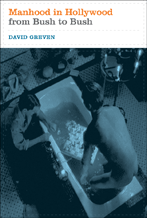
Manhood In Hollywood From Bush To Bush, David Greven's study on Hollywood's representations of masculinity from 1989 to 2009, was published last week by University of Texas Press. Greven has been a part of the De Palma online community for a number of years. Earlier this year, the online journal Genders published the Greven's insightful essay, Misfortune and Men's Eyes, which looked at male bonding in three early De Palma films (Greetings, Hi, Mom!, and Get To Know Your Rabbit). Greven's new book (which can also be purchased at Amazon) continues the author's discussion of the homosocial, and features an entire chapter on De Palma's Casualties Of War. Here is an excerpt from the book's introduction that discusses the chapter on Casualties Of War:In this chapter, I consider the original account by Lang and De Palma's cinematic rendering of it, which I view as the synthesization of several key themes in his oeuvre, especially the failed heroism of American manhood. I examine De Palma's film as a representation of American homosociality, providing a historical contextualization of it that illuminates American misogyny and homophobia, the latter no less a key factor in the events as described in the Lang account and De Palma's film. I provide a theoretical framework of the homosocial that allows us to consider De Palma's film as a critique of the normative codes of American manhood and what Gayle Rubin, following Levi-Strauss, calls the "traffic in women." The association of Eriksson, the man who opposed the kidnapping, rape, and murder of the woman, with homosexuality by the ringleader of the group, Meserve, is analyzed as a crucial component of the narrative. I explore the ways in which the film represents homoeroticism as both a galvanizing and threatening element in homosocialized manhood, which inculcates misogyny and homophobia. Further, this film represents a strong corrective to the particular forms of nationalism in the Reagan era, carried over into the Bush era. I also examine the film's staging of a masculine battle between a "negative narcissism" and a "heroic masochism."
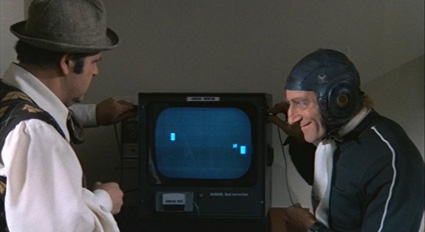
Mel Brooks, Robert De Niro, and Bruce Springsteen were three of the artists receiving Kennedy Center Honors last weekend in Washington. The Washington Post's Gary Arnold caught a compliment from Brian De Palma about Brooks' Silent Movie:Arnold would have loved to have seen Brooks and De Niro work together in the seventies.
Above is video of Richard Schechner discussing the filming of his play Dionysus In '69, following a screening of the Brian De Palma-directed film this past Sunday at Austin's Alamo theater. Schechner said that just as when he adapts a play and makes it his own, he felt strongly that the film was De Palma's, and that he could (and should) make it any way he wanted to. He said that De Palma rearranged some of the chronology of the performances via editing, so that the film (in De Palma's view) would play better dramatically. Schechner revealed that he and De Palma decided to make cameos at the beginning of the film: Schechner is a "kind of chubby moustached guy at the door," while De Palma walks in as a "sleek-looking young mafioso in a suit," according to Schechner. Schechner also confirmed that a gong heard on the soundtrack was added for effect during editing. The video here comes courtesy of the Austin Film Society's P.o.V. journal-- see more videos at their site.
Jeffrey Wells at Hollywood Elsewhere posted a bit about Brian De Palma's Carrie Tuesday night, saying that he was "half taken and half irked" when he originally saw the film in 1976. Wells writes that the ending, with the hand jumping up out of the grave, "made me jump out of my seat, and I was thereafter sold on the idea of DePalma being a kind of mad genius." Wells then continues:
I was gradually divested of this view in subsequent years, sad to say. Actually by The Fury, which was only two years later. To me De Palma was at his craftiest and most diabolical in Greetings, Hi, Mom, Sisters, Phantom of the Paradise and Carrie. Bit by bit and more and more, everything post-Carrie was one kind of problem or another (except for Scarface).
"FACE ON MARS IS ACTUALLY AN IMAX THEATRE -- SOUNDS LIKE DE PALMA TO ME"
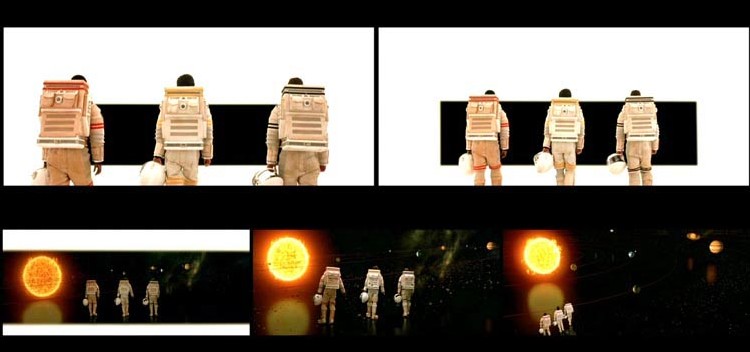
Wells' readers then chimed in throughout the next day and beyond, with widely differing views on De Palma's oeuvre. Everybody has their favorites, and most seemed to agree that there was something extraordinary in every De Palma film, whether they liked the entire film or not. There were staunch defenders of Femme Fatale, Dressed To Kill, Blow Out, and Carlito's Way. Mission: Impossible was also given props, with one commenter suggesting that the film will age quite gracefully throughout the coming years. A vague consensus seemed to emerge that De Palma's two most recent films, The Black Dahlia and Redacted, form a combined letdown, although The Black Dahlia also found its defenders. The most widely derided movie in the comments, though, seemed to be Mission To Mars, although that film had its defenders, as well, including this gem of a decscription from Sean: "It's a creation myth story where handsome actors [go] and discover that the face on Mars is actually an IMAX theatre -- sounds like De Palma to me."
Richard Schechner's Dionysus In '69 will be presented by Austin's Rude Mechanicals, using Brian De Palma's filmed version of the play as a key source material. It is a "painstaking" recreation of the original production, which was performed by the Performance Group in 1968. The play will run Decemeber 3-20 at The Off Center in Austin. Schechner himself led several rehearsals for the new production, and will be on hand opening night (listed as December 4th-- presumably the Dec. 3rd performance is a preview), when he will "briefly introduce the piece immediately before the show and will attend the opening night party following." Meanwhile, to coincide with the production, the Austin Film Society has programmed a screening of De Palma's film at 1pm on Sunday, December 6th, with Schechner in attendance. The screening will be at the Alamo theater.
Check local listings at PBS.com this week to catch the documentary, No Subtitles Necessary: László and Vilmos, which is being shown on PBS' Independent Lens series. The film, which has been shown at various film festivals, tells the real-life story of cinematographers László Kovács and Vilmos Zsigmond, who fled from Hungary to Los Angeles with footage they shot of the violent Hungarian Revolution of 1956. Zsigmond, of course, would go on to shoot several films for Brian De Palma: Obsession, Blow Out, The Bonfire Of The Vanities, and The Black Dahlia. According to a Los Angeles Times article by Michael Goldman, Zsigmond had previously been reluctant to make a film about their story, but after Kovács became ill in 2006, he decided to do it. Zsigmond told Goldman, "I had turned down this idea previously. I wasn't interested in a movie about me, and I'm not comfortable in front of the camera. But by the time this idea came up, László was very ill, and I was proud of our relationship and how we helped each other. That doesn't happen often in film circles. So I basically decided to do it for László. He was such a great cinematographer, and why he wasn't rewarded more is incredible. I thought I could help him by doing this movie and making sure people in the future remember his work."
Armond White at the New York Press begins his review of the new Iraq war-themed movie, The Messenger, by contrasting the acting style with that of Redacted:Later in the review, White gives praise to the homecoming bar scene in Redacted, before reiterating his opinion that Kathryn Bigelow's The Hurt Locker is "now overrated":
For Moverman, Iraq soldiers are already dead. The Messenger is a requiem for zombies at board and overseas. Moverman isn’t skilled enough to convey complex grief like Redacted’s homecoming bar scene; he leaves his actors hanging with specious dialogue all over their faces. Full-bodied Morton has a needful, open gaze but there’s no believable sense of her character’s social reality—she’s playing a conceit. So is Foster, who is always prone to over-acting; Foster confuses making pass at Morton with showing desperation. Or is that Moverman’s confusion? Moverman can’t keep up with his actors’ misguided intensity; his camera roams over the scenes’ emotional values.At least Kathryn Bigelow’s now-overrated Iraq War requiem, The Hurt Locker, was skillfully directed—noir tropes disguised as a war statement. Yet Bigelow’s skillful film let slip a similarly obnoxious suspicion of its characters—as in its “War is a Drug” conceit that, like The Messenger, critiques masculinity but fails to understand the depths of human commitment. It’s a sorry state when morally befuddled political tracts pass for drama.
BLOG CRITIC SAYS REDACTED ALMOST BURNS THE WAR MOVIE DOWN TO THE GROUND
Meanwhile, This Island Rod's Roderick Heath states that "Redacted almost succeeds in burning the war movie itself down to the ground, as it keeps the spirit of enquiring, experimental narrative as defined in '60s art alive and relevant." Heath feels the "cultural memory of Vietnam," along with De Palma's earlier films about that war, looming over Redacted. Heath further makes the distinction that in Redacted, De Palma is not concerned with reproducing reality, but instead, "turns realism into a mode of expression."