


AND ALSO SAVING PRIVATE RYAN, SCHINDLER'S LIST
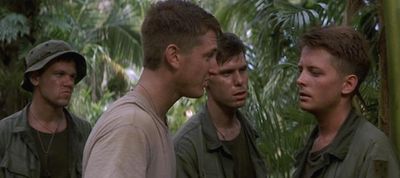 Samuel Blumenfeld, co-author of Brian De Palma: Conversations with Samuel Blumenfeld and Laurent Vachaud, interviewed Quentin Tarantino a couple of weeks ago for Le Monde 2. In the article, Tarantino talks about the war films that inspired him, including Brian De Palma's Casualties Of War. Blumenfeld states that these are not necessarily the films Tarantino prefers, but they are "images of war films that marked his life as a veteran moviegoer." Thanks in large part to the Virtuoso of the 7th Art's Romain Desbiens, who alerted me to the article (and who tells me that he is in the process of changing his terrific site into a blog format), here is an English translation of what Tarantino said about Casualties Of War:
 It’s the greatest film about the Vietnam war. Apocalypse Now would be classified in another category as Coppola's film goes beyond the war. De Palma adapts a very small news article, which must have occurred on several occasions in Vietnam or elsewhere. Elia Kazan had also been inspired by it for The Visitors (1972). He had made an intimate film. De Palma treats that same news item in the epic, operatic style that was his signature since Obsession (1976) and Blow Out (1981). Soldiers capture a young Vietnamese girl. Before her murder, every member of the unit, with the exception of one of them, torture and rape her. The cowardice associated with the forced courage of the character played by Michael J. Fox - who does not participate in the rape and denounces his friends – is very moving. Casualties of War presents the most traumatizing rape sequence in the history of cinema. It's also one of the best performances from Sean Penn, terrifying as the sergeant squad leader.
TARANTINO "SHAKEN" BY SPIELBERG'S WWII FILMS
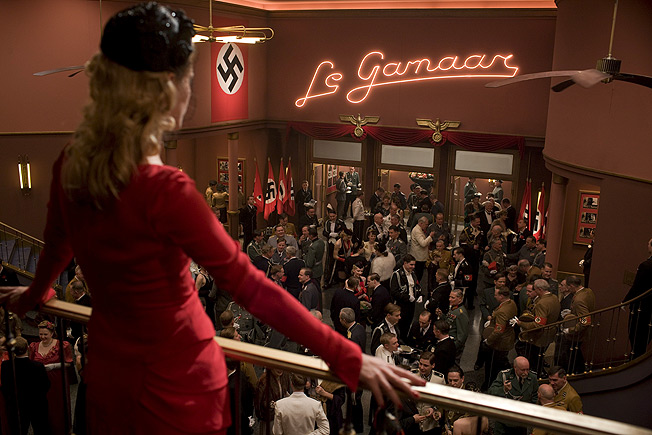
Tarantino also comments on The Guns of Navarone ("This is the first film about men on a mission, of which Inglourious Basterds is the distant heir"), The Longest Day ("The opening sequence, in which the Germans play with a German shepherd in the hills, is breathtaking"), The Dirty Dozen ("Previously, actors like John Cassavetes, Telly Savalas, Charles Bronson, and Jim Brown had never appeared in a war movie"), Kelly's Heroes ("This is one of the worst performances of Clint Eastwood"), and Inglorious Bastards ("This is not my favorite macaroni combat movie - that's the name given to these films on World War II, in reference to "spaghetti westerns." I am much more appreciative of Umberto Lenzi's Desert Commando").
 And with so much discussion going on about Tarantino's new film in relation to some of Spielberg's WWII films it is nice to see what Tarantino himself has to say about them. Here is what Tarantino told Blumenfeld about Saving Private Ryan:
Spielberg is doing something unheard of with the opening of this movie. When you watch the sequence of the landing, it’s no longer possible to look the same way at The Longest Day, or even Samuel Fuller's The Big Red One. I was shaken in a similar manner by Schindler's List. Even though I have seen many films about the Holocaust, none up to that point had managed to get at the feeling of what it was like to be in the inside of a concentration camp. Saving Private Ryan made me aware of some issues raised by the cinema of war that I was unable to ask on my own. The idea that forty men on a boat are exterminated in seconds by a volley of machine gun is terrifying. Can you imagine the most atrocious carnage? Obviously, yes. Except that throughout the scene, you are persuaded to attend the worst slaughter in history. The sequence of the knife fight between a U.S. soldier and a Nazi at the end of the film is also as notable as the landing. I hate war movies where they show a soldier killing his opponents without sweating, as if it were insignificant. If I was fighting to save my skin, I think it would be a little more difficult. It's hard to kill someone, it takes sweat, and even with this, you have no guarantee of reaching your goals. Spielberg managed admirably to stage this scene with that dimension.
 The passing of Ted Kennedy has inspired at least two bloggers to recall Brian De Palma's Blow Out, which had definite echoes of the infamous Chappaquiddick incident from 1969. In that incident, following a party on Chappaquiddick Island, Mary Jo Kopechne was found dead inside Kennedy's overturned car, which was submerged in a tidal channel. Kennedy had left the scene of the incident, and later said that the night before, he had taken a wrong turn and accidentally drove off a bridge and into the water. A scandal quickly took hold, and Kennedy's presidential hopes seemed forever scarred by the whole affair. Conspiracy theories emerged, as well, as Kennedy had apparently driven down the original road (before he made that "wrong turn") on several occasions, and also altered his story in a televised address about a week later.
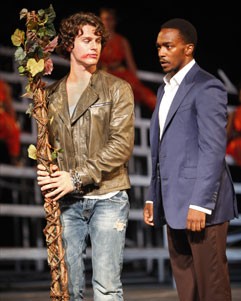 When Joan MacIntosh portrayed Dionysus' aunt Agave in Richard Schechner's Dionysus In '69, itself a 1968 adaptation of Euripides' The Bacchae, she was twenty-something years old. Now in her sixties, she is playing the same role in a new version of the play directed by Joanne Akalaitis (and with music by Phillip Glass), now running through August 30th at

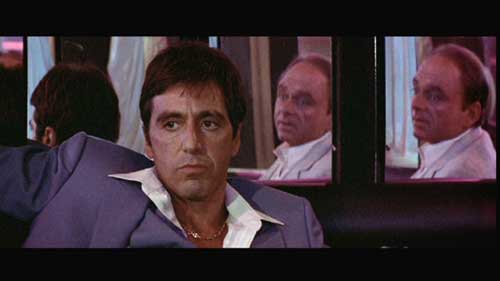 A digital version of Brian De Palma's Scarface was released in U.K. cinemas this weekend. A couple of U.K. critics had some interesting takes on the rerelease, with one suggesting that Scarface is the "definitive" film of the '80s, while the other finds tongue-in-cheek relevence to the current political atmosphere.