ARI ASTER & BILL HADER DISCUSS ON NEW EPISODE OF THE A24 PODCAST

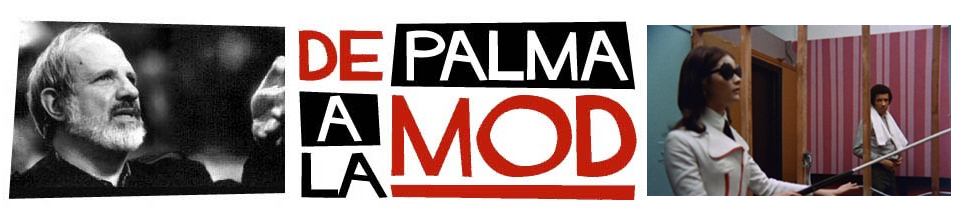 Hello and welcome to the unofficial Brian De Palma website. Here is the latest news: |
|---|
E-mail
Geoffsongs@aol.com
-------------
Recent Headlines
a la Mod:
Listen to
Donaggio's full score
for Domino online
De Palma/Lehman
rapport at work
in Snakes
De Palma/Lehman
next novel is Terry
De Palma developing
Catch And Kill,
"a horror movie
based on real things
that have happened
in the news"
Supercut video
of De Palma's films
edited by Carl Rodrigue
Washington Post
review of Keesey book
-------------
Exclusive Passion
Interviews:
Brian De Palma
Karoline Herfurth
Leila Rozario
------------
------------
| « | July 2025 | » | ||||
 |
||||||
| S | M | T | W | T | F | S |
| 1 | 2 | 3 | 4 | 5 | ||
| 6 | 7 | 8 | 9 | 10 | 11 | 12 |
| 13 | 14 | 15 | 16 | 17 | 18 | 19 |
| 20 | 21 | 22 | 23 | 24 | 25 | 26 |
| 27 | 28 | 29 | 30 | 31 | ||
De Palma interviewed
in Paris 2002
De Palma discusses
The Black Dahlia 2006

Enthusiasms...
Alfred Hitchcock
The Master Of Suspense
Sergio Leone
and the Infield
Fly Rule
The Filmmaker Who
Came In From The Cold
Jim Emerson on
Greetings & Hi, Mom!
Scarface: Make Way
For The Bad Guy
Deborah Shelton
Official Web Site
Welcome to the
Offices of Death Records

Individual tickets for each screening are availble for about $17 each, or you can get a pass for the entire festival, which runs August 7-17.
Here is the Popcorn Frights description of Phantom Of The Paradise:
DATE: Sunday, August 10
TIME: 8:00PM
VENUE: Savor Cinema Fort LauderdaleEXPERIENCE A TALE OF TWO PHANTOMS IN ONE UNFORGETTABLE NIGHT! CELEBRATE 100 YEARS OF THE PHANTOM OF THE OPERA WITH A LIVE ORIGINAL SCORE, THEN ROCK OUT WITH A ONCE-IN-A-LIFETIME SCREENING OF BRIAN DE PALMA’S PHANTOM OF THE PARADISE LIKE YOU’VE NEVER SEEN IT BEFORE!
Get ready to sell your soul for rock ‘n’ roll! Popcorn Frights is summoning all glam rock ghouls and horror hounds for a once-in-a-lifetime special presentation of Brian De Palma’s cult classic PHANTOM OF THE PARADISE—a mind-melting fusion of FAUST, FRANKENSTEIN, and glam rock fury that will leave your jaw on the sticky theater floor. This is not just another screening. This is a rare, electrifying event that will never happen again in quite this way. We’re not saying it’s legendary… but we’re also not NOT saying it.
This psychedelic rock opera fever dream features an Oscar-nominated score by the one and only Paul Williams (who also stars as the devilishly smooth music mogul Swan) and stars William Finley as the doomed and masked Phantom, plus a knockout performance by Jessica Harper (SUSPIRIA) and scene-stealing glam chaos from Gerrit Graham as Beef.
But that’s not all—this special screening will be introduced by The Swan Archives’ Principal Archivist Ari Kahan, the foremost historian and guardian of PHANTOM lore, who’s bringing exclusive insight and rare treats that will make this a screening for the ages. Trust us—you’ve never seen the film like this, and odds are you never will again.
Whether you’re a die-hard Phantom Phan or a first-time initiate into the cult, this is your chance to experience the film in its full, phantasmagoric glory.
One night only. One stage. One swan. Don’t miss your shot at cinematic immortality.


The Associated Press obituary of Schifrin states that John Williams was originally in talks to compose the score for De Palma's film, but that Williams wanted to compose a new theme for Mission: Impossible. De Palma wanted to keep Schifrin's theme, and so, the AP states, "Out went Williams and in came Danny Elfman, who agreed to retain Schifrin's music." There is some truth there, but it leaves out part of the story. After Williams was out of the picture, De Palma and Cruise enlisted Alan Silvestri, who indeed composed an unused score for the film after De Palma realized it was all wrong in tone. De Palma then worked very closely with Elfman, who composed an extraordinary score for the film, which beautifully incorporated Schifrin's theme.
Here's a portion of the Associated Press obituary:
Lalo Schifrin, the composer who wrote the endlessly catchy theme for "Mission: Impossible" and more than 100 other arrangements for film and television, died Thursday. He was 93.Schifrin's son Ryan confirmed that Schifrin died due to complications from pneumonia. He died peacefully in his home in Los Angeles, surrounded by family.
The Argentine won four Grammys and was nominated for six Oscars, including five for original score for "Cool Hand Luke," "The Fox," "Voyage of the Damned," "The Amityville Horror" and "The Sting II."
"Every movie has its own personality. There are no rules to write music for movies," Schifrin told The Associated Press in 2018. "The movie dictates what the music will be."
He also wrote the grand finale musical performance for the World Cup championship in Italy in 1990, in which the Three Tenors — Plácido Domingo, Luciano Pavarotti and José Carreras — sang together for the first time. The work became one of the biggest sellers in the history of classical music.
Schifrin, also a jazz pianist and classical conductor, had a remarkable career in music that included working with Dizzy Gillespie and recording with Count Basie and Sarah Vaughan. But perhaps his biggest contribution was the instantly recognizable score to television's "Mission: Impossible," which fueled the just-wrapped, decades-spanning feature film franchise led by Tom Cruise.
Written in the unusual 5/4 time signature, the theme — Dum-dum DUM DUM dum-dum DUM DUM — was married to an on-screen self-destruct clock that kicked off the TV show, which ran from 1966 to 1973. It was described as "only the most contagious tune ever heard by mortal ears" by New Yorker film critic Anthony Lane and even hit No. 41 on the Billboard Hot 100 in 1968.
Schifrin originally wrote a different piece of music for the theme song but series creator Bruce Geller liked another arrangement Schifrin had composed for an action sequence.
"The producer called me and told me, 'You're going to have to write something exciting, almost like a logo, something that will be a signature, and it's going to start with a fuse,'" Schifrin told the AP in 2006. "So I did it and there was nothing on the screen. And maybe the fact that I was so free and I had no images to catch, maybe that's why this thing has become so successful — because I wrote something that came from inside me."
When director Brian De Palma was asked to take the series to the silver screen, he wanted to bring the theme along with him, leading to a creative conflict with composer John Williams, who wanted to work with a new theme of his own. Out went Williams and in came Danny Elfman, who agreed to retain Schifrin's music.
Hans Zimmer took over scoring for the second film, and Michael Giacchino scored the next two. Giacchino told NPR he was a hesitant to take it on, because Schifrin's music was one of his favorite themes of all time.
"I remember calling Lalo and asking if we could meet for lunch," Giacchino told NPR. "And I was very nervous — I felt like someone asking a father if I could marry their daughter or something. And he said, 'Just have fun with it.' And I did."
"Mission: Impossible" won Grammys for best instrumental theme and best original score from a motion picture or a TV show. In 2017, the theme was entered into the Grammy Hall of Fame.
U2 members Adam Clayton and Larry Mullen Jr. covered the theme while making the soundtrack to 1996's first installment; that version peaked at No. 16 on the Billboard 200 with a Grammy nomination.
A 2010 commercial for Lipton tea depicted a young Schifrin composing the theme at his piano while gaining inspiration through sips of the brand's Lipton Yellow Label. Musicians dropped from the sky as he added elements.

De Palma's reimagination of Antonioni’s Blow-Up follows a sound effects man for raunchy slasher films (John Travolta) who witnesses a presidential hopeful's death. Spinning back his recording of the fatal car crash, he discovers an anomaly in the audio that suggests a bigger conspiracy. Responding to Chappaquiddick and Watergate and set amid a fictional "Liberty Day" in Philadelphia, Blow Out is a must-see screening before the Fourth of July!
Also at Doc, Brian De Palma’s siren song to seediness and cinema, 1981’s “Blow Out,” a deeply doomy melodrama of moviemaking and morality that looks better every year. The ending is brutal, and our flag is still there. Doc Films, Thursday, July 3, 4pm, 8:45pm.

So goes the description under the YouTube trailer for Video Heaven, which was posted today by JoBlo Movie Network. Back in the Winter 2014 issue of Cineaste, Perry was interviewed by Richard Porton, who asked the filmmaker how working at Kim's Video influenced his film education:
That overlapped with my time at NYU. I distilled it down to one point: Working at a place like that taught me not to be afraid of what I liked. Film school teaches you to be very afraid of what you like. You don't want to be the one who stands up in class and says, 'I think Sylvester Stallone is an incredible director.' You're going to look like an idiot, especially at NYU where everyone is trying to be as highbrow as possible. Working at Kim's taught me, working with people like Sean [Price Williams], to like what you like. But you have to defend what you like about these films. You could come into Kim's and say, 'I want to rent the two-tape edition of The Mother And The Whore.' Eustache is an incredible filmmaker. But you needed to defend why you were renting Staying Alive or Rocky IV. Stallone is an incredible filmmaker and even Jean Eustache respected him.That's a lesson you'll never be taught in an academic setting—how to equally appreciate high and low cinema. At NYU, people might see Brian De Palma as a trashy filmmaker who made pulpy movies in the Eighties. When you were working at Kim's, Brian De Palma was the master.


Here is the text of the letter, as printed in the November 29, 1960 edition of the Columbia Daily Spectator:
Managers' MoviesTo The Editor:
The Board of Managers has done it again. No great work of film art seems to be safe from their clutches. They carelessly prance on mutilating everything tihat comes within their leprous grasp.
They began their ignominious career by utterly defiling J. Arthur Rank's The Red Shoes. Never let it be said that the Board of Managers didn't carefully prepare their grizzly rape of this film. First they assaulted it aurally by distorting Brian Easdale's beautiful ballet score until it sounded like primeval gurglings from the depths of a quicksand swamp. But that was just the beginning of the evening's nightmare. Next the harpies preceeded to ravish the visual elements of the film. First, they managed to destroy the tempo of the film by creating fade-outs and black-outs at the discretion of the projectionist. Secondly, they caused fifteen minute breaks between reels so as to distroy any dramatic tension or mood the previous reel had created. I walked out of this destruction of an art form as many people did—even though this is one of my favorite films. But I came to tihe J. Arthur Rank version not the distortion of the Board of Managers!
This whole past nightmare was relived ... in The Board of Managers presentation of John Ford's The Grapes of Wrath and Ingmar Bergman's The Seventh Seal. The Film had not been on two minutes before I realized, to imy horror, that the phantom of the film was at his black art once more. The nightmare proceeded with the customary fade-outs and ultra low key projectionproduced by the phantom's hand across the projector lens.
There is absolutely no excuse for the complete incompetence which saturates ihe Board of Managers Film Series. They can't hide behind the ruse of technical difficulties" because they have new equipment thus making the only difficultieshuman inadequaties. I project a film series at Barnard and Sarah Larwence and never have I had difficulties mildly comparable to those that are visited upon the Board of Managers. And finally if the Board of Managers don't enact radical improvements in their presentations then they should not be allowed to continue defiling Film Art.
Brian De Palma '62
Columbia College


