

INCLUDING RECENT BOOKS BY DE PALMA & WALTER MURCH

Posted earlier today, The Film Stage's Christopher Schobert recommends new film-related books, including Ambrose Chapel: A Screenplay by Brian De Palma and Russian Poland by David Mamet (Sticking Place Books) -
Let us give thanks for the good people at Sticking Place Books, a publishing company that has released everything from studies of Casualties of War to the poems of Abbas Kiarostami. Two of the latest releases are unreleased 1990s scripts from Brian De Palma (yay!) and David Mamet (boo—oh wait, this is a David Mamet work from three decades earlier—yay!) Russian Poland is the strange, compelling story of two Jewish World War II veterans on a mission into late 1940s Israel. De Palma’s Ambrose Chapel is the more enticing of the two scripts, and its release is, I think, very noteworthy. As James Kenney explains in his introduction, “Ambrose Chapel adopts the sleek posture of a geopolitical thriller, all international intrigue and stealthy rescues. But before we’ve even found our footing, games are underway.” Kenney says the script’s DNA is “deeply De Palma, but the tone is surprisingly giddy, even liberatory.” Actors whose names had been bandied about for starring roles include Brad Pitt, Liam Neeson, Tea Leoni, and even Madonna. What a shame Ambrose never took flight, but thank goodness we can ponder what might have been.
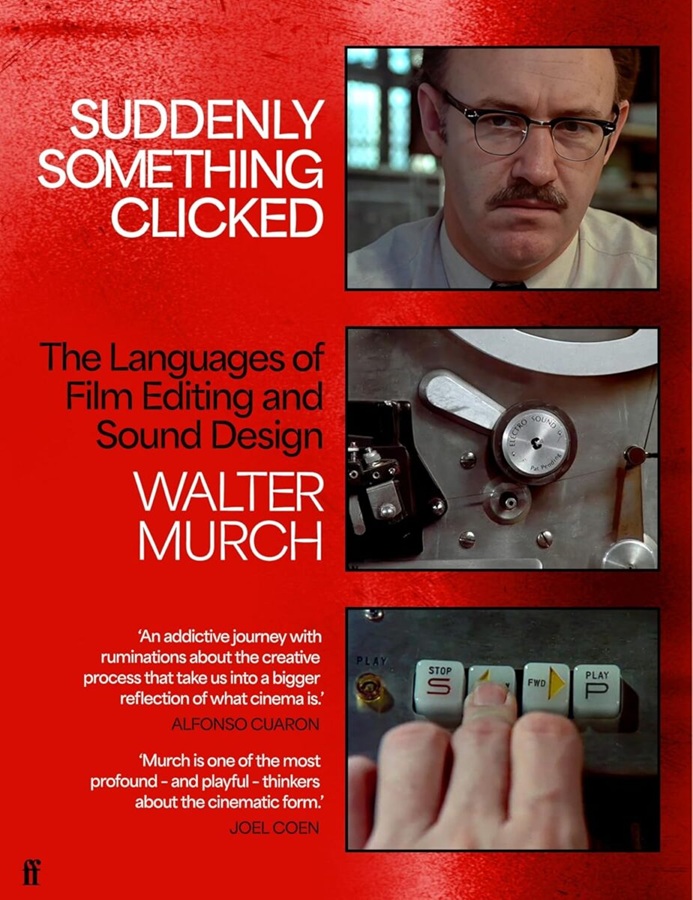
In the same column, Schobert also recommends Suddenly Something Clicked: The Languages of Film Editing and Sound Design by Walter Murch (Faber & Faber) -
There is no one better suited to discuss film editing and sound design than Oscar-winner Walter Murch, the editor of a litany of greats: The Conversation, Apocalypse Now, The Godfather. His first book, 1992’s In the Blink of an Eye: A Perspective on Film Editing, is a classic. “Much has happened in those years,” Murch writes, “but the most significant development was the two-decades-long (1990-2010) transformation of cinema from an analogue to a digital medium. As I suggested in Blink, it is a shift whose closest analogy in the history of European art might be when oil painting began to displace fresco in the fifteenth century.” Suddenly Something Clicked goes to great lengths to not repeat details from Murch’s earlier book. Rather, it is a worthy companion. The chapters covering his work on The Conversation and the restoration of Welles’ Touch of Evil are riveting.