



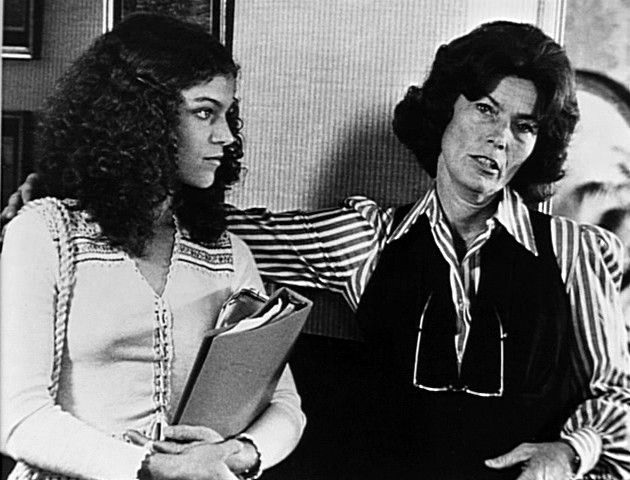
MRS. SNELL IN CARRIE WAS REAL-LIFE MOTHER TO AMY IRVING
On Facebook this morning, Amy Irving posted, "Priscilla Pointer, acclaimed stage television and film actress, and mother of David, Katie, and Amy Irving, died peacefully in her sleep at the age of 100, hopefully to run off with her 2 adoring husbands and her many dogs. She most definitely will be missed."
Pointer was mother to Amy Irving - and she was also Amy Irving's on-screen mother in Carrie (1976). This was the second time that Brian De Palma had cast a real-life mother-daughter duo in one of his films, having done so in Sisters (1972), with Mary Davenport playing mother to her real-life daughter Jennifer Salt. Earlier this month, in a Criterion "Closet Picks" video, Amy Irving pulled out a copy of David Lynch's Blue Velvet (1986), in which Priscilla appeared as Kyle MacLachlan's mother. "Mom's a hundred years old now," Amy says in the video, "and still going strong. And she and I do this kind of film sessions at her assisted living facility. And Blue Velvet was one of them."

Here's an excerpt from the Los Angeles Times obituary:
For 44 episodes of CBS’ series “Dallas,” Pointer played Rebecca Barnes Wentworth, Pamela and Cliff’s mother and the head of a rival oil family. In the 1976 movie “Carrie” she played Mrs. Snell, mother to Sue Snell, who was played by her daughter Amy.She was just shy of her 101st birthday, according to a family statement obtained by The Times.
“Priscilla had a long acting career. She met her first husband Jules Irving in Europe just after WWII in an army production of ‘Brother Rat,’” the statement said. “They returned to the U.S. and formed the Actor’s Workshop in San Francisco. The company eventually took over the Vivian Beaumont Theater in NYC.”
Pointer, who was born in New York City on May 18, 1924, began her stage career in the city the 1940s. She was was married to Irving from 1947 until his death in 1979, moving out west with him after the war. They returned to New York City as the San Francisco troupe was winding down and Irving served as artistic director of Manhattan’s Lincoln Center from 1965 to 1972. The couple moved to Southern California after he retired, settling down in Santa Monica.
After her first husband died, Pointer married Robert Symonds. The two knew each other from San Francisco, and Symonds had moved to New York from California to work as Irving’s associate director at the Lincoln Center.
Symonds recalled meeting Pointer for the first time at the Actor’s Workshop in San Francisco, where she was “sitting at a desk typing a letter,” he told The Times in 1997. “I remember she was very, very pretty.”
Former Times staff writer Daryl H. Miller dubbed Pointer a “natural beauty.”
“Whether hunkered on the floor petting a dog or sitting pertly on a couch,” he wrote, “she is regal yet casual, arresting yet homespun.”
Amy Irving told The Times in 1997 that her mother and Symonds were “unbelievably well-suited” as a couple. “I know my mom and dad were deeply in love with each other, but Mom and Bob have so much in common,” she said. “There’s such harmony in their lives, a really nice balance. They spark each other.”
The couple’s joint projects included the 1984 Blake Edwards film “Micki & Maude,” in which they played Ann Reinking’s parents, and the 1993 South Coast Repertory production of “Morning’s at Seven,” in which they played brother- and sister-in-law. “First Love” at the Odyssey Theater in 2003 and the 2000 production of Athol Fugard’s “Road to Mecca” at the Fountain Theatre in Hollywood were also twofer shows.
When Pointer and Symonds worked together on the 1997 production of “Fighting Over Beverly,” also at the Fountain, they rehearsed at home and carpooled across town to the theater, but their characters weren’t supposed to have seen each other in 50 years.
“That really requires acting,” Pointer told The Times, “because instead of having known him for 43 years, I have to pretend — and so does he — that we haven’t seen each other since we were 18.”
“The unflappable Pointer sails above the general mayhem with a ladylike aplomb that makes her subsequent emotional epiphany all the more moving,” The Times wrote about Pointer’s performance in that show.


