Hello and welcome to the unofficial Brian De Palma website.
Here is the latest news:

De Palma a la Mod

Brought to you by
GeoffSongs

E-mail
Geoffsongs@aol.com

Recent Headlines
a la Mod:

-Stranglers aiming
for fall shoot

-Williams & De Palma
working on stage
version of Phantom

-De Palma to narrate
episode of Hollywood's
Best Film Directors

« December 2009 »
S M T W T F S
1 2 3 4 5
6 7 8 9 10 11 12
13 14 15 16 17 18 19
20 21 22 23 24 25 26
27 28 29 30 31

Interviews...

De Palma interviewed
in Paris 2002

De Palma discusses
The Black Dahlia 2006


Enthusiasms...

The Virtuoso
of the 7th Art

Le Paradis de
Brian De Palma

The Swan Archives

Carrie...A Fan's Site

Phantompalooza

Brian De Palma's
Split World

Paul Schrader

Snake Eyes
a la Mod

Mission To Mars
a la Mod

Sergio Leone
and the Infield
Fly Rule

Directorama

The Filmmaker Who
Came In From The Cold

Jim Emerson on
Greetings & Hi, Mom!

Scarface: Make Way
For The Bad Guy

The Big Dive
(Blow Out)

Carrie: The Movie

Deborah Shelton
Official Web Site

The Phantom Project

Welcome to the
Offices of Death Records

The Carlito's Way
Fan Page

The House Next Door

The Film Doctor

The former
De Palma a la Mod
site

Entries by Topic
A note about topics: Some blog posts have more than one topic, in which case only one main topic can be chosen to represent that post. This means that some topics may have been discussed in posts labeled otherwise. For instance, a post that discusses both The Boston Stranglers and The Demolished Man may only be labeled one or the other. Please keep this in mind as you navigate this list.
All topics
Ambrose Chapel
Becoming Visionary
Black Dahlia
Blow Out
Blue Afternoon
Body Double
Bonfire Of The Vanities
Boston Stranglers
Bruce Springsteen
Capone Rising
Carlito's Way
Carrie
Casualties Of War
Cruising
Dancing In The Dark
David Koepp
De Niro
De Palma Blog-A-Thon
Demolished Man
Dionysus In '69
Dressed To Kill
Eric Schwab
Femme Fatale
Fire
Frankie Goes To Hollywood
Fury, The
Get To Know Your Rabbit
Greetings
Hi, Mom!
Hitchcock
Home Movies
Inspired by De Palma
Iraq, etc.
Lithgow
Mission To Mars
Mission: Impossible
Montreal World Film Fest
Mr. Hughes
Murder a la Mod
Nazi Gold
Obsession
Oliver Stone
Parties & Premieres
Paul Schrader
Phantom Of The Paradise
Prince Of The City
Print The Legend
Raising Cain
Red Shoes, The
Redacted
Responsive Eye
Rie Rasmussen
Robert De Niro
Sakamoto
Scarface  «
Sean Penn
Sisters
Snake Eyes
Stepford Wives
Tabloid
Tarantino
Toronto Film Fest
Toyer
Tru Blu
TV Appearances
Untouchables
Vilmos Zsigmond
Wedding Party
William Finley
Wise Guys
Woton's Wake
Blog Tools
Edit your Blog
Build a Blog
RSS Feed
View Profile
You are not logged in. Log in
Thursday, December 3, 2009


Posted by Geoff at 11:58 AM CST
Post Comment | Permalink | Share This Post
Sunday, August 16, 2009
SCARFACE RERELEASED IN U.K. THEATERS
"DEFINITIVE" '80S MOVIE HAS "ALL ITS DIALS TWISTED UP TO 11"
A digital version of Brian De Palma's Scarface was released in U.K. cinemas this weekend. A couple of U.K. critics had some interesting takes on the rerelease, with one suggesting that Scarface is the "definitive" film of the '80s, while the other finds tongue-in-cheek relevence to the current political atmosphere.

The Guardian's John Patterson

It's not the best film of the decade (that might be Raging Bull) or the most influential (except among gangsta rappers), or the most elegantly crafted (good god, no), but somehow Scarface manages, both intentionally and utterly accidentally, to capture the 1980s' atmosphere of unflagging greed, moral emptiness and materialistic crassness to a tee. It's as irreducibly 80s as Reagan's black plastic hairdo, Madonna's bustier and the Jane Fonda Workout.

Scarface is a movie with all its dials twisted up to 11. No one does lines of cocaine (a loathsome drug for a loathsome era), they do piles of cocaine; chainsaws are brandished, not switchblades; the vague, censor-baiting hints at Borgia-syle incest in the original morph here into Mary Elizabeth Mastrantonio screaming at her brother, "Ya wanna fuck me, huh, Tony? Huh?"

But Tony is a fully-fledged 1980s-style unzipped capitalist go-getter, worthy of admiration given the Friedman-fundamentalist economic fumes wafting through the zeitgeist back then; he's a Horatio Alger hero with a hole through his septum, he's Arkan in the making.

The List's Paul Dale

All of which makes this brilliant, cold-blooded masterpiece rather a strange proposition at a time when President Obama is opening up relations with the seemingly progressive sibling Raúl Castro. Myth has it that during his time as 46th Vice President of the United States in the Bush era, Dick Cheney liked to spend his downtime staring at a corporately revised map of Cuba which showed which US conglomerate would go where come the day that the US colonise the Caribbean island again. Could it be that Universal has been promised a spec there? A little place in the sun to wait out another Depression? Where multimillion-dollar mergers can be brokered by Skype and movies can be made for a tenth of the price? Could the re-release of Scarface be the beginning of their chainsaw wielding march on Cuba? Either way it’s great to see you again Tony.


Posted by Geoff at 12:22 AM CDT
Updated: Sunday, August 16, 2009 12:24 AM CDT
Post Comment | Permalink | Share This Post
Saturday, August 8, 2009
TONY MONTANA SNOW GLOBE
LEARN HOW TO MAKE YOUR OWN

What a lovely idea-- over at Make, Sean Michael Ragan shows you step-by-step how to make your very own Tony Montana snow globe. "What's that you say?" asks Ragan in his introduction. "You don't need an 8-inch diameter snow globe? Especially not one featuring a vignette of Al Pacino as Tony Montana in the climactic battle scene from Brian De Palma's Scarface? I say you're wrong: You need one of these. You need one so badly you don't even know it yet."


Posted by Geoff at 11:42 PM CDT
Post Comment | Permalink | Share This Post
Tuesday, July 7, 2009
THOMSON & TUCKER ON SCARFACE
AND SCARFACE MONTAGE MAKES BLOGGER'S TOP TEN LIST

The Untouchables isn't the only Brian De Palma film feeling the love from critics amidst the heat of Michael Mann's Public Enemies. Pauline Kael stated that Scarface was "a De Palma movie for people who don't like De Palma movies." David Thomson fits that bill perfectly, as he hates most De Palma films, but loves De Palma's Scarface. Thomson, generally unimpressed with Mann's Public Enemies, offers his list of ten great gangster films, courtesy of the Irish Times. Listed chronologically, De Palma's film is number nine, right before Martin Scorsese's GoodFellas. Here's what Thomson wrote about Scarface:

Howard Hawks’s Scarface (1932), in which Paul Muni played a version of Al Capone, is a deserved classic, but the 1983 remake, written by Oliver Stone and directed by Brian De Palma, is even better. For a start, shifting the action to Miami and making Tony Montana an outlaw from Castro’s Cuba is very clever, and it allows Al Pacino to play with a Cuban accent the way a cat teases a dying bird. It was as if all the restraints Pacino had respected to play Michael Corleone were tossed aside. Beyond that, this Scarface is a modern opera (with music by Giorgio Moroder) that builds from the first bloody job on Miami Beach to the assault on Tony’s cocaine palace by Colombian thugs. Along the way, we get deliciously sleazy performances from F Murray Abraham, Harris Yulin and Robert Loggia as low-lifes for whom Tony finds appropriate executions. Then there is the young Michelle Pfeiffer as the bad-tempered prize Tony craves, and Mary Elizabeth Mastrantonio as the sister he can share with no one.

TUCKER: DE PALMA GAVE PFEIFFER ONE OF THE MOST SPECTACULAR ENTRANCES
Meanwhile, sparked by Mann's latest, Entertainment Weekly's Ken Tucker (author of Scarface Nation) is offering an "EW University" gangster movie class all week long. In today's lesson, Tucker discusses the role of women in gangster movies, with a focus on Pfeiffer's Elvira:

Who’s the most famous, most recognizable female character in the gangster-film genre? I’d have to say Elvira Hancock, wife of Tony Montana in the 1983 Scarface. Since a lot of gangster movies are period pieces set during the Prohibition Era, it’s not surprising that women have been largely relegated to being gold digger girlfriends – “molls” -- or innocent companions or mothers of the male protagonists. It wasn't until the World War II era, when there were more women sitting in movie-theater audiences, that the female roles were made more substantial. There are enough exceptions to this rule, however, to make women in gangster films an intriguing area of EW University study. Most immediately, Marion Cotillard, as John Dillinger’s famous real-life moll Billie Frechette, is more of a presence than your average gangster accompaniment in the new Public Enemies; director Michael Mann didn’t cast this excellent actress (La Vie en Rose) to have her stand around and simper.

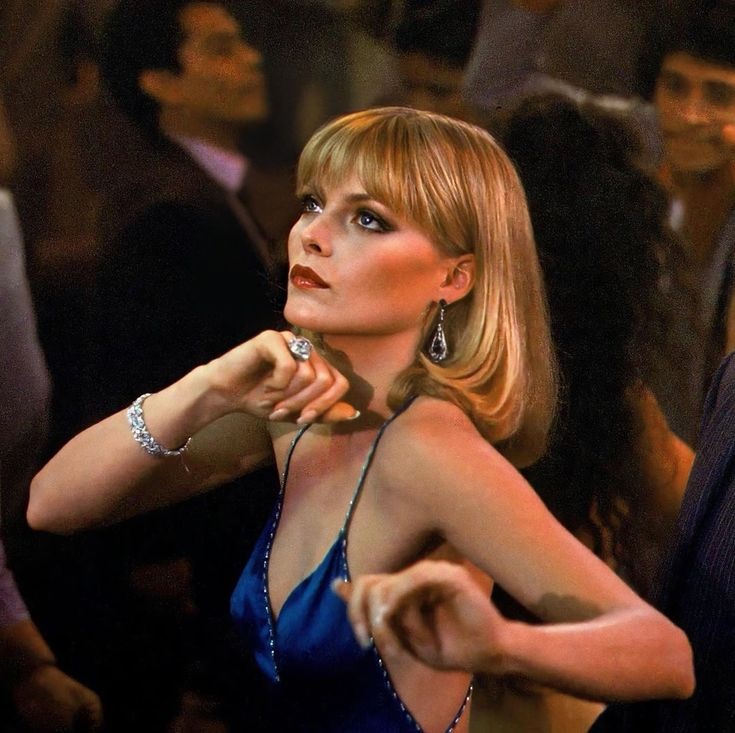
But let’s go back to Elvira in Scarface. This was Michelle Pfeiffer’s star-making role. Director Brian De Palma gave her one of the most spectacular entrances in movie history: dressed in a slinky dress that hugged every curve, Elvira descends slowly from a glass elevator, with Pacino’s Tony momentarily speechless, in awe. Wearing a blonde pageboy hairdo and talking tough, Elvira ends up matching Tony curse for curse and, as their cocaine consumption increases, toot for toot. This is a far cry from the original 1932 Scarface’s femme fatale, Poppy, played by Karen Morley. She’s little more than a pretty trinket Paul Muni’s Scarface Tony Camonte wears on his arm; the real woman in this movie is Scarface’s sister, Cesca, portrayed by Ann Dvorak. She’s so loyal, she grabs a gun and stays by her brother’s side for the film’s final shoot-out. The clear implication throughout the film, although this could never be stated outright, of course, is that Scarface’s sister loves him more — is more like a faithful lover or wife — than his girlfriend is.

SCARFACE MONTAGE TAKES IT TO THE LIMIT
Warren J. Cantrell's top ten list of movie montages, posted at Scene Stealers, is not specifically related to gangster films, but it does feature Scarface up there in the top five. Here is what Cantrell says about the montage:

Money. That’s not only a description of this montage, but the image that kicks it off and sweet-Christ, is there a lot of it! After solidifying his position as the go-to man for cocaine imports and distribution in Miami, Tony Montana (Al Pacino) goes to work maximizing his power base in the vacuum left in Frank’s absence. Wisely moving through what looks to be as many as six months of expansion and growth, director Brian De Palma gives the audience not-so-subtle hints regarding the extent of Tony’s ascension. We watch the spread of the protagonist’s influence through multiple business ventures, a chic wedding (that showcases a fucking domesticated tiger), lines of men marching into a bank with duffel bags full of money, and a good-for-nothing junkie wife that is in it for the gravy. The montage has been parodied before, and for good reason, as it is absolutely dripping with cheese (the background track rivals Bloodsport’s in sheer awesome-per-square inch), yet isn’t that the point? The film is a salute to the possibilities of life in the United States for any person with balls solid enough to take what is there. In Tony Montana, America found a willing taker, a victim of this country’s lop-sided promise who, while tough as nails and quite willing, did not understand the basic necessity of freedom: restraint. A microcosm of the thematic elements of the film at large, the montage represents both Tony at the peak of his power, yet in the midst of what will ultimately ruin him. It is Tony’s blind embrace of the American dream (and the idea that one must keep reaching for more) that will doom him, for he doesn’t understand (nor will he ever) that balls might be what it takes to get to the top, but that brains are needed to stay there. The song here is “Take It To the Limit,” and for good reason, as the montage demonstrates Tony doing what he does best, mainly chewing through everything and everyone to get higher up the social ladder (the tragic inevitability, of course, is that once to the top, to keep trying to climb will mean a terrible fall).


Posted by Geoff at 1:29 PM CDT
Updated: Saturday, July 11, 2009 1:42 PM CDT
Post Comment | Permalink | Share This Post
Sunday, May 24, 2009
SCARFACE IN THEATERS THIS SUMMER
AS ONE OF UNIVERSAL'S FIVE DIGITAL REISSUES
Brian De Palma's Scarface will be rereleased in digital theaters August 25th, as Universal rolls out five Cinema Classics between now and November. The other four films being reissued are: Spartacus (June 9), The Blues Brothers (July 28), The Thing (John Carpenter's version) (September 15), and National Lampoon's Animal House (November 2). Empire has a nice trailer for the series at its website, and we thank the Swan Archives for the news!

Posted by Geoff at 11:59 PM CDT
Updated: Monday, May 25, 2009 12:01 AM CDT
Post Comment | Permalink | Share This Post
Monday, April 13, 2009
2ND-DEGREE MURDER CONVICTION FOR SPECTOR
VICTIM HAD "WINDOW DRESSING" PART IN SCARFACE
After 29 to 30 hours of deliberations, a Los Angeles Superior Court jury this afternoon announced their verdict, and Phil Spector was convicted of second-degree murder in the death of Lana Clarkson, who was shot in the mouth at Spector's mansion after meeting him hours earlier while working her job as a nightclub hostess. According to an AP story, "prosecutors argued Spector had a history of threatening women with guns when they tried to leave." The article also states that this "was Spector's second trial. His first jury deadlocked 10-2, favoring conviction in 2007."

Clarkson had a small part in Brian De Palma's 1983 film Scarface. The actress had answered a reader's question about her role in Scarface in a June 2002 posting on her now defunct website, livingdollproductions.com:

Yes, indeed you did see me in the Babylon club scenes in Scarface. The director, Brian De Palma hired 12 Screen Actors Guild members, ladies, whom he put under contract for a couple of weeks. This was to avoid any union problems or restrictions while he was in creative mode. It was an interesting set to be on, though I wish I'd had more to do. I was taller than most of the "gang" members and therefore, was basically window dressing. Regardless, it was a great opportunity to watch artists of [Al] Pacino and De Palma's caliber work. Mr. Pacino was always in character, even when in his trailer which was just down from mine. I often overheard him speaking to his dresser in his Tony Montana accent. He's an extremely intense and focused actor who is a joy to be around because of his commitment. Steven Bauer was dreamy, Michelle Pffeifer, nervous and De Palma drank lots of coffee and smoked lots of cigarettes. I think they were all under a lot of pressure form Universal. We worked hard, right up 'till Christmas Eve. I got on a plane the next morning to join my family in Hawaii. I thoroughly enjoyed the experience.


Posted by Geoff at 5:18 PM CDT
Updated: Monday, April 13, 2009 9:48 PM CDT
Post Comment | Permalink | Share This Post
Monday, March 2, 2009
GOMORRAH & SCARFACE
BOOK & FILM SHOW INFLUENCE OF GANGSTER FILMS
Every review of Matteo Garrone's Gomorrah mentions Brian De Palma's Scarface, and for solid reasons: two characters in the film go around Naples acting out scenes from Scarface. The film is based on the book of the same name by Roberto Saviano, who has been under 24-hour armed protection since 2006, when his book, which peers unblinkingly into the Camorra Mafia, became a bestseller and the author was besieged by death threats. Fellow author Salmon Rushdie, who was famously condemned to death by Ayatollah Khomeini in 1989 and went into hiding when his novel, The Satanic Verses, was deemed by Khomeini as insulting to Islam, told reporters in Rome last October that Saviano is in even greater danger than Rushdie had been, because the reach of the Camorra is incredibly expansive.

In Saviano's book, he spends some time delving into the relationship between the Comorra and Hollywood, finding that it is not Hollywood reflecting reality, but the other way around. Here is an excerpt in which Saviano walks through the former mansion of one Mafia boss who had given his architect a copy of De Palma's Scarface because he wanted Tony Montana's villa, "exactly as it was in the movie," a villa, Saviano states, that everyone calls Hollywood. However, after being caught by the police, the boss had everything removed because, as Saviano writes, "If he couldn't use it, it shouldn't exist. Either his or no one's"...

He had the doors taken off their hinges, the windows removed, the parquet taken up, the marble pulled off the stairs, the expensive fireplace mantels disassembled. Ceramic bathroom fixtures, wood railings, light fixtures, and kitchen appliances were removed, and antique furniture, china closets, and paintings carried off. He gave orders to strew the house with tires and set them on fire, ruining the plaster and damaging the columns. Even so, he managed to leave a message. The only thing left untouched was a bathtub, sitting on three wide steps in the living room. A princely version, with a lion's face that roared water. The boss's great indulgence. The tub sat right in front of a Palladian window that looked directly onto the garden. A sign of his power as builder and Camorrista, like an artist who cancels out his painting but leaves his signature on the canvas.

As I wandered through those blackened rooms, I felt my chest swell, as if my insides had become one giant heart. It beat harder and harder, pumping through my entire body. My mouth had gone dry from the deep breaths I took to calm my anxiety. If some clan sentinel had jumped me and beaten me to a pulp, I could have squealed like a butchered pig but no one would have heard me. Evidently no one saw me enter, or maybe no one was guarding the villa anymore. A pulsating rage rose up inside me. Flashing in my mind, like a giant swirl of fragmented visions, were the images of friends who had emigrated, joined the clan or the military, the lazy afternoons in these desert lands, the lack of everything except deals, politicians mopped up by corruption, and empires built in the north of Italy and half of Europe, leaving behind nothing but trash and toxins. I needed to vent, to take it out on someone. I couldn't resist. I stood on the edge of the tub and took a piss. An idiotic gesture, but as my bladder emptied, I felt better. That villa was the confirmation of a cliché, the concrete realization of a rumor. I had the absurd sensation that Tony Montana was about to come out of one of the rooms and greet me with a stiff, arrogant gesture: "All I have in this world is my balls and my word, and I don;t break them for no one, you understand?" Who knows if Walter dreamed of dying like Montana too, riddled with bullets and tumbling into his front hall rather than ending his days in a prison cell, consumed by Graves' disease, his eyes rotting and his blood pressure exploding.

Saviano goes on in this chapter to relate how the movies are studied by generations of bosses and criminals who want to carve out an image for themselves. The author provides examples of these from several films, including The Godfather ("Before the film came out," writes Saviano, "no one in the Sicilian or Campania criminal organizations had ever used the term padrino"), Il camorrista ("The film's sound track has become a sort of Camorra theme song, whistled when a neighborhood capo walks by, or just to make a shopkeeper nervous"), Good Fellas (Saviano imagines one scene flashing in a would-be gangster's mind as he meets his death), The Crow (one man wore clothes reminiscent of Brandon Lee's in that film), Pulp Fiction (Camorra killers have started holding their guns crooked, the way they do in Tarantino's film, which makes them horrible shooters for which they compensate by leaving a bloody mess everywhere), Kill Bill (bodyguards for female bosses dress like Uma Thurman's character), Nikita (one woman's nickname), and even Taxi Driver (two young bullies would start fights with a look, and then repeat after Robert De Niro's famous lines from that film: "You talkin' to me?").

Those two bullies are the characters in the film mentioned at the top of this post. In early January, it was announced that Martin Scorsese would lend his name in support of IFC Films' U.S. release of Garrone's Gomorrah, which opened in select U.S. theaters this past weekend. "Matteo Garrone's Gomorrah is a tough, forceful look at the Neapolitan underworld," Scorsese told the Hollywood Reporter. "I admire the bluntness of this picture and the devotion of Garrone and his actors in their pursuit of a terrible truth. Gomorrah is despairing, but it's also enlightening and, because of its frankness, strangely heartening." Garrone responded, "I have been waiting for some time for the chance to thank Martin Scorsese publicly for the courage and generosity he has shown in laying his support on the line for Gomorrah. I can't forget how deeply touched I was seeing him arrive for the presentation of the film; of all directors, he is one of the most important in my development as a filmmaker. I am therefore extremely proud that the film has found such a prestigious adoptive father, and I will certainly cherish this memory for all time."

GOMORRAH REVIEWS
What follows are links to several reviews of Garrone's film, with selected excerpts:

Anthony Lane at the New Yorker

There is a pair of teen-agers, Marco (Marco Macor) and Ciro (Ciro Petrone), fools in love with a gangsterish ideal; “I’m No. 1! Tony Montana!” they cry, acting out their pantomime of Scarface in an empty tenement, where a sunken, unused bath echoes not just old Brian De Palma movies but much older tubs, in the balneae of Pompeii, across the bay...

Garrone’s film is less furious than Saviano’s book, which has the tang of personal nausea, and for that reason, I suspect, it will prove more enduring. (It failed to make the nominations for Best Foreign Film at the Academy Awards: the usual travesty.) As I watched various Scampians being slain or spared on a whim, I felt borne along not so much by reportage, however well dramatized, as by a fierce meditation on the vagaries of fate—and thus, oddly enough, by the pull of comedy. When Franco, in a cathedral-size quarry, needs a new set of truck drivers to shift his drums of corrosive chemicals, whom does he call? Local children, who perch on cushions to see through the windshield; in a way, they make better mafiosi than the adults, yielding with less caution and complaint to their instinctual urges. There is a terrible numbness to the grownups, spun in the endless cycle of revenge; “We don’t know anything” is the conclusion of one group, which agrees to press ahead with murder, for want of another plan. I’m not sure that, after this movie, I will be able to take quite such unquestioning pleasure in the suave, all-knowing dons of the Godfather trilogy, let alone the stylized brutality of Scarface; the spoiled earth of Gomorrah is the ground zero of Mob cinema, burning away the sleekness and self-congratulation of the genre.

Armond White at the New York Press

Director Matteo Garrone pretends to expose Camorra, the vicious Neapolitan version of the Mafia that has ravaged contemporary Italian society. His title’s clever reference to Sodom and Gomorrah decadence implies biblical judgment. But Gomorrah’s five interlocking stories are told with slow, almost obscenely casual regard. Garment worker Pasquale (Salvatore Cantalupo) tries to outfox the mob; Gaetano (Vincenzo Altamura) double-crosses a gang; young thugs Sweet Pea and Pitbull (Salvatore Ruocco and Vincenzo Fabricino) embark on a mini-war against townspeople while defying veteran hoods; and teenage delivery-boy Toto (Salvatore Abruzzese) chooses dangerous role models. Garrone’s mix of local color, environmental anarchy and sensationalism is prurient; Gomorrah always heads toward awful, inevitable moments of deception and vengeance.

In the Godfather films, Coppola’s revelations of our deepest thoughts about law, order and human weakness were enthralling. That’s why the three-thousand gangster movies The Godfather inspired don’t measure up—and why Coppola’s trilogy still feels definitive.

Chuck Williamson at Out 1 Film Journal

While it did not “reinvent the wheel” of contemporary gangster cinema, Brian De Palma’s Scarface nonetheless underlined in thick, bold strokes the genre’s internal frictions and contradictions. Scarface amplified the genre’s basest elements, reimagining its narrative as a sensationalistic, overstuffed, Grand Guignol cartoon that forced audiences to confront, up front and personal, the paradox implicit within all mob movies: the glamorization of the gangster. Because of its lack of nuance and subtlety, De Palma’s film made those once inconspicuous contradictions more explicit. Scarface, like most gangster films, turned its antagonist into an icon of cool, a two-fisted merchant of death with both charisma and cojones—and no amount of anti-crime moralizing could cancel out the intrinsic allure of such a character. For all the bullet wounds and moralizing of its “crime doesn’t pay” third act, the film largely functions as a male adolescent fantasy, a fever dream concoction where decadent materialism is rewarded, macho posturing leads to steamy sex (with nudity!), enemies are mowed down in satisfying spurts of splatter-gore, and men speak in expletive-laced bon mots like, “This town is a great big pussy just waiting to get fucked.”

Loaded with both implicit and explicit references to Scarface, Matteo Garrone’s Gomorra reappropriates the pop-culture image of gangster cool and makes visible its seams, cracks, and inherent hollowness.

In its most memorable scene, two skinny, anemic-looking teenagers—Marco and Ciro—strip down to their underwear, stroll through a riverbank, and crudely reenact Scarface’s final shoot-out sequence with a pair of stolen semi-automatic weapons. “You sounded just like Tony Montana,” one says to the other, but nothing could be further from the truth. Using Scarface as a “how-to” manual, these two boys may have memorized the film’s macho swagger and f-bomb sloganeering, but their ritual still comes across as a children’s game, a media-constructed façade that fails to mask the authentic image of two vulnerable, naked youths. They are pathetic, juvenile, a pair of children pretending to be big, bad gangsters—and despite their reprehensibility, they remain somewhat sympathetic, as they have bought into the false constructs of Hollywood and will, of course, pay the consequences. While the scene could be described as both self-reflexive and revisionist, it also carries an undercurrent of tragedy, as their inevitable (and bloody) downfall seems designed right from the first pull of a trigger.

R. Kurt Osenlund at Your Movie Buddy

Gomorrah redefines the mob flick because it shows a criminal association not as it might be, but as it is. Still, Garrone isn't above giving a nod to his genre predecessors, namely Brian De Palma and his immortal Pacino vehicle, Scarface. The brief opening sequence has a tacky neon opulence reminiscent of the cult classic – even the title logo goes from red to “Vice City” pink – and, later, the delinquent duo play with empty pistols in an empty warehouse and pretend to be Tony Montana. What would Tony say if he saw Gomorrah? Fuhgeddaboutit? No way. Not this merciless movie. It sticks with you for days.

Christy Lemire at Associated Press

Two cocky Italian teenagers run around their dilapidated Naples neighborhood, melodramatically riffing on Scarface lines to each other: "Now it has to be ours, the whole world. Miami, all of it."

They're certainly no more over-the-top than Al Pacino. But this is the closest director and co-writer Matteo Garrone comes to any sort of traditional, Hollywoodized depiction of mob life in Gomorrah.

It's appropriate, though, that Brian De Palma's bloody epic is the source of inspiration for wannabe thugs Marco (Marco Macor) and Ciro (Ciro Petrone). That film, and the genre in general, are so entrenched in contemporary pop culture that they've become a source of self-parody.

That's what's so compelling about Gomorrah: It upends everything you think you know about the mob, and mob movies.

Steve Erickson at Gay City News

In a sense, Gomorrah is a humanist gangster film. It goes out of its way to avoid glamorizing the Mafia - among recent films, only Johnnie To's Election and Triad Election have presented a grimmer version of organized crime.

Just to make sure we get the point, Gomorrah has two of its characters constantly quote dialogue from Brian De Palma's Scarface and compare themselves to its anti-hero, Tony Montana. No doubt they missed the memo that Scarface was intended as a critique of '80s excess and greed. Italian director Matteo Garrone clearly doesn't want anyone to make the same mistake with his film.

Ironically, despite its humanism, Gomorrah could hardly be more nihilistic. It veers among five different storylines. If the Mafia angle isn't immediately apparent in each one, it soon becomes clear. The screenplay never brings these narrative threads together; in a post-Paul Haggis climate, that's something for which we can be grateful. However, this is the kind of film where no one takes any moral stances until two hours have passed.

Greg Oguss at LA Snark

The Scarface references aren’t arguing the case that violent entertainment begets violent children or the truism about contemporary gangsters taking their cues from movie gangsters. Instead, they merely make an effective contrast between De Palma’s romantic vision and a milieu without any charismatic anti-heroes or blaze-of-glory deaths, where loyalties are never taken seriously enough to be betrayed. Even the few functionaries who walk away from the corrupt empire by the story’s end lack nobility, with their paths determined principally by cowardice and naiveté. Despite being well-versed in the bloody justice doled out by the mafia, the film’s myopic characters have little understanding of how completely the illegal and legal businesses of the Camorra shape their existence. Gomorrah’s end-titles offer a tally of official statistics to illustrate the Camorra’s social costs, suggesting that, by certain measures, this is the most criminally violent place on the planet. But the film offers no scenes of anti-mafia police efforts and the collective struggle required to change the region’s way of life is beyond the imagination.

J. Hoberman at the Village Voice

Martin Scorsese may be presenting Matteo Garrone's Gomorrah, but this corrosive, slapdash, grimly exciting exposé of organized crime in and around Naples comes on like Mean Streets cubed. Detailing daily life inside a criminal state, it's a new sort of gangster film for America to ponder...

In a vacant lot outside the fortress walls, two skinny teenagers play at being the antihero of Brian De Palma's Scarface. That's the fantasy; robbing African crack dealers is the reality, after which the two aspiring gangsters dance in scurvy triumph on some gray-sand beach. Their dreams come true when they stumble upon a cache of weapons, including AK-47s and a bazooka. Meanwhile, the Camorra expands into legitimate businesses, from garbage disposal to haute couture.

Garrone skips from one Camorra scam to another, all plots climaxing amid inexplicable internecine warfare in a more or less simultaneous reckoning. Gomorrah's episodic, mosaic structure is in some ways comparable to Steven Soderbergh's Traffic, but Garrone is not so much interested in diagramming a process as mapping a specific terrain. Despite its vivid characterizations, the movie stays on the surface—or, rather, it offers a sort of neorealist reportage. (Occasionally, the sober frenzy indulges in the sort of grotesque humor Garrone employed in his 2002 black comedy The Embalmer, wherein the Camorra enlists a professional taxidermist to stitch a shipment of drugs into a corpse.) The undistinguished visual style is predicated on a jittery wide-screen SteadiCam. There's a sense that Garrone's bobbing and weaving camera is just hanging with the homies—a strategy akin to Saviano's in his first-person book.

Saviano devotes an entire chapter to detailing the often-comic Camorrista fascination with Hollywood gangster flicks—mainly De Palma's Scarface, but also The Godfather, GoodFellas, and Pulp Fiction. "It's not the movie world that scans the criminal world for the most interesting behavior," he writes. "The exact opposite is true." Garrone has taken this to heart. Characterized as it is by a total absence of antiheroic glamour, his unsentimentally tough and unrelentingly squalid movie is unlikely to inspire much real-world imitation.


Posted by Geoff at 11:18 AM CST
Updated: Monday, March 2, 2009 11:22 AM CST
Post Comment | Permalink | Share This Post
Friday, December 12, 2008
MORE SCARFACE 25TH
OLIVER STONE, KEN TUCKER, MOVIE GEEKS
Movie Geeks United! paid tribute to the 25th anniversary of Scarface last Sunday by interviewing Ken Tucker, author of the recent Scarface Nation. The show also featured clips of the Geeks' previous interviews with Brian De Palma and Steven Bauer, as well as trivia and discussion of the film. Click here to listen to the Scarface show. On last Wednesday's show, the Movie Geeks interviewed Mark Margolis, who played Alberto the Shadow, the assassin whose lack of morals leads Tony Montana to draw a violent line in the sand. Discussing the filming of that scene with the Geeks last night, Margolis said that in between takes, Al Pacino did a lot of "lame" talking about locker room-type subjects. Margolis was wondering for an hour and a half what he was doing there listening to such uninteresting and uninspired machismo, and then suddenly came to the realization that Pacino was in fact talking in character-- it wasn't Pacino talking, but Tony Montana, 24-7.

STONE RESPECTS DE PALMA FOR CHOOSING HIS OWN APPROACH
Oliver Stone was interviewed by Tucker for Scarface Nation. We all know that Stone was at odds with De Palma for slowing down Stone's fast-paced narrative and excising dialogue scenes in favor of elaborate camera shots and long takes. Stone tells Tucker that had he been directing the film himself, he would have made it more "realistic and fast-paced, because it was more like, let's get to know this world. [But] Brian chose another approach, and I respect him for that."

In Tucker's book, Stone discusses some of the real life inspirations for his Scarface screenplay, and how De Palma added a oft-"excessive" operatic framework over the material that took liberty with logic. Stone is quoted as saying that certain things about De Palma's edits were sticking in his craw. "To me," Stone told Tucker, "what was being sacrificed was narrative sense and atmosphere."

OPERATIC FRAMEWORK, BUT LOGIC IS "REALLY LOOPY"
Stone elaborates on some of the issues he brought up in the memo he sent to producer Martin Bregman and Pacino in this excerpt from Tucker's book:

Stone's irksome memo addressed what he felt were "questions of logic. The film has a realistic base onto which was put an operatic framework. Which is okay-- it made the movie what it is, but for operatic purposes you don't throw out logic, and certain things were sticking in my craw. I think Brian had strayed--" Stone pauses here, looking for the right words before simply sighing and saying, "Sometimes his plot points are ridiculous. It's as if there's nobody keeping rational logic there. He's done certain things in other of his films too that are really loopy"-- Stone pauses to laugh almost affectionately-- "really loopy."

"A HONG KONG ACTION FILM BEFORE ITS TIME"
"I'll give you an example," Stone continues in Tucker's book...

"I think the ending was written realistically, that Tony had fucked over the cartel. And they came to get him at the mansion, and I'd written it as four or five gunmen sneaking up on him on his property, and, of course, when I got on the set"-- Stone laughs and shakes his head in disbelief-- "it was like thirty or forty gunmen! It could have been fifty or sixty-- it didn't matter. It became a Hong Kong [action] movie at that point. And I'm surprised-- but, well, people loved it! And I don;t say Hong Kong idly, because after Scarface, Hong Kong action films started upping their numbers, shooting people much more readily and easily.

It changes the nature of the film; it was so outrageous at this point, and Brian just kept going and going, and for some reason it works. Why does it work to have, I don't know, a hundred men go in there and shoot at Tony, all alone? I didn't know, I didn't see it, back then. [But] that's a Hong Kong action-film shoot-out before its time, right?

So despite Stone's misgivings, Tucker told Michael Sragow at the Baltimore Sun that Stone is a big enough man to say, "I have to hand it to Brian; he knew what he was doing. He captured something that was in the air." Part of what De Palma captured in the ending of Scarface may have been inspired by King Kong, with Tony Montana acting as the old-fashioned monster, defiantly fending off attackers from below as he sits on top of the world (which for the original King Kong would have been the Empire State Building). Indeed, it would seem as though De Palma could have read the script and, either consciously or subconsciously, amped up the threat to Tony Montana as an echo of the ending of the 1933 classic. The climax of King Kong is quite obviously referenced at the end of De Palma's 1962 short Wotan's Wake, so it is definitely a film on De Palma's radar.

In fact, in a 1997 Journal Of Film And Video article titled "At Work In The Genre Laboratory: Brian De Palma's Scarface," Tricia Welsch suggested that De Palma's film alludes to both Frankenstein and King Kong. For Welsch, this "postmodern hybrid" of the gangster film was problematic, as it alluded to the Cuban immigrant as a "monster." Welsch further felt that De Palma's reputation added an element of the slasher film to the mix, but it is also interesting to note that Stone himself began directing by making horror films like Seizure and The Hand (both made before writing Scarface), so Scarface as a horror/gangster hybrid seems valid from the ground up. In any case, De Palma spoke in those days of wanting to break out of genres and of creating new ones, and his free-wheeling sensibilities were perhaps most aptly described by critic Jake Horsley, when he referred to De Palma as a "pinball wizard."

A COUPLE MORE LINKS
Tucker was also interviewed recently by Craig D. Lindsey at the Philadelphia Weekly. Elsewhere, Tucker and Bauer are two of several people quoted in a Scarface 25th anniversary article posted by Lee Hernández three days ago at the New York Daily News.


Posted by Geoff at 2:11 AM CST
Updated: Sunday, December 14, 2008 11:08 AM CST
Post Comment | Permalink | Share This Post
Thursday, November 20, 2008
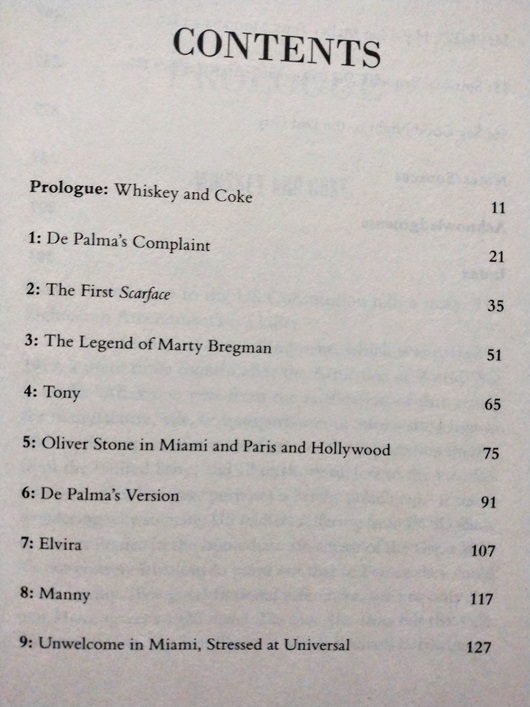
SCARFACE NATION
KEN TUCKER BOOK EXPLORES SCARFACE PHENOMENON
A terrific new book by Entertainment Weekly's Ken Tucker looks at the Brian De Palma-directed Scarface as "the ultimate gangster movie," and explores "how it changed America." Scarface Nation is the title of the almost-300-page paperback, which Tucker has been promoting since its release last week. Last Tuesday (November 11), Tucker posted on The Best American Poetry blog about "what it’s like to send a book out into the world," and finding that his local Barnes & Noble store is only stocking two copies. On Wednesday, New York Magazine's Boris Kachka posted an interview with Tucker in which he asked the author why the Scarface cast and crew was "so reluctant to discuss its influence?" Tucker, who says that Al Pacino would talk to him about any Pacino movie other than Scarface, replied:

I think their interpretation of its acceptance in pop culture is that it somehow tarnishes the movie and they can’t understand that it’s what keeps it alive. I think they really ought to loosen up and embrace it. They should own their Scarface.

Tucker echoes Pauline Kael's estimation of Orson Wells' Citizen Kane when he calls Scarface a "shallow masterpiece," but he differentiates the two films in his book's introduction. He writes:

No, what Scarface is, in a sense, is something bigger, more outsized than [whatever it is that makes Citizen Kane "great"]. [Scarface] is a great and shallow masterpiece of pop, a work of diverse mongrel artistry. It's all surface, but, boy, what Brian De Palma, Oliver Stone, and Al Pacino applied to that surface. It glows, it glistens, it retains its sheen of power, glory, and shimmeringly decadent rot a quarter century after its release. It remains a tremendously exciting and dismaying piece of moviemaking, unique in the careers of every one of its various creators.

As a film and as a pop culture phenomenon, Tucker appreciates Scarface very much, and his book takes a non-linear approach in exploring both the origins of De Palma's film and the unpredictable journey it has taken since it was released 25 years ago this month. Delving into the "disreputable and sneaky" way the film has and continues to seep into American culture (via posters, T-shirts, mansions, parties, etc.) Tucker concludes that "Scarface belongs to no single author, and therefore we are all free to be the auteurs of Tony Montana's saga, and his life everlasting."

TUCKER SAYS GOODNIGHT TO THE BAD GUY
I will write more about this book later this week, delving into some of Stone's thoughts on the film via a new interview for Tucker's book. At the end of Scarface Nation, Tucker acknowledges that he consulted the "superb" De Palma a la Mod, as well as Bill Fentum's "invaluable" (and unfortunately now defunct) website, briandepalma.net. Tucker was also able to get a few quotes from De Palma when he ran into the director during the 2005 Toronto Film Festival. Tucker closes his book with the following about that instance:

At that time, [De Palma] said he would sit down for a more extensive interview. He subsequently declined all my follow-up requests. I will refrain from using a Scarfacian imprecation regarding this behavior, and simply say goodnight to the bad guy.

I should also mention that throughout the book, Tucker displays a fondness for several of De Palma's films, especially The Fury, which he describes in loving detail as a way to delve into some of De Palma's stylistic themes. In this section, Tucker states, "The climax of The Fury is, in its way, just as bloody and tragic and 'operatic' as that of Scarface." However, as I loved Tucker's book overall, it pains me to say that he should have gone back and looked at The Fury more closely, because he gets certain significant facts about who was killing who and what actress was playing the one getting killed, etc., wrong. This leads Tucker to suggest inadvertantly that Gillian purposely killed a woman in a savage manner prior to meeting Robin, which simply is not true. But don't let that dissuade you from checking out this unique and otherwise well-informed book.

Also check out Michael Sragow's interview with Tucker.


Posted by Geoff at 1:38 PM CST
Updated: Saturday, November 22, 2008 5:22 PM CST
Post Comment | Permalink | Share This Post
Friday, August 29, 2008
BAUER & SALAZAR PACK SCARFACE SCREENING
IN MIAMI LAST FRIDAY
Steven Bauer and Angel Salazar, who both appeared in Brian De Palma's Scarface in 1983, hosted a packed screening of that film to mark its 25-year anniversary last Friday at Miami's Gusman Center for the Performing Arts. According to a report in the Miami Herald, the screening brought in about 800 fans of all ages. According to the report, Bauer shouted to the enthused crowd, "Feel free to yell out if you know the dialogue. Don't be shy!" Salazar and Bauer have remained friends througout the years. "After all this time, the cast is still pretty close," Salazar said with a wink, according to the Herald. "We still get together and talk about chain saws and machine guns." Bauer discussed the rough road Scarface had upon its initial release. "It's nice to see this kind of frenzy," the Cuban native said, according to the Herald. "For a long time we couldn't enjoy the success because there was a lot of backlash against the movie. The media really didn't take to it." The Herald article concludes with the following passage:

Zach Kosnitzky, formerly of the defunct CBS reality show Kid Nation, is a new fan. He's only 10. "I love Scarface!" joked Zach, dressed in a black zoot suit with an old school gangster fedora. "Just please don't tell my parents I'm here."


Posted by Geoff at 12:44 PM CDT
Updated: Friday, August 29, 2008 1:10 PM CDT
Post Comment | Permalink | Share This Post

Newer | Latest | Older