|
Places of Interest
Home Page
Thomastown
South Kilkenny
North Kilkenny
City
Graigenamanagh
Kells
Tullaherin
Tours by Car
Slide Show
|
TULLAHERIN & KILFANE
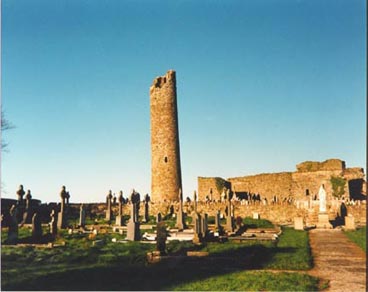
Tullaherin
Tullaherin
Tullaherin is an ecclesiastical site dedicated to Saint Kieran. The round tower at Tullaherin was most likely built by Cearbhall MacDunghal in the 9th century as a fortification against the Norseman. It is about 73 feet high and had seven storeys, although the upper storey is a later addition. The walls of the round tower are three feet thick. When repairing the round tower workmen found several walking sticks on top. These came from times past when young men in the area challenged each other to throw the sticks over the tower with on hand while resting the other hand against the wall of the tower. The church at Tullaherin is a 9th century building, which was added to in the 13th century. It was further rebuilt in 1616 to convert it for use by the local protestant population. Other features of historical interest at Tullaherin include two ogham stones and a marigold stone. Marigold stones date from pre-Christian or early Christian times and were used to mark burial sites.
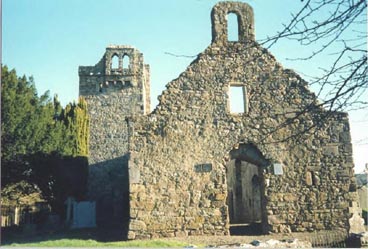
Kilfane Church
Kilfane
Two miles from Tullaherin lies Kilfane Church, founded by St. Paan around the time of St. Patrick. The present building and adjoining norman tower house dates from the 14th or 15th century. It features traces of the original consecration crosses (in red) on the wall near the West doorway and on the North and South walls; the three original ogee-headed doorways - two in the South wall and one in the North wall near the sacristy door. The most remarkable feature is undoubtly the world famous effigy of Cantwell Fada dating from mid-13th to early 14th century
Cantwell Fada is carved in high relief from a single slab of limestone. It is 951/2 inches high which makes it the tallest such effigy in Britain and Ireland.
Except for the face, the body is completely covered in a suit of chain mail. This was made of a mesh of individually riveted and overlapping metal links, up to 100,000 in a single suit. Mail was popular in the early period but went out of fashion in c1400 when it was replaced by plate armour.
The legs are crossed, the right over the left and this is thought to signify that the knight took part in the crusades. In the left hand is carried a large shield bearing the arms of the Cantwell family.
It is thought that the effigy may have been carved c1330 and that it represents one Thomas Cantwell who was said to be "worn out with age" in 1319. This is by no means certain and some authorities date the carving to a much earlier period.
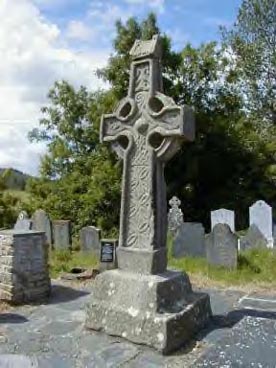 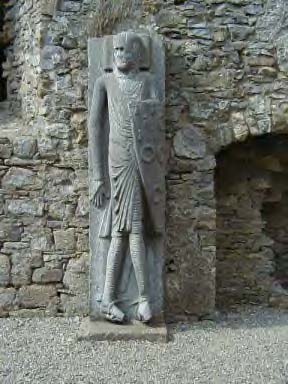
High Cross at Kilfane......Cantwell Fada
|

