
| |||||
| Wexford | Kilkenny | Waterford | Getting There | Tours | Gallery |
| Cork | Kerry | Clare | Tipperary | Galway | Mayo |
|
Places of Interest
Home Page
|
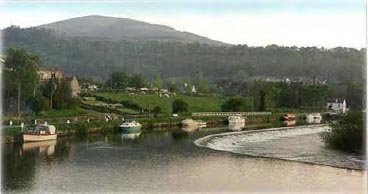 Greiguemanagh Graiguenamanagh-Tinnahinch straddles the River Barrow and the county border of Kilkenny and Carlow. While it is regarded as a single town, the bulk of the settlement is situated on the Kilkenny side of the picturesque bridge. Graiugenamanagh (or Graigue, as it’s called locally), is an ancient town, built around the famous Duiske Abbey, which is still at it’s centre. Duiske Abbey is a good example of an early Cistercian Abbey (A.D. 1204). It contains many fine Lancet windows and has a large effigy of a Norman Knight. In the nearby Abbey Centre there is an exhibition of contemporary Christian Art and local historic artifacts. The town retains it’s attractive medieval streetscape and character. The landscape surrounding Graigue, with the presence of the river and Brandon Hill looming to its south - is particularly scenic and dramatic, and offers considerable scope for outdoor pursuits on land and water.
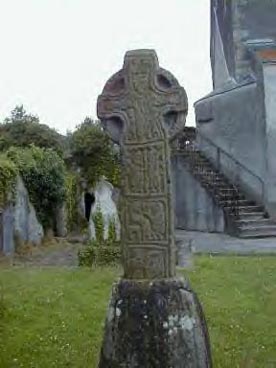 High Cross As early as 1180 an Irish Chief, Dermot O'Riain wished to build an abbey here for 'God, Saint Mary and Saint Benedict', in other words, a Benedictine Abbey. In 1166 the Normans, led by Strongbow, conquered Leinster and became landlords. Thus shattering his plans. William, the Earl Marshall, was the second richest man in England and he was a great benefactor of the Cistercian Order there. He wanted to build an abbey in Ireland. When he died his friend Philip de Prendergast knew about this desire and the Cistercian Order granted him permission to build one provided certain conditions were met. Several sites were investigated and finally in 1204 the site for the abbey was chosen at Bun Dubhuisce. In 1204 after a wooden cross was erected, the first tree was felled and the first sod was cut to excavate the site for Saint Saviour's Cistercian Abbey, Graignamanagh. The team of monks who built the abbey lived one mile west of the present site, where some monks also farmed. This was at Old Grange. Here McMurrough had begun to build a church but it was never finished, so the monks roofed it over and erected more farm buildings to accommodate their needs. These three centres were the economic units from which Duiske Abbey rose and because of their farming enterprises, they were called Granges. Grange comes from the Latin word 'Grangii' meaning barn; hence they had Annamult Grange, Cuffes Grange (also called Grange Castri) and Old Grange. In the 1970s the locals began restoring the church and it is now used by the local parish. Although the present floor level is about 2m above that of the original. In the baptistry, just off the S aisle, there is a very fine doorway of 13th century date, and the effigy of a knight of similar date is preserved in the church. In the graveyard there are two crosses. Figured scenes on the north cross include David, the Sacrifice of Isaac and the Fall of Man. The cross has a solid ring and is about 2.3m high with a high base. The south cross, which is about 2m high, also has a solid ring and is carved with a Crucifixion and panels of interlace. |
