|
Places of Interest
Home Page
Tramore
Dunmore
Ardmore
Waterford City
Commeragh Mts
East Waterford
Lismore
Tours by Car
Slide Show
|
City and County
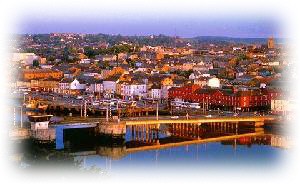
Waterford City
Waterford stretches 82km east to west and 44km north to south. It has the reputation for being the sunniest county in Ireland. Given our overall reputation for how much rain we have – one would think that tourists in their droves would be donning sunglasses and lotion and waving fans on the many beaches that dot our coasts. Not so. Waterford still maintains its rural and peaceful charm. It is still possible to find an isolated cove or a lonely mountain path to absorb and indulge in some life’s rare treasures – beauty, peace and tranquility. County Waterford, on the south coast, combines many kinds of beauty in its scenery. Much of the north and center of the county is mountainous, including the Commeragh range (they rise 2,600 feet above sea level) with its deep lake corries; the rest consists mainly of gentle hills and valleys. The coastline is a series of rugged headlands, cliffs and sand-fringed bays; Tramore is probably the best known. One of the many surprises visitors often get when visiting our beaches and coastal villages, is the abundance of palm trees. This together with the brightly coloured houses and buildings often give off an almost subtropical appearance. The river suir flows along the north and east of the county. The Blackwater river valley in the west of the county, with its flanking hills and numerous wooded stretches, provides the finest river scenery in Ireland. The River Blackwater rises in County Kerry and flows eastwards through Cork and Waterford, turning southwards at Cappoquin to flow in Youghal Bay by a narrow estuary 15 miles long.
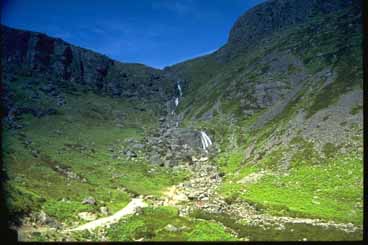
Commeragh Mountains Waterford
Waterford was probably one of the original settlements in Ireland by the original pre-Celtic nomads who came across the then-short channel from Europe. The route taken by most likely by the land bridge that once existed from Scotland to Ireland. It has been proven that these settlers arrived in Waterford some 9,000 years ago. These were Mesolithic in culture and survived by hunting, gathering and fishing. After these came the Celts, the Vikings and the Normans. And some say that many a ship came ashore that held visitors/invaders from Spain, Morocco and Algeria. Indeed there have been many ships sunk off the coast and from time to time one can see Spanish bullions or Peruvian silver surface into divers hands. Waterford has deep and safe harbours and today Dunmore East along with Killybegs in Donegal ranks as one of the top fishing destinations in Ireland. Historically Waterford is rich in the wealth of its surviving historical evidence. There are 16 megalithic tombs, ten portal tombs (or dolmens) five passage tombs and one court tomb. Some 4,500 years ago the first people that used metal settled here. They brought the stone, box like structures tapering to one end, known as wedge tombs. They also had cist burials in stone lined pits, tumulus burials and barrows. The celts ( the warrior aristocracy!!!) settled here. They built defense fortifications in the hills and on promontories over looking the sea. These promonotories are known as forts. Waterford contains two hill forts and over twenty promontory forts. More common are the lightly defended iron age farmsteads known as raths, fairy forts or lio's. These were usually circular enclosures, frequently tree covered, about fifty metres in diameter. Waterford suffered considerably in the years of the Great Famine, 1845-47. Between 1841 and 1851 the population of County Waterford fell twenty percent, from 196,000 to 164.000. Approximately 25,000 people died in County Waterford during the Famine years, with the rest emigrating to cities or abroad. Between 1851 and 1855 alone over 28,000 people emigrated from County Waterford, and the population continued to decline through emigration during the remainder of the 19th century. The population today is approximately 89,000.
HISTORIC AND PREHISTORIC SITES.
Knockboy Ogham Stones, Harrison Megalithic Tomb, Gallowshill Mound, Promontory Forts
Mothel Abbey, Ardmore Round Tower & Cathedral, Molana Abbey (12th c.), Mount Mellary Abbey, Waterford Castle, Geneva Barracks, Dunmore East Castle, 19th century navigation towers, Dromana Gate, Ballyduff Castle, Ormond Castle & Manor House, (16th c.) and Old Carrick Bridge. Reginals Tower, Knockeen Dolmen. Kilbrien Stone Circle. City walls in Waterford.
HOUSES AND GARDENS
Tourin House & Gardens, Curraghmore Estate, Portlaw, Cappoquin House & Gardens, Dromana House & Gardens, Lismore Castle Gardens, Mount Congreve Gardens, Glenleigh Gardens, Clogheen.
VISITOR CENTER AND MUSEUMS.
Waterford Treasures at the Granary, Waterford Crystal Visitor Centre, Lismore Heritage Centre, Dungarvan Museum, Tipperary South Riding County Museum, Reginals Tower Museum.
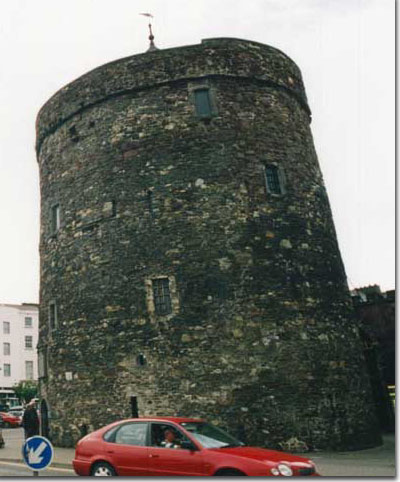
Reginals Tower Waterford City
|

