
| |||||
| Wexford | Kilkenny | Waterford | Getting There | Tours | Gallery |
| Cork | Kerry | Clare | Tipperary | Galway | Mayo |
|
Places of Interest
Home Page
|
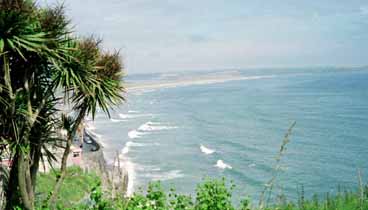 Tramore Bay
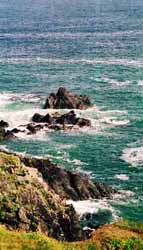 Newtown Cove One of the great seaside resorts of the Atlantic coast. Tramore brings thousands to its golden beach annually. The golden sands stretch for 5Km (3miles) with cliffs on the western end and dunes on the eastern end. These are home to a variety of wild life. At the end of the dunes is a channel called Rinna shark. This is the entrance to the Back strand, a 3000 acre area which floods at high time. These marsh lands are also home to a variety of wildlife and shellfishes. As of yet most of this area is unspoiled by commercial activities.
There are several small beaches and coves nearby that are a haven for those seeking the isolation and quietness that they crave. Rarely if ever will you find anyone but true locals on these beaches. Names like Kilfarrsey, Garris, Bunmahon, Boatstrand, Annestown, etc all familiar to the local population. Kilfarrsey is the largest of these beaches. But Garris is one of my favourites. Small and sheltered on three sides by high cliffs, you can seek shelter in some of the many caves that are creviced in these ancient cliffs. The mighty surf pounds against the rocks in front of you. A winter sunset over Garris is an awesome sight. 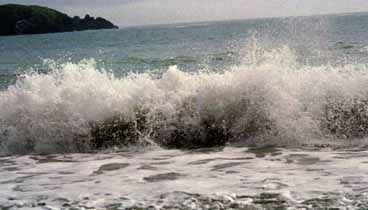 Garris In 1853 construction of the Waterford Tramore railway began. On the 6th of September of that year the first train ran. Trains ran right up to the late 1950s. Today little remains of the railway, Tramore Failte's offices are based in the Tramore Stationhouse. Visible from the beach you can to the west see the Metal Man. This is one of Tramores most famous landmarks. This is a statue of 4.5 meters (14ft) on top of a 15 metre (50foot) pilar at Grea t Newtown Head. Brownstown head at the east of Tramore bay and Great Newtown Head at the west were the scene of many shipwrecks. Marinars mistook the headlands for the entrance to Waterford Harbour and upon entering the shallow waters were almost always lost their ships. It was decided to built 2 pilarson Brownstown head and 3 pilars on Great Newtown head with the Metalman atop the middle pillar so as to avoid confusion with the light house at Hookhead on the Waterford estuary.The other striking feature of Tramore is its Catholic church. It was built on the instructions of the Rev. Nicholas Cantwell. It stands almost 30 meters(100ft) to the top of the spire at the highest point of the town and can be seen from parts of Waterford city 10Km (6 miles) away. The town is an attractive location that has brought people from all over Ireland to live there. Tramore was adjacent to intense pre-historic activity two to four thousand years before Christ. There are chamber tombs, portal dolmens passage graves and promontory forts and castles in the area all proof that people were here, but the used a language that we cannot understand. Take time to explore some of these ancient sites. Knockeen and Gaulstown dolmens and the passage grave at Matthewstown are good examples of this period. Aproximately 2 miles from Tramore is a Village called Fenor. This village is part of the Neolithic complex. In later years Fenor became the stronghold of the Powers. Their castle is at Dunhill, about 1 mile away. In Fenor you can find the Neolithic chamber tomb with an earth-fast capstone. In later years churches were built in Dunhill and Fenor by Terence Doolin. So what ever you choose to do in Tramore there is plenty for you to enjoy. For the active enthusiast you can hire surf boards (and take lessons), go wind surfing, horse riding, or just play it safe and stick to a nice run. If you prefer to be active on a more passive level, you can join the numerous people who walk the beach to the Back Strand. |
