
| |||||
| Wexford | Kilkenny | Waterford | Getting There | Tours | Gallery |
| Cork | Kerry | Clare | Tipperary | Galway | Mayo |
|
Places of Interest
Home Page
|
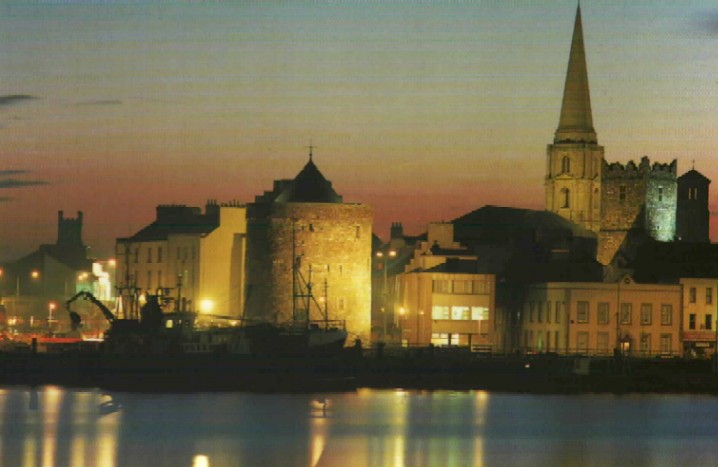 Waterford City
Waterford is the main city in the South East of Ireland. Like most Irish cities it is build on a river. The River Suir rises in Tipperary and combines with the Rivers Nore and Barrow before flowing into the Atlantic. The origins of Waterford in theory go back to prehistoric times. But no real concrete evidence has been discovered to support this theory. We can with certainity say that it was occupied and fortified by Sitric the Dane in 850AD. The name Waterford comes from the Viking "Vedra Fjord", which means "Weather Fjord". This presumably meant good or fair weather, or possibly a refuge in times of bad weather. Old Irish names are Loch Da Chaoch - Lake of the Two Blind Ones, or possibly Lake of the Two Breasts, a reference to two hills north of the city, framing the mouth of the harbour from the sea; and Port Lairge, the Port of the Hindquarters, a reference to the Tain Bo Cualainge. At the end of this 2000 year old epic, the Brown Bull, having impaled and killed the White Bull on his horns, shakes and scatters the carcase across Ireland, the hindquarters landing in Waterford (The ribcage landed in Dublin, resulting in the Irish name Baile Atha Cliath - Town Of the Ford of the Ribcage, according to one translation.). As a principal town there is a lot to see and do in Waterford. It is home to the world famous Waterford Crystal factory. The factory is located on the Waterford Industrial Estate on the Cork Road. And offers tours several times a week. The entrance boosts a magnificent chandelier. So even if you don’t go on the tour you can see several spectacular pieces of work in the main room. The city was once fortified by walls. These walls and towers can still be seen in several areas of the city. The traditional bar of T&H Doolans in Georges St, the Reginald Bar on the Quay, all incorporate part of the original city walls in their structures. Externally exposed walls and towers can be seen on the Mall. And of course there is the complete and intact Reginalds tower on the corner of the Quay and Mall. Other places of interest in the city are Cathedral Square, Christchurch cathedral, the Grannery market and just wandering along the old streets.
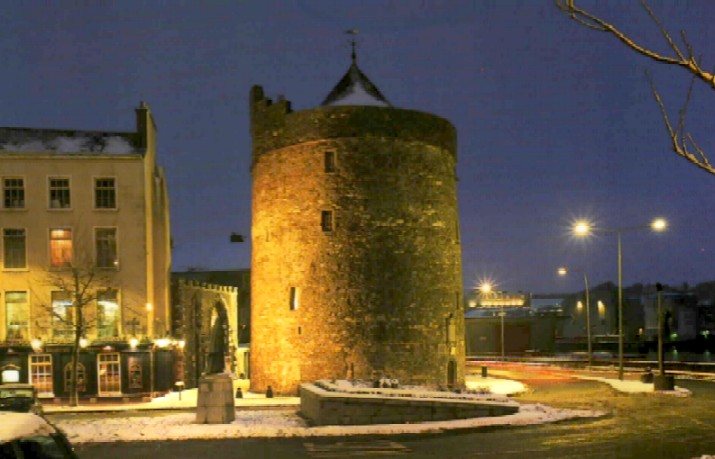 Reginals Tower Reginals Tower is 54 feet high and is circular in design. It si 42 feet in diameter. It is part of the original fortifications of the old Danish city founded by Satric. It is also the oldest civic building in Ireland. When the city fell to the Normans in 1170 A.D .the tower was occupied by Strongbow who used it as a prison. It was here that the last Viking king of the city was executed. Prince John established a mint here in 1185 and there are numerous coins extant from the tower's use as a mint. In 1463 coins were minted here, by order of the Irish Parliament then meeting in the city, with the words Civitas Waterford struck on one side. Subsequently the tower saw service as a military stores and a lock-up and later still as the residence of the city High Constable. Currently it is a museum.
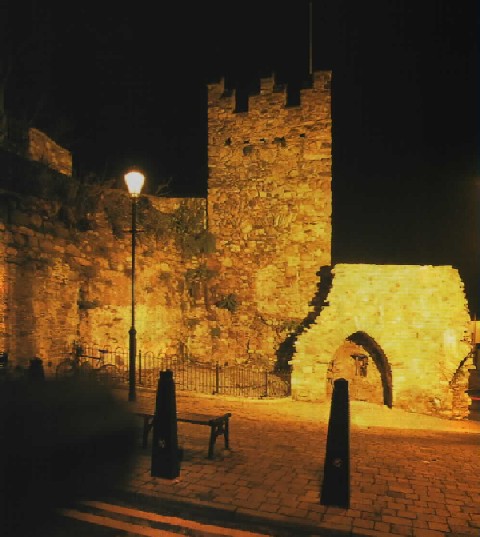 The walls of Waterford The Danish colony founded in 853AD was triangular in shape. It consisted of 15 acres. The walls extended from Reginalds tower to St. martins castle to Turgesius Tower and back along the river front to Reginalds tower again. Substantial remains of the wall in the 500 metre stretch between Reginald's Tower and St. Martin's Castle still exist. The construction of the City Hall and the opening of Colbeck Street intercerpts the wall. These traces may be observed between the houses of the Mall and Bailey's New Street and, further up, between Spring Garden Alley and Lady Lane, about 12 metres back from the northern frontage of the former. There are very limited traces of the wall linking St Martins castle with Turgesius Tower. The wall that ran along the Quay has completely disappeared. It was demolished in the most part by the Cromwellian occupants. Wander up Bailey's New St just behind the tower and you'll immediately come to Waterford's other important medieval building, the ruined French Church, or Greyfriars. Founded by Franciscans in 1240, it was used as a place of worship by French Huguenot refugees from 1693 to 1815. Nearby is the City Heritage Centre, a showcase for recently excavated Viking and Norman artifacts of outstanding quality and design.
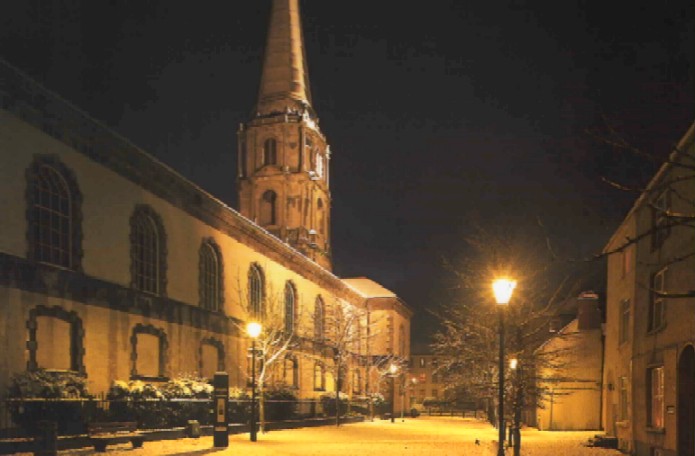 Catherdral Square There has been a cathedral in Waterford since Noramn times. After the Reformation, the old Christchurch Cathedral passed forever from Catholic hands. Twice it was repossessed: the Catholics occupied it for a few days when news reached the city of Elizabeth's death and for six years, during the days of the Confederation of Kilkenny. But, when the Confederation collapsed in 1649 the Catholics never again possessed the cathedral. The catholics went another 150 years without a cathedral. For the next century and a half there was no Cathedral for the Catholics. With the restoration of the monarchy in England the catholics rented a small building as a Mass house. This store was in Barronstrand street, behind the now Granville Hotel and directly opposite the present Cathedral. This lasted as a Mass-house until 1693 when the Corporation (Protestant) allowed the Catholics to erect a simple chapel - provided it would be “inconspicuous and not offensive” to the Protestants. The site given was more or less the same site where the present Cathedral stands but behind the houses on Barronstrand street - Catholics were not allowed to have a street frontage for their chapels. The entrance to this chapel was by way of a laneway leading from Keyser's street. Waterford's Catholics worshipped in this chapel for a hundred years and it must be remembered that this century was the century of the Penal Laws against Catholics. Masses were celebrated very early in the morning (around 5.00am) so as not to cause offence to Protestants on their way to their own churches and the chapel was closed when Mass was not taking place. The catholics were living on such a tight rope with the prodestants that any slight offense would cause the concession of their chapel to be reprieved.
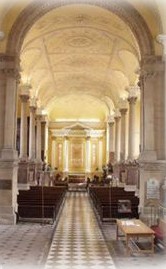 Catherdral
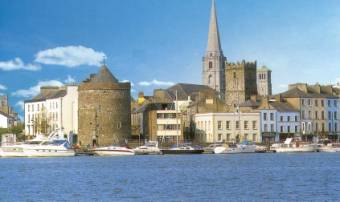 Waterford |
