
| |||||
| Wexford | Kilkenny | Waterford | Getting There | Tours | Gallery |
| Cork | Kerry | Clare | Tipperary | Galway | Mayo |
|
Places of Interest
Home Page
|
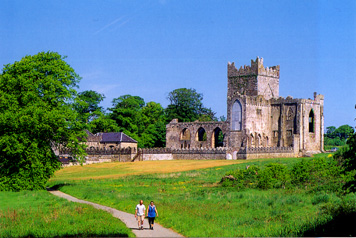 New Ross The Colclough family extensively modified the abbey church, converting the crossing tower and later, the nave, chancel and Lady Chapel to domestic quarters. In the 18th century Sir Vesey Colclough built many of the fine battlemented walls seen around the abbey today. In the 1790s, John Colclough converted the nave into a residence of neo-Gothic style. He also established a flour mill, the ruins of which stand on the south bank of the stream close to the upper bridge. At this period also, a thriving weaving industry had developed in Tintern village, located across the stream south-west of the abbey Following John's death, his brother Caesar inherited the estate and shortly after 1814 built the village of Saltmills to replace the old village of Tintern which was then demolished. The final member of the Colclough family to reside at Tintern was Lucy Marie Biddulph Colclough who left in 1959, a few years before the abbey was taken into Government care. Conservation and consolidation works started at Tintern in the early 1980s and archeological excavations between 1982 and 1994 exposed many of the features of the original Cistercian abbey. Constructed to the standard Cistercian plan, the abbey church was located to the north of an enclosed cloister garth which was surrounded on all sides by covered walks and a sequence of domestic buildings.
|
