 |
MOOK YUN JONG |
|
||||
CONTENTS |
INTRODUCTION
|
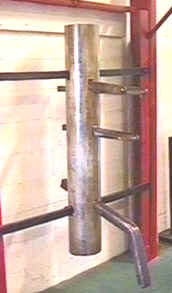
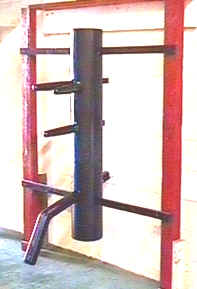
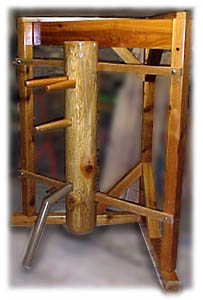
| However, the more usual support for the dummy is a wall mounted frame, using either a wooden frame or motor car/bus/coach suspension springs. The dummy should be set up with the two upper arms at your own shoulder height, and the leg should touch the floor in order to teach how to step around obstacles and not lazily pass the feet under. Many practitioners make an inordinate fuss over the leg having to have a knee, but the bend at knee height is of more importance. One should note the height of the knee joint from one individual to another varies very little in comparison to the total height of the person, as height is primarily made up in the femur or thigh bone. |
|
 |
'Chi Jong' refers to 'sticking' with the dummy and has the aim of simulating sticking with an opponent. It also emphasises that even when one has to break this is to be performed as economically as possible. The practitioner uses the dummy to correct angles in application in order to correct position when applying techniques. The upper arms are angled away from the trunk and as such will 'push' a trainee off balance if he attempts to force from poor angles, much as an opponent may do in a confrontation. |
| The correct use of strength also emphasised on the dummy. Most Wing Chun students will accept that it will not always be possible to be bigger, heavier, stronger or more aggressive than an opponent, and as such enormous disadvantages could result. But with the correct use of power some of these potential imbalances can be overcome. A framed dummy allows the trainee to use explosive power and to literally 'bounce' the dummy using a spring like action. This type of strength is very hard to combat in a fight and results in an ability to use the opponents strength to your advantage, and to withstand heavy onslaughts from a pressing opponent. |
 |
|
|
The form is divided into eight sections but the order is not as important as the application in each section. In fact the form is for artistic posterity and holds the syllabus of a large part of the style, the use of this syllabus is of more importance to any serious student than the sequence. There is also a dummy drill form based on the basic form in which many application are changed slightly in order that the repetition is of more direct advantage. However, like any art, fluidity is the mark of genuine ability and eventually one would and does work 'formless' but extolling and demonstrating the virtues of considerable technical and theoretical skill. |
| The dummy is made of hardwood and as such the practitioner will never 'beat' the dummy in a strength test. If a practitioner insists on conditioning their arms by hitting the dummy then they miss the correct use of this piece of equipment. 'Pak Jong' is the term often used as an expression to describe the way in which a poor practitioner of Wing Chun slaps the dummy about. |  |
There are many complex movements where both hands are used simultaneously but this is not used as one may expect in order to block and cover a large area as no student, at this stage, is so poorly coordinated that they can not judge if a punch is high or mid level. These techniques are representative of complex shapes used time and again in chi sau or sticking hands to offset a potential advantage an opponent may have, such as balancing out a dangerous double inside gate trap. Again, along a similar line, one often sees photos of teachers showing combination, block kick and punch techniques posed as if they would be applied in a coordinated way in a fight but this is simply ridiculous and beyond all expectation that such a situation will arise or can be created at will. Some Wing Chun students still argue that there are 116 instead of 108 moves. All they are counting are the 8 tok sau that complete each section on top of the 108. Again it is not the numbers that are important unless you live by the Pa Kua or I Ching where the number 108 has a symbolic or superstitious relevance. What really concerns a Wing Chun practitioner is application, application and more application. Artistic skill will develop fighting skill. With diligent practice and a skilled/experienced Sifu you will be a proficient fighter whilst maintaining the ability to hold the art under pressure, and be considered a martial artist, not just a fighter. With thorough understanding and ability on this training aid, students have to perform the 108 dummy form and the drill form. Only Sifu Mark Phillips, Sifu Eric Wilson AND Sifu Bobby Beach have, to date, passed this artistic challenge. Key Benefits
|
|
| ©2002 Kev's Martial Art Website | Movie Clips • Martial Arts • Pictures • Links • Forum • Back to top |

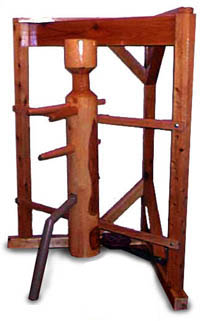
 It
is a peculiar item made from hardwood and traditionally mounted in a hole
in the ground with approx. 1" movement in all directions to allow the
dummy to absorb the blow and not damage the practitioner. The wood is usually
teak or some other heavy 'oily' wood as it will not split and crack due to
drying.
It
is a peculiar item made from hardwood and traditionally mounted in a hole
in the ground with approx. 1" movement in all directions to allow the
dummy to absorb the blow and not damage the practitioner. The wood is usually
teak or some other heavy 'oily' wood as it will not split and crack due to
drying.