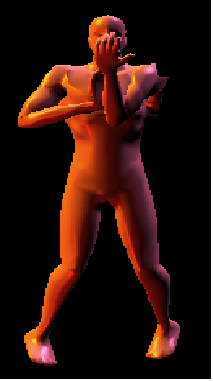
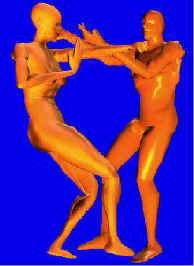
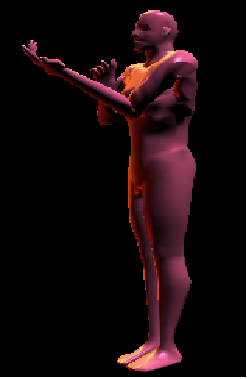
I can use tan da to intercept. I can also use it to draw the opponent
in and over extend them. The key is in the timing. If the opponent's punch
is almost extended, then you will be receiving the full brunt of their
force and momentum on your tan sau. If you can intercept their punch BEFORE
it reaches full extension, their power has not fully released yet and the
tan sau structure can jam and uproot them. The larger the person punching,
the better your timing has to be to put yourself in the best position because
you are dealing with more force. The tan, when used properly, is not force
on force, but rather it is force applied at a particular angle in relation
to the incoming force. When I intercept, I don't wait for the opponent,
I go out with my structure and intention and arrive at where they are going
before they get there. They cannot occupy the center if I am already there.
Similarly I can also use the tan to withdraw and overextend the punch. This requires
a different timing upon entry and I need to feel what my opponent is doing and
if he changes to something else.
I have also used the level tan when in close and the point of contact has moved
up the arm away from the wrist and closer to the elbow. It gives good leverage
to uproot someone when combined with structure and the horse to drive it.
There are lots of uses to the tan. How many ways can I 'disperse/spread' their
energy?
1. I can step in and deflect their energy to the side
2. I can stay and shift to change the centerline
3. I can step in and use it to uproot them
4. I can withdraw the tan and overextend them
5. I can use it to sink them
6. I can strike with it
7. I can throw with it
8. I can use it to transition to something else
9. I can use it to guide the energy in the direction it is going already
10. Etc…
The energy I feel can be different in each of these cases each particular time.
I need to find out the best physical position in response to this feeling.
Just my opinion.
About the Author
Dzu Nguyen is a practitioner of Robert Chu's (Chu Sau-Lei) Wing Chun Kuen. He
studies and lives in California. |