1830 Preface
1830 Preface continued
1830 Title Page
|
1830 Preface continued
1830 Title Page
|
Online — John Foxe's Book of Martyrs, 1563, 1570, 1576, 1583 Note the images on each Title Page: “The Image of the persecuted Church. { } The Image of the persecuting Church.” (Beware of “Modern Commentary”, “Critical apparatus” and additional material.) See also: ACTES AND MONVMENTS, John Foxe, 1610 Edition — VOLUME 1, VOLUME 2 THE ACTS AND MONUMENTS, John Foxe, G. Townsend, Vol. 1, 1837 THE ACTS AND MONUMENTS, John Foxe, G. Townsend, Vol. 2, 1837 THE ACTS AND MONUMENTS, John Foxe, G. Townsend, Vol. 3, 1837 THE ACTS AND MONUMENTS, John Foxe, G. Townsend, Vol. 4, 1837 THE ACTS AND MONUMENTS, John Foxe, G. Townsend, Vol. 5, 1837 THE ACTS AND MONUMENTS, John Foxe, G. Townsend, Vol. 6, 1837 THE ACTS AND MONUMENTS, John Foxe, G. Townsend, Vol. 7, 1837 THE ACTS AND MONUMENTS, John Foxe, G. Townsend, Vol. 8, 1837 |
Foxe Original 1570 Title Page! Note images on the Title Page! |
If you think that the information above was relevant only to the distant past, you will be surprised to learn the truth. Most of the gruesome history of the Roman Catholic church in the 20th century has been suppressed and or re-written, and as a result most readers in the 21st century know little or nothing of true Catholicism. The Satanic cruelties inflicted on God's people during the Dark Ages and during the Reformation era is a history that is poorly researched by most modern-day historians. For a period of more than 600 years some 50 million people, including many Bible believing Christians, were persecuted, tortured and murdered as a direct result of the official policies of the ‘Holy Mother Church’, the Roman Catholic church.
Pope Innocent III first instituted the office of the inquisition, which was also officially sanctioned by dozens of subsequent popes — Gregory IX in 1233, Clement VII in 1380, Leo X in 1531, et al. Catholic Popes also authorized the Crusades or so called “Holy Wars” (1095-1272), the French Wars of Religion (1562-98), and the Thirty Years' War (1618-48), a series of wars fought against Bible believing Christians and others who opposed papal supremacy. One Church historian writes:
“The extent of the destruction of life through the Thirty Years' War cannot be estimated. If we take into account the multitudes who died of starvation and exposure, the hundreds of thousands of women and children who were slain in the sacking and destroying of the towns and cities, the fearful waste of life that must have been involved in camp-following, the deaths caused by the war would amount to many millions. In Bohemia, at the beginning of the war, there was a population of two million, of whom about eight-tenths were Protestant; at the close of the war there were about eight hundred thousand Catholics and no Protestants.” (Church History, Newman, 2:392-93).
“When called on the carpet to account for these atrocities, Catholic apologists will invariably take cover behind such rhetoric as, "the spirit of the times," or "the unfortunate acts of an unenlightened age," etc. That this is pure nonsense can be easily confirmed by a survey of Catholic bloodletting in the twentieth century. Reference works such as The Vatican's Holocaust by Avro Manhattan and Convert or Die! by Edmond Paris present the documented facts that the Catholic church liquidated over 800,000 orthodox Serbians in Croatia, Yugoslavia, during the years 1940-1945.
The next time some bigoted Catholic tries to dismiss his murderous heritage as a "thing of the past," ask him to explain: 250 peasants buried alive in the Serbian district of Bjelovar; 2,000 children gassed in the death camp at Bosanska Gradiska; a father and son crucified together and then burned in their own home in Mliniste; mothers and children (as young as three) impaled on the same stake in Gorevac; a mother forced to hold the basin which caught the blood of her four sons as their throats were slit in Kosinj; an expectant mother having her unborn child cut out of her womb and replaced by a cat in the death camp at Jasenovac; 1,360 prisoners having their throats cut in a single night by one guard during a sadistic throat-cutting contest (also at Jasenovac); not to mention dismemberments; beheadings; crowns of thorns; "graviso" knives for specialized throat cutting; necklaces of human tongues and eyes; the confining of prisoners to rooms filled with blood to the ankles; and ten thousand other atrocities condoned by the Roman Catholic Archbishop Aloysius Stepinac who prayed at the opening of the Croatian Parliament in February of 1942, for "...the Holy Ghost to descend upon the sharp knives of the Ustashi (Catholic guerrilla army).” (Final Authority, pp. 193,194).
Historian Edmond Paris wrote, “It is difficult for the world to believe that a whole people could be doomed to extermination by a government and religious hierarchy of the twentieth century, just because it happened to belong to another ethnical and racial group and had inherited the Christianity of Byzantium rather than that of Rome.” (Convert Or Die, Edmond Paris).
In the 20th century successive Popes made open pacts with both Mussolini and Hitler (see Lateran Treaty with Mussolini, and the Reichskonkordat with Hitler). Some Roman Catholics claim that Adolf Hitler was an atheist. However, Hitler's own words reveal otherwise. Hitler said, “I am now as before a Catholic and will always remain so.” (Adolf Hitler, from John Toland [Pulitzer Prize winner], Adolf Hitler, New York: Anchor Publishing, 1992, p. 507). According to a memorandum in the documents of the United States Army's Counter Intelligence Corps, agents hunting escaped Nazi war criminals after WW2 purposely avoided capturing Roman Catholic dictator Ante Pavelic because “his contacts are so high and his present position so compromising to the Vatican, that any extradiction of the subject would deal a staggering blow to the Roman Catholic Church.” (U.S. Army Counter Intelligence Corps, 12 September 1947) (See The Catholic Church Helped Nazi War Criminals Escape: History Channel Documentary).
The hierarchy of the church of Rome has done its best to conceal these disturbing facts and re-write its own history. In 1534 the Jesuit Society, a Catholic organization, was established in Paris, France for the propagation of Catholic dogma and for the subversion of non-Catholic countries. In 1807 the Society was established in the United States. In May of 1816 John Adams wrote to Thomas Jefferson stating, “I do not like the late Resurrection of the Jesuits. They have a General, now in Russia, in correspondence with jesuits in the U.S. who are more numerous than everybody knows. Shall We not have Swarms of them here? In as many shapes and disguises as ever.... In the shape of printers, Editors, Writers, School masters, etc.” (The Writings of Thomas Jefferson, Vol. XV, 1905, p. 17). On August 1st Jefferson replied: “I dislike, with you, their restoration, because it marks a retrograde step from light towards darkness.” (The Writings of Thomas Jefferson, Vol. XV, 1905, p. 58; The Writings of Thomas Jefferson, Vol. VII, 1857, p. 27. The 1904 edition of Webster's Universal Dictionary says: “The power of the organization lies largely in its close scrutiny into affairs, its secret methods.... For the means it has sometimes employed to accomplish its purposes in statecraft it has been condemned as unscrupulous in intrigue and deceptive in purpose, tending to the subversion of legitimate government.” (Webster's Universal Dictionary, 1904, p. 907). Historian Edmond Paris commented on this secretive order: “It is the same today; the 30,000 official members of the Society operate all over the world in the capacity of her personnel, officers of a truly secret army containing in its ranks heads of political parties, high ranking officials, generals, magistrates, physicians, Faculty professors, etc., all of them striving to bring about, in their own sphere,“l'Opus dei”, God's work, in reality the plans of the papacy.” (Secret History, Paris, pp. 27,30).
Roman Catholic historian John Acton, while speaking on the subject of the power of the Popes, said that “Power tends to corrupt, and absolute power corrupts absolutely.” (Life and Letters of Mandell Creighton, 1913, p. 372). John Acton, commonly known as Lord Acton, wrote extensively about the history of the Inquisition and the Catholic church. Acton said, “The Inquisition is peculiarly the weapon and peculiarly the work of the popes. It stands out from all those things in which they co-operated, followed or assented as the distinctive feature of papal Rome. It was set up, renewed and perfected by a long series of acts emanating from the supreme authority in the Church. No other institution, no doctrine, no ceremony is so distinctly the individual creation of the papacy, except the dispensing power. It is the principal thing with which the papacy is identified, and by which it must be judged. The principal of the Inquisition is the Pope's sovereign power over life and death. Whosoever disobeys him should be tried and tortured and burnt. If that cannot be done, formalities may be dispensed with, and the culprit may be killed like an outlaw. That is to say, the principal of the Inquisition is murderous, and a man's opinion of the papacy is regulated and determined by his opinion of religious assassination.” (Letters to Mary Gladstone by Lord Acton, 1904, pp. 185, 186)
Speaking of the papacy's desire to suppress information, John Acton wrote: “The Council instituted the index of prohibited books, which is the fourth article in the machinery of resistance.... A German divine warned the Pope that if the fathers of Trent were allowed to read Lutheran books they would become Lutherans themselves, and such writings were accordingly forbidden even to cardinals and archbishops. The idea of drawing up a comprehensive list of all that no man should read commended itself to the zeal of Caraffa, having been suggested to him by Della Casa, who had published such a list at Venice.... A congregation was appointed to examine new publications, to issue decrees against them as required, and to make out catalogues from time to time of works so condemned. Besides this, censures were also pronounced by the Pope himself, the Inquisition, the Master of the Sacred Palace, and the Secretary of the Index, separately. In this way an attempt was made to control what people read, committing to oblivion the works of Protestant scholars, and of such men as Machiavelli, and correcting offensive texts, especially historians. Several such corrected editions were published at the time, and many things were reprinted with large omissions.” (Lectures on Modern History, ed. John Neville Figgis and Reginald Vere Laurence, London: Macmillan, 1906, pp. 119, 120).
Commenting on the Catholic immigration to America in the seventeenth century, Author Thomas E. Watson wrote:
“The refusal of [Lord] Baltimore and his Catholic colonists to forswear [reject] the Pope's asserted authority to dispose of crowns, kill kings and other rulers, and to change civil governments, throws a vivid light upon the hypocrisy of American priests of today, who are gulling and lulling the people by saying that Popes have never claimed such rights.
The truth is, that Pope Pius IX. reasserted that right in the syllabus of 1864, and it is the law of the Roman church, as it has been since the Dark Ages.
Lord Baltimore wanted to leave England, and take away as many Catholics as possible, for this reason: the country was getting too hot to hold them.
Puritanism had grown so strong, and resentment against recent Catholic atrocities was so intense, that no Romanist was safe, unless he swore allegiance to the crown.
This oath made him say that the Pope had no temporal power over the King, and none over the realm. Catholics were not willing to swear that: they believed then—as they believe now—that the Italian Pope is supreme ruler of earth, temporal and spiritual. No matter how many lies the priests now tell and publish, that is the orthodox Roman Catholic belief.” (Political and Economic Handbook, T. E. Watson, 1916, p. 4)
To this day the hierarchy of the Roman Catholic church believe that the Italian Pope is supreme ruler of earth, temporal and spiritual. And in much the same way that modern-day Muslims practice a watered-down version of Islam in civilized countries today, many modern-day Catholics in the United States today practice a watered-down version of Catholicism, and not the historical Catholicism that dominated the Roman Catholic church for over a thousand years. Watson continues:
“Baltimore's charter provided for religious freedom? Oh, yes: the Catholics needed it. They were settling among heretical hornets, and they didn't want to get stung. Within a few decades after these Catholics who, needing toleration, tolerated, their brethren in Ireland, not needing toleration, planned a general massacre of all Protestants, slaughtered thousands, and came near to success in their hellish design to extirpate heresy—as per the oath of every cardinal, every bishop, and every priest.
When religious freedom was established in Maryland, by American law, the Protestants did it; and, at that time, the Catholics were only one-fourth of the population.” (Political and Economic Handbook, T. E. Watson, 1916, p. 4) (See also The Home and Foreign Record of The Free Church of Scotland, 1854, Committee on Popery, p. 302)
Most of what is published today as authoritative scholarly research is nothing but propaganda. Modern-day scholarship has joined hands with the Vatican to present to the world a revised account of history. Don't be misled. Do your own research. There are many good sources available today to help the honest scholar and researcher prove the validity of the claims made here today.
The mock apologies made by pope John Paul II in 1998 and 2000 were quite pathetic, not to mention an insulting slap in the face to any intelligent person. The Catholic apologies:
are made on behalf of some unidentified members of the church, but not on behalf of the church itself;
they fail to identify exactly which past atrocity is being referred to;
they do not include any mention of present behavior that is sinful or deficient;
and they do not describe any plan to prevent the recurrence in the future of past crimes against humanity.
For a church that was supposedly created by Christ and is supposedly maintained by God to be free of error, in the past, present, and future, the Vatican's apologies should cause even Roman Catholics to wonder whether the church, which they have entrusted with the salvation of their eternal souls, is currently engaged in sinful behavior that will require some future pope to apologize for sins committed by the church leadership of today.
It is obvious why “holy mother” church does not want its members to search Libraries shelves and surf the Internet for information. The Catholic church discourage their followers from researching facts for themselves for the same reason followers of the Jehovah's Witness organization, the Mormon church and the Muslim faith are discouraged from doing their own personal research. The leadership of these organizations know that once their church members begin to personally research historical facts for themselves the church leaders will lose their influence and control over their followers. This is a characteristic of all cults. Cult leaders tell their followers only what they want them to know and then discourage or forbid their followers from reading or researching anything that might contradict their teachings.
Most cults discourage their followers from doing their own personal investigating and research by threatening them with excommunication or even eternal damnation. Unfortunately, people who are being misled are seldom aware of the fact that they are victims of deception. None of us are immune to deception. The moment we think we are immune to deception, we are in fact being deceived. Jesus said, “If ye continue in my word, then are ye my disciples indeed; And ye shall know the truth, and the truth shall make you free.”(John 8:31). The believers of Berea in the book of Acts “were more noble than those in Thessalonica, in that they received the word with all readiness of mind, and searched the scriptures daily, whether those things were so.” (Acts 17:11). “Come now, and let us reason together, saith the LORD:” (Isaiah 1:18). One cannot reason with a narrow-minded staunch Roman Catholic for the same reason one cannot reason with a devout Mormon, Muslim or a Jehovah's Witness. Until the Mormon, Muslim, Jehovah's Witness or Catholic is willing to consider the possibility that they might well be the victims of deception, they will simply not allow themselves to research any facts that contradict the beliefs of their organization or church.
These and other facts exposing the horrendous atrocities of the Roman Catholic church can be found on Library shelves across America, at various book stores, and on the Internet, waiting for anyone with enough humility and honesty to read for themselves and face the truth and be set free from delusion! (See 20th CENTURY ATROCITIES OF THE ROMAN CATHOLIC CHURCH: VIDEO). Poet George Santayana said, “Those who cannot remember the past are condemned to repeat it.” (The Life of Reason, by poet George Santayana, 1917, p. 284). Patrick Henry said, “I know of no way of judging the future but by the past.” (A Biography of the Signers of the Declaration of Independence, 1839, p. 308). A problem for the church today is that we ignore history at our peril! (See also Vatican policy and the American Civil War, and A Woman Rides The Beast)
THE “EVANGELICAL” SEDUCTION
|
RELIGIOUS FREEDOM AND CATHOLICISM
|
INQUISITION:
The New Universal Etymological English Dictionary, N. Bailey, London, 1756
(in Spain, Portugal, &c.) an ecclesiastical court of the church of Rome, erected for the putting a stop to Heresy, and the punishment of Heretics. The rise and progress of this court seems to have been as follows.
Some have observed that before the conversion of the emperor Constantine the Great, none but the bishops examined into doctrines and punished Heresy with excommunication; but after the emperors became Christians, they ordered that such as has been convicted of Heresy and excommunicated, should be banished and their effects confiscated; this practice was continued till about the year 800 after Christ, when the power of the western bishops enlarged to the authority citing persons to their courts, and to convict and punish them by penances or imprisonment.
This continued till the XIIth century, when Heresy, as it was then called, being much increased by the Albigenses and Waldenses, pope Gregory the IXth in the year 1229 in a council held at Thoulouss, established new constitutions, committing the whole management of them to the bishops; but afterwards he thinking that the bishops were too indulgent, he committed the direction of this inquisition to the Dominicans, who for their cruelty were banished from Thoulouss by the inhabitants.
And so this court was never firmly established in France; but was received by Italy, except the kingdom of Naples, and in Spain and Portugal and the countries depending.
This court or tribunal takes cognizance of Heresy, Judaism, Mahometanism, Sodomy and Polygamy; and the people of those countries so very much dread it, that parents deliver up their children, and husbands their wives to the officers, without so much as daring to murmur in the least.
In Portugal they erect a theatre capable of containing 3000 persons, on which they place a very rich alter; having seats fixed on each side of it, in the form of an amphitheatre, where the criminals are placed, and over against them there is a high chair, to which they are singly called by one of the inquisitors, to hear their crimes and condemnation.
The prisoners know their doom by the clothes they wear that day, for those who wear their own clothes are discharged, upon paying a fine: they that have a Santo Benito, or a strait yellow coat without sleeves, charged with a St. Andrew's cross, have their lives spared, but their effects forfeited to the royal chamber, and to pay the expenses of the inquisition: they that have flames of red serge sewed on their Santo Benito without any cross, are convicted of having been pardoned before, and threatened to be burnt, if ever they relapse again; but those which besides these have their own pictures round their Santo Benito, with figures of devils, are condemned to die.
The persons charged with or suspected of Heresy, are shut up in dismal dungeons, and there confined for several months, till they accuse themselves, being never let to know their accusers, or confronted by witnesses; their friends go into mourning for them as if dead, and dare not either solicit their pardon or come near them, and are often forced to fly their country for fear of being sent to the inquisition likewise.
Several other countries besides those above mentioned, have had inquisitions; but they have been laid down, by reason of the extraordinary severity and cruelty used in the punishment of those called offenders.
The power of the inquisition is also very much curbed in the republick of Venice, where it seems rather to be a political instrument to preserve the state than the church.
In the Indies it is severe to extravagancy, for those there must be the oaths of seven witnesses to condemn a person, yet slaves and children are allowed to be witnesses against him, and the person is tortured till he accuses himself, the slightest expression against the church or office of inquisition, which they call by the name of the holy office, is sufficient.
A Complete and Universal English Dictionary, by James Barclay, London, 1792
A spiritual court in Roman Catholic countries, appointed for the trial and punishment of heretics.
An Universal Etymological English Dictionary, by N. Bailey, Glasgow, 1802
The Spanish INQUISITION, a tribunal or great council, first erected by Ferdinand, the Catholic King of Spain, and the Pope, to cause all Moors and Jews living there to be baptized; But now the power of it is exercised with all barbarity and cruelty against Christians, under the notion of heretics, and all that are not stanch Roman Catholics.
An American Dictionary of The English Language, by Noah Webster, New York, 1828
In some catholic countries, a court or tribunal established for the examination and punishment of heretics. This court was established in the twelfth century by father Dominic, who was charged by pope Innocent III. with orders to excite catholic princes and people to extirpate [completely destroy] heretics.
A Dictionary of The English Language, by Samuel Johnson and John Walker, London, 1828
The court established in some countries subject to the pope for the detection of heresy.
A Universal and Critical Dictionary of The English Language, by Joseph E. Worcester, Boston, 1849
A court or tribunal, instituted in some Catholic countries, to inquire into offences against the established [Roman Catholic] religion, especially heresy.
Webster's Universal Dictionary of The English Language, Chicago, 1904
In the Roman Catholic Church, a court or tribunal for the examination and punishment of heretics. It was fully established in 1235 by Pope Gregory IX. It still nominally exists, but its rigor is entirely mitigated [suppressed], its action being confined to the examination of books and the trial of ecclesiastical offenses.
Funk & Wagnalls Standard Dictionary of The English Language International Edition, New York, 1969
1. A court or tribunal of the Roman Catholic Church for the discovery, examination, and punishment of heretics; specifically, the ecclesiastical tribunal for the discovery and punishment of heretics, active in central and southern Europe in the 13th century; also, the Spanish Inquisition (1237-1834), the notoriously severe tribunal which continued its persecution through the 16th century, put under state control 1480; abolished 1834: also called Holy Office.
2. The Congregation of the Holy Office.
Oxford American Dictionary, New York, 1980
a tribunal established by the Roman Catholic Church in the Middle Ages, especially the very severe one in Spain, to discover and punish heretics.
The Random House College Dictionary, New York, 1984
1. an official investigation, esp. one of a political or religious nature, characterized by lack of regard for individual rights, prejudice on the part on the examiners, and recklessly cruel punishments.
7. (cap.) Rom. Cath. Ch. a. a former special tribunal engaged chiefly in combating and punishing heresy. Cf. Holy Office.
See CATHOLIC INQUISITION VIDEO
PURGATORY:
An English Dictionary, C. Coles, London, 1717
l. the Papists Place of cleansing (by fire) between Death and Heaven.
An Universal Etymological English Dictionary, N. Bailey, London, 1724
an imaginary Place of Purgation for the Souls of the Faithful, according to the Roman Catholic Creed, where they are to be purified by Fire before they are admitted to the State of perfect Bliss.
The New Universal Etymological English Dictionary, N. Bailey, London, 1756
is supposed to be a place to which those persons souls go by way of punishment after the separation from the body, who have not expatiated their sins by acts of sorrow and penance in this life, where they are to bear temporary punishment hereafter.
The Roman Catholics, to shorten this time of punishment, conceive the prayers and works of supererogation of persons on earth, and intersession of saints in Heaven, to have a very great efficacy.
This doctrine was a stranger in the Christian church for the first 600 years, but in the times of gross ignorance, when visions, lyes, and legends prevailed much, it crept into the Roman church, but the Greeks would never receive this doctrine.
At first it became a custom among the Christians to visit the tombs and burying-places of martyrs, in order to excite their minds and raise their courage, to be able to undergo martyrdom; there they repeated what this and that saint had done and suffered, and commended and praised them for them; intimated how agreeable it would be to the saint, if those who were living would imitate them. From this they proceeded to say, that they did hear and approve their resolutions.
And as opinions concerning the state of the soul before the day of judgment grew into vogue, they imagined them not so completely happy as they might be, the custom of praying for them, and not long after they proceeded to pray to them.
With these notions came in the doctrine of saying masses for souls departed, and building monasteries, and leaving large sums for saying masses, &tc.
A Complete and Universal English Dictionary, by James Barclay, London, 1792
a place where souls, according to the Romish church, are cleansed from carnal impurities before their reception into heaven.
An Universal Etymological English Dictionary, N. Bailey, Glasgow, 1802
an imaginary place of purgation for the souls of the Faithful, according to the Roman Catholic Creed, where they are to be purified by fire before they are admitted to the state of perfect bliss.
An American Dictionary of The English Language, by Noah Webster, New York, 1828
Among catholics, a supposed place or state after death, in which the souls of persons are purified, or in which they expiate such offenses committed in this life, as do not merit eternal damnation. After this purgation from the impurities of sin, the souls are supposed to be received into heaven.
A Dictionary of The English Language, by Samuel Johnson and John Walker, London, 1828
A place in which souls are supposed by the papists to be purged by fire from carnal impurities before they are received into heaven.
A Critical Pronouncing Dictionary and Expositor of The English Language, by John Walker, 1831
An imaginary place of purgation from smaller sins after death.
Todd's Johnson's Dictionary of The English Language, by Thomas Rees, 1834
A place in which the Papists suppose that souls are purged by fire from carnal impurities, before they are received into heaven.
A Universal and Critical Dictionary of The English Language, by Joseph E. Worcester, Boston, 1849
A place of expiation or purification: - according to Roman Catholics, an intermediate state of the souls of the penitent after death, and before the final judgment, during which they are supposed to expiate, by certain punishments, the guilt which they have incurred through life.
Funk & Wagnalls Standard Dictionary of The English Language International Edition, New York, 1969
1. In Roman Catholic theology, a state or place where the souls of those who have died penitent are made fit for paradise by expiating venial sins and undergoing any punishment remaining for previously forgiven sins.
Oxford American Dictionary, New York, 1980
1. (Roman Catholic belief) a place or condition in which souls undergo purification by temporary punishment.
INDULGENCE (INDULGENCY):
The New Universal Etymological English Dictionary, N. Bailey, London, 1756
INDULGENCES (with Roman Catholics) pardons which the church gives to penitents, in remitting the punishment due to their sins.
A Complete and Universal English Dictionary, by James Barclay, London, 1792
In the Romish church, the remission of punishment due to a sin, granted by the church, and supposed to save the sinner from purgatory.
An American Dictionary of The English Language, by Noah Webster, New York, 1828
3. In the Romish church, remission of the punishment due to sins, granted by the pope or church, and supposed to save the sinner from purgatory; absolution from the censures of the church and from all transgressions.
A Dictionary of The English Language, by Samuel Johnson and John Walker, London, 1828
Grant of the church of Rome; a release of the temporal penalty remaining due to sin.
A Universal and Critical Dictionary of The English Language, by Joseph E. Worcester, Boston, 1849
A power claimed by the Roman Catholic church of granting, to its contrite members, remission, for a certain term, either on earth or in purgatory, of the penalty incurred by their transgressions.
Webster's Universal Dictionary of The English Language, Chicago, 1904
3. In the Roman Catholic Church, remission by church authority, to a repentant sinner, of the canonical penance attached to certain sins in this life, and also of the temporal punishment which would await the impenitent in purgatory.
Funk & Wagnalls Standard Dictionary of The English Language International Edition, New York, 1969
4. In the Roman Catholic Church, remission, by those authorized, of the temporal punishment still due to sin after sacramental absolution, either in this world or in purgatory; also, a relaxation, in a person's favor, of a particular rule of ecclesiastical law: properly called Dispensation.
DISPENSATION:
An Universal Etymological English Dictionary, N. Bailey, Glasgow, 1802
a distributing or dealing; also a suffering or permitting a man to do a thing contrary to law; an indulgence from the Pope.
POPE:
A Complete and Universal English Dictionary, by James Barclay, London, 1792
the bishop of Rome, who claims sovereign over all ecclesiastics and civil governors, as being the vicegerent of God; the immediate successor of St. Peter; endowed with infallibility, and invested with the keys of heaven and hell.
An Universal Etymological English Dictionary, N. Bailey, Glasgow, 1802
a name anciently given to all bishops; but about the end of the 11th Century, Gregory VII, ordered the name of Pope should peculiarly belong to the bishop of Rome, and that he should have supreme authority in the church. As the power of the Popes increased, they extended their supremacy from things ecclesiastic to politics, and for several centuries influenced or regulated every kingdom of Europe; but happily that power is now on the decline, and perhaps nearly extinct.
Noah Webster said that “The pope pretends to be vicar of Jesus Christ on earth.”
(See VICAR in An American Dictionary of The English Language, Noah Webster, New York, 1828)
APOCRYPHA (APOCRYPHAL):
The New Universal Etymological English Dictionary, N. Bailey, London, 1724
certain Books of doubtful Authority, which are not received into the Canon of Holy Writ.
A Complete and Universal English Dictionary, by James Barclay, London, 1792
In Theology, books appended to the sacred writings of uncertain authority, and rejected as uncanonical.
A Dictionary of The English Language, by Samuel Johnson, London, 1805
It is used for the books appended to the sacred writings, which, being of doubtful authors, are less regarded.
We hold not the apocrypha for sacred, as we do the holy scripture, but for human compositions. Hooker's
An American Dictionary of The English Language, by Noah Webster, New York, 1828
APOCRYPHAL, a. Pertaining to the apecrypha; not canonical; of uncertain authority or credit; false; fictitious.
A Critical Pronouncing Dictionary and Expositor of The English Language, by John Walker, 1831
APOCRYPHAL, Not canonical.
A Universal and Critical Dictionary of The English Language, by Joseph E. Worcester, Boston, 1849
This word is properly plural, though sometimes used as singular. "The Apocrypha are a series of books not admitted into the canon of Scripture." Scholey's Bible. "The Apocrypha is not a canonical book." Richardson's Dictionary.
Webster's Universal Dictionary of The English Language, Geo. W. Ogilvie, 1904
APOCRYPHAL, Having no authority ecclesiastically; hence, fictitious; false; doubtful.
Webster's Revised Unabridged Dictionary of The English Language, G. & C. Merriam Co., 1913
APOCRYPHAL, Not canonical. Hence: Of doubtful authority; equivocal; mythic; fictitious; spurious; false.
Funk & Wagnalls Standard Dictionary of The English Language International Edition, New York, 1969
APOCRYPHA, Fourteen books of the Septuagint in the Vulgate but not in the canonical Hebrew Scriptures nor in the Authorized Version [King James Bible].
APOCRYPHAL, Of doubtful authenticity; spurious.
The Random House College Dictionary, New York, 1984
1. a group of 14 books, not considered canonical, included in the Septuagint and the Vulgate as part of the Old Testament. 2. various religious writings of uncertain origin regarded by some as inspired, but rejected by most authorities.
Webster's New Dictionary of The English Language, Merriam-Webster Inc., 2001
APOCRYPHA, writings of dubious authenticity.
APOCRYPHAL, not canonical : SPURIOUS.
TRANSUBSTANTIATION:
A Complete and Universal English Dictionary, by James Barclay, London, 1792
in Theology, is the conversion or change of the substance of the bread and wine in the Eucharist, into the body and blood of Jesus Christ, which the Romish church hold is wrought by the consecration of the priest.
An Universal Etymological English Dictionary, N. Bailey, Glasgow, 1802
the act of changing from one substance to another; the supposed change of Bread and wine into Christ's real Body and Blood, as is absurdly held by the papists.
A Dictionary of The English Language, by Samuel Johnson, London, 1805
A miraculous operation believed in the Romish church, in which the elements of the eucharist are supposed to be changed into the real body and blood of Christ.
How is a Romanist prepared easily to swallow, not only against all probability, but even the clear evidence of his senses, the doctrine of transubstantiation?
An American Dictionary of The English Language, by Noah Webster, New York, 1828
Change of substance. In the Romish theology, the supposed conversion of the bread and wine in the eucharist, into the body and blood of Christ.
A Universal and Critical Dictionary of The English Language, by Joseph E. Worcester, Boston, 1849
Change of substance: - the doctrine held by the Roman church, that, in the eucharist, the bread and wine are changed into the real body and blood of Christ.
The 1953 Book OF Common Prayer of the Episcopal church in America describes Catholic Masses and Transubstantiation as “blasphemous fables, and dangerous deceits.”(Article 31, p. 609). American lexicographer Noah Webster said, “All worship of images and saints, is an abomination to God; it is idolatry, which is strictly forbidden in the Bible;”(History of the United States, 1832, p. 299). In 1765 Jonathan Mayhew, a Congregationalist minister, Harvard graduate and Pastor of The West Church in Boston, published a sermon entitled “Popish Idolatry.” In this sermon Mayhew addressed, among other idolatrous practices, the popish doctrine of transubstantiation. In his published sermon, Mayhew stated,“The Romanists do not pretend to deny, but that all the five senses bear testimony against it, as much as they possibly could if it were false, or if the bread and wine remained after the juggling, hocus-pocus trick, which they term consecration.... For the truth of the Christian revelation itself depends on the truth of certain facts, by which there was an appeal made to the senses of men; particularly the miracles and resurrection of our Saviour.... Thus does the church of Rome, by this doctrine, subvert the very foundations of Christianity.... transubstantiation is the grossest imposition and insult, that ever the priesthood itself put upon the superstitious credulity of mankind. This doctrine then, being plainly false, the church of Rome is certainly guilty of idolatry, in worshipping the eucharist as true God.” (Popish Idolatry, Jonathan Mayhew, 1765, pp. 11,12).For more than three centuries, the vast majority of American pulpits reverberated with the sound doctrine of the Holy Scriptures. Ministers of the gospel knew the true source of man's salvation as revealed in the Holy Bible. They also knew the source of man's depraved nature and his inclination to follow dangerous heresies. And this is why pastors of churches regularly preached against false doctrines and cunningly devised fables. It is only in the last two generations that many, if not most, American Christians have become ignorant of the history of the world, of the history of their nation, and of the history of the churches both at home and abroad.The history of the Roman Catholic church is a history of deceit and corruption from its inception. The Roman Emperor Constantine, who in 312 A.D. professed his “conversion” to Christianity, sought to unite paganism with Christianity and promoted Origen's corrupt bible in the Roman empire... and in 325 A.D. established the Roman Catholic Church at the Council of Nicaea. Constantine's life and conduct were a mixture of Christianity and paganism. He had his eldest son, Crispus, and his second wife, Fausta, put to death. “Constantine the Great was the [Roman] empire's first ever ‘Christian’ Pontifex Maximus (the pagan title meant supreme pontiff or chief priest at Rome; this honor was retained by Constantine until his death and perpetuated in our day by... the ‘Holy Father’ himself)” (Final Authority, p.109).
The apostle Paul warned us of “that man of sin” and the blasphemous “signs and lying wonders” of “the mystery of iniquity”:
3 Let no man deceive you by any means: for that day shall not come, except there come a falling away first, and that man of sin be revealed, the son of perdition;The title “Holy Father” appears only one time in the Scriptures and it refers to God, and God alone (John 17:11). The pope of Rome has, nonetheless, taken this title unto himself. But Jesus said to “call no man your father upon the earth: for one is your Father, which is in heaven.” (Matt. 23:8,9). When the Lord Jesus gave the apostle John the Revelation, he said, “I saw a woman sit upon a scarlet coloured beast, full of names of blasphemy” (Rev. 17:3). In A.D. 1198, Innocent III became pope of the church of Rome and declared himself “the bridegroom”, a title belonging exclusively to our Lord Jesus Christ (Matt. 9:15; 25:1-13). “And the woman was arrayed in purple and scarlet colour [official colors of the Roman Catholic church], and decked with gold and precious stones and pearls, having a golden cup in her hand full of abominations and filthiness of her fornication: And upon her forehead was a name written, MYSTERY, BABYLON THE GREAT, THE MOTHER OF HARLOTS AND ABOMINATIONS OF THE EARTH. And I saw the woman drunken with the blood of the saints, and with the blood of the martyrs of Jesus: and when I saw her, I wondered with great admiration.” (Rev. 17:4-6). Pope Innocent III declared, “Yea, I am the bridegroom; for I have the noble, rich, and high exalted, yea, the honorable, pure, gracious, and holy Roman church for my bride.... I have espoused her sacramentally. This bride has not been wedded to me portionless, but has given me her rich dowry, namely, the fullness of spiritual and of temporal power.” Through this “temporal power” the “holy mother church” of Rome slaughtered millions of innocent people, including many Bible believing Christians, and became “drunken with the blood of the saints, and with the blood of the martyrs of Jesus,” true believers who chose to suffer rather than corrupt one word of scripture, faithful Christians who died rather than renounce their faith in Christ and submit to the dogmas of the papacy. (Innocent. 3, in Consecra. Pontif., Serm. 3, page 19).
4 Who opposeth and exalteth himself above all that is called God, or that is worshipped; so that he as God sitteth in the temple of God, shewing himself that he is God.
5 Remember ye not, that, when I was yet with you, I told you these things?
6 And now ye know what withholdeth that he might be revealed in his time.
7 For the mystery of iniquity doth already work: only he who now letteth will let, until he be taken out of the way.
8 And then shall that Wicked be revealed, whom the Lord shall consume with the spirit of his mouth, and shall destroy with the brightness of his coming:
9 Even him, whose coming is after the working of Satan with all power and signs and lying wonders, (II Thess. 2:3-9).During the reign of pope Innocent III (1198-1216) he wrote a letter to King John of England after John had agreed to give the pope both England and Ireland in return for release from the papal interdiction imposed on John's lands. In this letter Innocent III stated that “as every knee is bowed to Jesus, of things in heaven, and things in earth, and things under the earth, so all men should obey His Vicar [the pope].” Innocent III demanded that “all secular kings for the sake of God so venerate this Vicar [the pope]....” Continuing on his theme of absolute power, Innocent III said to King John, “you have decided to submit in a temporal sense yourself and your kingdom to him... so that kingdom and priesthood, like body and soul... might be united in the single person of Christ's Vicar [the pope].... so that those provinces which from of old have had the Holy Roman Church as their proper teacher in spiritual matters should now in temporal things also have her as their peculiar sovereign.” Innocent III concluded his letter saying of John “by a devout and spontaneous act of will... have offered and yielded, in the form of an annual payment of a thousand marks, yourself and your kingdoms of England and Ireland... to the Holy Roman Church and to us and our successors, to be our right and our property.” (Selected Letters of Pope Innocent III Concerning England, 1955).
To this day the hierarchy of the Roman Catholic church believe that the Italian Pope is supreme ruler of earth, temporal and spiritual. And in much the same way that modern-day Muslims practice a watered-down version of Islam in civilized countries today, many modern-day Catholics in the United States practice a watered-down version of Catholicism, and not the historical Catholicism that dominated the Roman Catholic church for over a thousand years. Thus, many Roman Catholics and Protestants today are unaware of the deceitful nature of this church and the dangers it poses to fundamental Biblical Christianity.
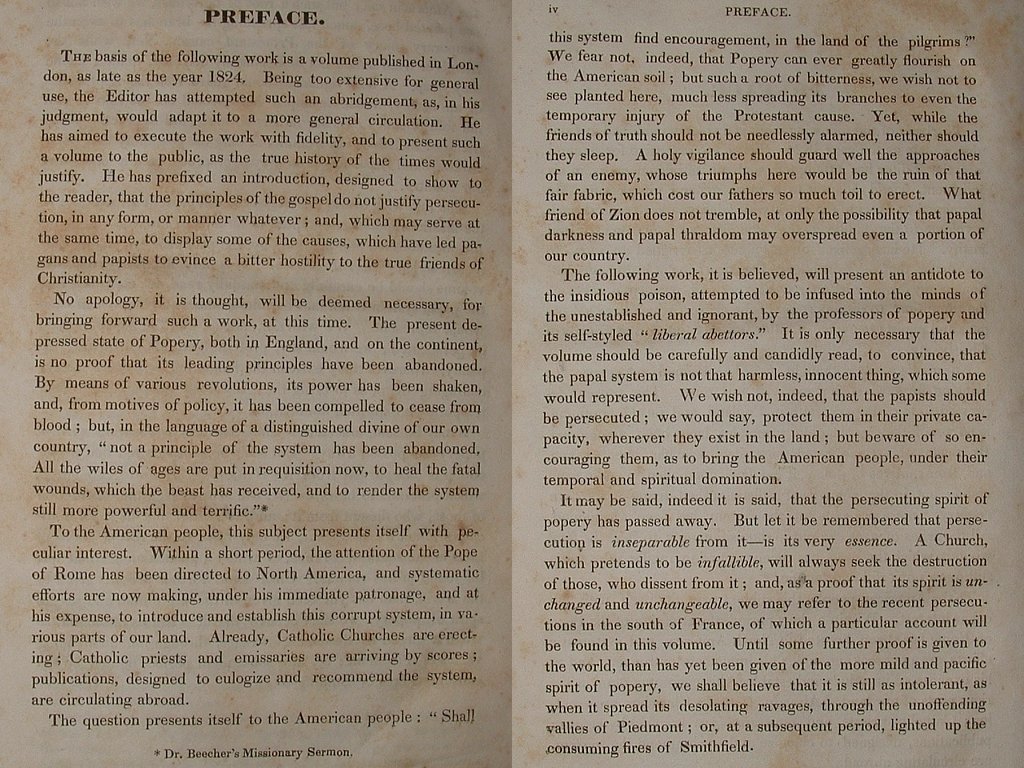
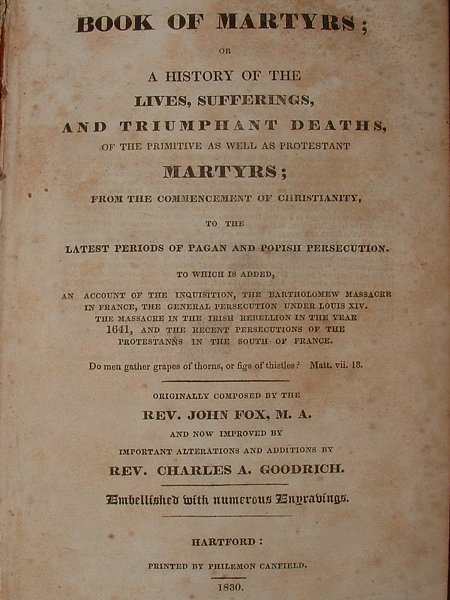
In 1830 Charles Goodrich warned Americans that the leading principles of the Roman Catholic church have not been abandoned. Goodrich said, “A Church, which pretends to be infallible, will always seek the destruction of those, who dissent from it;” (Book Of Martyrs, Hartford, Connecticut, printed by Philemon Canfield, 1830, pp. 3,4). It is an undeniable fact that conspiracies exist. It is also an under appreciated fact that most people have been conditioned to pay little or no attention to conspiracies. Misinformation is often circulated in the media and elsewhere for the purpose of leading people away from the truth. This was in the past and still is today one of the main functions of the Catholic Jesuit organization. It is no coincident that high level Jesuits are also high ranking Freemasons. The following information reveals some of the methods employed to deceive. “Morals and Dogma” is an official Masonic book written by occultist Albert Pike. Pages 104 and 105 of this Satanic occult book states:
“Masonry, like all the religions, all Mysteries, Hermetiscism, and Alchemy, conceals its secrets from all except the Adepts and Sages, or the Elect, and uses false explanations and misinterpretations of its symbols to mislead those who deserve to be mislead;”In his informative book, A History of the Holy Catholic Inquisition, Cyrus Mason (no affiliation with Masonry) wrote in 1835,
“So Masonry jealously conceals its secrets, and intentionally leads conceited interpreters astray. (Morals and Dogma, pp. 104, 105)“They [Jesuits] regard our country [the U.S.A.] as an open field, where they may pursue their schemes without molestation, and with entire success; where they may profit by the toleration enjoyed under our mild and free institutions.”
“These sworn servants of a foreign potentate [the pope] have as a leader an avowed defender of the inquisition.... They believe that her intolerance of all modes of faith but her own, is for the glory of God and the good of the whole world; and, holding her infallibility, they must, of course, defend the machinery by which she has, in former ages, carried out her spirit of intolerance against those who have dared to think and speak for themselves in the interpretation of the Scriptures.”
“The practical effects of the Catholic religion, in the hands of these [Jesuit] agents of the pope, will be the same in our country as they are in the old world, only they must be more slowly disclosed, and defended with caution.... There is nothing like a gradual initiation to a new order of things.”(A History of the Holy Catholic Inquisition, pp. 5,6,7). (See also the NEW WORLD ORDER and THE OCCULT: CATHOLIC & ISLAMIC CONNECTION)Throughout the Dark Ages faithful Christians preserved the true scriptures, the scriptures that revealed Christ and exposed antichrist. From the early 1600's to the 20th century our Bible believing American ancestors and forefathers knew Christ as well as antichrist, because the scriptures clearly reveal both. “The entrance of thy words giveth light; it giveth understanding unto the simple.” (Psa. 119:130). For this reason, more than 600 years ago, the Roman Catholic Church placed the Holy Scriptures on its official list of banned books*, and for centuries confiscated and burned Bibles and condemned Bible believers to death. But when these methods failed to win converts, the papacy devised new strategies. Through its overt and covert policies, "Holy Mother Church" began infiltrating Protestant communities, schools and churches. And by hiding its past and re-writing history, the Catholic Church spread its propaganda from one Protestant generation to the next, till at last most modern-day Christians no longer recognize “THE MOTHER OF HARLOTS AND ABOMINATIONS OF THE EARTH” (Rev. 17:5). (The Catholic Church has never removed the KJV Holy Bible from its list of forbidden books; * Pope Innocent III, 1199; Council of Toulouse, 1229; Council of Tarragona, 1234; Synod of Oxford, 1408; Pope Pius IV, Index of Trent, 1559; Dogmatic Constitution, Pope Clement XI, 1713; Constitution Auctorem fidei, Pope Pius VI, 1794; Ubi Primum, Pope Leo XII, 1824; Traditi Humilitati, Pope Pius VIII, 1829; Inter Praecipuas, Pope Gregory XVI, 1844; Quanta Cura, Pope Pius IX, 1866; Pope Leo XIII, Apostolic Constitution Officiorum ac Munerum, 1897; Code of Canon Law On Censorship And Prohibited Books, 1918; Index Of Prohibed Books, 1930; Code of Canon Law On Vernacular Bibles, 1983)
“So Christ was once offered to bear the sins of many”, “Who...by himself purged our sins” (Heb. 1:3; 9:28)). For “we are sanctified through the offering of the body of Jesus Christ once for all.... But this man,.. offered one sacrifice for sins for ever.... For by one offering he hath perfected for ever them that are sanctified. Whereof the Holy Ghost also is a witness to us: for after that he had said before, This is the covenant that I will make with them after those days, saith the Lord, I will put my laws into their hearts, and in their minds will I write them; And their sins and iniquities will I remember no more. Now where remission of these is, there is no more offering for sin” (Heb. 10:10-18).
No amount of suffering we could go through, either in “this present evil world” or in some fictitious purgatory, would cleans us from one single sin (Gal. 1:4; Heb. 9:27; John 12:47,48). Otherwise, Jesus Christ was born, lived a sinless life, and died for nothing. If we can be saved by our own righteousness or by our own sufferings “then Christ is dead in vain.” (Gal. 2:21). No man can pay for his or anyone else's sins. A man will reap what he sows, but he cannot pay for his sins (Gal. 6:7).
“But after that the kindness and love of God our Saviour toward man appeared, Not by works of righteousness which we have done, but according to his mercy he saved us, by the washing of regeneration, and renewing of the Holy Ghost; Which he shed on us abundantly through Jesus Christ our Saviour; That being justified by his grace, we should be made heirs according to the hope of eternal life.” (Titus 3:4-7). “Looking unto Jesus the author and finisher of our faith” (Heb. 12:2). “Knowing that a man is not justified by the works of the law, but by the faith of Jesus Christ, even we have believed in Jesus Christ, that we might be justified by the faith of Christ, and not by the works of the law: for by the works of the law shall no flesh be justified.” (Gal. 2:16). “But the scripture hath concluded all under sin, that the promise by faith of Jesus Christ might be given to them that believe.... For ye are all the children of God by faith in Christ Jesus.” (Gal. 3:22,26). “For by grace are ye saved through faith; and that not of yourselves: it is the gift of God: Not of works, lest any man should boast.” (Eph. 2:8,9). “For all have sinned, and come short of the glory of God; Being justified freely by his grace through the redemption that is in Christ Jesus: Whom God hath set forth to be a propitiation through faith in his blood, to declare his righteousness for the remission of sins that are past, through the forbearance of God;” (Rom. 3:23-25). “Much more then, being now justified by his blood, we shall be saved from wrath through him.” (Rom. 5:9). “In whom we have redemption through his blood, the forgiveness of sins, according to the riches of his grace;” (Eph. 1:7). “In whom we have redemption through his blood, even the forgiveness of sins:” (Col. 1:14).
As late as 1953 The Book OF Common Prayer of the Episcopal church in America in its ARTICLES OF RELIGION states:
ART. XXXI. Of the one Oblation of Christ finished upon the Cross.
The Offering of Christ once made is that perfect redemption, propitiation, and satisfaction, for all the sins of the whole world, both original and actual; and there is none other satisfaction for sin, but that alone. Wherefore the sacrifices of Masses, in the which it was commonly said, that the Priest did offer Christ for the quick and the dead, to have remission of pain or guilt, were blasphemous fables, and dangerous deceits.
Let us again hear what the sound doctrine of the holy scriptures contained in the Holy Bible says:
“Wherefore, as by one man sin entered into the world, and death by sin; and so death passed upon all men, for that all have sinned:” (Rom. 5:12). “For as by one man’s disobedience many were made sinners, so by the obedience of one shall many be made righteous.” (Rom. 5:19). “For what the law could not do, in that it was weak through the flesh, God sending his own Son in the likeness of sinful flesh, and for sin, condemned sin in the flesh:” (Rom. 8:3). “For God hath concluded them all in unbelief, that he might have mercy upon all.” (Rom. 11:32). “But when the fulness of the time was come, God sent forth his Son, made of a woman, made under the law, To redeem them that were under the law, that we might receive the adoption of sons.” (Gal. 4:4,5). “And for this cause he is the mediator of the new testament, that by means of death, for the redemption of the transgressions that were under the first testament, they which are called might receive the promise of eternal inheritance.” (Heb. 9:15). “For there is one God, and one mediator between God and men, the man Christ Jesus;” (I Tim. 2:5).
As we can see, good dictionaries, honest historians, and trustworthy scholars and ministers are all in agreement with the Holy Scriptures. People can try to hide the truth, or they can try to hide from the truth, but God will always bring the truth to light. Jesus said, “If ye continue in my word, then are ye my disciples indeed; And ye shall know the truth, and the truth shall make you free.” (John 8:31,32). “I am come a light into the world, that whosoever believeth on me should not abide in darkness. And if any man hear my words, and believe not, I judge him not: for I came not to judge the world, but to save the world. He that rejecteth me, and receiveth not my words, hath one that judgeth him: the word that I have spoken, the same shall judge him in the last day.” (John 12:46-48).
"A FALLING AWAY" II Thess. 2:3
The following was taken from the 1953 edition of The Book OF Common Prayer of the Episcopal church in America:
THE BOOK OF COMMON PRAYER
and Administration of the Sacraments
and Other Rites and ceremonies
of the Church
ACCORDING TO THE USE OF THE
PROTESTANT EPISCOPAL CHURCH
IN THE UNITED STATES OF AMERICA
1790, 1801, 1892, 1928, 1953
ARTICLES OF RELIGION
ART. VI. Of the Sufficiency of the Holy Scriptures for Salvation.
Holy Scripture containeth all things necessary to salvation: so that whatsoever is not read therein, nor may be proved thereby, is not to be required of any man, that it should be believed as an article of Faith, or be thought requisite or necessary to salvation....
ART. XI. Of the Justification of Man.
We are accounted righteous before God, only for the merit of our Lord and Savior Jesus Christ by Faith, and not for our own works or deservings. Wherefore, that we are justified by Faith only, is a most wholesome Doctrine, and very full of comfort,...
ART. XIV. Works of Supererogation.
VOLUNTARY Works besides, over and above, God's Commandments, which they call Works of Supererogation, cannot be taught without arrogancy and impiety: for by them men do declare, that they do not only render unto God as much as they are bound to do, but that they do more for his sake, than of bounden duty is required: whereas Christ saith plainly, When ye have done all that are commanded to you, say We are unprofitable servants.
ART. XIX. Of the Church.
The visible Church of Christ is a congregation of faithful men, in the which the pure Word of God is preached, and the sacraments be duly ministered according to Christ's ordinance, in all those things that of necessity are requisite to the same.
As the Church of Jerusalem, Alexandria, and Antioch, have erred; so also the Church of Rome hath erred, not only in their living and manner of Ceremonies, but also in matters of faith.
ART. XXII. Of Purgatory.
The Romish Doctrine concerning Purgatory, Pardons, Worshipping and Adoration, as well of Images as of relics, and also Invocation of Saints, is a fond thing, vainly invented, and grounded upon no warranty of Scripture, but rather repugnant to the Word of God.
ART. XXVIII. Of the Lord's Supper.
Transubstantiation (or the change of the substance of Bread and Wine) in the Supper of the Lord, cannot be proved by Holy Writ; but is repugnant to the plain words of Scripture, overthroweth the nature of a Sacrament, and hath given occasion to many superstitions.
ART. XXXI. Of the one Oblation of Christ finished upon the Cross.
The Offering of Christ once made is that perfect redemption, propitiation, and satisfaction, for all the sins of the whole world, both original and actual; and there is none other satisfaction for sin, but that alone. Wherefore the sacrifices of Masses, in the which it was commonly said, that the Priest did offer Christ for the quick and the dead, to have remission of pain or guilt, were blasphemous fables, and dangerous deceits.
ART. XXXII. Of the Marriage of Priests.
Bishops, Priests, and Deacons, are not commanded by God's Law, either to vow the estate of single life, or to abstain from marriage: therefore it is lawful for them, as for all other Christian men, to marry at their own discretion, as they shall judge the same to serve better to godliness.
The following was taken from the 1646 Westminster Confession of Faith of the church of England:
The Westminster Confession of Faith (1646)
Chapter I
Of the Holy Scripture
ART. I. Although the light of nature, and the works of creation and providence do so far manifest the goodness, wisdom, and power of God, as to leave men unexcusable;[1] yet are they not sufficient to give that knowledge of God, and of His will, which is necessary unto salvation.[2] Therefore it pleased the Lord, at sundry times, and in divers manners, to reveal Himself, and to declare that His will unto His Church;[3] and afterwards for the better preserving and propagating of the truth, and for the more sure establishment and comfort of the Church against the corruption of the flesh, and the malice of Satan and of the world, to commit the same wholly unto writing;[4] which makes the Holy Scripture to be most necessary;[5] those former ways of God's revealing His will unto His people being now ceased.[6]
ART. III. The books commonly called Apocrypha, not being of divine inspiration, are no part of the canon of the Scripture, and therefore are of no authority in the Church of God, nor to be any otherwise approved, or made use of, than other human writings.[8]
ART. IV. The authority of the Holy Scripture, for which it ought to be believed, and obeyed, depends not upon the testimony of any man, or Church; but wholly upon God (who is truth itself) the author thereof: and therefore it is to be received, because it is the Word of God.[9]
ART. VII. All things in Scripture are not alike plain in themselves, nor alike clear unto all:[15] yet those things which are necessary to be known, believed, and observed for salvation are so clearly propounded, and opened in some place of Scripture or other, that not only the learned, but the unlearned, in a due use of the ordinary means, may attain unto a sufficient understanding of them.[16]
ART. IX. The infallible rule of interpretation of Scripture is the Scripture itself: and therefore, when there is a question about the true and full sense of any Scripture (which is not manifold, but one), it must be searched and known by other places that speak more clearly.[23]
ART. X. The supreme judge by which all controversies of religion are to be determined, and all decrees of councils, opinions of ancient writers, doctrines of men, and private spirits, are to be examined, and in whose sentence we are to rest, can be no other but the Holy Spirit speaking in the Scripture.[24]
In this day of apostasy of the churches we thank God for the remnant of Bible believing Christians who have not fallen away from “the faith which was once delivered unto the saints”. In this day of compromising with “this present evil world” we thank God for the faithful in Christ Jesus who refuse to turn away their ears from the truth of the scriptures unto fables, and doctrines of devils, and commandments of men (II Thess. 2:3; Jude 1:3; Gal. 1:4; I Tim. 4:1-5; II Tim. 4:1-4).
A Dictionary of the Holy Bible
By John Brown
Edinburgh, 1789
and
A Dictionary of the Holy Bible
By John Brown
Philadelphia, 1798
(Note: In 18th century English a long sounding lower-case "s" resembled a lower-case "f" in appearance)
(page 71)
ANTICHRIST,
an adversary of Jesus Christ. Heretics who denied the doctrine of the Trinity, or the divinity or incarnation of Christ, &c. were called Antichrist: of this sort there were many in the time of the apostle John, i John ii. 13, 22. and iv. 3. But one particular system of wicked persons, principles, and practices, is chiefly so designed: in the daily fear of which the primitive Christians lived. The scripture represents this Antichrist as a very man of sin, and son of perdition: as a strong delusion over-spreading the whole Roman empire; as a terrible judgment introduced by ignorance and hatred of the truth and apostacy from it; as springing from the bottomlefs pit, amidst terrible smoke of superstition and error; as sitting in the temple or church of God; as exalting himself above magistrates, angels, and every thing called God; as a contemner of the gods of the idolatrous Heathen, and the God of his professed fathers, in the primitive church, and setting up a new class of Mahuzzim, deities to protect his different dominions; as given to the vilest blasphemy, error, cruelty, and persecution; as possessing a civil and ecclesiastic power over the ten parts of the Roman empire, and seizing upon three of them for his proper domain; as establifhing his abominations, unnumbered by false miracles, and lying wonders; as excluding from civil commerce such as do not more or less solemnly acknowledge, and submit to his power.
United under one head, the destructive angel of the bottomless pit, the promoters of this delusion, were to be many and mischievous, as locusts and scorpions: ruinous to such as had not the true grace of God; having their conscience seared as with an hot iron; speaking lies in hypocrisy; propagating the doctrines of devils, forbidding to marry, or on occasions, to use lawful and wholesome meats;—while their hearers had itching ears, heaped up teachers, and gave heed unto fables:
(page 72)
they were to be lovers of them-selves, covetous, proud, blasphemers, disobedient to parents, unthankful, unholy, without natural affection, truce-breakers, falfe accusers, incontinent, wallowers in all manner of uncleanness, intemperate, fierce, defpisers of those that are good, traitors, heady, high-minded, lovers of pleasures more than lovers of God, creeping into houses, and leading captive silly women laden with sins. The chief residence of this monster was to be Rome: its name, Mystery, Babylon the great, the mother of harlots, and abominations of the earth. The Number of his name is 666, whose numeral letters constitute Latinus or Romish, and whose square root is 25, the number of the articles of faith, and of many other things in the Romish church. This Antichrist began to work in the apostolic age, but was checked by the power of the Roman empire till that was destroyed, and a fearful apostacy from the faith happened in the church. His duration is 1260 years; during which he promotes idolatry, lies, and blasphemy, treads the church under foot, and persecutes the saints, who all along bear Witness against his abominations; nor do the terrible ravages of the Turkish angels, loosed from the Euphrates, in the least make his subjects to repent of their idolatries, murders, sorceries, fornications, thefts. At the end of his reign, he shall, with craft and fury, almost entirely cut off faithful witnessing for Chrift:—but all of a sudden, by the pure preaching of the gospel; by the effusion of sevenfold plagues, or vials of divine wrath; by the revolt and opposition of his own subjects, shall he be terribly destroyed, to the consternation of his adherents, and the great joy of the saints, both Jews and Gentiles, Dan. vii. 8—12. 20—26. and xi. 36—40. 2 Thess. ii. 3—12. 1 Tim. iv. 1—3. 2 Tim. iii. 1—7. and iv. 3,4. Rev. ix. 1-—11. 20, 21. and xi. and xiii. to xix. chapters.
The above characters, drawn from the scripture, can, with no justice, be applied to the heathen emperors of Rome; much less to the fanciful Danitish Antichrift of Popish writers, the Armillus of the Jews, or the Daggial of the Mahometans. The Mahometan system may indeed be considered as a lesser and more improper Antichrist; but neither are the most of the characters applicable to it. It sits not in the church, nor contains any pretensions of men to power equal to God's: allows of no idolatry, nor is it noted for persecution of the saints: nor was it established by lying wonders, but by the power of the sword.
But every part of the above character is clearly applicable to the PAPACY. In the apostolic age it began to work in the ambition and false doctrines of the pretended apostles; all along, in the succeeding ages, it operated more and more in the growth of error and superftition; and in the aspiring temper of the clergy, chiefly of the bishops of Rome. The continued power of the emperors was long a check to the pride of the Roman bishops; but when the seat of the empire was removed to Constantinople, about A.D. 330; when the western empire was entirely dissolved by the barbarians, A.D. 476; and finally, when in A. D. 566, the emperor Justin stript Rome of her consuls and senate, and made it subject to the Exarch of Ravenna, they had full opportunity to exert their ambition.
Seven forms of government, viz. by kings, consuls, decemvirs, tribunes, dictators, emperors, Heathen and Christian, and by Gothish kings, had already had their turns at Rome; and the empire was parcelled out into ten different Sovereignties. The Christian clergy had heaped up the
(page 73)
unscriptural dignities of lordly bishops, archbishops, metropolitans patriarchs, one over another. They still wanted an head to unite them into one body. The bishops of Rome, by encouraging appeals to their bar, by pretending deeds of council in their favour, and a thousand other fraudulent methods, struggled for the sovereignty; nor were the patriarchs of Conftantinople idle. Gregory the Great filled the Romish see about A.D. 600. In opposition to John of Constantinople, he loudly maintained, That whoever claimed an universal headship over the Christian church, was doubtless the forerunner of Antichrist, if not actually He. Meanwhile, he laboured with all his might to increase the fooleries of superstition; the multitude of which, along with their attendant errors, now darkened the face of the Chnftian church; and to procure preferment flattered Phocas. About A.D. 606, or 608, bishop Boniface the 3d, by flattering of Phocas the emperor of Constantinople, one of the vilest traitors and murderers, and one of the most inhuman and wicked wretches, that ever breathed, procured himself the title of Universal Bishop. Deputies were immediately dispatched through the western churches to introduce the new superstition, and procure submission to the Romish yoke. These deputies were often very ignorant, and quite incapable to officiate, in the language of the countries whither they came. A remedy was found; about A. D. 666, it is said Pope Vitalian appointed all religious worship in public to be performed in Latin. This at once concealed the ignorance of the deputies, and marked the churches with an implicit subjection to Rome. The Popes exerted their sacred power in promoting the idolatrous worship of images, reliques, saints, and angels; in adding to the former
superstition; in erecting new offices and orders of monks, till the nations groaned under the load of the numerous and oppressive clergy, who, by means crafty and base, appropriated to themselves the most part of the wealth and power of the Christian world. Not content with ecclesiastic authority, the Popes grasped at the civil. About 750, or 756, they became princes of Italy, lords of the three sovereignties of the dukedom of Rome, the exarchate of Ravenna, and the region of Pentapoles. They gradually proceeded to claim a supreme authority over all the kings and emperors in Christendom; deposing the emperors of Germany, kings of France, England, &c. at pleasure, and absolving their subjects from their allegiance. They pretended to dispose of the countries in Asia, Africa, and America, to the Portuguese and Spaniards, who conquered them. They extended their power to the angels, charging them to conduct to the celestial mansions, such departed souls as they pleased ; and ordering devils to leave the bodies which they had possessed. They assumed a practical supremacy over the divine persons themselves, in pretending to form and divide the glorified body of Jesus at pleasure; in altering the divine laws; issuing forth pardons, and indulgences in sin; in cancelling the obligation of oaths, &c. What ignorant, proud, blasphemers, Atheists, inchanters, murderers, whoremongers, incestuous and perjured persons, many of the popes were! and how ignorance, superstition, idolatry, and every other crime, abounded by their means, is obvious to every one acquainted with their history.
In the 10th and 11th centuries, things were in a most deplorable condition: the great part of the Romish Christians were similar to beasts in stupidity, and to infernals in im-
(page 74)
piety. In the subsequent age, the scholastic learning began. Its chief tendency was to pervert and obscure the scripture, render the Christian principles quite unintelligible, and to support the abominations then introduced. To render it impossible for the laics to discover the errors and horrid villainies of the clergy, their reading of the scripture was represented as extremely dangerous, and enacted to be no less criminal. To prevent every murmur against their conduct, courts of inquisition were erected, by means of which, the least suspicion of pretended heresy, or even the falsest accusation, exposed multitudes to the danger of confiscation of goods, of imprisonment, tortures, and death.
In every part of the Antichristian period God had his witnesses for the truth; and terribly were these persecuted and murdered by the Papists. The Waldenses of Piedmont and France, in the 12th and 13th centuries; the Wickliffites of England, in the 14th; the Bohemians in the 15th, were the most noted; and between a million or two, or perhaps more, were murdered on that account. In the i6th century the shocking impiety, fraud and oppression of the Romanists provoked vast numbers to throw off their yoke. The Pope's authority was abolished in Britain, in Sweden, Denmark, Holland, and a great number of States in Germany and Switzerland. Multitudes in France, Poland, Hungary, and even in Italy and Spain, were convinced of, and rejected the Popish delusions. By an establishment of their abominations in the council of Trent, but chiefly by murderous wars and persecutions in Germany, Low-countries, France; by horrid massacres in France and Ireland; by bloody perfections in Poland, Hungary, England, Scotland, Savoy, &c. the Popes agents, for about 150 year, attempted to reduce them.
Great men have thought, that Antichrist's general slaughter of the witnesses, and their death of three years and a half, have already happened. Some things similar have indeed taken place. After the council of Constance, about 1414, sat three years and a half to ruin them, and establish Popery, the Bohemians remarkably prevailed. After the affairs of the Protestants had been about three years and a half in a ruined condition, Maurice, who had formerly betrayed them, took arms in their favour, and recovered their liberties about A.D. 1551. After about three years and a half persecution, have the Protestants of Savoy oftener than once got relief. Three years and a half the Protestant religion seemed almost ruined in England, under Queen Mary; and again under King James II. of Britain; and at the end thereof, was re-established by Elisabeth, and K. William: nor was it much above three years and an half; when relief from the massacres began to be granted the Protestants in France and Ireland. But it is observable, all these slaughters were particular; nor are the kingdoms of this world yet become the kingdoms of our Lord, and of his Christ. We must therefore believe the sad and most grievous conflict with Antichrist to be still future. The present abounding of ignorance, the contempt of the scripture, the prevalent errors on the head of justification and free will, the attachment to gaudy pomp in the worship of God, the pride, ambition, contention, and loose living of the Protestants, appear wide steps towards a return to Rome.
http://books.google.com/books?id=x_4qAAAAYAAJ&printsec=frontcover&dq#PPA71,M1
See also:
A Dictionary of the Holy Bible, By John Brown, Albany, 1816, pages 40-42
http://books.google.com/books?id=V31AAAAAIAAJ&printsec=frontcover&dq=&lr=#PPA40,M1
The Union Bible dictionary
For The Use Of Schools, Bible Classes, and Families
By Frederick Adolphus Packard, Philadelphia, 1855
(page 55)
ANTICHRIST.
Who is antichrist? has been a question of curious and not uninteresting speculation for ages. The prevailing opinion seems to be, that the papal power is intended to be represented; and that the history of that power thus far corresponds very accurately in its principal features with the sure word of prophecy.
http://books.google.com/books?dq=&pg=PA55&id=1BYXAAAAYAAJ#PPA55,M1
The Westminster Bible Dictionary
Philadelphia, 1880
(page 332)
Man of Sin
Whoever reveals the distinctive features of the Man of Sin; whoever wields the temporal or spiritual power in any degree similar to that in which the Man of Sin is described as wielding it,—he, whether pope or potentate, is beyond doubt a type of Antichrist.
http://books.google.com/books?dq=&pg=PA332&id=Dp0_AAAAYAAJ
People's Dictionary Of The Bible
Philadelphia, 1893
(page 26)
Antichrist
The word antichrist does not always mean openly opposed to Christ, but putting something in the place of Christ. Any person teaching any way to God, excepting through Christ, is Antichrist. Any person teaching any way of salvation, excepting through the blood of Christ, is Antichrist. John says that in his day, "Now are there many antichrists." 1 John 2:18. The papal church, putting its traditions in the place of the Scriptures, putting the Virgin Mary, the saints, the Pope, the priest, good works, the mass, purgatory, etc., as the way of salvation, in place of salvation by faith in the Lord Jesus Christ, is pre-eminently Antichrist.
http://books.google.com/books?id=QbEsAAAAYAAJ&printsec=frontcover&dq=#PPA26,M1
Let us now move forward a hundred years and witness the apostasy of modern Christianity. Nominal Christians unfamiliar with history are easily misled by biased modern-day reference works such as the 1997 edition of the Illustrated Dictionary Of The Holy Bible which states:
“The main reason the Bible discusses the Antichrist is not to encourage idle speculation, but to warn believers not to be misled by his deceit (Matt. 24:4-5, 23-24). The time when the Antichrist will appear will be very hard for the faithful. They need to be prepared with special instructions on how to deal with this unsettling event.“ (Illustrated Dictionary Of The Holy Bible, Thomas Nelson Publishers, Nashville, 1997, p. 68)
As we can see, even our modern Bible dictionaries now agree with the Jesuit propaganda of Francisco Ribera and Robert Bellarmine, and ignore the pages of history, the documented events that have taken place over many centuries which clearly reveals the system of antichrist. As early as the late 1800's, coinciding with the growth and spread of Roman Catholicism in America, Bible dictionaries began the process of omitting any reference that connected the papacy to Antichrist. Fortunately, the scriptures give us a clear picture of antichrist — past, present and future.
1) “Now the Spirit speaketh expressly, that in the latter times some shall depart from the faith, giving heed to seducing spirits, and doctrines of devils;...Forbidding to marry, and commanding to abstain from meats,” (1 Timothy 4:1,3) (Abstinence from meats on certain "holy days" and celibacy of the clergy is not in the New Testament.)
a) Canon 277 of the Roman Catholic church: “Clerics [priests, bishops, etc.] are obliged to observe perfect and perpetual continence for the sake of the Kingdom of heaven, and are therefore bound to celibacy.” (Compare this with the scriptures: “A bishop then must be blameless, the husband of one wife,” “Let the deacons be the husbands of one wife,” (1 Timothy 3:2,12))
b) Canons 1250-1252 of the Roman Catholic church: “The law of abstinence prohibits meat and soups made of meat....”(1250.) and “must be observed every Friday.”(1251) “every Ash Wed, every Friday and Saturday of Lent, [etc.]...”(1252. 2.) (Compare this with the scriptures: “For every creature of God is good, and nothing to be refused, if it be received with thanksgiving: For it is sanctified by the word of God and prayer.” (1 Timothy 4:4,5))
2) “and I saw a woman...full of names of blasphemy,” (Revelation 17:3)
a) The Pope of Rome has taken unto himself the title of "Holy Father", a title belonging exclusively to God (John 17:11).
b) Circa 1200 A.D., Pope Innocent III declared himself "the bridegroom", a title belonging exclusively to the Lord Jesus Christ (Matthew 9:15; 25:1-13).
c) The Pope claims to have the authority to forgive sins ("And the scribes and the Pharisees began to reason, saying, Who is this which speaketh blasphemies? Who can forgive sins, but God alone?" Luke 5:21)
d) Pope Pius IX declared himself "infallible" in July of 1870; (Theological quarterly, Vol. XIII, 1909 p. 66)
e) Pope Leo XIII, in an encyclical letter dated June 1894, said, ”We hold upon this earth the place of God Almighty,” i.e. “We hold the regency of God on earth.”
Note: These are not merely extravagant adulations of the Dark Ages, to be repudiated by the moderns; these terms express the unchanging doctrinal claims of the Roman Church, that put man in the place of God. ("so that he as God sitteth in the temple of God, shewing himself that he is God” (2 Thessalonians 2:3,4) (The Roman Catholic Church challenged, 1920, p. 155; The Encyclical Letters, p. 330; The Great Encyclical Letters of Leo XIII, p. 304; The Rights of the People: or, Civil Government and Religion, 1895, p. 216; Americanism Vs. Roman Catholicism, 1921, p. 194; Our Day in the Light of Prophecy, 1918, p. 149)
3) “And call no man your father upon the earth: for one is your Father, which is in heaven.” (Matthew 23:9)
a) Catholic priests insist on being called "Father" by their followers.
4) “For there is one God, and one mediator between God and men, the man Christ Jesus;” (1 Timothy 2:5)
a) The Roman Catholic church has substituted the one and only mediator between God and men, via Peter, Paul, Mary, the pope, the priest, etc.
5) “But when ye pray, use not vain repetitions, as the heathen do: for they think that they shall be heard for their much speaking.” (Matthew 6:7)
a) Catholics are told by their "Fathers" to say "12 Hail Marys", "10 Our Fathers", etc., and they will be absolved of their sins.
6) “And the woman was arrayed in purple and scarlet colour,” (Revelation 17:4)
a) Purple and scarlet are official colors of the Roman Catholic church. (Photos of Bishops and Cardinals at Pope John Paul II funeral: Photo 1; Photo 2; Photo 3)
7) “I will shew unto thee...the great whore that sitteth upon many waters: With whom the kings of the earth have committed fornication....And the woman which thou sawest is that great city, which reigneth over the kings of the earth.” (Revelation 17:1,2,18)
a) The Bible tells us that the kings of the earth will gather together under a religious cloak to do battle against the true God of the Bible, Jesus Christ and his true followers (Psalms 2; Acts 4; Revelation 16). (See Kings of The Earth)
8) “Notwithstanding I have a few things against thee, because thou sufferest that woman Jezebel, which calleth herself a prophetess, to teach and to seduce my servants to commit fornication, and to eat things sacrificed unto idols. And I gave her space to repent of her fornication; and she repented not.” (Revelation 2:20,21)
a) Jezebel adopted the worship of "the queen of heaven" and taught God's servants to commit spiritual fornication. The Catholic church teaches people to bow down before idols and images of Mary whom they call "the queen of heaven." (Photos of Catholics worshipping the "queen of heaven": Photo 1; Photo 2; Photo 3)
9) “Behold, I will cast her into a bed, and them that commit adultery with her into great tribulation, except they repent of their deeds.” (Revelation 2:22)
a) During the Catholic Mass the priest holds up the bread and wine and says, "We believe that bread and wine truly become the glorified Body and Blood of Jesus Christ", and is "truly become the Body and Blood, soul and divinity, of our Lord Jesus Christ", and "What had been bread before has truly become the Blood of Christ, and Jesus is truly present on the alter under both forms." (see "The Mass" in the NASB, 1975 Catholic heirloom Edition, pages 462:14-30). This practice is clearly defined as Idolatry and Adultery in Webster's dictionary; “the kings of the earth have committed fornication with her” “Come out of her, my people, that ye be not partakers of her sins” (Revelation 18:3,4)
The same ancient Pagan symbols of idolatry are being used today in Roman Catholic churches around the world (see Photos comparing ancient Pagan idols with modern Catholic symbols).
10) “And I saw the woman drunken with the blood of the saints, and with the blood of the martyrs of Jesus:” (Revelation 17:6); “the same horn made war with the saints, and prevailed against them;” (Daniel 7:21); “And it was given unto him to make war with the saints, and to overcome them:” (Revelation 13:7)
a) See The Catholic Inquisition: Video; and Torture Tools of The Catholic Inquisitions. “Beside those victims of the Inquisition, there were Huguenots, Albigenses, Waldenses, and other Christians who were massacred, tortured, and burned at the stake by the hundreds of thousands simply because they refused to align themselves with the Roman Catholic Church and its corruption and heretical dogmas and practices. Out of conscience they tried to follow the teachings of Christ and the apostles independent of Rome, and for that crime they were maligned, hunted, imprisoned, tortured, and slain.” (A Woman Rides The Beast, Dave Hunt, 1994. These facts have been documented by many historians. Our Banquet, H.A. St. John, 1894, pp. 362-364)
11) “And he [the man of sin of the harlot church] shall speak great words against the most High, and shall wear out the saints of the most High, and think to change times and laws:” (Daniel 7:25)
a) The Roman "Decretalia," an authoritative work in the Roman ecclesiastical law, exalts the pope thus: "He can pronounce sentences and judgments in contradiction to the right of nations, to the law of God and man....He can free himself from the commands of the apostles, he being their superior, and from the rules of the Old Testament, etc." "The pope has power to change times, to abrogate laws, and to dispense with all things, even the precepts of Christ." (Decretal De. Translat. Episcop. Cap.)
b) The Roman Catholic church changed the laws of God's ten commandments: 1st- by virtually abolishing the second commandment prohibition of idolatry, thus allowing the institution of statues of saints as a sort of intermediary between man and God; 2nd- by changing the fourth commandment to keep holy the seventh day sabbath, thus erroneously proclaiming the first day of the week as the day of the Lord and allowing the institution of the first day of the week as a sort of holy day. (See The Seventh Day Sabbath)
12) “The seven heads are seven mountains, on which the woman [harlot church] sitteth.” [hills are sometimes called mountains] (Revelation 17:9)
a) The Catholic Encyclopedia states: "It is within the city of Rome, called the city of seven hills, that the entire area of Vatican State proper is now confined." (The Catholic Encyclopedia, Thomas Nelson, 1976, see "Rome"). The official Catholic Bible, NASB, states, “The seven heads are seven hills on which the woman sits enthroned.” (Revelation 17:9)
Only one church in the world fits all of these prophetic Scriptures perfectly. The Holy Bible foretold of it. History confirms it!
Historian Dave Hunt said, “Why would Rome ever apologize for or even admit this holocaust? No one calls her to account today. Protestants have now forgotten the hundreds of thousands of people burned at the stake for embracing the simple gospel of Christ and refusing to bow to papal authority. Amazingly, Protestants are now embracing Rome as Christian while she insists that the "separated brethren" be reconciled to her on her unchangeable terms! Many evangelical leaders are intent upon working with Roman Catholics to evangelize the world.... They don't want to hear any "negative" reminders of the millions of people tortured and slain by the Church to which they now pay homage, or the fact that Rome has a false gospel of sacramental works.” (A Woman Rides The Beast, Dave Hunt, 1994)
Read the following information which was taken directly from the NAB (New American Bible), the official Roman Catholic Bible, and see if the church of Rome does not present a false gospel of sacramental works thereby promoting “another Jesus” and “denying the Lord that bought them” (II Cor. 11:4; II Pet. 2:1):
The Mass
It is a true, but unbloody, sacrifice, in which the Body and Blood are offered to God under the appearance of bread and wine. On the Cross the sacrifice of Christ was physical and personal; in the Mass Christ is both priest and victim, and the sacrifice is made through the Ministry of His priests. Pope Pius XII indicated the role the laity should play in the celebration of the Mass.... The faithful are no longer to be mere spectators at the Mass, but are to participate in it, along with the priest. The second Vatican Council convened under Pope John XXIII and Pope Paul VI, further declared: "The Church, therefore, earnestly desires that Christ's faithful, when present at this Mystery of Faith, should not be there as strangers or silent spectators. On the contrary, through a proper appreciation of the rites and prayers they should participate knowingly, devoutly, and actively. They should be instructed by God's word and be refreshed at the table of the Lord's body . . . by offering the Immaculate Victim, not only through the hands of the priest, but also with him.... (page 462-2)THE OFFERTORY (Liturgy of the Eucharist). After the Offertory procession, the priest prepares the gifts of bread and wine which will be used in the Eucharist.... "Blessed are You, Lord God of all creation. Through Your goodness we have this bread to offer which earth has given and human hands have made. It will become our bread of life. (page 462-14)
PREPARATION OF THE GIFTS (Liturgy of the Eucharist). Having prepared the gift of bread, the priest now prepares the gift of wine, which is to be changed into the Blood of Christ. (page 462-15)
THE CELEBRANT WASHES HIS HANDS (Liturgy of the Eucharist). This washing of the hands is symbolic of the purification of the soul, so that the priest may approach the great sacrifice without blemish. (page 462-16)
CONSECRATION OF THE BREAD (Liturgy of the Eucharist). We believe that bread and wine truly become the glorified Body and Blood of Jesus Christ. (page 462-19)
THE ELEVATION OF THE HOST (Liturgy of the Eucharist). Now the priest raises the consecrated Bread for all to see and adore. What had been bread before had truly become the Body and Blood, soul and divinity, of our Lord Jesus Christ. (page 462-20)
CONSECRATION OF THE WINE (Liturgy of the Eucharist). The Wine has now truly become the Blood of Christ, and Jesus is truly present now on the alter under both forms. (page 462-21)
THE ELEVATION OF THE CHALICE (Liturgy of the Eucharist). Again, the celebrant raises the chalice for all to see. It is the Blood of Christ. Jesus offers Himself anew to His Heavenly Father as He did on the Cross.... (page 462-22)
BEHOLD THE LAMB OF GOD (Liturgy of the Eucharist). The celebrant holds a particle of the Eucharistic bread and uses the words first used by St. John the Baptizer: "Behold the Lamb of God; behold Him who takes away the sins of the world." (page 462-29)
THE COMMUNION PROCESSION (Liturgy of the Eucharist). Having humbly confessed their unworthiness, and asking for forgiveness, mercy, and peace, the communicants proceed to the foot of the alter to receive Holy Communion. The priest holds the Consecrated Host before each communicant saying: "The Body of Christ!" and each communicant replies: "Amen." (page 462-30) (New American Bible, 1975, Catholic heirloom Edition)
The so called Mass, the Eucharist, the Transubstantiation of the wafer cake and the wine supposedly transformed into the very flesh and blood of the Lord Jesus Christ and reverenced, adored and worshiped as the “true God”, is absolute idolatry according to the scriptures. Before the participant of the Catholic “Mass” can receive the “actual flesh of Jesus” (according the Catholic church) every participant must affirm that the bread, or wafer, that he or she is about to consume is in fact the very flesh of Jesus Christ and is the true God. This is blatant idolatry. This practice is nowhere to be found in the scriptures. No apostle or disciple of Jesus Christ ever performed such superstitious blasphemous ceremonies. On the contrary, the apostles of Christ warned us that such “doctrines of devils” would be taught by “false apostles” who would “privily bring in damnable heresies” which would “deceive many.” (I Tim. 4:1-3; II Cor. 11:13,14; II Pet. 2:1; Mat. 24:4,5)
Jesus often used analogies and comparisons to teach his people. He called men “branches,” “sheep,” “vipers,” a “tree,” and so forth. Jesus' followers, and even his enemies, understood that he was only speaking comparatively. Speaking to his disciples, Jesus said, “I am the vine, ye are the branches.” Jesus was never a physical vine. When Jesus said, “I am the bread of life:” we can no more interpret this literally than when he said, “I am the vine” and “I am the door”. At the Passover when Jesus took a piece of bread and told his disciples “this is my body, which is broken for you:” it was no more of a literal meaning than when Jesus said “I am the door of the sheep.” Jesus does not become a piece of physical wood for us to enter through. Jesus is the spiritual door, not physical wood. Jesus is no more present in the physical bread of the so called Eucharist than he is present in the physical wood of the door of a church building. (Mat. 12:33,34; 23:33; John 6:35; 10:7; 15:5; I Cor. 11:24)
If the Roman Catholic Mass is not a false gospel of sacramental works, then nothing is. If the so called act of “Transubstantiation” and the elevation and veneration of the “Host” as the “Real Presence” of the “true God” is not gross idolatry and another gospel, another spirit and another Jesus, then neither is the Mormon Temple Ceremony false. So what if a Catholic claims to believe in only one God: “the devils also believe, and tremble.” (James 2:19). Compare the false Romish gospel of sacramental works with the “once for all.... one sacrifice for sins for ever” in the true scriptures of the Holy Bible where “there is no more offering for sin”, even as the Lord Jesus Christ was dying on the cross some two thousand years ago, and said, “It is finished” (John 19:30), and the old covenant of sacrifices offered by priests for the sins of the people was “finished” and forever done away with at Calvary (Heb. 8:13; 10:18):
“But Christ... by his own blood he entered in once into the holy place, having obtained eternal redemption for us. For if the blood of bulls and of goats, and the ashes of an heifer sprinkling the unclean, sanctifieth to the purifying of the flesh: How much more shall the blood of Christ, who through the eternal Spirit offered himself without spot to God, purge your conscience from dead works to serve the living God?” (Heb. 9:11-14)
“So Christ was once offered to bear the sins of many”, “Who...by himself purged our sins” (Heb. 1:3; 9:28). For “we are sanctified through the offering of the body of Jesus Christ once for all.... But this man,.. offered one sacrifice for sins for ever.... For by one offering he hath perfected for ever them that are sanctified. Whereof the Holy Ghost also is a witness to us: for after that he had said before, This is the covenant that I will make with them after those days, saith the Lord, I will put my laws into their hearts, and in their minds will I write them; And their sins and iniquities will I remember no more. Now where remission of these is, there is no more offering for sin” (Heb. 10:10-18)
Article six of chapter twenty-nine of The Westminster Confession of Faith states:
Of the Lord's Supper.
ART. VI. That doctrine which maintains a change of the substance of bread and wine, into the substance of Christ's body and blood (commonly called transubstantiation) by consecration of a priest, or by any other way, is repugnant, not to Scripture alone, but even to common-sense and reason; overthroweth the nature of the sacrament; and hath been, and is, the cause of manifold superstitions, yea, of gross idolatries. (The Westminster Confession of Faith, 1646, 29:6)
We'll conclude this revealing study by quoting the apostles Peter and Paul, as they urge us to “turn from these vanities” of “superstitious” “doctrines of men” and “from dead works to serve the living God” (Acts 14:15; 17:22; Col. 2:22; Heb. 9:14):
“Looking unto Jesus the author and finisher of our faith” (Heb. 12:2); “In whom ye also trusted, after that ye heard the word of truth, the gospel of your salvation: in whom also after that ye believed, ye were sealed with that holy Spirit of promise,” (Eph. 1:13); “Receiving the end of your faith, even the salvation of your souls.” (I Pet. 1:9); “Wherefore, my dearly beloved, flee from idolatry.” (I Cor. 10:14)
FOXE's BOOK of MARTYRS
|
AVOID CORRUPT CATHOLIC EDITIONS OF FOXE'S MARTYRS
|
|
Frequently Asked Questions 1. Do new versions corrupt the gospel? 2. Do new versions corrupt the Lord's model prayer? 3. Do new versions permit sodomy? 4. Do new versions support foul spirits? 5. Do new versions support Roman Catholic errors? 6. Do new versions hurt Christians? 7. Does the Amplified Bible ignore the Rev. 22 warning? 8. Do some Dead Sea Scrolls pervert scriptures? 9. What about the Geneva Bible? 10. Why didn't Jesus use the Septuagint? 11. Do new version editors admit "important" changes? 12. Where does the NIV omit 15 verses? 13. Why avoid Greek and Hebrew lexicons, interlinears, software, and grammars for Bible study and translation !!!!!!!! 14. What is the most subtle Catholic change in new versions? |
Answer:
They all teach that you cannot trust nor believe the Holy Bible; and that you must put your faith in their theologies, traditions, customs and rituals in order to please God and have everlasting life.
|
ABORTION FACTS
ALLEGED KJV ERRORS: Easter/Passover AMERICA: REPENT OR PERISH! ARE YOU A MORMON ? BIBLE VERSIONS - WHICH IS THE REAL WORD OF GOD? CHRIST'S MASS - HISTORY REVEALS THE TRUTH CHRISTMAS 2000 Years Before Christ COULD THIS BE THE MARK OF THE BEAST ? GOD and AMERICA HISTORY OF BAPTISM HISTORY OF THE RED LETTER EDITION IMPORTANT NEWS ARTICLES IN AWE OF THY WORD IN DEFENSE OF ERASMUS IS HELL REAL ? IS SUNDAY SACRED AND HOLY ? JESUS' BIRTH - THE UNTOLD STORY |
NEW AGE BIBLE VERSIONS
ONLY ONE GOD PROPHECIES OF THE MESSIAH FULFILLED IN JESUS CHRIST REMEMBER THE SABBATH DAY ROMAN CATHOLIC AND PROTESTANT CONFESSIONS ABOUT SUNDAY SCRIPTURES FROM THE HOLY BIBLE THE BIG BANG THE KINGDOM OF HEAVEN IS AT HAND THE GOD OF HEAVEN OR THE god OF THIS WORLD ? THE ONE WORLD GOVERNMENT THE TEN COMMANDMENTS THE TRUE SABBATH WHAT'S WRONG WITH HALLOWEEN WHAT MUST I DO TO BE SAVED ? WICCA/PAGAN — SATANIC TIES WORLD RELIGIONS WORLD RELIGIONS - Article 2 |
