|
DISCLAIMER: I do not support all adds displayed by the host web site; they are required as part of this free web space. |
(05/26/2005)
“THIS BOOK is the first and only documented history of the words of the Holy Bible.”
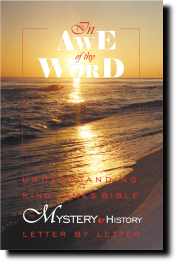
IN
AWE OF
THY WORD
Understanding the King James Bible
Its Mystery &
History
Letter By Letter
 |

by G.
A. Riplinger
Two books in
one!
- 1200
pages
- Hardback
- Color-coded
- Red ribbon
marker
|
A Classic
To Order From
Catalogue
| |
Detailing
Doctrinal Defects in the TNIV, NIV, NKJV, NASB, HCSB,
ESV
| |
The MYSTERY
|
The HISTORY
|
| DISCOVER what
translators and past generations knew --- exactly how to find
the meaning of each Bible word, inside the Bible itself.
|
THIS BOOK is the first and only
documented history of the words of the Holy Bible.
| |
- Understand also what translators, such as Erasmus and
Coverdale, meant when they spoke of the vernacular Bible's
"holy letters" and "syllables."
- See how these God-set alphabet building blocks build a
word's meaning and automatically define words for faithful
readers of the King James Bible --- which alone brings
forward the fountainhead of letter meanings discovered by
computational linguists from the world's leading
universities.
- Learn about the latest research tools from the
University of Toronto (EMEDD) and Edinburgh University,
which prove the purity of the KJV and the depravity of the
new versions.
- Find out how only the King James Bible teaches and
comforts through its "miraculous" mathematically ordered
sounds.
- Meet the KJV's built-in English teacher, ministering to
children and over a billion people around the globe.
- Journey around the world and see that only the KJV
matches the pure scriptures preserved "to all generations"
and "to all nations," including the Greek, Hebrew, Old
Italia, Italian, Dutch, German, French, Spanish and others.
|
- It is based on word-for-word and letter-by-letter
analysis of a vault of ancient, rare and valuable Bibles.
Ten thousand hours of collation rescued echoes from these
documents almost dissolved by time.
- See for yourself the unbroken preservation of the pure
holy scriptures, from the first century to today's beloved
King James Bible. Watch the English language and its Holy
Bible unfold before your very eyes.
- Examine the letters and sounds, shown in red, which bind
the words of each successive Bible from the Gothic,
Anglo-Saxon, pre-Wycliffe, Tyndale, Coverdale, Great,
Geneva, and Bishops' to the King James Bible.
- Uncover time-buried eyewitness reports, views and Bible
study secrets of history's great translators and martyrs.
- See word-for-word collations, aided by the KJV
translators' newly discovered notes, revealing exactly how
the KJV translators polished the sword of the Spirit.
- Watch in horror as the destroyer, through the NIV, TNIV,
HCSB, NKJV, NASB and ESV, teams up with Jehovah Witness and
Catholic versions to silence the utterances of the Holy
Ghost. History's Bibles and their champions defeat their
challengers, as they meet on this book's pages.
| |
Only the King James Bible matches "the scriptures...to all nations," which the "Holy Ghost" gave "every nation under heaven" in their "own language" (Rom. 16:26, Acts 2:4, 5, 6). In Awe of Thy Word has a thorough collation of the valuable Nuremberg 12 Language Polyglot of A.D. 1599, showing that only the KJV matches the historic Greek, Hebrew, Syriac, Spanish, Italian, French, German, Danish, Old Latin, Polish and other language scriptures, written before the KJV.
| To All Generations (Psa. 33:11) To All Nations (Rom. 16:26) |
A Brief preview of In Awe Of Thy Word - the Book
The Holy Bible has been hidden in hearts, hidden in
homes, and hidden from the wise and prudent; its
true history has been hidden by heretics. Yet, thousands of
years ago, penned in the East, the words of the true Bible,
have never ceased. It was the first book on the printing
press, bound there to stay, no less than every day. Millions
are given away; some are worth millions today. The Bible
so seeks to touch the blind, it raised its type for them to
find. “[F]or there is nothing covered, that shall not be
revealed” (Matt. 10:26). The “deep and secret things” he
has not concealed (Dan. 2:22). “But God hath revealed
them unto us by his Spirit: for the Spirit searcheth all
things, yea, the deep things of God” (1Cor. 2:10). The “word
of God is not bound” (2 Tim. 2:9). The bounty in the Bible knows
no bounds. The treasures it bestowed overflowed. The book
that you now hold broke the usual mold -- this guide is
two books in one and one of a kind. Scholars and children
alike will find a mine of discoveries on every line. To feed
both young and seasoned saint the chapters and tables are
set with milk and meat. Come feast with me at Jesus’ feet.
Discover how the Holy Bible may be studied and its words
understood. Learn where the Bible was before the KJV
1611. These mysteries are unveiled in this book. It will give
the reader a better understanding of the King James Bible,
its mystery and its history, letter by letter.
THIS is the first book to unveil treasures in the word
of God, using tools from the new field of
computational linguistics. This new research demonstrates
what Auburn University Professor, Ward Allen calls --
“[T]he miraculous perfection of the Authorized Version”
(Translating for King James, p. ix). The “miraculous” phenomena
documented in this book are found in every line of the KJV.
All sample verses were gathered at random. They represent,
not special spots, but the entire fabric of “holy scriptures.”
THIS book is the first and only history of the Holy
Bible based on a word-for-word and letter by
letter collation of ancient and early Bibles. It
demonstrates the Bible’s unbroken preservation from the
apostles to the King James Bible. Discover the kernel of the
King James Bible in the ancient Gothic Bible. See its
Germanic seeds sprout in the Anglo-Saxon Bible. Witness
as the English Bible’s bud bursts forth in the 12th and
13th centuries, even before it bloomed with the watering of
Wycliffe, Tyndale and Coverdale. Savor how the perennial
King James Bible sends forth the sweet scent of the full
bloom. This is the untold, underground hidden history of
the Bible, written, not by this author, but by the Bibles,
their translators, and the martyrs themselves -- Christians
who died rather than corrupt one word. It does not tell the
reader what to believe, but rescues echoes from ancient
documents almost dissolved by time, so today’s readers
may see the facts for themselves. Many books have been
written which have chronicled the history of the English
Bible. Unfortunately, many are like a hall of mirrors,
merely copying and echoing the same sounds. They repeat
what a few men say other men did, not what the scripture
says, God did. A history of the Bible must come from the
Bible itself.
The charts bound in this book are windows to the
past. Like Rahab, they “bound the scarlet line in
the window” to show the people of God the safe haven
(Joshua 2:18, 21). The charts’ scarlet line of letters, like our
Saviour’s life-preserving blood, binds the words of each
successive Bible from the most ancient to the English King
James. The Bible’s text is like a textile, a weaving of
words. God wove it from a fabric which could withstand
the wear and tear of the ages. Wycliffe said that to peel a
thread from any word is to begin unraveling the entire holy
garment of scripture (On the Truth, p. 2). The charts uncover the
fact that the enemy is at war with the word of God....
Brief preview of Chapter 9
Get close to the King James Bible and hear the hidden
heartbeat of God, just as the apostle John did when he
leaned on Jesus’ breast.
The word of God “liveth” (1 Peter 1:23). Only in
the “miraculous” KJV do accented syllables and
matching letter sounds pulse at equally
proportioned intervals, echoing the rhythm of the
life-giving breath of a living, breathing speaker --
the Spirit of the living God.
Because of this parasympathetic rhythm, the King
James Bible comforts the Christian, just like the
rhythmic rocking chair and the mother’s pulsing
heartbeat calms the nestled baby. “As one whom
his mother comforteth, so will I comfort you;” (Isa. 66:13).
Brief preview of Chapter 11
Examining the most important words in the Bible,
those being the names of God -- JESUS & JEHOVAH,
and then examining the seemingly least important endings
on words like “lovest” or “cometh,” demonstrates that only
the KJV brings forward every word and meaningful letter
in the Hebrew and Greek. The NKJV, NIV, TNIV, HCSB,
ESV, and NASB are bound together, like the thorns plaited
on Jesus’ brow, to pierce the name JESUS (e.g. Acts 3:13,
26, 4:27, 30, 7:45; Heb. 4:8) and completely remove the
name JEHOVAH from their pages. Worse yet, unbelieving
German lexicon editors and new version margins (e.g.
HCSB, KJV-ER) incorrectly replace the name JEHOVAH
with Yahweh, an off-shoot of the pagan Canaanite god,
Yaho. In 1767, John Gill defended the KJV’s translation of
the Hebrew, observing that “its explanation goes along with
it,” making “explanation by tradition” and lexicons
unnecessary (Gill, p. 234).
Brief preview of Chapter 16
This is the only history of the Bible that is built
almost entirely from the time-buried words of old
Bibles, their texts, their prologues, and the eye-witness
reports of history’s great Christians, translators, and
martyrs. This is an all-new history of the text itself; it
proves wrong many of the time-fogged imaginations of
modern writers. This and upcoming chapters [of] this book will
document the never-before-seen footsteps of the early pre-English
scriptures - from the disciples (1st century), century by century, to Wycliffe (14th
century) - through direct quotations from the men who actually lived during
these times: Tertullian (200s), Gildas (500s), Bede (700s),
Asser (800s), William of Malmesbury (1100s), The Anglo-Saxon
Chronicles (700-1200s), and John Foxe (1500s). In
these pages this author will share the extraordinary blessing
one receives by reading, not about old Bibles and great
martyrs, but reading their very words. The English Bible’s
seven purifications are covered, including,
•• The Gothic
•• The Anglo-Saxon
•• The Pre-Wycliffe
•• The Wycliffe
•• The Tyndale/Coverdale/Great/Geneva
•• The Bishops’
•• The King James Bible
Brief preview of Chapter 17
Inspired vernacular Bibles, in a sense, were born in Acts
chapter 2, when the “Holy Ghost” inspired men to speak
the “language” of “every nation under heaven.” Gothic, the
great great grandfather of English, was a major world
language at the time of Christ and the apostles. Gothic
benefited from this gift, by which the Holy Ghost
superintended over the preaching of the “word...in all the
world” (Col. 1:5, 6) and the translation of the “scriptures
...made known to all nations” (Rom. 16:26). The words of
English are much older than most think. The earliest
English sentence to be discovered appears on an old coin
dated around A.D. 450. (It says, “This she-wolf is a reward
to my kinsman” (see The Mother Tongue: English and How It Got That Way by
Bill Bryson). Gothic is so like English in the pronunciation of
its root words and even in its spelling, that it was relatively
easy for this author to learn Gothic (and Anglo-Saxon) in
one year and then collate their ancient scriptures. Many
dozens of verses are given to demonstrate that the Gothic
scriptures match the words and even the sounds of the King
James Bible (even italicized words!). All new versions are
shown to depart from this ancient Gothic text.
Brief preview of Chapter 18
Watch the English language and its Holy Bible unfold
before your very eyes - letter by letter and word by word
- from the first Gothic Bible, to the Anglo-Saxon Bible,
to the Wycliffe Bible, to the Tyndale Bible, to the Geneva
Bible, to the Bishops’ Bible, and finally to the King James
Bible. Watch in horror as the NIV, TNIV, HCSB, NKJV,
and ESV team up with the Jehovah Witness and Catholic
versions to silence the utterances of the Holy Ghost. The
move by editors (i.e. Cardinal Martini) to omit the Gothic
evidence in the 4th United Bible Society’s Greek New
Testament makes this history so very important.
Brief preview of Chapter 19
The trail of blood which brought us our English Bible
begins with those nameless Christians, who according to
Acts 2, received that tongue spoken by the “Barbarians” --
Celtic Britons -- living “in the isles of the sea” (Acts 2, Isa.
24:15). These missionaries brought the gospel and the
vernacular scriptures to England and Ireland. The
documentation presented here establishes a firm first
century foundation for the English Bible. It proves that God
preserved his word to “all generations” (Ps. 33:11). In spite
of intense persecution, a strong Christian community
passed the treasured vernacular scriptures from one
generation to the next. It dispels the myth that God fed his
true church at the hand of Rome with crumbs from corrupt
Latin scriptures. The Cambridge History of the Bible states
that scriptures were so widely known worldwide that a
deacon in the ancient church in Heraclea was “confident
that even if all copies of the Scriptures should disappear,
Christians would be able to rewrite them from memory...”
“[I]t is assumed by writers of the next hundred
years that lay people can without difficulty get
hold of Bibles for private study, if they will.
‘Get books that will be medicine for the soul,’
Chrysostom [A.D. 345-407] told his people. ‘At
least procure the New Testament, the Acts of
the Apostles, the Gospels.’ More surprisingly
perhaps, in the sixth century, Gaul Caesarius of
Arles can press his flock to buy the Bible and
read it at home in the dark hours of winter. He
does not appear to anticipate any lack of copies,
or that they will be impossibly expensive for
the farmer and tradesman” (vol. 3, pp. 476-477).
Brief preview of Chapter 20
Dozens of charts show the stable and steady scriptures from
the Anglo-Saxon Bible to the King James Bible.
Brief preview of Chapter 21
The myth that the English scriptures began with John
Wycliffe in the 1300s is shattered, letter by letter, with
quotations which prove that the roots and shoots of the
English scriptures flourished from Acts 2, through the
Anglo-Saxon period, and throughout the 11th, 12th, and 13th centuries, before Wycliffe. A comparison of verses from Middle English Bibles reveals that neither Wycliffe’s nor the King James Bible was the ‘first’ English Bible.
Brief preview of Chapter 23
The English Bible was used widely from the 1200s through
the 1500s, in spite of the “furnace” which burned at the
stake hundreds of English Christians and thousands upon
thousands of English Bibles. The handwritten
English Bible was cast in print under the watchful eye of
William Tyndale. What a blessing it is to read the very
words he penned about preaching, soul winning, salvation,
the Holy Bible, the Christian life, marriage, and the corrupt
Roman system. This author’s word-for-word comparison of
the actual scriptures of Tyndale, Coverdale, Rogers, and the
Great Bible sheds new light on their contributions to the
English Bible. Uncover dusty documents written in the
1500s revealing the deathbed salvation of Henry VIII, the
zeal for the Bible and subsequent poisoning of King
Edward VI, and the depravity of bloody Queen Mary.
Brief preview of Chapter 24
Tyndale and Coverdale agreed with Wycliffe, that “God” is
the “author” of vernacular Bibles. Coverdale said, “...the
Holy Ghost is as much the author of it in Hebrew, Greek,
French, Dutch, and English, as in Latin...[I]t is given by the
inspiration of God...” (see Ch. 24). Other ancient documents,
martyrs, and even secular kings concur. Hear martyrs
echoing agreement moments before they were burned. See
letter by letter collations proving the unbroken lineage of
the English Bible -- Tyndale lent a finishing touch,
polished a bit by Coverdale, the Bishops’, and the King
James translators. To keep the Bible pure, these multi-lingual
editors (e.g. Wycliffe, Erasmus, Tyndale,
Coverdale, etc.) compared pure Holy Bibles in various
languages. The current practice of transferring the Holy
Bible’s authority to “private” interpretations in pagan
Greek lexicons is proven to have no precedence in history.
Brief preview of Chapter 25
The means of understanding the word of God has been
a bone of contention since the first private interpreter,
Satan, said, “Yea, hath God said?” Read the words of
Christians who were burned, not merely for having Bibles,
but for believing that each word of the English Bible was
inspired. KJV translators, as youths, were eyewitnesses of
an era when men would rather be burned at the stake than
deny one word of the English Bible -- even dying to
defend the Bible’s built-in dictionary! (See also chapters 23, 22,
25, and 27). The Bible says, “...the inspiration of the
Almighty giveth them understanding” (Job 32:8). Did God
inspire Holy Bibles or lexicons?
Brief preview of Chapter 26
Examine the simple, but seldom seen, Bible study secrets
of the translators and martyrs. To define Bible words, they
did not recommend Greek tools, but turned instead to
God’s school, using the Bible’s own word twins.
Translators join a chorus of martyrs to warn against what
"man’s wisdom teacheth” and to recommend instead what
“the Holy Ghost teacheth” to those who have received
Jesus Christ as their Saviour and follow these seven keys.
• Fear of the LORD (Psa. 111:10; Prov. 1:7)
• Humility
• Believing the Holy Bible
• Praying
• Desiring to obey
• Meditating on holy scriptures
• Reading the Holy Bible again, and again.
Brief preview of Chapter 27
The translators of the King James Bible stated on a title
page that the New Testament was “translated out of the
Originall Greeke.” The translators would not have made
this claim if they had not had documentary proof or if they
had followed any Latin Vulgate readings. My seventh
textbook, New Age Bible Versions, gives a history of the
Greek New Testament, proving that the KJV matches the
oldest manuscripts, as well as the majority of manuscripts.
New versions are shown to base their changes on the
scantiest of evidence. My eighth textbook, The Language of
the King James Bible, shows that only the KJV matches the
oldest New Testament fragment, the Magdalene papyrus.
The book in hand, my ninth textbook, documents that the
King James Bible mirrors the manuscripts and printed
Bibles which for millennia were the mainstay of Europe. It
traces and examines the actual text of rare old Bibles
‘received’ by various language groups since the apostles.
These include, among others, the Old Italia, the Italian, the
Gothic, the Anglo-Saxon, the Dutch, the German, the
French, the Spanish, the Greek and the Hebrew. In Acts 2
God’s safety net provided that no one language group
would have a monopoly on the pure gospel. Discover how
these ancient and medieval vernacular Bibles would have
provided evidence for the readings in the KJV, particularly
wrongly disputed ones in the book of Revelation. Erasmus
also reveals why some Greek and Latin copies corrupt
verses about the deity of Christ and the blood; these errors
appear today in the NIV, TNIV, NASB, HCSB and ESV.
This chapter will trace the rich history of Europe’s Bibles,
through the discerning eyes of Erasmus, the crowning spirit
and intellect of Europe in the 1500s. Erasmus’s piety and
hands-on access to these ancient Bibles merged to make his
edition of the pure Greek New Testament unsurpassable by today’s critical ‘scholars.’ Erasmus’s view that vernacular Bibles are inspired led him to use them as proofs for
disputed readings and to use them in place of lexicons,
because Holy Bibles show the God-honored translation of
each word in each context. His esteem for vernacular
Bibles is shared by Wycliffe, Coverdale, the KJV
translators, and Theodore Beza, whose Greek New
Testament was compiled using a collation of Greek and
vernacular editions, particularly the Syriac and Aramaic.
Few have given a clear-sighted view of the true beliefs of
Erasmus. What has been hidden from sight, is here in black
and white. Armed with one of the rare remaining original
editions of Erasmus’s work (valued at over $26,000.00) and his
own comments on many subjects, this author allows the
reader to see Erasmus through his own devotional writings.
These unmiter the myths which match him with Rome.
A Brief preview of In Awe Of Thy Word - the CD
|
[ In addition to containing the entire 27 chapters of the hardcopy book In Awe Of Thy Word, the CD also contains other valuable information, including the Nuremberg 12 Language Polyglot of A.D. 1599; Important little known facts about Erasmus and the Scriptures; and The Acts And Monuments by John Foxe (known today as Foxe's Book of Christian Martyrs – all eight volumes). ]
|
|
NUREMBERG POLYGLOT
Where was the Bible before the English King James Bible of 1611? How do we know
which type of Bible God gave to “all nations under heaven” (Acts 2)? .... These questions can be answered by looking at the Bibles that the KJV
translators had access to, those that were used around the world before the King James
Bible.
God has graciously given this author one of the scarce remaining original editions of the
twelve language polyglot Bible printed at Nuremberg, Germany in A.D. 1599. It contains
the Gospels in Greek, Hebrew, Syriac, Latin, French, Italian, Spanish, English, German,
Danish, Bohemian, and Polish. Its previous owner was A. Gifford D.D., co-founder of the
British Museum. Its price tag was well worth the secrets it revealed. It demonstrates the
perfect agreement of the English King James Bible with all pure Bibles from other
languages. It is perhaps the most important polyglot Bible in print because it was printed
twelve years before the KJV and five years before the KJV’s translation work began.
Its editor, Elias Hutter, was an unsurpassed linguist who “founded a school of languages at Nuremberg...a thing at that time without precedent in any school or University” (The New Schaff-Herzog, vol. V, p. 422). As a Reformer he followed the vernacular editions which were not from the Catholic lineage. Therefore, Anglo-Catholic historians have a distaste for his text. Europe’s monarchs recognized his text as the authoritative and beloved Bible of the Christian people. In 1579 he was asked to teach Hebrew to the elector Augustus of Saxony. In 1600 Charles IX of Sweden asked him to produce a Swedish Bible.
In 1599 the following fonts were used in some languages in place of those used today: f =
s, v = u, u = v, and i = j; those letters were pronounced just as they are today; for
instance, the English Jefus was pronounced Jesus; actually the old f font is not ‘f’ but a
giant ‘s’ with a tiny line in it. Letter capitalization did not carry the same meaning it
does today, nor does it carry the same meaning in all languages.
The verso (left hand pages) show the Gospels (from left to right) in Syriac, Hebrew, and
Greek. Below them (from left to right) is Italian, Spanish, and French.
The recto (right hand pages) show the Gospels (from left to right) in Latin, German, and
Bohemian. Below them (from left to right) is English, Danish, and Polish.
The Nuremberg Polyglot provides documentation for chapter 28 of In Awe of Thy Word
by G.A. Riplinger (Ararat, VA: A.V. Publications, 2003). It also allows the readers to document for themselves the agreement of the pure “scriptures... made known to all
nations” (Rom. 16:26). It makes glaringly clear that new versions, such as the TNIV,
NIV, ESV, NKJV, HCSB and NASB divert dangerously from "the word" given "in all
the world" (Col. 1:5, 6). (A tool such as Harrap's Five-Language Basic Dictionary, ISBN
0-13-387986-0, can speed the comparison, should the reader not be blessed, as I was,
with collation help from internationally known multi-lingual translator, Carlos Donate,
who is conversant in almost all of the languages of the Polyglot.)
THE TOME OF THE PARAPHRASES OF ERASMUS UPON THE NEW TESTAMENT
The Tome of the Paraphrases of Erasmus Upon the New Testament (A.D. 1548-1549) is
accompanied by the corresponding text of the Great Bible (c. A.D. 1539-1540). (The
Great Bible was a revision by Coverdale of the Mathews Bible.) This dual document was
placed in all churches by the command of King Edward VI.
The heir of Henry VIII, nine-year-old Prince Edward VI, brought six years of peace and
the printing of Bibles once again to England. When crowned King, Edward was given
three swords, symbolizing the three countries he ruled. He asked where the fourth sword
was –
“The Bible, the sword of the Spirit, and to be preferred
before these swords” (W. Kenneth Connolly, The Indestructible
Book, Grand Rapids, MI: Baker Books, 1996, p. 154).
Edward VI, “did that which was right in the sight of the Lord,” like godly King Josiah,
who began ruling Judah at the age of eight. Like Josiah, he returned “the book of the law
in the house of the LORD” (2 Kings 22). Thirty-one printers in England set about
printing only Bibles (Guppy, p. 24). He commanded also that “the whole Bible of the largest volume in English and...the paraphrase of Erasmus” be placed in churches for, “every person to read the same as the very lively word of God” (Foxe, vol. 5, p. 708). Through the kindness of the Lord and the generosity of Jewel and David Smith, this author has one of the few remaining original editions (now kept in a bank vault). Its preface shows strong Christian convictions and marked anti-popery; the Paraphrase of Erasmus shows strong Christian orthodoxy.
Coverdale returned to England in 1548 and was made chaplain to King Edward VI. He
“assisted in the translation” of the Paraphrases of Erasmus (1549 edition of Whitchurch, 2nd volume; Guppy, p. 25). Coverdale took part in King Edward’s reforming measures.
King Edward had decreed before his death that the next ruler should be Lady Jane Gray, a godly Christian relative. However, his sister Mary, with much public support, took the crown.
In 1554 the reading of Scripture was by Act of Parliament placed under severe
restrictions. To get rid of what the Catholics called, the “heretically translated Bible,”
Mary banished every “preacher, printer, bookseller” in 1554 (Foxe, vol. 6, pp. 504, 430). The Great Bibles and Paraphrases of Erasmus were removed from the churches and destroyed; yet to glorify his word, the Lord hid one for this writer’s collection.
Rare Bible collectors are offering for sale, Erasmus’ Paraphrases upon the New
Testament [English translation], bound with an edition of the Great Bible. It is the only
copy on the market today in the world. The price for this second edition is $26,000. God
gave me the first edition (1548-49), which is now nestled away in a bank vault, following
my eye straining analysis of it....
Erasmus comments on the New Testament are made available on this CD-ROM,.. to make available a primary source, written by a man
whose character has generally been distorted by second-hand slanders. It reveals the
views of a man God used to print the pure Greek New Testament which parallels the
King James Bible.
The main reason for making this rare document available to the public is to allow readers
to actually see the text of the Great Bible, an historic English Bible used before the King
James Bible of 1611. Could the reader locate a Great Bible today, it alone would cost
between $10,000.00 and $20,000.00.
This document will provide documentation for and expand upon the research presented in
the book, In Awe of Thy Word by G. A. Riplinger (Ararat, VA: A.V. Publications, 2003). It will also enable the reader to compare the text of the Great Bible to today’s versions, verifying the faithfulness of the KJV and exposing the corruption and omissions in
today’s TNIV, NIV, NASB, NKJV, NRSV, ESV and HCSB.
THE ACTS AND MONUMENTS BY JOHN FOXE
THE ACTS AND MONUMENTS (known today as Foxe's Book of Christian Martyrs) by John Foxe, traces Christianity from the first century to the 1500s. All eight of its large volumes from A.D. 1563 are included on this wonderful CD (In Awe Of Thy Word, the CD). Most modern reprints or newer versions of John Foxe's books tend to distort or omit much of what the Author actually wrote. View for yourself the very words of one of the greatest Christian historians of all times (available on the CD).
See also CATHOLIC INQUISITION VIDEO
and FOXE's BOOK of MARTYRS, 1830 (and 1563) PREFACE
and ANTICHRIST REVEALED IN SCRIPTURE
God knows his English ABCs. He apparently wrote them
on butterfly wings, even before the English Bible took
flight. A Smithsonian Institute photographer has discovered
that each of the 26 letters of the English alphabet is written
on the wings of butterflies! In the 1500s Erasmus said,
“God is in every syllable” (The Bible Through the
Ages, p. 306).
When God made the butterfly, he was sure to cross its ‘t’ and dot its ‘i’s.
Smithsonian Institute nature photographer, Kjell Sandved,
discovered that every letter of our English alphabet, A to Z,
is drawn beautifully on the wings of butterflies. He has
documented all 26 letters in his book and fine art poster,
The Butterfly Alphabet (available from AV Publications).
“The heavens declare the glory of God; and
the firmament sheweth his handywork. Day
unto day uttereth speech, and night unto
night sheweth knowledge. There is no
speech nor language, where their voice is
not heard...their words to the end of the
world” Ps. 19:1-4.
The “voice” of God’s “handywork” “uttereth speech,” even
through English letters on butterfly wings. It is as if the
skies were scrolls and the seas were ink. God dipped his
pen to paint his love letters and sent them ‘air mail.’ They
have flown by, sky high, then drawing nigh, so you and I
can see them fly. Like butterfly wings, the delicate fluttery
pages of the Holy Bible open, side by side, revealing God’s
holy letters.
“In the mouth of two or three witnesses shall every word be established.” (Matt. 18:16; II Cor. 13:1)Recommended Reading
- 1611 KING JAMES BIBLE's NEW TESTAMENT Photographic Reproduction of the Original 1611 KJV Bible's New Testament
Seeing its readings proves to cynics that the KJV's text has never been "revised" and is identical to that used today (except for the rare 1611 typographical slips which were shortly thereafter fixed by King James translators themselves).
- BIBLE PROBLEMS by Gerardus Bouw
Answers every question. A classic! Proves KJV error free!
- KING JAMES: UNJUSTLY ACCUSED by Stephen Coston
Conclusively proves false the myriad of lies propagated about King James.
- CHRONOLOGY OF THE OLD TESTAMENT by F. Jones
Compelling answers for those who say there are errors in the KJV.
- A DISSERTATION CONCERNING THE ANTIQUITY OF THE HEBREW LANGUAGE, LETTERS, VOWEL-POINTS, AND ACCENTS by John Gill
It documents and traces the Hebrew Old Testament to its origin, proving that God's name was pronounced JEHOVAH.
- A TESTIMONY FOUNDED FOREVER: THE KING JAMES BIBLE DEFENDED IN FAITH AND HISTORY by James Sightler
The most thoroughly researched book on the KJV issue in the last 100 years!
- WHICH BIBLE? edited by D.O. Fuller
The classic defense of the KJV which led Dr. S. Franklin Logsdon, who had set forth the guidelines for the NASB, to renounce his own NASB and all new versions.
- THE IDENTITY OF THE NEW TESTAMENT TEXT edited by Wilbur Pickering
The best single book (facsimile) documenting that the most recent scholarship and collation of the papyri prove that the KJV readings are earlier than those in modern versions.
- THE KING JAMES VERSION DEFENDED by Edward F. Hills
The author presents overwhelming evidence for the historical accuracy of the KJV.
- FOREVER SETTLED by Jack Moorman
An excellent history of the bible and its documents. It answers well the question "Where was the bible before the KJV 1611?"
- HISTORY OF THE DEBATE OVER 1 JOHN 5:7-8 by Michael Maynard
Powerful new release.
- KJV's OWN DEFINITION OF OVER 800 WORDS by Barry Goddard
(50+ xerox pages)
- IN AWE OF THY WORD by G.A. Riplinger
This book is the first and only documented history of the words of the Holy Bible.
- NEW AGE BIBLE VERSIONS by G.A. Riplinger
An exhaustive documentation exposing the message, the men and the manuscripts moving mankind to the antichrist's One World Religion.
- HAZARDOUS MATERIALS by G.A. Riplinger
Sequel to New Age Bible Versions. Proving the inspiration of the KJV & the hazardous materials underlying the NIV, NKJV, ESV, NASB, and HCSB.
- MASONIC AND OCCULT SYMBOLS by Cathy Burns
Traces the history of occult/Satanic symbols and their influence upon society and the church. Includes 728 illustrations.
- FINAL AUTHORITY by William Grady
This book exposes the deceit behind many of the common charges leveled against the A.D. 1611 Authorized version, and addresses those issues rarely discussed by critics of the King James Bible.
- ONE BOOK STANDS ALONE by Douglas D. Stauffer
This author personally exposed the errors of the NKJV editor, James Price, in front of Price's bible school's president, leaving Price speechless and the president promoting this author's book.
Click here for important notice regarding information & recommended material on this web site!
Most of the books listed above are available at AV Publications, Corp.
CLICK HERE FOR RONALD REAGAN AND THE KING JAMES BIBLE
CHRISTIAN LIFE & CHARACTER OF THE CIVIL INSTITUTIONS OF THE UNITED STATES
CLICK HERE FOR FACTS ABOUT AMERICAN PUBLIC SCHOOL EDUCATION
CLICK HERE FOR HISTORICAL BOOKS & DOCUMENTATION OF FACTS
————————— Articles and Books by Various Authors —————————
Click your Back button to return to the previous page! or
CLICK HERE for the MAIN PAGE!To Top of Page!