
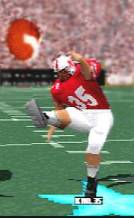
 Nebraska's Kris Brown puts another through the uprights, keeping his extra point streak alive. The Huskers pound Washington 55-7. Nebraska's Kris Brown puts another through the uprights, keeping his extra point streak alive. The Huskers pound Washington 55-7.
|
Special Teams
 Basic Tips Basic Tips |
 On kickoffs, always try to kick it deep into the end zone to avoid any possible return. Any return can be a dangerous return that could give your opponent better field position. Make them earn every yard. The chances of pinning your opponent deep are not worth the chances of giving up on the "field position" game. On kickoffs, always try to kick it deep into the end zone to avoid any possible return. Any return can be a dangerous return that could give your opponent better field position. Make them earn every yard. The chances of pinning your opponent deep are not worth the chances of giving up on the "field position" game.
On kickoffs, choose the middle kickoff. Kickoffs left or right do not cover the field well. A kickoff returner can either run wide to the opposite side where your defense is thin, or run straight up the near sideline where your defense usually over runs the play. This is especially dangerous if the returner has blazing speed. Save kickoff left or right for when you are behind and need to gamble.
On kickoffs, choosing middle, kick the ball slightly left to the first "notch" in the meter bar and use the "low long kick" (O) button. A "low long kick" will improve your chances of getting good distance. It also is much more difficult for a returner to get in position. If for some chance you did not make the full meter on the kick, a "low long kick" gives you a better chance of the ball hitting the ground, thereby rolling into the endzone.
| Blocking Punts |
Ok, Ok, Ok, your down a couple touchdowns and the clock is ticking. You've made a good solid defensive stand, forcing your opponent to punt. But you want to make more happen. Your tired of seeing that smirk on your opponent's face. Time to wipe it off. Time for a blocked punt!
There are many ways to block a punt. I am sure a few of you out there have your own technique. The blocked punt procedure that I have used has about a 50/50 percent success rating when excuted properly. There are some key ingredients though. I will list them as follows:
The Recipe
A fast linebacker with a speed/agility rating of at least 70.
Placing him at the weak side on a 4-3.
Calling "only" a weak side blitz from a 4-3.
A defensive line shift to the opposite or strong side.
Letting the computer control this blitzing player early.
Controlling him at the end with a dive.
A little luck.
| In Figure 1 Tennessee's #46 Thompson is lined up on the weak side. He is not under human control. The defensive line has already shifted. This shift to the opposite side pulls the opposing LT momentarily away leaving less traffic to contend with. As a decoy, I highly recommend taking the defensive end on the opposite side using a swim move (R2) trying to put as much pressure as possible. | 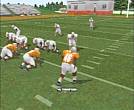 Figure 1
|
| In Figure 2 he has already shed the opposing 2nd string TE with sheer speed/agility. Note that he is still under computer control, taking the most direct route to the punter. If you have taken the defensive end on the opposite side, that will draw the holder's attention - reducing the chances of the him getting a last second block on your rushing weak side linebacker. | 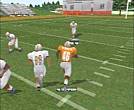 Figure 2
|
| In Figure 3 he is finally under human control. It is here you take a few steps with him as you prepare for the big dive. It is essential that you dive, because of the angle it is difficult to actually block the ball. The goal here is to tackle the punter with the ball. | 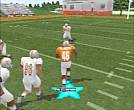 Figure 3
|
| In Figure 4 only the inevitable remains - the blocked punt. There still is a chance that the tackle will not be made, as on some rare occasions the punter does not come down. But rest assured, possibility of getting the kick off has been eliminated. The punter is left to run it on his own like a chicken running from a pack of wolves. | 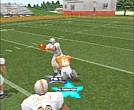 Figure 4
|
Finding The Speed
Can't find a linebacker with enough wheels to make the play? The blocked punt scheme above demands personnel with speed. You can find it elsewhere though. Try the tips below.
Choose Dime and audible into the 4-3 Weak blitz. Here your 4th string cornerback will take the place of the linebacker. Your stuck with using this cornerback, because in Dime all corners are used and there are no spares for rotating substitution. If your 4th stringer has speed/acceleration above 70, this might be a easy "no hassle" alternative. Make sure to follow the same scheme above.
Go to the substitution menu, then choose -defense, -special teams, -punt return, and put your fastest player (whether be a HB, WR, CB, etc.) in at the weak linebacker position. This will blow one of your 25 team substitutions' limit, but it will pay dividends when the game is on the line. Again, follow the scheme described above. Good Luck!
| Going For Two |
Games can come down to a matter of inches. They can also come down to a "second guessed" two point conversion decision. Here is a chart to assist you with the decision:
If your team's
ahead by: | You should: | If your team's
behind by: | You should: |
| Even | Kick | Even | Kick |
| 1 | Go for 2 | 1 | Kick (depends on time,
consider going for 2 to win) |
| 2 | Kick | 2 | Go for 2 |
| 3 | Kick | 3 | Kick |
| 4 | Go for 2 | 4 | Kick (but consider going for
2 to win with a field goal) |
| 5 | Go for 2 | 5 | Go for 2 |
| 6-10 | Kick | 6-8 | Kick |
| 11 | Go for 2 | 9 | Kick (but consider going for
2 because you'd only need a touchdown to tie) |
| 12 | Go for 2 | 10 | Go for 2 |
| 13-18 | Kick | 11 | Kick |
| 19 | Go for 2 | 12 | Kick (but consider going for
2 because then a touchdown
and field goal could tie) |
| 20 | Kick | 13-15 | Kick |
| 21 | Kick | 16-18 | Go for 2 |
| 22 | Kick | 19-20 | Kick |
| 23-24 | Kick | 21 | Go for 2 |
| 25 | Go for 2 | 22-24 | Kick |
| 26-28 | Kick | 25-26 | Go for 2 |
| | 27 | Kick |
| | 28 | Go for 2 |
MAIN |
User Profiles |
Analog Passing |
Bluff Mode |
The Offense |
The Defense |
Special Teams
Substitutions |
Play Submission |
2000 Wish List |
Rosters |
Game Codes |
EA Faqs |
Sermon Archive
Message Board |
Chat Room |
Links
|

