
 Texas QB. Richard Walton is swarmed by a stingy Kansas State defense. Texas lost the battle 7-48.
|
The Defense
 Basic Tips Basic Tips |
 Choose to control a defensive lineman and rush the quarterback aggressively using the "swim move" (R2). Choosing to control another defensive player in a man/zone coverage will only increase human error, blowing vital coverage assignments against passing routes. Choose to control a defensive lineman and rush the quarterback aggressively using the "swim move" (R2). Choosing to control another defensive player in a man/zone coverage will only increase human error, blowing vital coverage assignments against passing routes.
Control the defensive end closest to an opposing tight end, and bump 'em. Bump the tight end as you perform your "swim move" (R2). If the tight end is on a pass route, this can severely affect his timing, thereby affecting his chances of catching a short pass.
Shift your defensive line frequently (L1,R1) before the snap. It can be a small gamble in your favor, especially if done at the snap of the ball. This tests the offensive line's "awareness" and occasionally creates missed offensive blocking assignments. The payoffs are easy defensive sacks and stuffs up the middle.
Stick to choosing conservative "cover-all" defenses (4-3 man/zone,4-3 zone base), and adjust from there. These defenses can cover a lot of what an offense can throw at you, with little emphasis or "commitment" to any particular area of the running or passing game. These are wise choices when you find it difficult to "anticipate" what your opponent will run at you.
Choose 10 or 15 minute quarter games. Stay away from the quicky 5 minute quarter game trap. Good solid defensive play shines in a longer game. With the longer quarters, you can take advantage of a patient, tactical, defensive game plan (especially if you're behind early). The "luck" element can therefore be eliminated, or limited to a minimun. I have always tried to attain victory through the efforts of my defense, rather than the execution of my offense. Defense wins games!
Play man to man defense inside the 20 yard line. Due to the shorter field of play, zone (or area) of coverage is not as effective (esp. with defesive backs). An offense is more apt to strike quick inside the twenty, therefore defense should be tight. The only exception to this would be to allow a wide zone coverage from your outside linebackers to assist in the short field containment and cover short passes to running backs in the flat.
Get wacky with positioning your defensive linemen before the snap for a enhanced rush against the QB. Getting to the QB is a critical part of being successful defensively in NCAA Football 99. Positioning your defensive linemen in unorthodox alignments exploits offensive linemen whose "awareness" is suspect. Best used exclusively when your rushing the QB against the pass with only linemen. Not recommended when anticipating the opposition running the ball up the middle.
| Formation Overview |
It all starts with a good defensive formation choice. Here is a run-down of the basic formations, What They Do, and When They Work Well. Linemen are shown in white, linebackers in red, and defensive backs in yellow.

GOAL LINE:
What It Does: Stacks everybody on the line of scrimmage, and pulls all necessary defensive backs off the field, leaving only a couple of cornerbacks and a safety, if even that. Make sure your opponent won't pass very far, if at all.
Works Well When: You use it against the run, especially on the - you guessed it - goal line. There, your lack of pass coverage is hidden by the small amount of passing area.
|
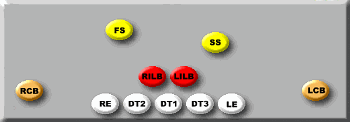
5-2:
What It Does: Provides a goal line-like defense by having five linemen but has a bigger safety net against long passes since an extra safety is brought in. Still, don't for a second think this is a strong pass defense.
Works Well When: Your opponent runs the ball, and might even be pretty good to use if they run a short pass play. The extra safety also provides a nice piece of mind.
|
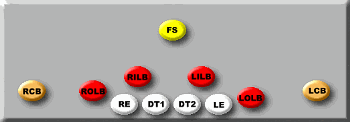
4-4:
What It Does: Provides a good over-all interior run support by having four linebackers. With the abundance of linebackers, it is a good formation to "blitz" from. This defense can also be considered good against short passing routes.
Works Well When: Your inside your own 20, and need good defense in limited spaces. Also a good choice when you anticipate your opponent's goal to be 3-7 yards. This one can get burned deep with linebackers not keeping pace with speedy multiple receiver sets.
|
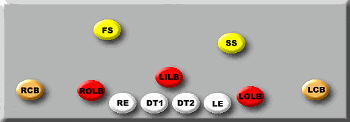
4-3:
What It Does: Covers every part of the field adequately by spacing out defenders evenly. Also allows for run stuffing by keeping three linebackers within striking distance of the line of scrimmage. Good overall defense choice when you need something to cover all the bases.
Works Well When: You pick a good play out of the formation. It is soft against outside runs and some long and very short passes, but it's not going to excel or fail at anything too often.
|
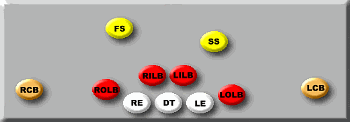
3-4:
What It Does:Deducts a defensive lineman and adds a fourth linebacker. It is a very flexible defense. Ideally suited to defend multiple offensive formations, allowing you to match personnel effectively.
Works Well When: You don't have enough quality defensive linemen. The four linebackers allow for more blitz versatility. It can be a bit soft on the inside run, depending on linebacker personnel assignments.
|
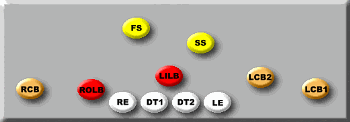
Nickel:
What It Does: Substitutes a linebacker with a cornerback. This gives a defense flexibility against the pass, while leaving enough bruising linemen and linebackers to stuff or at least contain runs.
Works Well When: The offense is running three wide receiver sets, or when the opposing offense is having trouble running the ball. If that's happening go to this set to stifle the pass.
|
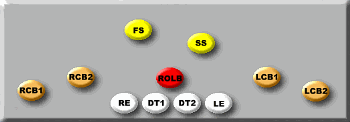
Dime:
What It Does: Leaves in only one token linebacker to provide some bulk, but has two more defensive backs than most defensive formations. It will stifle the medium to long pass, but is extremely weak at the line of scrimmage.
Works Well When: Your opponent is running three or four wide receiver sets. This is also the formation teams use when they are in Prevent Mode, trying to protect a lead.
|
| Coverage Audibles |
Defensive Coverage Audibles are nothing new to this year's Ncaa Football '99 title. They made their debut in the '98 version. But to some, they still my be a new and unknown. The direction booklets devoted minumal attention to this very maximizing aspect of the game. Well, those folks had to leave something for you to dig for. And...here you are digging.
These audibles basically tell your linebackers, cornerbacks, and safeties (or whoever is in coverage) how to "behave". According to EA, after activating the audible with (triangle) choose one of the following:
Push (square) to call a tight coverage. When a tight coverage audible is called the player will either move up into
a tighter zone (when in zone coverage) or tighten up their man coverage
(play a little closer to their receiver). This also is a good choice when trying to defend the run.
Push (O) to call a loose coverage. When a loose coverage audible is called the player will either move back into a looser zone (when in zone coverage) or loosen up their man coverage (play looser or reactionary defense against their receiver). This is also a good choice when you anticipate your opponent passing more than 20 yards. It maximizes the prevent capabilities of any defensive formation.
Push (X) to call a normal coverage. When a normal coverage audible is called the player will react "normal", as the default coverage coming into any defensive play. You can look at this as a "cancel" varible, but it also makes for a good bluff against your opponent.
Push (triangle) to cancel the coverage audible. This will take you back to your "normal" or "default" coverage.
MAIN |
User Profiles |
Analog Passing |
Bluff Mode |
The Offense |
The Defense |
Special Teams
Substitutions |
Play Submission |
2000 Wish List |
Rosters |
Game Codes |
EA Faqs |
Sermon Archive
Message Board |
Chat Room |
Links
|

