|
|
Because I am from Indiana I have placed info regarding Indiana fishing. License Regulations for The State of Indiana To fish in public lakes, streams, rivers or tributaries in the state of Indiana or its boundary waters, you must have a valid fishing license. License holders must carry their license while fishing and present it to a conservation officer (or any authorized law enforcement official) upon request. There are fines and penalties for fishing without a license. You must also have a valid trout and salmon stamp in your possession to legally fish for or take trout and salmon from public waters. These regulations only apply to fish that originate from, or are taken from, the public waters of Indiana. Fish from public waters that migrate into or from private waters are still covered by these regulations. These regulations do not apply to fish in private waters that did not originate from public waters.
A fishing license may be revoked if the license holder is convicted
of violating fish and game regulations. Any equipment, appliances and
apparatus used in the violation of Indiana fish and game laws may be
seized for evidence and, upon conviction, confiscated. Resident of Indiana
A resident is a person who has lived in Indiana continuously for a
period of 60 days preceding the date of license or permit purchase.
A fishing license and trout and salmon stamp are NOT required for: o Indiana residents 65 years of age or older. However, you should carry your driver's license or other identification to verify your age and residency. o Resident and non-resident anglers under the age of 17. o Residents who are legally blind. o Residents of a state-owned mental rehabilitation facility. o Residents of any licensed health care facility in Indiana taking part in a supervised fishing activity sponsored by the facility. o Fishing a private pond does not require a license. However, you must have permission from the property owner to fish. o Residents of Indiana who are engaged in full-time military service may fish without a license while on approved military leave. However, the angler must carry leave orders and a valid Indiana driver's license or voter registration card. Non-resident military personnel stationed within Indiana must obtain a resident license to fish or hunt in Indiana. o Landowners or lessees of farmland, who farm that land, their spouses and children living with them, while fishing in public waters from the farmland they own or lease. o Some non-resident landowners, while fishing in public waters from the farmland they own, according to the exemptions that their state provides to Indiana residents. See the website at www.wildlffe.IN.gov or call (317) 233- 4976 for specific information. Purchasing a License ONLINE:
To purchase resident and non-resident licenses online - 24 hours a
day, seven days a week, IN PERSON: Most licenses, including youth hunting licenses, are available from independent agents, county clerks and most Department of Natural Resources properties throughout the state. Non-resident licenses are available at the state's Customer Service Center in Indianapolis and at most DNR properties.
(317) 233-4976
Send your order with the following information:
o Name, date of birth o Complete address, city, state, zip, phone number o Height, weight, sex, color of hair and color of eyes o Social security number is mandatory o Specify the licenses that you need and dates for one-day or multi-day licenses
Send check, money order or credit card number (Visa or MasterCard
only) for licenses BY PHONE:
To purchase licenses by phone, call (317) 233-4976.
For more information, call the Indiana DNR Customer Service
Center at (317) 233-4976. Lifetime Licenses
Avid Indiana resident hunters and anglers may purchase lifetime
hunting, trapping and fishing licenses. Discounts apply for lifetime
license buyers over 50 years old. For an application and information, write to DNR Customer Service Center, 402 W. Washington St., Room W160, Indianapolis, IN 46204, or call (317) 233-4976 or go to www.wildlffe.IN.gov.
Landing nets, gaff hooks or grab hooks may be used only to assist in
the landing of a legally caught fish. You may fish with no more than three poles or hand lines at any one time. Each line may have no more than two single or multi-barbed hooks two artificial baits or two harnesses for live bait.
Single or multi-barbed hooks may be used for hand or pole lines,
float or jug fishing, limb, drop or trot lines. Special hook size and
barb regulations apply to Lake Michigan and its tributaries. Trot Lines
A trot line (also called a set line or throw line) is a fishing line
with smaller lines attached to it extending out into the water from a
fixed point, such as a boat dock or tree. You may fish with no more
than one trot line at any one time. The trot line must have no more
than 50 single or multi-barbed hooks. Each drop line on a trot line
may have only one hook. Trot lines must bear a readable tag clearly
showing the name and address of the user, and be checked at least
once every 24 hours. It is illegal to use a trot line within 300
yards of any partial or full dam structure on any stream or river.
Trot lines are not allowed on lakes and reservoirs. Limb Lines
A limb line (or drop line) involves suspending a fishing line
from a limb extending beyond the bank of a body of water. You may
fish with no more than 10 limb or drop lines at any one time. Each
line may have no more than one single or multi-barbed hook attached
to it. Each line must have a readable tag showing the name and
address of the user. All lines must be checked at least once every 24
hours. It is illegal to use a limb or drop line within 300 yards of
any partial or full dam structure on any stream or river. Limb lines
are not allowed on lakes and reservoirs. Float Fishing Float or jug fishing is the use of any buoyed container (made of any material other than glass) that suspends a single fishing line and a single or multi-barbed hook. As many as five floats may be used, but only one hook may be attached to each float line. Each float must be marked with the user's name and address, and all lines must be in constant visual contact. Float fishing is not allowed on lakes and reservoirs for public safety.
There is no closed season for bass in Indiana. However, no largemouth bass may be taken at any time from Dove Hollow Lake at Glendale Fish and Wildlife Area.
Inland
trout seasons and closures are listed here.
All other waters and fish species have no closed season.
Suckers, carp, gar, bowfin, buffalo and shad may be taken at the
locations below with the equipment listed, and only during the hours
noted. There are no bag limits for these fish.
Large Streams o White River from the Wabash River upstream to the junction of East and West Forks o West Fork of White River, upstream to the dam below Harding Street in Indianapolis o East Fork of White River, upstream to the dam at the south edge of Columbus o The Wabash River, upstream to the town of Wabash o The Tippecanoe River, upstream to 1/2 mile below its confluence with Big Creek o The Maumee River, upstream to the Anthony Blvd. Bridge in Ft. Wayne o The Kankakee River, upstream to Highway 55 bridge o The St. Joseph River (upstream from Twin Branch dam) in St. Joseph and Elkhart counties Equipment: Fish spear, gig, spear gun, underwater spear can be used all year, day or night. A pitchfork and bow and arrow can be used only between sunrise and sunset. Crossbows may not be used.
Small Streams Any and all streams or partial streams not listed above. Equipment: Pitchfork, and bow and arrow only. Crossbows may not be used. Time: All year, sunrise to sunset.
Non-flowing Waters Equipment: Fish spear, gig, spear gun, underwater spear, pitchfork, and bow and arrow. Crossbows may not be used. Time: All year, day or night. Smelt may be taken from Lake Michigan and Oliver Lake in Lagrange County from March 1 through May 30. Smelt may be taken only with a single seine or net. The seine or net may not exceed 12 feet in length and six feet in depth nor have a stretch mesh larger than 1-1/2 inches. A dip net may not exceed 12 feet in diameter. You may want to consider using fishing sinkers that do not contain lead if you are concerned about your exposure to lead. Alternatives to lead sinkers are made out of steel, bismuth, tungsten and resin. Wildlife health may be affected if lead or zinc sinkers are ingested. Anyone interested in marking or tagging fish in public water must get approval from the Division of Fish and Wildlife before marking or tagging begins. An application, available from the Division of Fish and Wildlife, must be processed 21 days be fore the scheduled start date. An approved permit must be carried by the permit holder when fish are being marked and tagged. Contact the division for more details, (317) 232-4080.
Fisheries biologists attach external tags or mark fish using finclips
for research projects. Please report all tags to a district fisheries
biologist. At some waters, voluntary tag return boxes have been
installed. If you cannot locate one of these tag return boxes, mail
the tag to the nearest fisheries biologist (see page 31). Provide the
biologist with the type of fish caught, the length, date, location,
weight of fish and the tag number. If a tagged fish is released, the
tag should be reported but left in the fish in good condition. The
following waters have active tagged fish projects under way:
Tn-County Fish and Wildlife Area (largemouth bass), Lake Wawasee
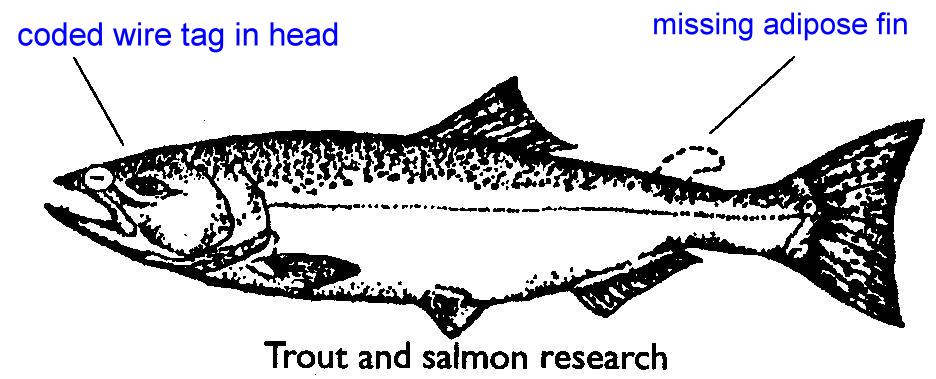
(largemouth bass) and Lake Michigan (yellow perch, trout and salmon). Some fish, such as paddlefish on the Ohio River and trout and salmon on Lake Michigan and its tributaries, have internal tags about the size of a hyphen on this page. The adipose fin on trout and salmon has been removed to make it easier to determine if the fish you catch has an internal tag.
Your cooperation is needed to recover these tags from trout and
salmon missing an adipose fin. The adipose fin is the small fleshy
fin on the backs of some fish between the dorsal fin and the tail
(caudal fin). If you catch trout or salmon with a missing adipose
fin, please record the length, weight and species, as well as the date and location where the fish was caught. The nose area of trout and salmon with a missing adipose fin contains a micro wire containing important research information. Please save the head from your tagged trout and salmon, then contact the Division of Fish and Wildlife at (219) 874- 6824 for instructions on what to do with the head. The micro wire tags can be recovered and reused. Remember, only trout and salmon with a missing adipose fin contain micro tags. Except for the Ohio River (see page 10), it is illegal to snag fish from public waters in Indiana. Snagging is the practice of dragging or jerking a hook (or hooks), baited or unbaited, through the water with the intention of snagging fish on contact. Warning: it is illegal to take a paddlefish from any lake or stream in Indiana except the Ohio River. Paddlefish caught from any public inland lake or stream must be immediately returned to the water. When ice fishing, no more than three lines may be used at any one time. Each line may contain no more than two hooks (single, double or treble) or two artificial baits. Holes cut for ice fishing cannot be more than 12 inches in diameter. Tip-ups must be identified with the name and address of the user, and must be in constant visual contact by the person using them.
All ice shanties and fishing tents must have the owner's name and
address in three-inch block letters posted on at least one side of
the structure. At least one red reflector must be mounted to each
side. All ice shanties and fishing tents must be removed from public
waters before ice-out. If used after Feb. 15, all structures must be
removed daily. Boating and Life Preserve Rules
All motorboats used in public waters must be registered. For a copy
of Indiana boating laws, write to A U.S. Coast Guard approved Type 1,2,3, or 5 wearable personal floatation device is required for each person in any boat. Boats 16 feet and longer, except for canoes or kayaks, must also have one USCG approved throwable PFD on board. Lake Michigan, the Ohio River and boundary waters of the Wabash River have special regulations. Call the USCG at 1-800-368- 5647 for a copy of federal boating regulations.
On state-owned, leased or licensed lakes smaller than 300 acres, only
electric motors may be used. No more than two 12 volt batteries can
be used to power trolling motors on these waters.
Walleye and hybrid walleye taken from all waters in Indiana must be 14 inches in length or longer, except on the Ohio River where there are no minimum size limits. The St. Joseph River has a special size limit. In cooperation with the State of Michigan, a 15-inch minimum size limit has been established for walleye and hybrid walleye taken from the St. Joseph River (St. Joseph and Elkhart counties). There is no bag limit on catfish taken from streams and no bag limit on channel catfish taken from Gibson Lake (Gibson County) or Turtle Creek Reservoir (Sullivan County). In all other lakes and reservoirs, the bag limit is 10 fish for any combination of flathead, blue or channel catfish. Anglers are responsible for maintaining fish in a healthy condition if they wish to return that fish to the water. Dead and dying fish cannot be released back into the water. How ever, sorting of fish may be allowed within the bag limit if fish are in a healthy condition at the time of release. Fish must be released into the water from which they were taken and be able to swim away normally. At no time may anglers have more than a bag limit of fish in their possession while engaged in a day's fishing. All fish in possession must meet legal size limits. For example, if you catch five largemouth bass (daily bag limit is five) and later that day catch a larger largemouth bass, it is legal to release any of the other fish in good condition in order to keep the larger one. The intentional waste and destruction of fish is prohibited unless the fish is required by law to be killed. Fish must not be mutilated and returned to the water unless the fish is law fully used as bait. Fish parts, including entrails, must not be discarded into any state waters, but should be disposed of in a sanitary manner that does not pollute the water or become detrimental to public health or comfort. No fish, frogs or turtles taken under a fishing or hunting license may be bought, sold or bartered. You may keep fish that you catch for an aquarium if that fish meets legal size and bag limit requirements. If you give your catch away, it's a good idea to provide that person a note identifying the fish you gave them. This avoids confusion with exceeding the daily bag limit or possessing fish without a fishing license. It is illegal to collect or take live or dead mussel shells from public waters. A ban on harvesting shells has been in effect since 1991 to protect against a rapid decrease in the abun dance and distribution of mussels. Please do not disturb living mussels or take dead shells. You may use no more than one snare to take suckers, carp, gar, and bowfin. Snaring these fish may be done only between sunrise and sunset. All native reptiles and amphibians, their parts, eggs and offspring are protected by law. Indiana residents over the age of 17 may not collect these species from the wild without a valid hunting or fishing license. Native species cannot be taken from a DNR property without a scientific purposes license. Species specified as game species (see table below) are exempt from this rule. A complete list of Indiana's native reptile and amphibian species and the complete set of regulations is available at www.wi1dl Species of frogs, lizards, salamanders, snakes, toads or turtles that are listed on the state or federal endangered species list may not be taken at any time. An Indiana resident with a valid hunting or fishing license may take game frog and turtle species from private property or from a DNR property where hunting and fishing is authorized. Season dates, bag limits and legal collection methods must be followed. The possession limit for all non-endangered, non-game species is four. Collected species may not be sold. All non resident adults and most non-resident youth must possess a non-resident annual hunting license.
The following fish species are classified as endangered in Indiana:
It is illegal to take or possess these fish at any time. Most of
these species are small and would not be caught while angling.
However, these species could be encountered during bait fish
collection. If captured, immediately return them unharmed to the
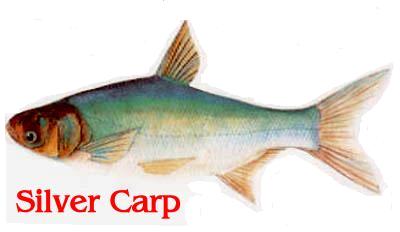
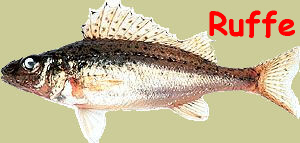
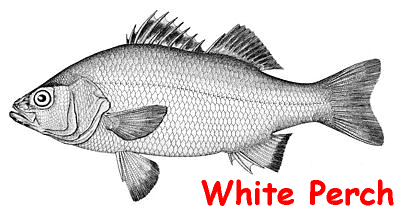
water in which they were found. It is illegal to use the following devices to take fish from public waters: a weir, electric current, dynamite or other explosive, a firearm, a crossbow, hands alone, or any substance that may weaken or poison fish. Cast nets cannot be used to catch sport fish. Non-native aquatic invaders may be costly to you and to the environment. Boaters and anglers should take necessary safeguards to avoid the spread of aquatic nuisance species. The decisions you make about discarding bait fish, where you dump bilge water or water from your live well and removing plants attached to your trailer, boat or lower unit are very important. Without holding a special permit, it is illegal to possess live bighead carp, black carp, silver carp, white perch (not freshwater drum), snakehead fish of the family Channidae, walking catfish of the family Clariidac, rudd, ruffe, tubenose goby, round goby, zebra mussel, quagga mussel or Asiatic clam. If any of these fish are caught, they must be killed immediately and not returned to the water. Your cooperation is essential. Silver carp are strange-looking fish with upside-down-looking faces. The new immigrants to Indiana waters have joined another recent invader and similar nuisance fish -- the bighead carp. These Asian carp species were accidentally introduced to the Mississippi River watershed in the 1980s, and have recently appeared in Indiana's portion of the Ohio River and southern sections of the Wabash and White rivers. These prolific fish feed mostly on plankton and compete with native larval fishes and mussels for food. To protect our wildlife and environment, Indiana law requires that silver and bighead carp, along with other non-native aquatic invaders like snakehead fish, walking catfish, round goby, zebra mussels and white perch, be killed if caught and not returned to the water. The invasive white perch are east-coast cousins to striped and white bass. They are not the common freshwater drum that are sometimes called white perch or sheepshead. Ruffe and round goby, originally from Eurasia, have invaded the Great Lakes. Fishery Resources Offices in the Great Lakes continuously work with States and universities to monitor their populations defining their range of invasion. Sampling equipment used for monitoring is developed, tested, and refined. The diets of round gobys are also being studied. For instance, preliminary analysis indicates that they eat zebra mussels, insect larvae, and small fish.
Minnows and crayfish may be collected at any time through out the year, if you possess a valid sport fishing license. You must have a bait dealer's license to sell minnows or possess more than 500 minnows. You cannot transport more than 100 crayfish across the state boundary in a 24 hour period unless you are commercially raising crayfish. You may use artificial lighting to take crayfish. If you plan to catch your own minnows or crayfish the following restrictions apply. See page 10 for special regulations for collecting minnows and crayfish on the Ohio River. o Minnow seines cannot be larger than 12 feet in length and four feet deep with mesh no larger than 1/2 inch stretch. o Minnow dip nets cannot exceed three feet square, without sides or walls, and may not have a mesh larger than 1/2 inch stretch. o Minnow traps cannot exceed 24 inches in length, with the opening of the trap no larger than one inch in diameter. o Cast nets may be used, provided the net is no larger than 10 feet in diameter and the mesh stretch is no larger than 3/4 inch. You may use wild fish as live bait as long as the fish was caught legally and meets any size, catch, or possession limits established for that species. Goldfish may be used as live bait. Carp and gizzard shad cannot be used as live bait, except at Brookville Lake where live shad may be used. All minnows purchased from bait shops or taken from public waters cannot be of any species considered threatened or endangered. Minnows should not be released into the water after you finish fishing. Emptying bait buckets can contaminate a body of water with undesirable fish. Fishing worms should be discarded in trash containers. No individual may take any live fish (native or nonnative) and release it into any other public waters without a stocking permit. Fisheries biologists in the DNR approve stocking of fish only after careful consideration of the potential impacts of the new fish on existing sportfishing activities and endangered species.
There is no closed season for taking trout from inland lakes.
All fishing closed from April 20 to April 24, 2004: o Pigeon River and Pigeon Creek in Lagrange County from the Steuben County line to CR 410 East (Troxel's Bridge). This does not include the impoundment known as Mongo Mill Pond. o Harding Run, Curtis Creek, Bloody Run and Graveyard Run (tributaries of the Pigeon River) in Lagrange County. o Turkey Creek north of CR100 S in Lagrange County. o Rainbow Pit located on Pigeon River FWA, approximately one mile east of Ontario in Lagrange County. Trout fishing closed from March 15 to April 1, 2004: o Island Lake on Minnehaha FWA, Sullivan County o Little George Lake on Chinook FWA, Clay County Lake Michigan and Tributaries Sizes and Limits o You cannot possess more than 5 trout or salmon (no more than 2 may be lake trout) or more than 15 yellow perch while fishing on Indiana's portion of Lake Michigan- even if you have a fishing license from a neighboring state. o You can take sucker, carp, gar, bowfin, buffalo and shad from Lake Michigan with a how and arrow. o You cannot use a trot line (power line), set line or throw line to take fish from Lake Michigan. o Fishing is not allowed within 100 feet above or below the Praxair Dam on the East Branch of the Little Calumet River. o See page 9 for Lake Michigan bass regulations. You may not possess a fish spear, gig, gaff, pitchfork, bowfishing equipment, crossbow, grab hook, spear gun, club, snag hook or un derwater spear in, or adjacent to the Galena River (LaPorte Co.), Trail Creek (LaPorte Co.), the East Branch of the Little Calumet River (LaPorte and Porter counties), Salt Creek (Porter Co.), the West Branch of the Little Calumet River (Lake and Porter counties), Burns Ditch (Lake and Porter counties), Deep River downstream from the dam at Camp 133 (Lake Co.) or the tributaries to these waterways. While there is no closed season for taking trout and salmon from Lake Michigan, certain tributary streams are closed to all fishing from April 1 through June 15. These streams are stocked annually with trout and salmon. The closed fishing period allows these small, vulnerable fish to migrate safely downstream to Lake Michigan. The closed season applies to: o The East Branch of Little Calumet River in Porter County from US 12 upstream to US 20. o Trail Creek in LaPorte County from the Frankiin Street Bridge in Michigan City upstream to US 35. In the waters including Lake Michigan tributaries, the St. Joseph River and its tributary streams from the Twin Branch Dam downstream to the Michigan state line (St. Joseph County), you may not fish with more than one single hook per line or one artificial bait or harness for use with live bait.
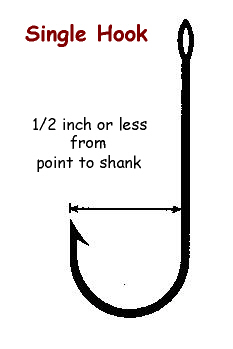
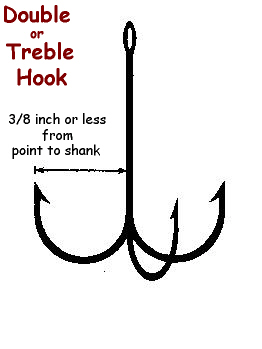
Single hooks, including those on artificial baits, cannot exceed 112
inch from point to shank. Double and treble hooks are only allowed on
artificial baits and shall not exceed 3/8 inch from point to shank.
Special regulations apply to fishing the St. Joseph River and its tributaries from Twin Branch Dam in Mishawaka, downstream to the Michigan state line. These include: o Minimum size for trout and salmon is 14 inches. o No fishing is allowed at any time in the East Race Waterway in South Bend. No fishing is allowed within 100 feet of the entrance and exit of the East Race. o No fishing is allowed at any time from the fish ladders located on the South bend or Mishawaka Central Park Dams. No fishing is allowed within 100 feet of the entrances and exits of the fish ladders. o No fishing is allowed by boat or other watereraft in the St. Joseph River below the South Bend Dam for a distance of 200 feet, and from the Mishawaka Central Park Dam down stream to the Main Street bridge, Mishawaka. o Any fish taken from the Lake Michigan tributaries defined in this section must be hooked in the mouth. Foul-hooked fish must be returned to the water.
|
|||||||||||||||||||||||||||||||||||||||||||||||||||||||||||||||||||||||||||||||||||||||||||||||||||||||||||||||||||||||






 Sitemap