The Coasters Web
Site
Member´s Mini
Bio´s
|
Carl Gardner, lead | Bobby Nunn, bass | Leon Hughes, tenor
Billy Guy, baritone | Adolph
Jacobs, guitar
Will "Dub" Jones, bass | Cornell Gunter, tenor
Sonny Forriest, guitar | Earl "Speedo" Carroll, tenor
Thomas Palmer, guitar | Ronnie
Bright, bass | Jimmy Norman, baritone
Alvin Morse, baritone | Carl Gardner Jr,
| J.W. Lance,
new lead tenor
|
THE
COASTERS
Members´ Mini Bio´s
Edited by Claus Röhnisch (updated
June 16, 2011)
Note: Most
birth dates and birth names ctsy (and confirmed by) Eric LeBlanc - thanks, Eric!
Thanks also to Todd Baptista and Matthew Broyles
.. and to Dave "Daddy Cool" Booth for the info on Gunter's birth place.
FAST-LOAD PRINTER-FRIENDLY:
All line-ups and
members | All the singles with
leads
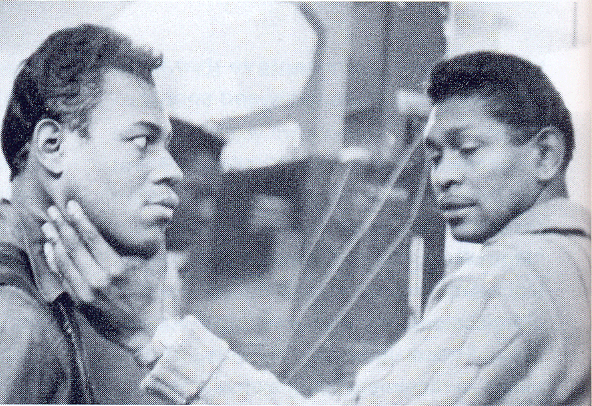
The two fore-most lead singers.
The Coasters: Members´ Duration
ten |
| LH |
| Gunter |
| Earl Carroll |
| vacancy |
| AM |
|
|
bar |
| Billy Guy |
| Billy Guy/sub |
| Jimmy Norman |
| CGj |
|
| JWL |
bass |
| Nunn |
| Dub Jones |
| Ronnie Bright |
|
|
gtr |
|
| Jacobs |
| SF |
| Thomas Palmer |
|
|
|
LH = Leon Hughes; AM = Alvin Morse (turned baritone when JW Lance entered in 2001).
Billy Guy/sub = Billy Guy on records and occasionally on stage
(substituted by Vernon Harrell and later Jimmy Norman on stage).
CGj = Carl Gardner, Jr. (returned in November 2004 to join the other five)
JWL = JW Lance (tenor); SF = Sonny Forriest. |
|
|
|
|
|
THE
COASTERS OF TODAY
THE TRUE AUTHENTIC
COASTERS TODAY
|
|
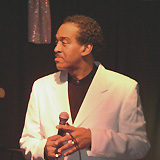
J. W. Lance
|
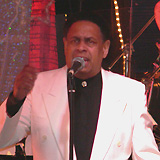
Primo Candelara |
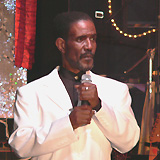
Eddie Whitfield
|
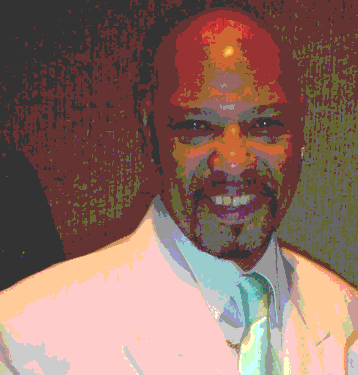
Dennis Anderson
|
Promo
Video ctsy
Veta Gardner
| |
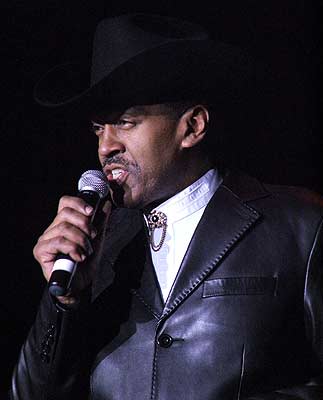
|
J. W. LANCE - lead
He has performed live on stage with
Carl Gardner Sr. for several years, personally hand picked by Carl in
July 2001.
Born Joe
Lance Williams in New Orleans on June 16, 1949 - nowadays living in Bronx, N.Y. Talented,
versatile vocalist (can sing tenor, baritone or bass) guitarist and songwriter.
A veteran face to both country and contemporary
music. Lance has performed with such names as Ben E. King, Fantastic Violnaires of Detroit
Michigan, the Original Five Blind Boys of Mississippi, and the Gospelaires of Dayton,
Ohio. He has toured throughout the United States, Australia and Virgin Islands.
He has recorded two country and western albums (“Sounds of J.W. Lance” has something for everyone). J.W. quit the Larry Marshak Drifters and Coasters to join the true Coasters,
and does great versions of "Smokey Joe's Cafe", "Zing! Went The
Strings Of my Heart", and "Along Came Jones".
|
|
| |
 |
PRIMO
CANDELARA -
tenor
He joined the Coasters in
October 2008 after an audition for Carl Sr. Carl liked Primo's
voice and said he was a very good singer. He lives in Philadephia,
Pennsylvania.
Born Primotivo Candelara on October 3,1952. He has been singing since he
was 10 years old. He teaches choreography and also has produced many
shows. Was also was with the group Chapter One for several years, and
sang with The Intruders and many other professional groups. He has a
very beautiful smooth tenor voice and has been a great asset to the continuation Coasters group of Carl Gardner Sr.
He sings lead on among others "Baby That Is Rock & Roll" and "Down In
Mexico".
|
|
| |
|
EDDIE
WHITFIELD - bass
He joined the Coasters in November 2009 after auditioning for Carl Sr.
He lives in Philadelphia, Pennsylvania.
Born December 26,1948. Nicknamed "Fast Eddie", Whitfield started singing
when he was a teenager and can sing both bass and baritone. He toured
with a group by the name of Neighbors Complaint for four years.
They recorded "Piece of Mind". His great bass really impresses
on "Charlie Brown" and "Yakety Yak". |
|
| |
|
DENNIS
ANDERSON - baritone
He joined the Coasters after the death of Carl Gardner Sr. Dennis lives in
New Jersey.
Dennis has a background of long musical roots, singing gospel, soul, and
country - and he was a member of the fake Marshak Cornell Gunter's
Coasters from 1995 up into the early 2000s. Dennis sings lead on among
others "Searchin'", "Young Blood", and "Poison Ivy" |
|
Membership
timeline
Note: Carl
Gardner Jr returned to the Coasters in 2004, and became lead in 2005. He
started his own "breakaway" group in August 2011.
The Veta Gardner managed authentic Coasters group continued the legacy
with J. W. Lance taking over the lead.
|
Year |
Lead |
Bass |
Baritone |
Tenor |
Guitar |
|
Late 1955 |
Carl Gardner |
Bobby Nunn |
Billy Guy |
Leon Hughes |
|
|
1956 |
Adolph Jacobs |
|
Early 1957 |
Young Jessie |
|
1957 |
Leon Hughes |
|
1958–1959 |
Will "Dub" Jones |
Cornell Gunter
|
1959–1961
|
Albert "Sonny" Forriest |
|
Earl "Speedo" Carroll |
|
1962–1965 |
Thomas "Curley" Palmer |
|
1965–1967 |
Billy Guy,
Vernon Harrell |
1968–1973
|
Ronnie Bright |
Billy Guy,
Jimmy Norman |
|
1973–1979 |
Jimmy Norman |
|
|
1980–1997
Note: 17 years |
Jimmy Norman |
|
|
1998–2001 |
Alvin Morse |
Carl Gardner Jr. |
|
2001–2005 |
J. W. Lance |
|
Gardner Jr & Lance |
|
2006–2008 |
Carl Gardner Jr. |
J. W. Lance |
|
2008–2009 |
Primo Candelara |
|
2009–2011 |
Eddie Whitfield |
from
August 2011 |
J. W. Lance |
Eddie Whitfield |
Primo Candelara |
Dennis Anderson |
Dick Milano
road manager |

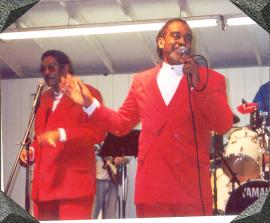
Carl Gardner Jr, Eddie Whitfield, Primo Candelara, and J.W. Lance.

The Coasters of June 2011:
(photo by Veta
Gardner, 2010)
J.W. Lance, Carl Gardner Jr, Primo Candelara, and Eddie Whitfield
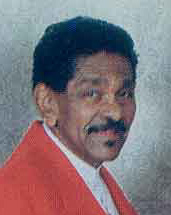 CARL GARDNER CARL GARDNER |
|
original lead singer since October, 1955
- coach from November, 2005
(more on Gardner) |
 CARL
GARDNER, JR CARL
GARDNER, JR |
|
tenor & baritone early 1998 - July 2001;
- extra lead singer from November 2004
- and lead vocals from November 5, 2005 - up to his father's death
(more on Gardner Jr) |
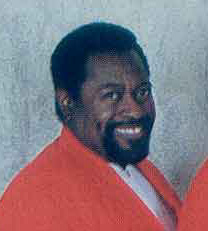 ALVIN "AL" MORSE
 |
|
baritone vocal from November, 1997 to September 2008
- wonderful and talented voice, adding
an extra "dimension" to the group
- born in February, 1951
(more on Morse)
In October 2008 Alvin was replaced by Primo Candelara.
|
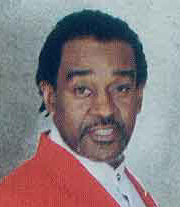 J.W. LANCE J.W. LANCE |
|
tenor vocal since July, 2001
- born Joe Lance Williams in New Orleans
on June 16, 1949
- now living in Bronx, N.Y.
(more on Lance) |
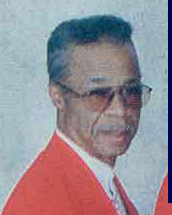 RONNIE BRIGHT
 |
|
bass vocal since April, 1968
(more on Bright)
In November 2009 Ronnie was replaced by "Fast" Eddie Whitfield. |
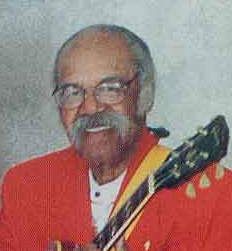 THOMAS PALMER
 |
|
guitarist since February. 1962
(more on "Curley")
- also known as "Curly"
A true veteran, leaving the Coasters for Carl Jrs new group in August 2011. |
The Coasters Gallery
CARL
GARDNER 
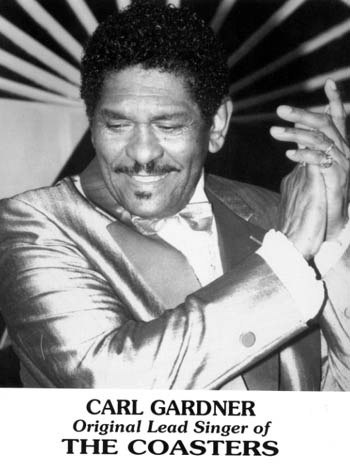
Carl Edward Gardner - the true Coaster
April 29, 1928 - June 12, 2011
(Original lead singer since October 1955, coach from November 2005)
lead tenor vocal
|
|
 Carl Gardner is the undisputed leader of the
Coasters - by now for more than 50 years. Born Carl Edward Gardner April 29, 1928 in Tyler, Texas
(not 1927 as stated in some biographical notes). His father was black, his mother a
Comanche Indian. Carl trained singing from his early teacher (a German classical pianist,
who also trained his sister Carol) and later studied at Emmett Scott High School, where he
linked up with Lasalle Gunter´s "territorial" band, singing and playing drums.
Carl signed to the Army at 16, but moved to Los Angeles (Watts), California in
late 1952 or early 1953, and was influenced by Eddie "Cleanhead" Vinson, Nat "King"
Cole and especially T-Bone Walker. Sister Carol became an opera singer (and his elder
brother Richard a chicken farmer - Carl also had a younger brother, Howard, and yet
another sister, Iris). Carl hung around the 5-4 Ballroom and at other small clubs on
Western Avenue, and soon joined up with jazz pianist Carl Perkins (who later recorded for
a.o. Dootone). His career changed direction from his love for jazz and soft standards when
he was introduced to R&B by Johnny Otis at Johnny´s new club, "the Oasis".
Around late 1953 Carl met the legendary Lester Sill, who introduced him to the R&B
pioneer vocal group The Robins. At first he substituted for their lead singer Grady
Chapman, who always did seem to get into trouble, and later the quintet became a sextet.
Carl recorded with The Robins during 1954-1955 for Spark Records. Spark was owned by Alvin
Stoller (father of Mike), Jerry Leiber, Mike Stoller and Lester Sill, and Carl sang lead
on among others "If Teardrops Were Kisses" (his very first recording), "I
Must Be Dreamin´", "Loop De Loop Mambo" and the R&B charting
"Smokey Joe´s Cafe" (of which he did a funky great swinger in later
years). Carl Gardner is the undisputed leader of the
Coasters - by now for more than 50 years. Born Carl Edward Gardner April 29, 1928 in Tyler, Texas
(not 1927 as stated in some biographical notes). His father was black, his mother a
Comanche Indian. Carl trained singing from his early teacher (a German classical pianist,
who also trained his sister Carol) and later studied at Emmett Scott High School, where he
linked up with Lasalle Gunter´s "territorial" band, singing and playing drums.
Carl signed to the Army at 16, but moved to Los Angeles (Watts), California in
late 1952 or early 1953, and was influenced by Eddie "Cleanhead" Vinson, Nat "King"
Cole and especially T-Bone Walker. Sister Carol became an opera singer (and his elder
brother Richard a chicken farmer - Carl also had a younger brother, Howard, and yet
another sister, Iris). Carl hung around the 5-4 Ballroom and at other small clubs on
Western Avenue, and soon joined up with jazz pianist Carl Perkins (who later recorded for
a.o. Dootone). His career changed direction from his love for jazz and soft standards when
he was introduced to R&B by Johnny Otis at Johnny´s new club, "the Oasis".
Around late 1953 Carl met the legendary Lester Sill, who introduced him to the R&B
pioneer vocal group The Robins. At first he substituted for their lead singer Grady
Chapman, who always did seem to get into trouble, and later the quintet became a sextet.
Carl recorded with The Robins during 1954-1955 for Spark Records. Spark was owned by Alvin
Stoller (father of Mike), Jerry Leiber, Mike Stoller and Lester Sill, and Carl sang lead
on among others "If Teardrops Were Kisses" (his very first recording), "I
Must Be Dreamin´", "Loop De Loop Mambo" and the R&B charting
"Smokey Joe´s Cafe" (of which he did a funky great swinger in later
years).
Gardner became the
first original Coaster in late September or early October 1955 and has stayed with the
group and been the Coasters´ spokesman ever since. He was a favorite of Leiber-Stoller´s
and has led such Coasters classics as "Down In Mexico", "One Kiss Led To
Another", "Young Blood", "Idol With The Golden Head",
"Dance!", "Three Cool Cats", "Sexy", "That Is Rock & Roll",
"Bad Blood", "Love Potion Number Nine" and "Cool Jerk" among
others.
Carl´s happy clear tenor also played the most important role in the Coasters´ famous
unison sung hits "Yakety Yak", "Charlie Brown", "Along Came
Jones", "Poison Ivy", "I´m A Hog For You", and "What About
Us". Carl moved with the Coasters to New York in 1958. Finally settled in Port St.
Lucie, Florida in 1990. His wife, Veta Gardner, now his manager.
The Coasters were inducted into the Rock and Roll Hall of Fame on January 21, 1987 as the first vocal group receiving that honor (Gardner,
Guy, Jones, and Gunter received individual awards and reunited for some special
performances). Carl Gardner's Coasters (as Carl´s group of today often bill
themselves) are still highly active, with around a hundred shows per year in New York,
Florida and Texas a.o., and performing in Canada in August of 1993 (that same autumn Carl
was treated for cancer, but returned to business in 1994). The group today consists of
Gardner (coach), two veteran Coasters - bass Ronnie Bright and guitarist Thomas Palmer (who both
are residents in New York and have acted with Gardner for more than the last 40 odd years)
- plus newcomers Alvin Morse, baritone; J.W. Lance, tenor; and Carl´s son Carl Gardner,
Jr. In April, 1996 Gardner full-filled a
life-long dream, recording new interpretations of material originally done by his old
idols (a.o. Louis Jordan, T-Bone Walker, Roy Brown and the Ink Spots). A CD was issued
later that same year titled "One Cool Cat".
Carl participates with three numbers, "Young Blood", "Stormy
Monday" and "Merry Christmas Baby", on the 5-set video "Rock &
Roll Graffiti" distributed by Prairie Dog Productions, Texas.
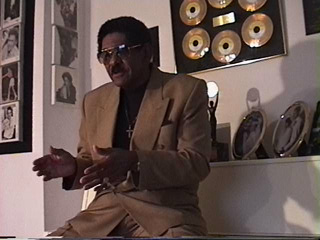
Carl has six Golden Records
(for million sellers) on the wall in his home (for "Searchin´", "Yakety
Yak", "Charlie Brown", "Poison Ivy", "Along Came
Jones", and "Young Blood"). Despite competition from several fake, false
and phony bogus Coasters (some comprising singers from remnants of former members of original
Coasters, a.o. the late Bobby Nunn´s Coasters Mark II, and the late Cornell Gunter´s Las
Vegas Coasters) - at times even his old friends Jones, Guy, and Hughes have acted with
their own groups - Carl Gardner's Coasters are the only ones who truly and legally
can call themselves THE COASTERS, and they are also the best - Better Than Ever!
 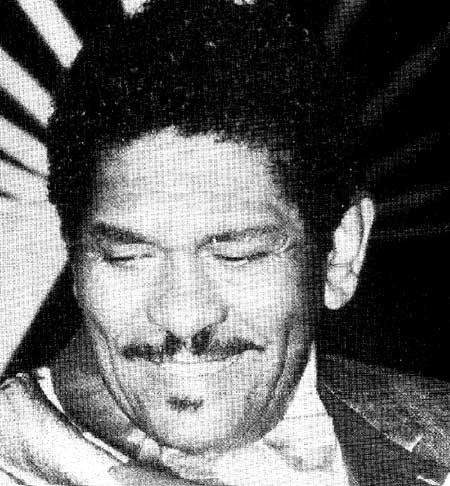
Vocal groups often emerge when youngsters meet in school or at street corners. As
amateurs they are trying to copy one or several of their fore-runners, and sometimes they
manage to find their own new sound, adding new gimmicks to the rich tradition of
harmonizing. In the case of the Coasters a complete different background is on hand. Each
of the members were hand-picked professionals when the group originated and that formula
has stuck throughout the whole of their career.
During more than 50 years of existence, ten other singers and three guitarists have made
records with Carl Gardner as The Coasters. Throughout the career of the group each member
has been carefully hand-chosen, and for rather long periods the line-ups were more or less
unaltered.
Carl
Gardner at Wikipedia
|
|
Here is what they say about Carl
(from the "One Cool Cat
CD" insert)
 Carl Gardner´s beautifully rich and sonorous voice (first heard on
the late recordings of The Robins) was featured on every hit of The Coasters, either as a
soloist or as a part of a comedic duet with former Coaster Billy Guy. With his incredibly stylistic range, he takes command of every song he sings - from the most soulful of ballads
and blues, to the most hilarious comedy numbers and funkiest R&B. Carl Gardner´s beautifully rich and sonorous voice (first heard on
the late recordings of The Robins) was featured on every hit of The Coasters, either as a
soloist or as a part of a comedic duet with former Coaster Billy Guy. With his incredibly stylistic range, he takes command of every song he sings - from the most soulful of ballads
and blues, to the most hilarious comedy numbers and funkiest R&B.
(Mike Stoller, Leiber and Stoller Productions)
Carl Gardner´s ability to sing has never been questioned by any of his peers...
The success of The Robins and The Coasters was largely due to the fact that all of the
members were exquisite singers.
(Tom Dowd, recording engineer)
Carl Gardner is a living embodiment of our Rock´n Roll heritage. His uniquely
identifiable sound is one of rock´s musical treasures.
(Jay Warner, aouthor of The Billboard Book of American Singing Groups)
|
|
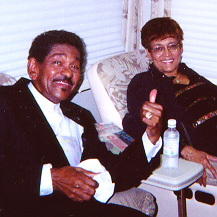
Carl Gardner and Veta Gardner
in May, 2001 visiting
Bob Walker
in New Orleans.
|
|
|
|

Carl Gardner, founder of the Coasters
(Photo courtesy of TCPalm.com -
Alex Boerner)
|
Obituary -
Sun Sentinel
Port St. Lucie resident
Carl Gardner,
lead singer of Coasters, dies at 83
By
Monica Villar, TCPalm.com - Port St. Lucie, June 13,
2011
Carl Edward Gardner, lead singer of the legendary 1950s doo-wop group
the Coasters, died Sunday at the St. Lucie Hospice Home. He was 83.
Gardner, who lived in Port St. Lucie since 1990, died of congestive
heart failure, according to his wife, Veta. Gardner also fought with
Alzheimer's disease for many years. Gardner was one of the band's
founding members in 1955 and his tenor voice led such Coasters classics
as "Yakety Yak", "Poison Ivy", and "Along Came Jones".
The
comedy-styled band, later known as "the clown princes of
rock and roll,"
became the first group to be inducted into the
Rock and
Roll Hall of Fame
on Jan. 21, 1987. They scored more than a dozen gold hits and sold more
than 15 million records.
Gardner was born on April 29, 1928 in Tyler, Texas, to a black father
and Comanche Indian mother. He sang from an early age and for a while he
had a spot singing on a radio station while attending Emmett Scott High
School. At age 16, he enlisted in the army and upon his return moved to
Los Angeles. Before the days when he and his band had crowds shouting
back "Don't talk back!," Gardner sang with R&B vocal group, the Robins.
Gardner married schoolteacher Ladessa Richardson in 1951.
In 1955, Carl Gardner became the first Coaster and remained part of the
group until he semi-retired in 2005, when he became the band's coach. In
the past 50 years, the group has undergone several changes in band
members. He played an important role in hits like "Down In Mexico," "One
Kiss Led To Another," "That Is Rock & Roll," "Bad Blood," "Love Potion
Number Nine" and "Cool Jerk."
Gardner married his second wife, Veta Gardner, in 1987. She has been
managing the band since 1986, recently taking a leave of absence to take
care of her husband. Gardner's son, Carl Gardner Jr., replaced Gardner
as the lead singer for the Coasters in 2005. In 1997, Port St. Lucie
mayor Bob Minsky presented Gardner with the key to the city. "I remember
his birthday was coming up so Veta and I planned it and I surprised him
at a council meeting," Minsky said. "He was taken away by it. He was so
far from the kind of things you read in newspapers about celebrities."
The group was honored by
President Bill Clinton
in 2000, in celebration of 45 years in the business. The group
celebrated its 50th anniversary at Club Med Sandpiper on Nov. 5, 2005.
Carl Gardner Sr. announced his retirement at the event. In 2007, he
published his autobiography "Yakety Yak I Fought Back," where he spoke
about his life and struggles in the music business. He was the last
surviving member of the original Coasters.
Gardner is survived by his second wife Veta; sons Carl and Ahilee;
daughter Brenda; stepsons Ramon, Wayne and Hanif; grandchildren Monique,
Amber, Nikko, Lauren and Rachel; and great-granddaughter Kalina. Funeral
plans are being finalized.
"He would always walk around in his baseball cap and jeans and you'd
never know he was famous," Veta said. "But when he got on stage he sure
controlled it
Obituary - New York Times
Carl Gardner, Singer With Coasters Pop Group, Dies at 83
By
BRUCE WEBER
Published: June 13, 2011
Carl
Gardner, the spunky tenor who was the lead singer of the original
Coasters, whose mixture of rhythm-and-blues, doo-wop and sitcom humor
created 1950s hits like “Yakety Yak,” “Charlie Brown” and “Searchin,’ ”
died on Sunday in Port. St. Lucie, Fla. He was 83.
The cause was
congestive heart failure, his wife, Veta, said. She said he also had
Alzheimer’s disease.
The Coasters, one of
the early black groups of the rock ’n’ roll era, specialized in witty
story songs about characters who often exemplified the problems of
teenagers. Formed at the suggestion of the songwriters Jerry Leiber and
Mike Stoller, who wrote much of the group’s material, they made their
debut recording, "Down In Mexico," in 1956. A bluesy number with a Latin
tinge, it featured Mr. Gardner’s clear-voiced, plaintive and faintly
licentious narration of an episode involving a seductive dancer in a
south-of-the-border honky-tonk.
The song was an echo of
a previous Leiber and Stoller hit, another semi-humorous, semi-sexy bar
tale, “Smokey Joe’s Cafe,” which Mr. Gardner had recorded with his
previous group, the Robins. The Coasters’ first big hits, “Searchin’ ”
and “Young Blood,” released in 1957, had the same yearning sexuality.
As the Coasters went
on, however, their work took a turn for the light and youthful. In songs
like “Yakety Yak,” a parental warning to a teenager to behave — “Don’t
talk back!” — and do chores; “Charlie Brown,” a portrait of a class
clown (“Who calls the English teacher Daddy-o?”); “Poison Ivy,” about
the kind of girl who will make a young man itchy with desire (“You’re
going to need an ocean/Of calamine lotion”), the Coasters spoke to
teenagers in winking, clean-cut little melodramas — playlets, as Mr.
Leiber called them.
Carl Edward Gardner was
born in Tyler, Tex., on April 29, 1928. His father, Robert, was a hotel
bellman who, according to Mr. Gardner’s autobiography, “Yakety Yak I
Fought Back,” ran a side business in bootleg liquor. His mother,
Rebecca, was a Comanche Indian whose fine singing voice was the source
of his own, Mr. Gardner wrote.
The young man was
singing at parties for a living in Tyler when he left for California in
the early 1950s to seek his fortune in the music business, leaving a
wife and daughter behind. In 1954 he joined the Robins as a replacement
for a singer who was in jail and stayed on as an additional member.
Mr. Gardner’s first
marriage ended in divorce. In addition to his wife, the former Veta
Ryfkogel, whom he married in 1987, his survivors include a brother,
Howard, of Los Angeles; a sister, Carol Bartlett, of East Orange, N.J.;
his sons Carl Jr., of Dallas, and Ahilee, of Pennsylvania; a daughter,
Brenda, of Dallas; three stepsons, Hanif, Ramon and Wayne Lalloo, all of
Port St. Lucie; and several grandchildren and step-grandchildren.
The original Coasters
included Bobby Nunn, who was also a member of the Robins; Leon Hughes;
and Billy Guy. Over the years the personnel changed, but during the
group’s heyday, 1958 to 1961, the lineup included Mr. Gardner, Mr. Guy,
Cornel Gunter and Will Jones. These four were inducted as the Coasters
into the Rock and Roll Hall of Fame in 1987. Mr. Gardner was their last
surviving member. |
CARL GARDNER
By ROCKIN' ROBIN - from Cash Box website (Obituaries).
Carl Gardner, the
founder and original lead singer of the 1950's group the Coasters, died
Sunday (June 12, 2011) at a Port St. Lucie, Florida, hospice. He was 83.
According to the Associated Press and writer Dennis McLellan of the Los
Angeles Times, Gardner died of congestive heart failure plus had been
battling Alzheimer's Disease and throat cancer.
What made the Coasters so successful was how the American public
didn't care that they were all African-Americans. That's because their
music was just plain fun for black and white audiences alike. One
appropriate nickname for the group was "The Clown Princes Of Rock And
Roll."
The Coasters were the very first group to be inducted into the Rock
and Roll Hall of Fame, joining the second class in 1987. The Everly
Brothers were among the rock hall's first class in 1986, but they were a
duo. The Beatles didn't gain induction into the hall until the third
class in 1988.
When Casey Kasem counted down the top 40 rock and roll acts of the
1950's in the fall of 1975, the Coasters were ranked #13. Only three
groups were ahead of the Coasters…the Diamonds, Bill Haley and His
Comets and the biggest group of the 50's, the Platters.
According to Joel Whitburn's Record Research, the Coasters' roots go
back to 1947, when the Robins were formed in Los Angeles. Among the
Robins' hits were "Smokey Joe's Café" and "Riot In Cell Block #9." In
the mid-1950's, the Robins split into two groups. Some members of the
Robins chose to remain the Robins while Gardner and Bobby Nunn decided
to the form the Coasters.
The combination of the Coasters' joining Atco Records and teamming up
with songwriters Jerry Leiber and Mike Stoller led to a slew of hits.
Although their first release, "Down In Mexico," failed to crack the Cash
Box Magazine pop chart in 1956, it was a major R&B hit.
The next year, 1957, the Coasters exploded onto the R&B and pop scene
with what to this day is believed to be the most successful two-sided
R&B single ever, "Searchin' / Young Blood." The record was #1 on the R&B
chart of one magazine for roughly a dozen weeks. On the Cash Box pop
chart, "Searchin'" peaked at #7 while "Young Blood" reached #15.
The Coasters got an additional boost of exposure in the summer of
1957. Helping them was Dickie Goodman, who was famous for his "flying
saucer" novelty records where questions were answered in the form of
snippets of then-current hit songs. On the (Bill) Buchanan and Goodman
single, "Flying Saucer The 2nd," the early part of "Young Blood" where
the Coasters are jokingly saying "Look At There" was used early in the
novelty recording.
The Coasters had their biggest pop hit in the summer of 1958 with the
#1 classic, "Yakety Yak." The song dealt with parents chewing out their
teenage kids, starting out with the opening line, "Take out the papers
and the trash…or you don't get no spending cash." The song also had the
group members yelling out the title and then one member (probably Will "Dub"
Jones) saying, "Don't Talk Back." King Curtis provided the unforgettable
saxophone solo.
The Coasters nearly duplicated the feat of "Yakety Yak" with their
followup, "Charlie Brown." That #2 1959 hit was about a class clown
who'd say in the song, "Why's everybody always picking on me?" The
Coasters had another top tenner in 1959 with "Poison Ivy" (#9) and that
same year just missed the Top 10 with "Along Came Jones" (#11).
In late 1959, the Coasters had still another Top 40 with the
#33-peaking "What About Us." The group had two more Top 40's in the
early 1960's with "Wake Me, Shake Me" (#34, 1960) and "Little Egypt"
(#30, 1961).
To list all the instances of Coasters' remakes would be impossible,
but here's some of the more memorable ones (with thanks to Wikipedia):
The Beatles remade "Searchin',"; Bad Company had a 1976 Top 40 remake of
"Young Blood"; Elvis Presley sang "Little Egypt" in the soundtrack of
the movie "Roustabout"; the Monkees had "D.W. Washburn" in 1968; Ray
Stevens redid "Along Came Jones" the next year; and in 1970, the Pipkins
followed up "Gimmie Dat Ding" with "Yakety Yak." Also, Leon Russell sang
"Young Blood" at George Harrison's 1971 Concert for Bangladesh while at
least two groups have done "Riot In Cell Block #9"--the Beach Boys and
Commander Cody And His Lost Planet Airmen.
Sadly, Wikipedia also reports that some associated with the Coasters
met tragic deaths. Saxophonist King Curtis was only 37 when he was
stabbed to death in 1971. Two other Coasters' members are believed to
have been murdered about 10 years apart, Nate Wilson (1980) and
Cornelius Gunter (1990).
The Coasters had at least 21 different members but Leon Hughes is
believed to be the only surviving member. Among the more prominent
Coaster members over the years were Earl "Speedo" Carroll, who sang lead
on the Cadillacs hits "Speedo" and "Peek-A-Boo"; and Ronnie Bright, who
was the bass singer on the 1963 Johnny Cymbal hit, "Mr. Bass Man."
It's believed the memory of the Coasters has been kept alive to this
day with occasional performances by a modern-day lineup that includes
Gardner's son, Carl Gardner, Jr. Some group members were part of a small
claims court case that was seen on the TV show "People's Court" in the
1980's when Joseph Wapner was the presiding judge.
When he was alive, the elder Gardner was emphatic in his belief that
there shouldn't be any copycat Coasters groups. In 2007, the state of
Florida passed legislation outlawing such fake groups.
Carl
Cardner was born April 29, 1928 in Tyler, Texas. He got into the music
business in the early 1950's after serving in the Army, mostly as a
teenager.
|
BOBBY NUNN

September 20, 1925 - November 5, 1986
(member October 1955 - c:a November 1957)
bass vocal
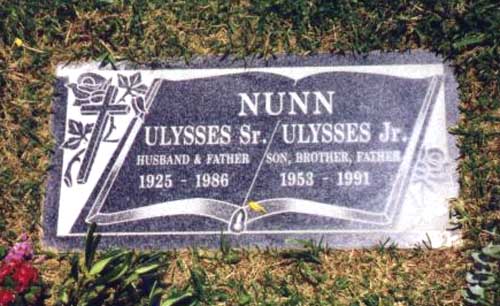
Los Angeles (ctsy Todd Baptista)
|
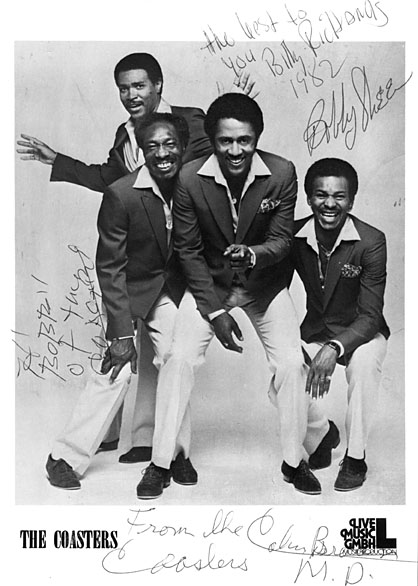
enlarge image!
Bobby Nunn´s Coasters
(or Billy Richards Jr´s - if you want to)
of 1982 - touring Germany.
(photo ctsy Stefan Pingel-Wriedt)
|
|
 Born
Ulysses B. Nunn on September 20, 1925 in Birmingham, Alabama (not June 25).
Raised in Detroit, Michigan. Toured with the Brownskin Models vaudeville show
and settled in Watts, California after U.S.A.F. (where he hade become
welterweight boxing champion) discharge in 1947. Was discovered by Johnny
Otis´ drummer Leard Bell at "The Barrelhouse" club. Teamed up with the
A-Sharp Trio from San Francisco, comprising brothers Billy and Roy Richard,
and "Ty" Terrell Leonard; and recorded with them as the Four Bluebirds for
Excelsior (featuring Otis´ band) in early 1949. He sang lead with this group
as the Robins from 1949 for Aladdin, and especially for Savoy, waxing a.o.
"If It´s So Baby", "The Turkey Hop", and "Our Romance Is Gone". For Savoy he
also duetted with Little Esther (and the Robins) on "Double Crossing Blues",
a #1 R&B hit. The Robins were closely associated with Johnny Otis during
this period. In December, 1950 Bobby Nunn guested Modern Records (where
"Bobby Nunn with the Robbins" waxed Leiber-Stoller´s first record
composition, "That´s What The Good Book Says" on March 2, 1951). He worked as a solo artist
both during and between his stints with the Robins (who did military
services in 1952), recording for Hamptone,
Blue (aka Blu), Dootone and Recorded in Hollywood; and duetted with girl singer Mickey
Champion (featuring the Robins), with Little Esther again (now without the
Robins); and also with the legendary Bobby Day
(who in his early days recorded under his true name, Robert Byrd) in
recordings for Sage & Sand also including Ty Terrell. In 1953 Nunn and the
Robins (now enlarged with tenor Grady Chapman) recorded for RCA and Crown,
and later moved to Spark Records, where Carl Gardner joined them. Nunn sang
lead on a.o. "Framed" for Spark, and left the Robins together with Gardner
to become original bass for the Coasters. Born
Ulysses B. Nunn on September 20, 1925 in Birmingham, Alabama (not June 25).
Raised in Detroit, Michigan. Toured with the Brownskin Models vaudeville show
and settled in Watts, California after U.S.A.F. (where he hade become
welterweight boxing champion) discharge in 1947. Was discovered by Johnny
Otis´ drummer Leard Bell at "The Barrelhouse" club. Teamed up with the
A-Sharp Trio from San Francisco, comprising brothers Billy and Roy Richard,
and "Ty" Terrell Leonard; and recorded with them as the Four Bluebirds for
Excelsior (featuring Otis´ band) in early 1949. He sang lead with this group
as the Robins from 1949 for Aladdin, and especially for Savoy, waxing a.o.
"If It´s So Baby", "The Turkey Hop", and "Our Romance Is Gone". For Savoy he
also duetted with Little Esther (and the Robins) on "Double Crossing Blues",
a #1 R&B hit. The Robins were closely associated with Johnny Otis during
this period. In December, 1950 Bobby Nunn guested Modern Records (where
"Bobby Nunn with the Robbins" waxed Leiber-Stoller´s first record
composition, "That´s What The Good Book Says" on March 2, 1951). He worked as a solo artist
both during and between his stints with the Robins (who did military
services in 1952), recording for Hamptone,
Blue (aka Blu), Dootone and Recorded in Hollywood; and duetted with girl singer Mickey
Champion (featuring the Robins), with Little Esther again (now without the
Robins); and also with the legendary Bobby Day
(who in his early days recorded under his true name, Robert Byrd) in
recordings for Sage & Sand also including Ty Terrell. In 1953 Nunn and the
Robins (now enlarged with tenor Grady Chapman) recorded for RCA and Crown,
and later moved to Spark Records, where Carl Gardner joined them. Nunn sang
lead on a.o. "Framed" for Spark, and left the Robins together with Gardner
to become original bass for the Coasters.
Several music "analysts" claim Bobby was more a baritone singer than a basso
- which is totally wrong - Bobby was a bass singer not a baritone (Richard
Berry though is a baritone - not a basso). There is still doubts if Richard
Berry really was a guest lead on "Riot In Cell Block #9" or if (as the
original album sleeve of Atco 33-101 says) Nunn actually sings the bass also
on that recording.
Bobby Nunn stayed in California when the Coasters moved to New York (in
order to avoid duodenal ulcer), recorded two singles with Leon Hughes as The
Dukes on Flip in 1959, and and with Ginny Tyler for Titan in 1960,. Nunn
also sang on some of Dorsey Burnette´s country recordings. Nunn also
arranged “Whip It On Me Baby” (the Billy Guy Trip song) for The O´Jays on
Imperial in 1965. He launched a West-Coast based new group, "The Coasters,
Mark II" in 1963. Toured with this group, initially including Billy
Richards´ nephew Billy Richards, Jr and Bobby Sheen from Bob B. Soxx & the
Blue Jeans and soon also former Robins member Grady Chapman (a busy artist,
who substituted for Carl Gardner during Carl´s treatment for cancer in the
autumn of 1993). Later members included Randy Jones and Billy Wilson. They
acted all over the U.S., and even in Germany in the ´80s, up to Nunn´s death
by heart-failure in Los Angeles on November 5, 1986. His group is now led by
Billy Richards, Jr. (originally manages by Larry Marshak, who went to Billy
Guy to re-capture "The Coasters" when Richards made an agreement with Carl
Gardner). Nowadays Billy Richards´ group call themselves Billy Richards'
Coasters".
Bobby
Nunn at Wikipedia
Video
on Bobby Nunn's Coasters
(doing "Yakety
Yak" in the early 1980s - featuring Billy Richards Jr. and Bobby Nunn).
Dick Clark with Bobby's Coasters
Find information on Bobby Nunn and other Coasters in
LA
Times (since 1985) or Search the LA Times Archives
The Robins |
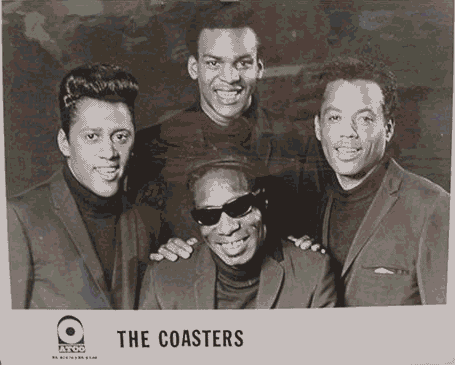
Bobby Nunn´s Coasters, Mark II of late 1963/early 1964.
From left: Billy Richards, Jr; Bobby Sheen, Grady Chapman, and bottom center: Bobby
Nunn.
(Note the Atco mark! - and thanks, Charles Sheen, for identification).
|
|
BOBBY NUNN DISCOGRAPHY
Based on information from Leslie Fancourt, Paul
Pelletier and Galen Gart.
In 1950
Bobby Nunn had signed a contract with Sammy Lane of International Records as a
"bandleader" (although he was a singer and no member of the AFM) in order to
record as a solo artist. Below are listed all of Bobby Nunn´s recordings (except for
those with The Robins and The Coasters). In 1952 Savoy Records (see Robins Discography),
forced Nunn to end his recordings as a solo artist.
Bobby Nunn with
Hamptone All-Star Orchestra
vcl; with unknown accomp. Prod. by Sammy Lane.
Los Angeles, c. December 1949
Why Did You Leave Me, Baby? Hamptone International 605
Alone About Midnight ditto
Note: Single issued in January, 1950 (possibly a reissue of Robins
tracks - Aladdin/Score)
Bobby
Nunn & His Hot Five
(Blue 105)
or
Bumps Myers & His Frantic
Five, vocal Bobby Nunn
(Blu 115)
vcl; with Hubert "Bumps" Myers,tens; p, b, d. Prod. by Dootsie Williams.
Los Angeles, 1950
You Wig Me Baby unissued
Bring Your Lovin´ Back To Me Blue 105 (1950)
I Got A Country Gal Blue 105
Clappin´ And Shoutin´ Blu 115 (1951)
I´m Tellin´ You Baby Blu 115
Bobby Nunn and Combo
(as above)
Anticipating Blues Dootone 302 (released 1951)
Note: Reverse by Big Duke with Pete Johnson All Stars.
Bobby Nunn with Maxwell Davis
and His Orchestra
vcl; with
orchestra conducted by Maxwell Davis
Los Angeles, c. December 1950
MM 1463-7 California Blues Modern
unissued
MM 1464
Well I'm So Glad ditto
Note: Recorded before the Robins' "Rockin'" session.
Bobby Nunn with Music by Que Martyn
vcl; with Que Martyn,tens; pno, bs, dms. Prod. by Big John Dolphin.
Los Angeles, late 1951
Christmas Bells Rec. in Hollywood 244
Note: Reverse by Que Martyn. Title advertised as "X-Mas Bells".
Note:
Bobby Nunn did not record with Bobby Byrd on Sage & Sand -
This is a hillbilly group.
Little Esther
and Bobby Nunn
(Little Esther Mae Jones (later Phillips), lead vcl; Bobby Nunn, bass vcl with Don
Johnson,tpt; George Washington,tbn; Eli Wolinsky,alts; James Von
Streeter,tens; Fred Ford,bars; Devonia
Williams,pno; Pete Lewis,gtr; Albert Winston,bs; Leard Bell,dms; Johnny Otis,dir. Prob. not the Robins, background
vcls on 269 and 270 (since they served
the forces). Omit Nunn on 270. Prod. by
Ralph Bass.
Los Angeles, July 25, 1952
F 269-1 Saturday Night Daddy
Federal 12100, Collectables CD 2896
F 270-1 Mainliner Federal 12100, King LP 622,
Collectables
CD 2896
F 271 You Took My Love Too Fast Federal 12122,
Collectables
CD 2896
Note: F 268 and reverse of Federal 12122 by Little Esther. F 270 issued as by "Little
Esther".
|
|
|
|
BOBBY NUNN'S SINGLES
(according to Wikipedia)
- Why Did You Leave Me
Baby?/Alone About Midnight (Hamptone International #605)
(1/1950)
- Bring Your Lovin’ Back To
Me/I Got A Country Gal (Blue #105) (1950) (as Billy Nunn)
- Anticipating Blues/Hard Luck
Women & Strife (Side-B by Big Duke with Pete Johnson
All-Stars) (Dootone #302) (1950)
- Clappin’ And Shoutin’/I’m
Tellin’ You Baby (Blue #115) (1951) (as Billy Nunn)
- Christmas Bells/Two Sisters
(Side-B instrumental by Que Martin) (Recorded In Hollywood
#244) (1951)
- Saturday Night
Daddy/Mainliner (Side-B by Little Esther) (Federal #12100)
(1952) (Bobby Nunn & Little Esther)
- You Took My Love Too Fast/Streetlights
(Side-B by Little Esther) (Federal #12122) (1952) (Bobby
Nunn & Little Esther)
- Please Don’t Hurt Me/Delicious
Are Your Kisses (Sage & Sand #203) (1952) (with Bobby Byrd
"Day" & Ty Terrell)
- Candle Of Love/Peanut
Brittle (Sage & Sand #204) (1952) (with Bobby Byrd "Day" &
Ty Terrell)
- Like/Henrietta (Titan #1703)
(1960) ("Henrietta" with Ginny Tyler)
LEON HUGHES

Born August 26, 1932
(member October 1955 - c:a November 1957)
tenor vocal
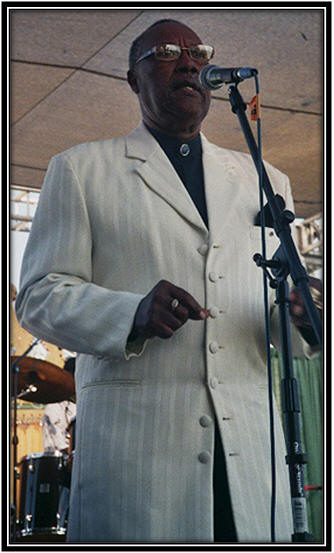

Listen to Leon's group 2008

Leon Hughes in 1988
(copyright M. del Costello)

Find Leon Hughes
Leon Hughes
latter day Coasters group

Check the
R&B Page
for:
Interview with
Leon
Hughes
not available now!
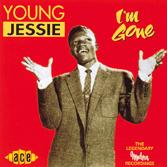
Young Jessie
|
|
 Born
Thomas Leon Hughes, August 26, 1932 (not a day later) in Los Angeles County,
CA. Started acting with his parents as a child and toured with early lineups
of the Hollywood Flames (with which he also recently acted in a 1998 revival
show). He was an original member of the Lamplighters during 1952-53
(together with Mathew Nelson and Willie Ray Rockwell). Hughes left the
Lamplighters before they recorded with new lead Al Frazier. Leon was
recommended by Bobby Nunn (who knew him from Watts, L.A.) for the Coasters´
original line-up. Around this time (or possibly in early 1957) Leon recorded
with The Celibritys (which included his brother Elder O’Neal) on Caroline
and also recorded on his own label Leoneal Records with The Signeals (a
group inlcuding both his brother and his sister Shirley Hughes). Leon stayed
in California when the Coasters moved to New York (recorded the two Flip
singles as The Dukes with Bobby Nunn in 1959) and later launched a
non-original, occasionally acting, Coasters group. originally featuring
Young Jessie
(one record on
Chelan was issued as
The Coasters Two Plus Two featuring him and Nunn in 1975 – and two other
singles were issued as The World Famous Coasters). Hughes’ group didn´t
reach the same status as Nunn´s and other Coasters´ off-shoot groups and was
later called "Leon Hughes Sr and the Fabulous Coasters" (often also named
"Leon Hughes and his Original Coasters" or "Leon Hughes - the Original & His
Coasters" and nowadays "Leon Hughes - one of the first original Coasters").
Hughes´ Coasters also recorded a video (Hughes
at YouTube). Born
Thomas Leon Hughes, August 26, 1932 (not a day later) in Los Angeles County,
CA. Started acting with his parents as a child and toured with early lineups
of the Hollywood Flames (with which he also recently acted in a 1998 revival
show). He was an original member of the Lamplighters during 1952-53
(together with Mathew Nelson and Willie Ray Rockwell). Hughes left the
Lamplighters before they recorded with new lead Al Frazier. Leon was
recommended by Bobby Nunn (who knew him from Watts, L.A.) for the Coasters´
original line-up. Around this time (or possibly in early 1957) Leon recorded
with The Celibritys (which included his brother Elder O’Neal) on Caroline
and also recorded on his own label Leoneal Records with The Signeals (a
group inlcuding both his brother and his sister Shirley Hughes). Leon stayed
in California when the Coasters moved to New York (recorded the two Flip
singles as The Dukes with Bobby Nunn in 1959) and later launched a
non-original, occasionally acting, Coasters group. originally featuring
Young Jessie
(one record on
Chelan was issued as
The Coasters Two Plus Two featuring him and Nunn in 1975 – and two other
singles were issued as The World Famous Coasters). Hughes’ group didn´t
reach the same status as Nunn´s and other Coasters´ off-shoot groups and was
later called "Leon Hughes Sr and the Fabulous Coasters" (often also named
"Leon Hughes and his Original Coasters" or "Leon Hughes - the Original & His
Coasters" and nowadays "Leon Hughes - one of the first original Coasters").
Hughes´ Coasters also recorded a video (Hughes
at YouTube).
|
Obie Jessie and
Leon Hughes Coasters |

The Original Leon Hughes World Famous Coasters -
(featuring Obie Jessie top left and Leon Hughes center front
(ca early 1970s) - thank you Matthew Broyles for information.
 Leon
with the Hollywood Flames in 1952. Leon
with the Hollywood Flames in 1952.
 Leon
Hughes' Coasters Tribute group (featuring Adolph "Al" Jacobs today). Leon
Hughes' Coasters Tribute group (featuring Adolph "Al" Jacobs today).
Leon
Hughes at Wikipedia
Leon and his Coasters in 2010
Lester Sill tried to persuade Young Jessie to replace Hughes in 1957 and give up
his solo career. Jessie did not make anya stage appearances with the Coasters
though, but did
record with the group in 1957.
Young Jessie was never a member of The Coasters - but here is his story
Born December 28, 1936 in
Lincoln Manor, Texas as Obediah
(Obie) Donmell Jessie, later nicknamed "Young" Jessie. Teamed up with Jefferson
Hig School friends Young "Guitar" Watson, Richard Berry and Cornell Gunter
in Los Angeles. In 1953 that group, the Debonaires, signed to the Flair label and
changed their name to the Flairs. Jessie started his solo career in 1954-55 on Modern
Records, hitting with "Mary Lou" and later made his classic "Hit, Git &
Split". After his records with the Coasters he signed with Atco and Atlantic (1957),
Capitol (1959), Mercury (1961), Vanessa (1962), and Bit (1964). Sang with the Seeds of
Freedom in the ´70s and toured Europe in the ´80s singing both blues and jazz. Lives
with his wife, singer Barbara Prince, near Venice Beach, California and has acted with a
fake Coasters group lately.
More on Jessie from Bill Dahl, All Music Guide
The Los Angeles R&B vocal group scene
of the 1950s was a fairly incestuous one - members flitted from one aggregation to the
next, often sporting several connections at the time. Young Jessie was a member of the
Flairs, Hunters, and Coasters, as well as scoring a solo West Coast hit with his 1955
rocker "Mary Lou." Obediah Jessie was a Los Angeles high-school classmate of
Richard "Louie Louie" Berry. The two put together the Flairs and debuted on the
Bihari brothers' Flair label in 1953 with "She Wants to Rock." The Flairs
recorded steadily for the firm, but solo status awaited Jessie, who cut a cover of Big
Mama Thornton's Leiber/Stoller-penned "I Smell a Rat" for Modern (the Biharis'
flagship logo) in 1954. "Mary Lou," arranged by saxist Maxwell Davis, emerged
the next year; its unusual minor-key arrangement must have appealed to rockabilly wildman
Ronnie Hawkins, who hit the pop lists with it in 1959 for Roulette. Platters manager Buck
Ram took over Jessie's career in time to pen his torrid 1956 rocker "Hit, Git &
Split" under the sobriquet of Lynn Paul. Both that cut and its follow-up,
"Oochie Coochie," stemmed from a New York date that backed Jessie with Mickey
Baker on guitar and saxman Sam "The Man" Taylor. Jessie reverted to his vocal
group roots in 1957, joining the Coasters to sing harmonies on their smashes
"Searchin'" and "Young Blood" for Atco. The same firm issued a solo
Jessie 45, "Shuffle in the Gravel," before moving him to Atlantic for
"Margie." Later singles for Capitol and Mercury did little to rekindle Jessie's
career, though the Mercury 45s sported some impressive credits. "Be-Bop Country
Boy" was produced by ex-Little Richard/Sam Cooke cohort Bumps Blackwell, while a
remade "Mary Lou" found Jessie collaborating with a trio of Phil Spector
associates: Jack Nitzsche arranged, and Lester Sill and Steve Douglas co-produced. |
LEON HUGHES' RECORDINGS
(according to Wikipedia)
- This Is My Plea/Juanita
(Caroline #2301) (1956) (The Celebritys)
- We Made Romance/Absent
Minded (Caroline #2302) (1956) (The Celebritys)
- Juanita/Show Me The Way (Leoneal
#1483) (1956) (The Signeals)
- No One/What Is This Thing (Leoneal
#02) (1956) (Leoneal & Janet)
- Leap Year Cha Cha (Leoneal)
(unreleased) (1956) (The Signeals)
- Looking For You/Groceries,
Sir (Flip #343) (1959) (The Dukes)
- I Love You/Leap Year Cha Cha
(Flip #344) (1959) (The Dukes)
- Searchin ’75/Young Blood (Chelan
#2000) (1975) (The Coasters Two Plus Two)
- If I Had A Hammer/If I Had A
Hammer (Disco Version) (AI #1122) (1976) ("World Famous"
Coasters - also issued as The Coasters)
- So Fine / Baby What You Want
Me To Do (AceHi #M-101) (ca 1977) (The World Famous Coasters)
BILLY GUY 
June 20, 1936 - November 5, 2002
(member October 1955 - 1972, occ. absent from 1963)
baritone vocal
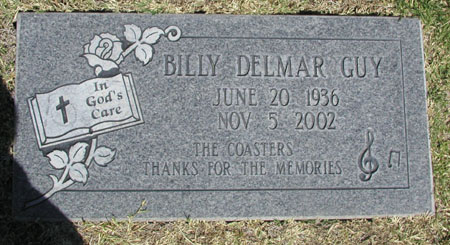
Las Vegas (ctsy Todd Baptista)
Downtown Soulville
with
Mr. Fine Wine
Find a One Hour tribute show
with
Billy Guy songs
on November 27, 2002.
A tribute with lesser known Guy
Coasters leads and Guy solos.
(MP3 and RealAudio)
|
|
 Born
Delmar Phillips on June 20,
1936 in Itasca, (Hill County), Texas. Mother: Sewillie Thompson,
father: Frank Phillips. Moved to Hollywood at ten years of age;
started acting as a child and worked in Johnny Otis´ new club "The
Oasis" in the mid ´50s. Became very popular in the south of
California, probable member of the Emerlads, and also recorded with Mexican Emmanuel Perez as Bip & Bop
(Guy was Bip) on Aladdin single 3287 in 1955 ("Ding Ding Dong" b/w
"Du-Wada-Du"). Became an original Coaster by suggestion from Carl
Gardner, who lived across the street in Watts. Guy became the great
comedian of the Coasters (and posed with a guitar on an early
Coasters publicity shot). He was a genius of musical adventures and
of exploring new vocal hights (as Leiber & Stoller put it: "He could
do anything we wanted him to do"). Born
Delmar Phillips on June 20,
1936 in Itasca, (Hill County), Texas. Mother: Sewillie Thompson,
father: Frank Phillips. Moved to Hollywood at ten years of age;
started acting as a child and worked in Johnny Otis´ new club "The
Oasis" in the mid ´50s. Became very popular in the south of
California, probable member of the Emerlads, and also recorded with Mexican Emmanuel Perez as Bip & Bop
(Guy was Bip) on Aladdin single 3287 in 1955 ("Ding Ding Dong" b/w
"Du-Wada-Du"). Became an original Coaster by suggestion from Carl
Gardner, who lived across the street in Watts. Guy became the great
comedian of the Coasters (and posed with a guitar on an early
Coasters publicity shot). He was a genius of musical adventures and
of exploring new vocal hights (as Leiber & Stoller put it: "He could
do anything we wanted him to do").
Guy stayed with the Coasters up to 1973 on recordings and acted lead
on most of the Coasters´ later recordings - starting with "Searchin´"
and later a.o "The Shadow Knows", "Wake Me, Shake Me", "Wild One"
(the last two he also wrote), "Wait A Minute", "Little Egypt", and
the notorious "Let´s Go Get Stoned" - although he started his first
attempt as a solo artist back in 1962 - recording singles for Lloyd
Price on ABC-Paramount and on Price's
Double-L Records, a.o. "Women" (later issued as "The Prophet" on
several fake Coasters albums); also a.o. "Whip It On Me, Baby" and
"The Big Break". He was often substituted from the mid ´60s on
stage, first by soul singer
Vernon Harrell, and later by Jimmy
Norman (Lou Rawls, by the way, once substituted for Carl Gardner on
a tour). Guy continued his solo career for Chalco, Sew City, Verve
("Shake A Leg" 1967) and other companies and did singles as "Billy
Guy & The Coasters" in 1975 (with H.B. Barnum co-producer). Billy is listed with 41 songs in the
BMI
songwriters´ database. Guy
acted as vocal coach during the late 1960s and early 1970s, and
worked as producer for J.R. Bailey (the former Cadillac, who was a
writing partner to Vernon Harrell). Guy and J.R. had a record
company, GuyJim. Billy also worked as a night-club story teller and
producer for All Platinum – one single was “The Ugly” b/w “Hug One
Another” in 1971. His most notorious album (of several) was "The
Tramp Is Funky" on All Platinum / Snake Eyes in 1972. In 1977 he
recorded with Will "Dub" Jones in Nashville and soon moved back to
Los Angeles, where he worked as back-up studio singer with Grady
Chapman and Jerome Evans (for Michelle Phillips in 1977) and with
Billy Richards during the ´80s. He teamed up again with Will Jones
in the West-Coast stationed group of "World Famous Coasters" - on
and off - from the late ´70s up into the early ´90s. Billy, who
lived near Las Vegas during his later years, turned bald. His wife
June had died several years earlier and Billy lived with girlfriend
Vanessa Van Klyde for 30 years until his death. He became victim of
bad business advises during later years - mostly semi-retired -
although he during the late ´90s acted as coach and cameo act with a
young fake Coasters´ Las Vegas group - often billed as "The Billy
Guy Coasters" (this was a Larry Marshak-promoted group, nowadays
touring as “The Cornell Gunter Coasters”). During mid 1999 Guy sued
Carl for a million dollar trying to get Carl to give up the
"trade-mark" of THE COASTERS (without success).
Billy Guy died in his home at sleep (probable heart attack) in Las
Vegas, Nevada on November 5, 2002 (not November 12, as one could
assume by reading The New York Times obituary). Jerry Leiber and
Mike Stoller were among those who payed for Billy’s funural.
Burial fund-raising and Guardian Unlimited
obituary
 
Billy Guy at Wikipedia
|
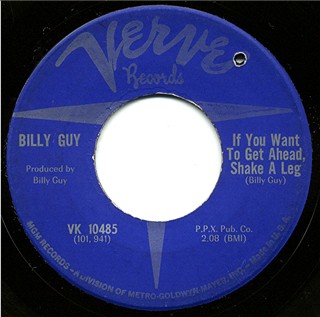 
A Verve single of 1967 by Billy Guy featuring
"If You Want To Get Ahead, Shake A Leg"
and "I´m Sorry About That".- plus an ABC single of
1963.
|
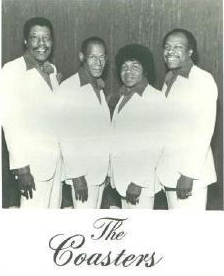
The Will Jones-Billy Guy Coasters of the
late ´80s
(with Jones first and Guy second left).
|
The
New York Times Obituary
(Veta & Carl Gardner interviewed)
Billy Guy, 66,
Baritone Voice of the Coasters,
Is Dead
By
DOUGLAS MARTIN
The New York Times November 15
2002 |
Billy Guy, an original member of the
Coasters vocal quartet who stood out for the raw quality of his baritone voice and sense
of comedy on 50's hits like "Searchin'," died on Tuesday (November 5, 2002;
ed.note) in his apartment in Las Vegas. He was 66. The cause was cardiovascular disease,
said Carl Gardner, the only surviving member of the original Coasters. The Coasters
were among the first black singing groups to be considered truly a rock 'n' roll act, not
rhythm-and-blues. They are best known for their string of narrative comic songs like
"Yakety Yak" and "Charlie Brown," written by Jerry Leiber and Mike
Stoller. When the Rock 'n' Roll Hall of Fame inducted its first members, in 1987, the
Coasters were included (the first inductees were solo artists in 1986; ed.note).
The group's doo-wop-inspired sound was characterized by the low tones of its bass, Bobby
Nunn, and what MusicHound's Essential Album Guide for rock calls Mr. Gardner's
"wolf-in-sheep's-clothing tenor." But it was Mr. Guy who was the exuberant lead
singer on the 1957 song "Searchin'," which featured an "alley" piano
style — essentially two bass notes played alternately on every second beat — and
suitably rough vocal support from the rest of the group. Mr. Guy declares his
determination to find his girl, even if it calls for the detective talents of Charlie
Chan, Sam Spade and Bulldog Drummond — not to mention the Canadian Mounties.
"This was one of the first songs to introduce specific figures from American culture
into its lyrics," Charlie Gillett wrote in "The Sound of the City: The Rise of
Rock and Roll" (Pantheon, 1984). Mr. Guy said in an interview with The Milwaukee
Journal-Standard in 1998, "We had more fun than any other group."
Mr. Guy was born in Itasca, Tex., on June 20, 1936. His birth certificate recorded that
his parents were Frank Phillips and Sewille Thompson, but did not show his name, according
to Veta Gardner, Carl Gardner's wife. By the time he found his way to Southern California,
just as Mr. Gardner was looking for a baritone for a new group, his name was Billy Guy.
Mr. Gardner and Mr. Nunn had been members of the rhythm-and-blues group the Robins, which
recorded the Leiber and Stoller hits "Riot in Cell Block No. 9,"
"Framed" and "Smokey Joe's Cafe."
But Mr. Leiber and Mr. Stoller's small record company was having trouble distributing
their successful records and sold the company, Spark Records, to Atlantic. As part of the
deal, they acquired the rights to the Robins, but the Robins objected to the deal. Mr.
Gardner and Mr. Nunn left the Robins to form a new group in 1955. Mr. Gardner said he
needed to a new voice fast, and found Mr. Guy singing in a duo called Bip and Bop. Leon
Hughes was also recruited to become a Coaster, a name chosen to refer to the West Coast.
The Coasters' first song was "Down in Mexico," which was similar to "Smokey
Joe's Cafe." Neither it nor their next song, "One Kiss Led to Another," was
particularly successful. Then in 1957, they recorded "Searchin' " and
"Young Blood" on the same record, and both were hits. Then came extensive tours
and appearances on a wide range of network television shows, including "The Ed
Sullivan Show" and Dick Clark's "American Bandstand."
Through the 1950's, they kept turning out hits, almost all written by Leiber and Stoller,
including "Poison Ivy," "Framed," (actually a Robins recording of
1954; ed.note) "I'm a Hog for You" and "That is Rock and Roll."
Mr. Guy, who wrote several songs himself, including the group's hits "Wake Me Shake
Me" and "Wild One," said the wackier songs like "Yakety Yak"
could be done only by a special mix of voices like the Coasters.' "It was hard to
find voices," he told the Milwaukee newspaper. "The songs were really based on
country-western. Remember Homer and Jethro? Everyone had to be a specialist. It was black
voices singing in the middle of rhythm-and-blues and country-western."
His survivors include his companion, Vanessa Van Klyde; a sister; a brother; a son; and a
daughter. |
|
Los Angeles Times
Obituary
(Mike Stoller interviewed)
Billy Guy, 66; Baritone Was an
Original Member of the Coasters
By Dennis McLellan
Times Staff Writer November 16 2002
|
Billy Guy, an original member of the
Coasters, the Los Angeles-originated rhythm and blues-based comedy quartet that recorded
"Charlie Brown," "Yakety Yak" and other hits of the 1950s and early
'60s, has died. He was 66. Guy, a baritone who memorably sang the lead on the group's 1957
hit "Searchin' " and was one of the quartet's main comic voices, died of
cardiovascular disease Tuesday (Nov 5; ed.note) in his Las Vegas apartment. Considered by
some the preeminent vocal group of the early days of rock 'n' roll, the Coasters were
formed in 1955 and produced by the legendary songwriting team of Jerry Leiber and Mike
Stoller. Debuting with "Down in Mexico" in 1956, the Coasters recorded a string
of Leiber and Stoller hits that, in addition to "Charlie Brown" and "Yakety
Yak," included "Along Came Jones," "Poison Ivy," "I'm a Hog
for You," "Young Blood" and "Little Egypt." The Coasters, Times
pop music critic Robert Hilburn wrote a few years ago, "made some of the most
entertaining and imaginative records of the '50s -- marvelously funny and often satirical
looks at the world, mostly framed through a restless teen perspective." In 1987, the
Coasters were voted into the Rock and Roll Hall of Fame. "Billy was one of the main
clowns in the group, a very bright guy, very talented," Stoller told The Times
Thursday. Stoller said he and Leiber "looked upon the Coasters as our own voice. We
wrote the songs for them, and we shared a sense of humor." Leiber would sometimes
sing a line of a new song for Guy, "and Billy would take it from there with the same
sense of humor, the same delivery, only better," Stoller said. The Coasters would
perform in theaters, Stoller recalled, "then they'd come back and show us how they
performed [the songs] on stage, and we'd fall on the floor. Then we'd start teaching them
the new songs, and they'd fall on the floor. "It was the most fun of any of the
artists we worked with." The feeling was mutual from Guy's standpoint. "We had
more fun than any group," he told the Milwaukee Journal in 1998. Born in Itasca,
Texas, in 1936, Guy was singing in a duo called Bip and Bop when he was recruited to
become a member of the Coasters, whose name referred to the West Coast. The Coasters
evolved out of the Los Angeles-based R&B group the Robins. The group signed with
Leiber and Stoller's Spark record label in 1954 and scored West Coast hits with the
songwriting team's "Riot in Cell Block 9," "Framed" and "Smokey
Joe's Cafe." After Leiber and Stoller became independent producers for Atlantic
Records, they tried to bring the Robins with them, but part of the group decided to stay
with their manager. Two Robins -- lead singer Carl Gardner and bass singer Bobby Nunn --
stuck with Leiber and Stoller and, teaming with Guy and tenor Leon Hughes, formed the
Coasters. The group, however, underwent various personnel changes over the next few years.
Nunn was soon replaced by Will "Dub" Jones and Hughes was replaced by Young
Jessie, who was replaced by Cornell Gunther, who in turn was replaced by Earl
"Speedo" Carroll. Stoller recalled that one of the key sounds in the Coasters
for quite a few records, including "Yakety Yak" and "Charlie Brown,"
was a harmony duet by Gardner and Guy. But on "Searchin'," Stoller said,
"that was Billy all the way on the lead. And also on 'Along Came Jones,' the little
part in the middle was Billy, who went, 'eh, eh, along came Jones....' And he also was the
lead on 'Little Egypt.' "Stoller likened the Coasters to a vaudeville group or a
commedia dell'arte troupe. "They each played a different role," he said.
"Billy frequently played kind of the country bumpkin, like on 'Little Egypt,' where
he's the rube who walks into the tent show, and on 'Searchin'' also. Carl was more like
the straight man and, of course, the bass singers were always the father figure or the
heavy. When Cornell was in the group, he'd do the female role if there was one. "They
all played a role, but Billy was definitely a master of comic timing." In his later
years, Guy led a group that billed itself as the Coasters -- as did Gardner and, at
various times, many other former members -- thus provoking a series of legal disputes over
who owned the rights to the group's name.Guy reunited with other former Coasters members
about a dozen years ago to perform at a party hosted by the American Society of Composers,
Authors and Publishers in honor of Leiber and Stoller's long collaboration. "That's
the last time I think I saw him face to face," Stoller said, "and he was just as
wonderful as ever." Guy is survived by his companion, Vanessa Van Klyde; a sister; a
brother; a son; and a daughter. |
|
Las Vegas Review-Journal Obituary
Friday, November 15,
2002
Copyright © Las Vegas Review-Journal
Coasters baritone Billy Guy dies at age 66 in LV
Vocal quartet was inducted into Rock 'n' Roll Hall of Fame in 1987
THE ASSOCIATED PRESS
 Billy Guy, who sang baritone on the hits "Searchin' " and "Yakety
Yak" as part of the 1950s vocal quartet the Coasters, has died. He was 66. The singer
died on Tuesday (Nov 5; ed.note) from arteriosclerotic cardiovascular disease at his home
in Las Vegas, the Clark County Coroner's office said Thursday. The Coasters combined
doo-wop rhythm-and-blues with an upbeat rock sound and were best known for comedic,
narrative songs such as "Charlie Brown," nearly all of them penned by Jerry
Leiber and Mike Stoller. Guy wrote some songs himself, including 1960's "Wake Me,
Shake Me." The group was among the first (no - the first;
ed.note) inducted into the Rock 'n' Roll Hall of Fame in 1987. Guy performed with one
edition of the Coasters in a packaged revue that played the Sahara in April 1998 and
returned in revised form that August. But he did not stay with the revue that continued at
the hotel for more than a year. "We all go back together a long ways," Guy said
of the Coasters, Platters and Drifters in 1998. "It was all about friendship. ...
That's when you gave gas money to help somebody get to the gig. It was all about survival.
"And it really wasn't about making any money," Guy added. "You were in it
because you just loved to sing." The Coasters, formed in 1955 with members Carl
Gardner, Billy Guy, Leon Hughes and Bobby Nunn, evolved out of several other singing
ensembles. One of their first songs was "Down in Mexico" in 1956, followed by
"One Kiss Led to Another," then "Searchin' " and "Young
Blood" on the same record the next year. Other hits included "Poison Ivy,"
"Framed," "I'm a Hog for You" and "That is Rock and Roll."
Performers occasionally were replaced through the 1950s and some began their own Coasters
touring groups. Guy and Will "Dub" Jones started their own Coasters tour in the
late 1960s (actually recorded together already in the 1970s; ed.note), while fellow singers Cornell Gunter, who
later was murdered in Las Vegas, Gardner, Hughes and Nunn began their own respective
groups (Gardner actually continued to tour with the original group; ed. note). Legal
wrangling surrounding the claim to such group names led to 1999 legislation pushing for
change in federal trademark law. "There are some Coasters out there that ain't 19
years old," Guy told the Review-Journal in 1998. "At one point there were 10
phony Drifters and Platters running around like the fake Coasters," Guy noted.
"But it wasn't worth going to court over it. Why sue somebody who doesn't have any
money anyway? I've just learned to accept it as a problem that can't be solved." Billy Guy, who sang baritone on the hits "Searchin' " and "Yakety
Yak" as part of the 1950s vocal quartet the Coasters, has died. He was 66. The singer
died on Tuesday (Nov 5; ed.note) from arteriosclerotic cardiovascular disease at his home
in Las Vegas, the Clark County Coroner's office said Thursday. The Coasters combined
doo-wop rhythm-and-blues with an upbeat rock sound and were best known for comedic,
narrative songs such as "Charlie Brown," nearly all of them penned by Jerry
Leiber and Mike Stoller. Guy wrote some songs himself, including 1960's "Wake Me,
Shake Me." The group was among the first (no - the first;
ed.note) inducted into the Rock 'n' Roll Hall of Fame in 1987. Guy performed with one
edition of the Coasters in a packaged revue that played the Sahara in April 1998 and
returned in revised form that August. But he did not stay with the revue that continued at
the hotel for more than a year. "We all go back together a long ways," Guy said
of the Coasters, Platters and Drifters in 1998. "It was all about friendship. ...
That's when you gave gas money to help somebody get to the gig. It was all about survival.
"And it really wasn't about making any money," Guy added. "You were in it
because you just loved to sing." The Coasters, formed in 1955 with members Carl
Gardner, Billy Guy, Leon Hughes and Bobby Nunn, evolved out of several other singing
ensembles. One of their first songs was "Down in Mexico" in 1956, followed by
"One Kiss Led to Another," then "Searchin' " and "Young
Blood" on the same record the next year. Other hits included "Poison Ivy,"
"Framed," "I'm a Hog for You" and "That is Rock and Roll."
Performers occasionally were replaced through the 1950s and some began their own Coasters
touring groups. Guy and Will "Dub" Jones started their own Coasters tour in the
late 1960s (actually recorded together already in the 1970s; ed.note), while fellow singers Cornell Gunter, who
later was murdered in Las Vegas, Gardner, Hughes and Nunn began their own respective
groups (Gardner actually continued to tour with the original group; ed. note). Legal
wrangling surrounding the claim to such group names led to 1999 legislation pushing for
change in federal trademark law. "There are some Coasters out there that ain't 19
years old," Guy told the Review-Journal in 1998. "At one point there were 10
phony Drifters and Platters running around like the fake Coasters," Guy noted.
"But it wasn't worth going to court over it. Why sue somebody who doesn't have any
money anyway? I've just learned to accept it as a problem that can't be solved."
Guy's survivors include his companion, Vanessa Van Klyde; a sister; a brother; a
son; and a daughter, according to The New York Times.
Review-Journal writer Mike Weatherford contributed to this report.
|
|
BILLY GUY'S RECORDINGS (according to
Wikipedia)
Singles
- Ding Ding
Dong/Du-Wada-Du (Aladdin #3287) (1955) (as
Bip and Bop)
- As Quiet As
It’s Kept/Here I Am (ABC Paramount #10320)
(1962)
- It Don't
Take Much/She’s A Humdinger (ABC Paramount
#10397) (1962)
- Whip It On
Me, Baby/Women (aka The Prophet) (Double-L
#719) (1963)
- Foxy Lady/ (B-Side
Unknown) (Chalco) (1960’s)
- I’m Sorry
‘Bout That/Lookin’ Like A Nut Nut (GuyJim
#GJ-587) (about 1967) (as The New Way)
- Lookin’ Like
A Nut Nut/Here ‘Tis (Sew City #109) (1967)
(as Billy Guy & The Odds 'N' Ends)
- If You Want
To Get Ahead, Shake A Leg/I’m Sorry About
That (Verve #10485) (1967)
- Let Me Go
Getto/ (No Side B) (All Platinum #2320)
(1970)
- The Ugly/Hug
One Another (All Platinum #2323) (1971)
- All I Need
Is Love/Shake A Leg (Bell #124) (1971) (as
Happy) (also released as Happy Cats)
- Watergate (Put
Some Funk On, Cause The Money's Been Long
Gone)/Hockey-Puck (Black Circle #102)
(1970's) (produced by Billy Guy &
H. B. Barnum) (as Billy Guy and The
Coasters)
- You Move Me/Take
It Easy Greasy (Sal-Wa #1001) (1975) (as
Billy Guy and The Coasters)
- Ain’t No
Greens In Harlem/Jumbo Bwana (Polydor
#2040-273) (1977) (as Billy Guy and The
Coasters)
Albums
- Universal
Messengers: An Experience In The Blackness
Of Sound (Turbo/All Platinum) (about 1969) (produced
only)
- A Little Of
This And A Little Of That (All Platinum) (about
1971) (possibly unreleased)
- Hungry (Joy
#189) (England) (1971) (includes solo tracks
recorded in 1962) (released as by The
Coasters)
- The Tramp Is
Funky (Snake Eyes/All Platinum #9000) (1972)
- Pearl Box
Revue: Call Me Misster (Snake Eyes/All
Platinum #9001) (about 1972) (produced and
appeared on album)
- It Ain’t
Sanitary (Trip #8028) (1973) (includes solo
tracks recorded in 1962) (released as by The
Coasters) reissue of Joy LP
- The Coasters
(Stateside #40028) (Germany) (1973) (all 16
solo tracks recorded in 1962) (released as
by The Coasters)
- Michelle
Phillips: Victim Of Romance (A&M #4651)
(1977) (backup vocals on "Paid The Price"
track)
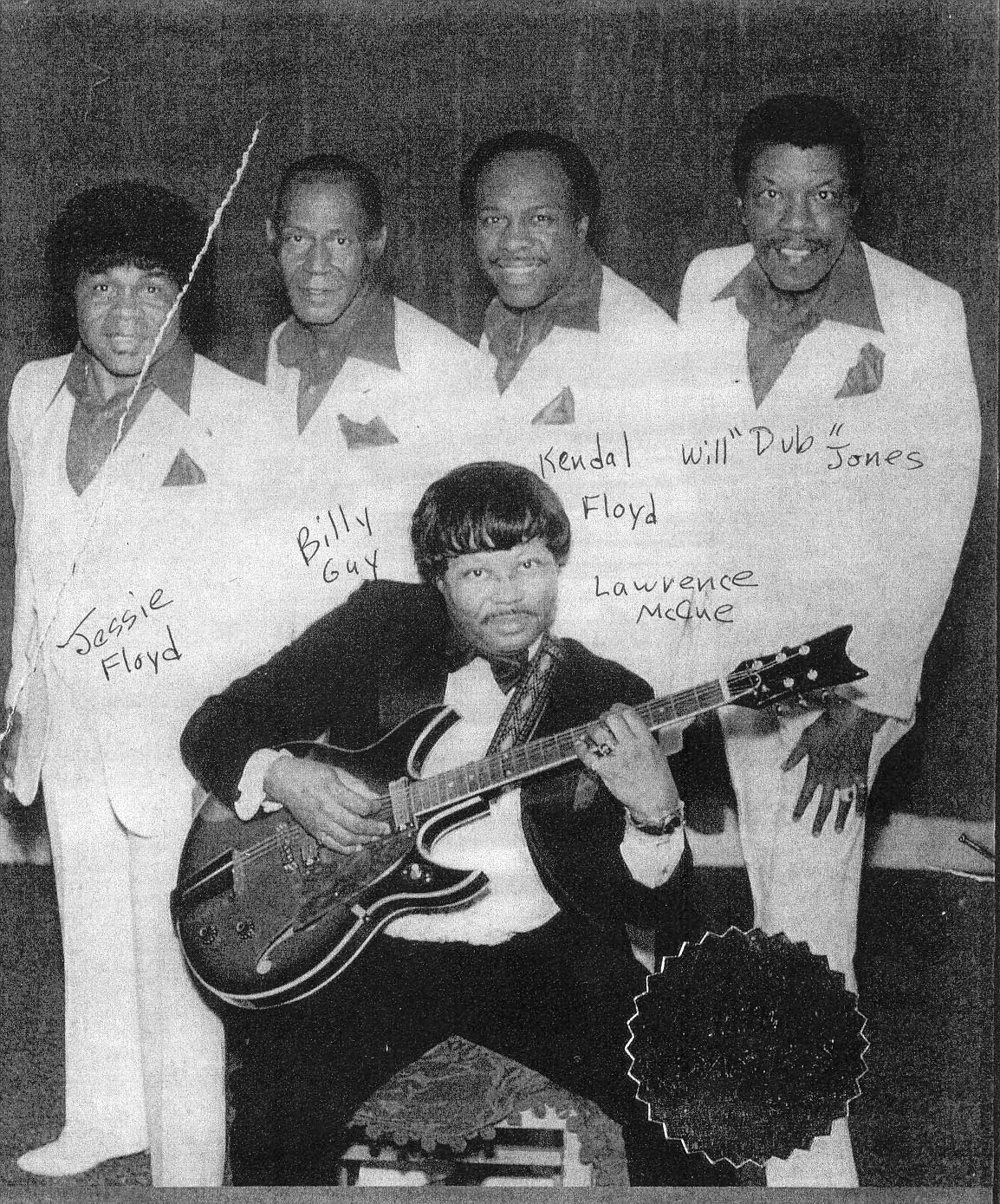
"The Coasters"
Jessie Floyd, Billy Guy, Kendal Floiyd, Will "Dub" Jones,
and guitarist/music director Lawrence McCue in thelate '80s/early '90s.
The original Coasters
(1956-1968) were inducted into the
Rock & Roll Hall of Fame in 1987
and are most famous for their hits
Yakety-Yak,
Charlie Brown,
Down in Mexico, and
Searchin’. Though they
broke up in 1968, every original member has since had his
own touring version of the band over the years. Lawrence and
his musical partner Jessie Floyd began playing + touring
with original Coasters members
Billy Guy and
Will “Dub” Jones in 1983
when Lawrence and Jessie ran into Billy Guy by chance at the
Gower Gulch Denny’s in Hollywood. They bought Guy lunch and
the idea came up of putting together a new unit of The
Coasters. They contacted Will “Dub” Jones who agreed to come
aboard, then got Jessie’s cousin Kendal Floyd to join and
within days the next incarnation of the band was born. They
played together for 17 years till the passing of Jones and
then Guy whereupon they retired the band. -
From
Lawrence Mcue (Ryan Romera Photography) web site.
ADOLPH JACOBS 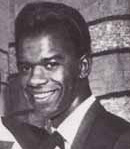
Born April 15, 19., Died in L.A. July 23, 2014.
(member c:a January 1956 - c:a December 1958)
guitarist
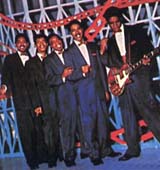
|
|
 Born
Adolf Jacobs, April 15, 1939 in Pineland, Sabine County, East Texas (data
confirmed). Moved to
Oakland and played with the Medallions on Essex and wrote "I Know" for
them in 1955. Was spotted by Gardner in late 1955 and regarded a regular Coasters member
until his departure. Recorded his own "Walkin´ & Whistlin´" for Class
Records in L.A. in 1959. Jacobs never settled in New York, but worked with Johnny
"Guitar" Watson, Larry Williams, and Little Richard in Hollywood during the
´60s and made jazz records for Kent Harris in the ´70s (Harris was the originator of
"Clothes Line", the song that stood model for the Coasters´ "Shoppin´ For
Clothes"). Led his own band in California in later years (and is the only original Coaster
who had´t tried his luck with new Coasters until the newest millennium - although his orchestra backed the Jones-Guy
Coasters a couple of times during the late '80s-early '90s and recently has
joined the Leon Hughes group - and started his own Coasters just shortly
before his dead). Born
Adolf Jacobs, April 15, 1939 in Pineland, Sabine County, East Texas (data
confirmed). Moved to
Oakland and played with the Medallions on Essex and wrote "I Know" for
them in 1955. Was spotted by Gardner in late 1955 and regarded a regular Coasters member
until his departure. Recorded his own "Walkin´ & Whistlin´" for Class
Records in L.A. in 1959. Jacobs never settled in New York, but worked with Johnny
"Guitar" Watson, Larry Williams, and Little Richard in Hollywood during the
´60s and made jazz records for Kent Harris in the ´70s (Harris was the originator of
"Clothes Line", the song that stood model for the Coasters´ "Shoppin´ For
Clothes"). Led his own band in California in later years (and is the only original Coaster
who had´t tried his luck with new Coasters until the newest millennium - although his orchestra backed the Jones-Guy
Coasters a couple of times during the late '80s-early '90s and recently has
joined the Leon Hughes group - and started his own Coasters just shortly
before his dead).
Move around easy /
Walkin' and Whistlin'

Adolph
Jacobs at Wikipedia
|
 Adolph
Jacobs with the Medallions in 1956.
Adolph
Jacobs with the Medallions in 1956.
ADOLPH JACOBS' RECORDINGS (according
to Wikipedia)
Solo
records
- Move Around Easy/Walkin’ And
Whistlin’ (Class #253) (9/1959)
- Gettin' Down With The
Game/Do It (Romark #101) (about 1964)
- Title Unknown (Kent Harris)
(1970’s) (jazz recordings)
Various group singles and recordings
- A Little Taste/Thin Possum
(Raja #65001) (1960’s) (Elliot Shavers) (played guitar)
- Little Richard: The Second
Coming (Reprise #2017) (9/1972) (played guitar)
- Don And Dewey: Jungle Hop (Specialty
#7008) (1991) (played guitar)
- Billy Lamont Meets Chuck
Edwards (Official #5678) (played guitar)
WILL
"DUB" JONES 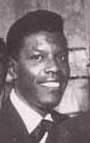
May 14, 1928 - January 16, 2000
(member c:a December 1957 - c:a January 1968)
bass vocal
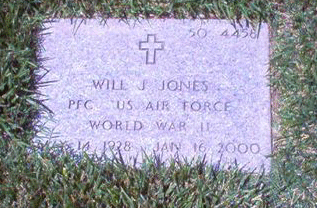
Riversida, CA (ctsy Todd Baptista)
|
|
 Born Will J. Jones in Shreveport, Louisiana May
14, 1928 (not 1930 or 1936). Received his military discharge in Los Angeles, California. Was one
of the early "pupils" of the West Coast "doo-wop father" Jesse Belvin
and became a spiritual singer in partner-ship with the young Ted Taylor and Lloyd McCraw
in 1954 (in the Santa Monica Soul Seekers), the precursors of the Cadets/Jacks. This group
(a quintet with Aaron Collins and Willie Davies - Taylor left a bit later) recorded
several famous cover hits for Modern Records during 1955-1957 as the Cadets (they also
recorded as the Jacks for the Bihari brothers). Notable titles: "Heartbreak
Hotel", the hit version of "Stranded In The Jungle", and as Will Jones
& The Cadets the ballad "Hands Across The Table". Will also worked behind Jesse Belvin,
Young Jessie and Richard Berry's girl group the Dreamers in studios and sang lead on the the Crescendos' "Sweet
Dreams" (featuring Bobby Relf and Bobby Day) for Atlantic in L.A. 1956. Became the obvious replacement for Bobby Nunn,
when Leiber-Stoller decided to bring the Coasters to New York. Jones was a member of the
Coasters during the classic years. He recorded with Cora Washington as "Cora &
Dub" during the 1960s (on MJC) and after his leave (on Cotillion) and is rumored to have guested the Trammps (on a revival of
"Zing! Went The Strings Of My Heart"). He also did some recordings
aropund 1976, issued on a "The World Famous Coasters" LP (including a.o.
"If I A Hammer" for AIA) and teamed up with Billy Guy in Nashville in 1977 for
some "Coasters" King/Starday recordings, but soon moved back to Los Angeles,
where he teamed up with his old mentor, the creator of the Cadets, Lloyd McCraw, recording
spirituals/gospels (a.o. "Joshua Fit The Battle" as the Melodians). He again
launched "The World Famous Coasters" in Los Angeles around 1979, often featuring
Billy Guy. This group (which acted sporadically and later mostly as just "The
Coasters") also featured Jessie Floyd, Kendal Floyd and guitarist Lawrence McCue
during the 1980s and was scheduled for England in 1992, but didn´t materialize. Jones
sang on The Charades' "We Got It All" in 1987 - and with the legendary Amazing Zion Travelers during the early and mid 1990s (by
then also featuring guitarist McCue and Willie Chambers Jr.). Will "Dub" Jones
died in Long Beach, California on January 16, 2000 at the age of 71 after some years of
semi-retirement and diabetes Born Will J. Jones in Shreveport, Louisiana May
14, 1928 (not 1930 or 1936). Received his military discharge in Los Angeles, California. Was one
of the early "pupils" of the West Coast "doo-wop father" Jesse Belvin
and became a spiritual singer in partner-ship with the young Ted Taylor and Lloyd McCraw
in 1954 (in the Santa Monica Soul Seekers), the precursors of the Cadets/Jacks. This group
(a quintet with Aaron Collins and Willie Davies - Taylor left a bit later) recorded
several famous cover hits for Modern Records during 1955-1957 as the Cadets (they also
recorded as the Jacks for the Bihari brothers). Notable titles: "Heartbreak
Hotel", the hit version of "Stranded In The Jungle", and as Will Jones
& The Cadets the ballad "Hands Across The Table". Will also worked behind Jesse Belvin,
Young Jessie and Richard Berry's girl group the Dreamers in studios and sang lead on the the Crescendos' "Sweet
Dreams" (featuring Bobby Relf and Bobby Day) for Atlantic in L.A. 1956. Became the obvious replacement for Bobby Nunn,
when Leiber-Stoller decided to bring the Coasters to New York. Jones was a member of the
Coasters during the classic years. He recorded with Cora Washington as "Cora &
Dub" during the 1960s (on MJC) and after his leave (on Cotillion) and is rumored to have guested the Trammps (on a revival of
"Zing! Went The Strings Of My Heart"). He also did some recordings
aropund 1976, issued on a "The World Famous Coasters" LP (including a.o.
"If I A Hammer" for AIA) and teamed up with Billy Guy in Nashville in 1977 for
some "Coasters" King/Starday recordings, but soon moved back to Los Angeles,
where he teamed up with his old mentor, the creator of the Cadets, Lloyd McCraw, recording
spirituals/gospels (a.o. "Joshua Fit The Battle" as the Melodians). He again
launched "The World Famous Coasters" in Los Angeles around 1979, often featuring
Billy Guy. This group (which acted sporadically and later mostly as just "The
Coasters") also featured Jessie Floyd, Kendal Floyd and guitarist Lawrence McCue
during the 1980s and was scheduled for England in 1992, but didn´t materialize. Jones
sang on The Charades' "We Got It All" in 1987 - and with the legendary Amazing Zion Travelers during the early and mid 1990s (by
then also featuring guitarist McCue and Willie Chambers Jr.). Will "Dub" Jones
died in Long Beach, California on January 16, 2000 at the age of 71 after some years of
semi-retirement and diabetes
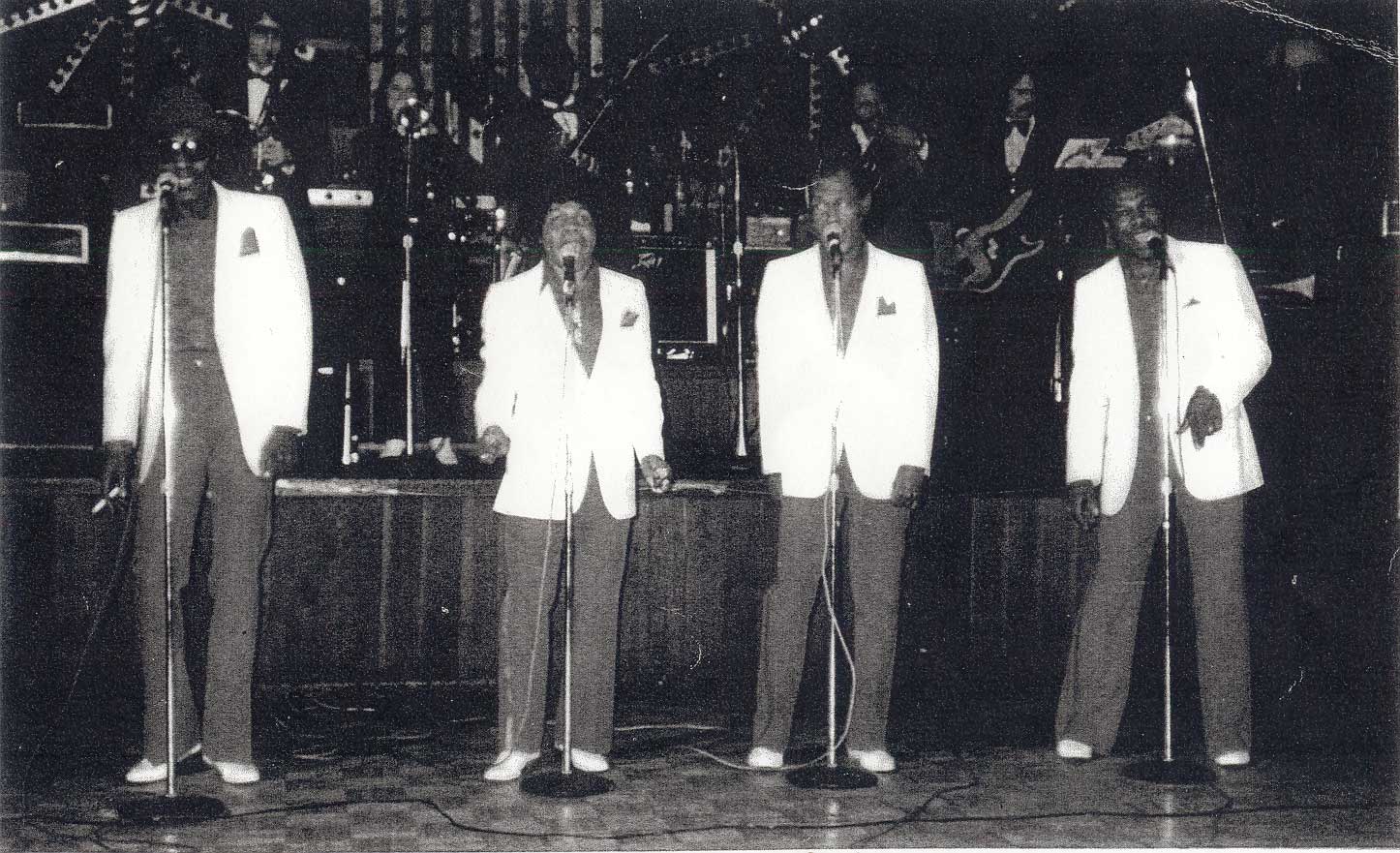
"The Coasters" (Will Jones' group) in circa 1990
-
Will Jones, Jessie Floyd, Billy Guy, and Kendal Floyd.
(among the instrumentalists in the background are guitarists Adolph Jacobs and Lawrence
McCue)
- at a party hosted by the American Society of
Composers, Authors and Publishers
in honor of Leiber and Stoller's long collaboration. Photo ctsy Dr. Lawrence W. McCue
(and thanks Lawrence for the information).
Will "Dub" Jones at Wikipedia
Reading on the Cadets/Jacks:
Group Harmony - Echoes of the Rhythm and Blues Era
by
Todd
R. Baptista - new edition (Collectables,
www.oldies US
2007)
From the story of THE
CADETS - by Jim Dawson, 1994
In early 1955 Joe Bihari of Modern Records in Los Angeles hired a
local gospel quintet and turned them into a utility in-house R&B act. Over the next
nearly three years this group would record a total of 20 singles under two separate
identities - the Cadets (14 releases) and the Jacks (six releases) - on different labels
and have a hit under each name. "I got started singing in church
back in Arkansas, where I grow up," the Cadets' lead tenor and occasional songwriter,
Aaron Collins, now 64, said recently. After spending three years with a gospel group in
Michigan, Collins moved west to Southern California. "I joined a spiritual group out
here called the Santa Monica Soul Seekers," he recalled. "There were six of us:
besides myself, there were Willie Davis, Ted Taylor, Lloyd McGraw, Will Jones - who we
called 'Dub' and a fellow named Glendon Kingsby. We mostly migrated from someplace else.
Ted came from Oklahoma, Willie was from Texas and Glendon was from around Arkansas, like I
was. [Baritone] Lloyd McGraw, who was sort of our manager, went and got us a deal to make
a spiritual album at Modern Records in Culver City. Their A&R guy, Maxwell Davis, had
us come to his house to go over our material and get ready to record. But when he heard
us, heard how all of us could sing lead with strong voices, well, he kind of talked us
into going in a different direction. He wanted us to sing rock'n'roll. We all agreed
except for Glendon, and he quit the group to stay with spirituals. And that's when we
became the Jacks and the Cadets."
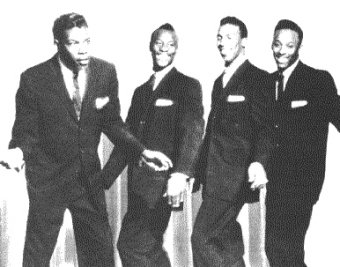 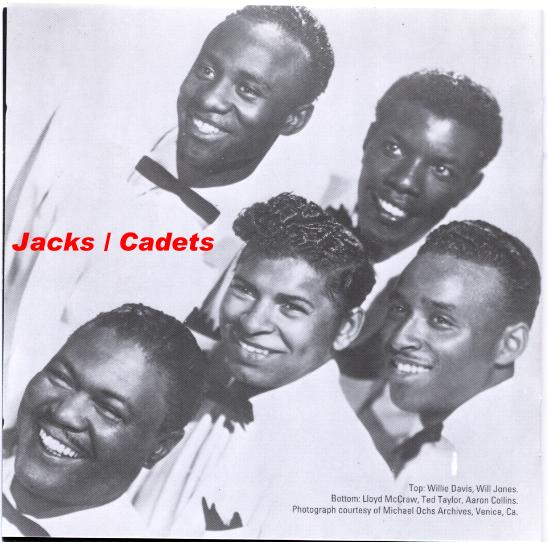
| The
Jacks/Cadets/Flares |
(The Doo Wop Nation - with discographies)
copy of above at
this site
Maxwell Davis arranged and Joe Bihari
supervised most of the group's sessions and, according to Collins, guided their eclectic
recording career. As a rule, bass singer Dub Jones or Collins sang lead on the Cadets'
recordings, while tenor Willie Davis fronted the Jacks. (Ted Taylor was also featured on
several songs.) Modern was hoping that the Cadets and, to a lesser extent, the Jacks,
would be what the Charms were to DeLuxe Records: a successful black cover group taking
hits away from other black vocal artists on smaller labels. Collins recalled, "We'd
go into the studio with Maxwell Davis and he'd play the [original] records for us. We'd
see who was best suited to sing lead on them. We were so talented that we could listen to
a song and almost repeat it. We'd just write down the words and read them off the page. We
worked real fast. I can remember flying back into town one afternoon and going into the
studio that night and recording stuff that we'd never seen before. And we did all of it
live. The whole band, the group, everybody would be there in one big room, we'd do about
four takes and move on to the next song.
The most distinctive voice of the group was Dub Jones, who was probably the
greatest bass man in rock'n'roll. A native of Louisiana, Jones, now 65, recalled that he
linked up with the others after he got out of the military service in Los Angeles. "I
was always a big fan of the Ravens - you know, Jimmy Ricks," he said. "So I
liked what we were doing at Modern." Signing a three year, 32 song contract with
Modern on 10 April 1955, the quintet was rushed into the company studio to record a cover
of Savoy Records artist Nappy Brown's' DON'T BE ANGRY', which had just begun to break
nationally. Aaron Collins was picked to sing lead, and the group was dubbed the Cadets.
"That was Joe Bihari that came up with the name", Collins said. Then, a couple
of weeks later, when a local black-owned, store front label called Showtime had a breakout
single, 'Why Don't You Write Me' by the Feathers, the group were rushed back into the
studio to cover it as well this time with Willie Davis singing lead. At the same session
they also covered a humorous Charles Calhoun recording on MGM Records called 'SMACK DAB IN
THE MIDDLE' featuring Dub Jones. Charles Calhoun, incidentally, was Jesse Stone, the
legendary songwriter-arranger for Atlantic Records. In order that this second single could
be hurried onto the market at the same time as the Cadets' 'Don't Be Angry', the Biharis
christened the group the Jacks and released this second single simultaneously on a
subsidiary label, RPM. "They thought they had something real big, so they wanted to
put out records real fast on us," Collins said. "They couldn't release the
records fast enough under just one name, and that's why we also became the Jacks."
Nappy Brown's 'Don't Be Angry' spent most of the summer on the national R&B charts
(topping out at #2 for three weeks) and even reached #25 on the pop charts despite being
edged out by a better-selling cover (#14) by the white Crew-Cuts on Mercury Records. But
the Cadets' single Modern 956), backed on the flipside by Ted Taylor singing lead on 'I
Cry', failed to catch much of the overflow. By then their first Jacks record, 'Why Don't
You Write Me' was a hit, and when the group went out on tour and ended up spending a week
at the Apollo Theater, they performed only as the Jacks. It wasn't until later that they
also toured as the Cadets.
The Cadets finally hit the jackpot on their seventh outing, 'STRANDED IN THE
JUNGLE'/'I Want You' (Modern 994). 'Stranded' had been co-written by a local teenage girl
Ernestine Smith and singer James Johnson, and recorded by Johnson's local group, the
Jayhawks, for a small, storefront operation on Vernon Ave (Flash Records). The record had
an almost cartoon quality that immediately appealed to young people, and was broken into
essentially two separate, alternating songs with different rhythms - one for the jungles
of darkest Africa, the other for the streets of urban America. Despite the single's low
fidelity sound and the Jayhawks' shaky harmony, 'Stranded In The Jungle' became a local
R&B hit in the spring of 1956. Modern Records, recognising the song's potential,
recorded a more polished version with the Cadets. Maxwell Davis sparked up the recording
by giving it a subtle mambo flavour, and the Cadets delivered the song with considerably
more power and finesse than the Jayhawks. "Dub Jones did the lead and Willie Davis
and I did like a duet behind him," Collins said. "We didn't really want to do
that record, We wanted to SING, and this was just a novelty thing. But we did it,
tongue-in-cheek, we didn't care anything about the thing." Dub Jones gave the deadpan
performance of his career, but the hook that differentiated the Cadets' recording of
'Stranded In The Jungle' from the Jayhawks' version was provided by a substitute tenor
named Prentice Moreland, standing in for an absent Ted Taylor on that particular session.
"Prentice was singing Ted's part, you know, that real high tenor, and at the end of a
verse he just stepped right in there and shouted, 'Great googa mooga, let me outta here!'
When he did that it surprised everybody, but we decided to leave it in." Moreland's
"Great googamooga" squeal, along with Little Richard's opening syllables to
'Tutti Frutti', would become one of rock'n'roll's most memorable pieces of nonsense.
"I think he picked that up from Rochester [black comedian Eddie Anderson]",
Collins said. "Prentice know Rochester pretty well." The Cadets' 'Stranded'
entered Billboard's R&B chart on 21 July 1956 and rose to #4; it also charted pop at
#15, beating out the Jayhawks' original (#18). For once, Modern was also able to outsell
the huge Chicagobased Mercury company, which specialised in knocking off smaller companies
with white cover records of black songs. A single of 'Stranded' by Mercury's Gadabouts
only made it to #39. The Cadets' recording was picked up by Phonodisc in Canada for
distribution there, and released in Great Britain on London Records. Along with the
familiar version of 'Stranded In The Jungle', we've included the original studio recording
before the exotic jungle sounds and maracas were overdubbed onto it. You be the judge: did
the overdubs enhance the record?
... Veteran songwriter named Bob Russell briefly got Collins onto Capitol
Records, which released at least one single on its brief Crazy Horse subsidiary. Then
Collins and Davis joined Buck Ram's Flares group (with George Hollis and Tommy Miller) in
1961 in time to enjoy a national Top 30 hit, 'Foot Stomping - Part One'. Aaron Collins,
Willie Davis, Dub Jones and Joe Bihari still live in the Los Angeles area (1994). Ted
Taylor, Lloyd McGraw, Prentice Moreland and Maxwell Davis are deceased.
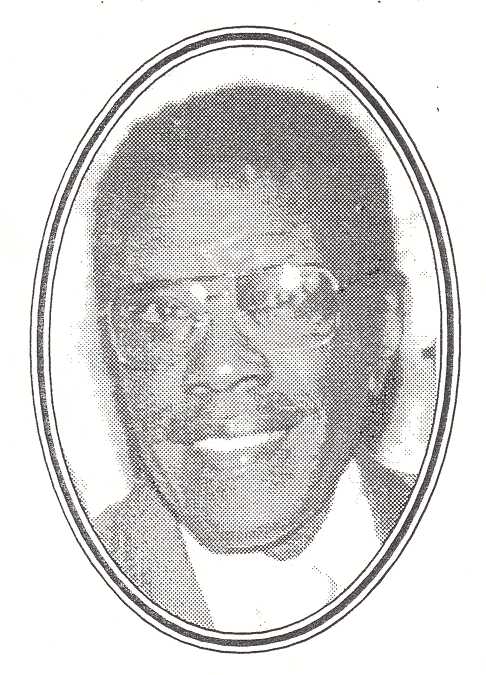
|
|
GOLDMINE OBITUARY:
 Will "Dub" Jones, the floor-rumbling bass voice of The Coasters, whose
deadpan reading of the immortal line "Why's everybody always pickin' on me"
enlivened the group's 1959 Jerry Leiber/MikeStoller–penned and produced smash
"Charlie Brown," died Jan. 16, 2000, in Long Beach, Calif., at age 71. Born May
14, 1928, in Shreveport, La., as a young man Jones completed his military service in Los
Angeles and joined a gospel sextet, The Santa Monica Soul Seekers (along with Aaron
Collins and Ted Taylor). Modern Records A&R director Maxwell Davis convinced five
members (including Jones) to cross over to the secular side of the tracks in 1955. Thus
began a curious chapter in L.A. R&B history — the quintet recording
simultaneously as The Cadets for Modern and as The Jacks for its RPM subsidiary. Jones'
deep-hued vocals (one of his main influences was Ravens' bass Jimmy Ricks) were often out
front on The Cadets' releases, many of which were covers of then-hot R&B tunes issued
by other labels. Such was the case with The Cadets' biggest hit, "Stranded In The
Jungle"; the jumping novelty song had only recently been released on L.A.'s tiny
Flash logo, by The Jayhawks. In The Cadets' more polished hands, "Stranded In The
Jungle" vaulted to #4 on Billboard's R&B charts and #15 Pop in the summer
of 1956. Jones also handled leads for The Cadets' covers of "Heartbreak Hotel"
(needless to say, their reading made scant inroads against Elvis Presley), Charles
Calhoun's "Smack Dab In The Middle," Peppermint Harris' "I Got Loaded"
and Johnny "Guitar" Watson's strutting "Love Bandit" (better known as
"Gangster Of Love"). Will "Dub" Jones, the floor-rumbling bass voice of The Coasters, whose
deadpan reading of the immortal line "Why's everybody always pickin' on me"
enlivened the group's 1959 Jerry Leiber/MikeStoller–penned and produced smash
"Charlie Brown," died Jan. 16, 2000, in Long Beach, Calif., at age 71. Born May
14, 1928, in Shreveport, La., as a young man Jones completed his military service in Los
Angeles and joined a gospel sextet, The Santa Monica Soul Seekers (along with Aaron
Collins and Ted Taylor). Modern Records A&R director Maxwell Davis convinced five
members (including Jones) to cross over to the secular side of the tracks in 1955. Thus
began a curious chapter in L.A. R&B history — the quintet recording
simultaneously as The Cadets for Modern and as The Jacks for its RPM subsidiary. Jones'
deep-hued vocals (one of his main influences was Ravens' bass Jimmy Ricks) were often out
front on The Cadets' releases, many of which were covers of then-hot R&B tunes issued
by other labels. Such was the case with The Cadets' biggest hit, "Stranded In The
Jungle"; the jumping novelty song had only recently been released on L.A.'s tiny
Flash logo, by The Jayhawks. In The Cadets' more polished hands, "Stranded In The
Jungle" vaulted to #4 on Billboard's R&B charts and #15 Pop in the summer
of 1956. Jones also handled leads for The Cadets' covers of "Heartbreak Hotel"
(needless to say, their reading made scant inroads against Elvis Presley), Charles
Calhoun's "Smack Dab In The Middle," Peppermint Harris' "I Got Loaded"
and Johnny "Guitar" Watson's strutting "Love Bandit" (better known as
"Gangster Of Love").
When Bobby Nunn left The Coasters, Jones replaced him in early 1958 — just in time to
participate in the group's across-the-board chart-topper for Atco, "Yakety Yak."
This was the heyday of the legendary vocal group, and their producers, Leiber And Stoller,
took full advantage of Jones' sharp comic timing. He shared lead vocal duties with Cornell
Gunter on "Yakety Yak's" breathtaking flip, "Zing! Went The Strings Of My
Heart" and took over altogether for the Latin-tinged "Sorry But I'm Gonna Have
To Pass." Jones' contributions to "The Shadow Knows," "Along Came
Jones," "That Is Rock & Roll," "Three Cool Cats" and
"Shoppin' For Clothes" helped to make them enduring classics. The Coasters' 1960
Atco LP One By One gave Jones and his each of his comrades (Carl Gardner, Billy
Guy, and Gunter) a chance to croon some serious material, the bass vocalist responding
with smooth renditions of "The Way You Look Tonight," "You'd Be So Nice To
Come Home To" and "But Beautiful." Jones remained a Coaster for most of the
rest of the decade, putting in a memorable appearance with the group on the Feb. 10, 1965,
episode of the weekly ABC-TV rock spectacular Shindig! and providing his usual
flawless vocal bottom for The Coasters' '67 reading of "D.W. Washburn" on
Columbia's Date subsidiary. Funeral services for Jones were held Jan. 24 at Bethel Miracle
Church in Long Beach, Calif.
— Bill Dahl |
|
|
|
|
WILL JONES' SOLO RECORDINGS (according
to Wikipedia)
- Hands Across The Table/Love
Can Do Most Anything (Modern #1024) (1957) (as Will Jones &
The Cadets)
- Cold Blooded Women/What Can
I Do (MJC #101) (about 1969) (as Dub & Cora)
- Cold Blooded Woman/Heaven’s
Not So Far (MJC #108) (about 1969) (as Dub Jones)
- Cold Blooded Women/What Can
I Do (Cotillion #44079) (1970) (as Dub & Cora)
CORNELL GUNTER 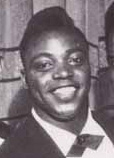
November 14, 1936 - February 26, 1990
(member c:a December 1957 - May 1961)
tenor vocal
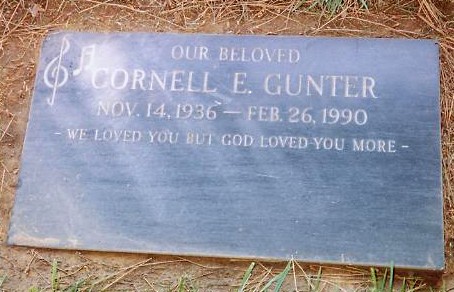
Inglewood, CA (ctsy Todd Baptista)
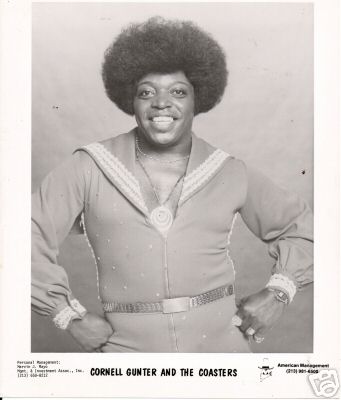

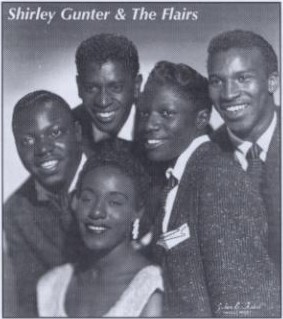
Shirley Gunter
& The Flairs
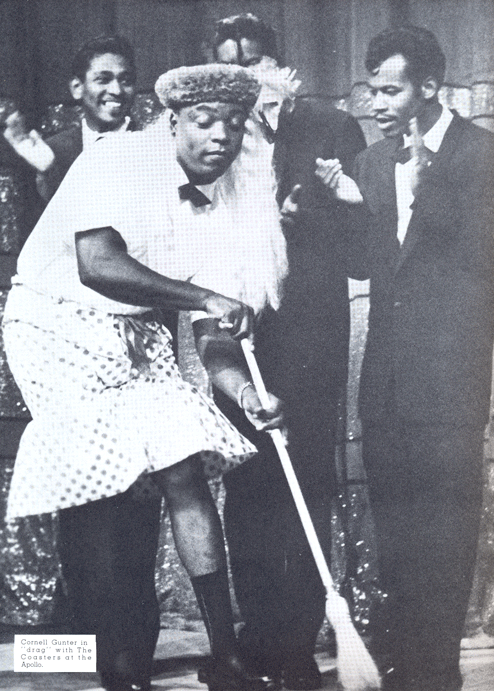
Cornell and the true Coasters
at Dick Clark TV-show in 1958.
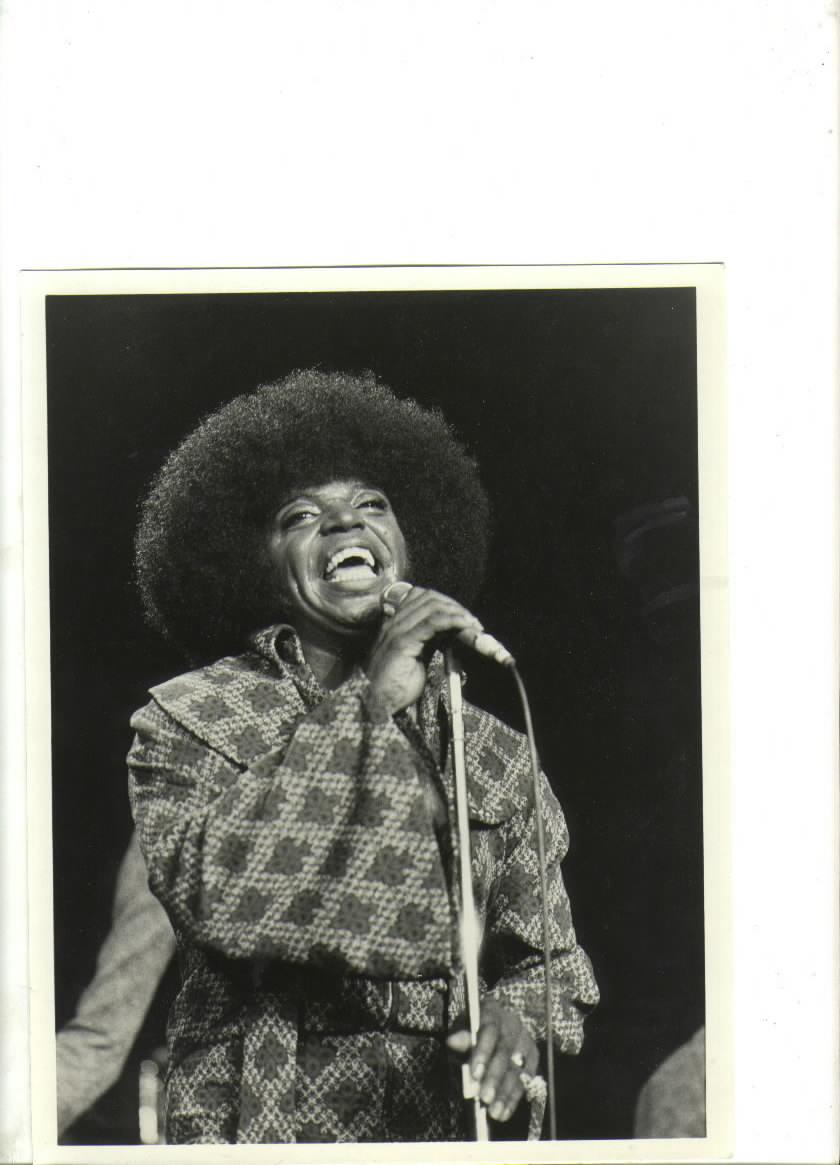
Gunter´s grave
Cornell Gunter´s
"Fabulous Coasters".
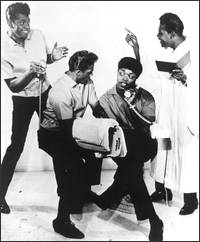
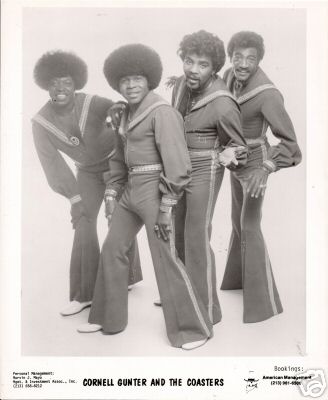 |
|
 Born
Cornelius E. Gunter November 14, 1936 (his tombstone says 1936, some
files say 1938) in Coffeyville, Kansas. Later nicknamed Cornel and
Cornell. Came to Los Angeles around 1942 and studied at Jefferson
High. Formed the original Platters (as the Flamingoes, not to be
confused with the Chicago group the Flamingos) in 1952 with Alex and
Gaynel Hodge and Joe "Jody" Jefferson. He probably sang with this
group as back-up on Big Jay McNeely’s “Nervous Man Nervous” for
King in 1953. Other teenage friends from those early years were
Curtis Williams (of the early Penguins) and Jesse Belvin. Cornell
was an original member of the Platters when Herb Reed joined that
group and shared leads with him up into mid/late 1953. When Tony
Williams entered the Platters Cornell and his new friend Richard
Berry joined a group led by Young Jessie called the Debonaires (no
records). This new line-up made its recording debut for John Dolphin
with a Gunter-led song, titled "I Had A Love" as the Hollywood
Bluejays. This song was soon re-recorded for Flair Records (one of
the Bihari brothers´ many labels) as by the Flairs, where the group
stayed up into 1955. Later Cornell formed the Ermines and a new
line-up of Flairs for ABC-Paramount ("Aladdin´s Lamp" a.o.). Around
1956 the Flairs consisted of Cornell, Young Jessie, Randy Jones, and
Pete Fox with Cornell’s sister Shirley Gunter as guest. Cornell also
toured with Charlie Fuqua´s new Ink Spots; with Tony Williams´
Platters in 1956, and recorded as a solo act during 1957 for Dot,
Eagle and Liberty (a.o. a cover of Sam Cooke´s "You Send Me" - Jesse
Belvin also covered that song). He sang the title song on the 1957
Susan Oliver movie “The Green Eyed Blonde”. Before his engagement
with the Coasters, Gunter also launched a group called the Cornells
(which never did record at the time, but included Jesse Belvin and
Joe Jefferson) and claimed he was the piano player on "Earth Angel".
Gloria Gunter (another sister) recorded an “answer” single of
“Yakety Yak” for Arch, titled “Move On Out” (which included back-up
singing from Cornell). Born
Cornelius E. Gunter November 14, 1936 (his tombstone says 1936, some
files say 1938) in Coffeyville, Kansas. Later nicknamed Cornel and
Cornell. Came to Los Angeles around 1942 and studied at Jefferson
High. Formed the original Platters (as the Flamingoes, not to be
confused with the Chicago group the Flamingos) in 1952 with Alex and
Gaynel Hodge and Joe "Jody" Jefferson. He probably sang with this
group as back-up on Big Jay McNeely’s “Nervous Man Nervous” for
King in 1953. Other teenage friends from those early years were
Curtis Williams (of the early Penguins) and Jesse Belvin. Cornell
was an original member of the Platters when Herb Reed joined that
group and shared leads with him up into mid/late 1953. When Tony
Williams entered the Platters Cornell and his new friend Richard
Berry joined a group led by Young Jessie called the Debonaires (no
records). This new line-up made its recording debut for John Dolphin
with a Gunter-led song, titled "I Had A Love" as the Hollywood
Bluejays. This song was soon re-recorded for Flair Records (one of
the Bihari brothers´ many labels) as by the Flairs, where the group
stayed up into 1955. Later Cornell formed the Ermines and a new
line-up of Flairs for ABC-Paramount ("Aladdin´s Lamp" a.o.). Around
1956 the Flairs consisted of Cornell, Young Jessie, Randy Jones, and
Pete Fox with Cornell’s sister Shirley Gunter as guest. Cornell also
toured with Charlie Fuqua´s new Ink Spots; with Tony Williams´
Platters in 1956, and recorded as a solo act during 1957 for Dot,
Eagle and Liberty (a.o. a cover of Sam Cooke´s "You Send Me" - Jesse
Belvin also covered that song). He sang the title song on the 1957
Susan Oliver movie “The Green Eyed Blonde”. Before his engagement
with the Coasters, Gunter also launched a group called the Cornells
(which never did record at the time, but included Jesse Belvin and
Joe Jefferson) and claimed he was the piano player on "Earth Angel".
Gloria Gunter (another sister) recorded an “answer” single of
“Yakety Yak” for Arch, titled “Move On Out” (which included back-up
singing from Cornell).
After leaving the Coasters, Cornell embarked "D´s Gents" (with Chuck
Barksdale and Johnny Carter from Chicago´s the Dells plus the
nucleus from Pittsburg´s the Altairs), touring as back-up group to
Dinah Washington. In 1962 he recorded for Warner Bros. In late 1963
he formed his own Coasters group in L.A., comprising singers of the
declining Penguins, including Randy Jones, Teddy Harper and Dexter
Tisby - for a short period around 1971 managed by H.B. Barnum.
Cornell´s Coasters even recorded (but under the name of "Cornell
Gunter & The Cornells" with sister Shirley as guest, a.o. "Wishful
Thinking" on Challenge in 1964/65). They were heavily engaged in Las
Vegas (with a fresh line-up comprising Nat Wilson, Bobby Stregar and
McKinley Travis) and even toured Britain in the mid ´60s as "The
Fabulous Coasters". Cornell´s group became stage favorites and
performed with various line-ups into the ´80s. Cornell´s bass singer
Nat "Buster" Wilson was killed in 1980 (by their at that time
manager,
Patrick Cavanaugh,
- parts of Wilson's
body were found near Hoover Dam shortly after the murder - then two
years later, other parts of the body were found in a canyon near
Modesto, CA). During the 1980s and 1990s Cornell's group was a trio
with Charlie Duncan and Edwin Cook (who replaced Harper in 1983).
Gunter died on February 26, 1990 (some files say February 27).
Cornell (who was gay and often saw his name spelt Gunther) was in
the process of making a new comeback at the Lady Luck Hotel, when an
unknown shot him in his car in Las Vegas. He was shot twice in his
head, sitting behind the wheel of his car. Trying to escape he
attempted to speed away, but due to his severe injuries he drove
into a brick wall - the murderer ran away (a 19-year-old man was
later acquitted for the slaying). Sammy Davis Jr and Bill Cosby paid
for his funeral expenses (Cornell is buried in Inglewood, Calif.).
Several survivors of his group continued to tour - Randy Jones had a
group and soon also a "Cornell Gunter´s Coasters Inc." was formed -
members were the trio Charlie Duncan (who played drums for Cornell
already in the ´60s.), Edwin Cook (who came from the Buck Ram
Platters) and Lionel "Z" Pope. That trio has split up into two
"Coasters" groups (when Cook and Duncan separated), but that is not enough: when Billy
Guy surrendered to Carl in early 2000, Cornell´s sister Shirley
handed over the right to use the name "Cornel Gunter´s Coasters"
(later mostly "The Cornell Gunter Coasters") to Larry Marshak, who
promotes several bogus Coasters, Platters and Drifters groups
(sometimes three different Marshak Coasters groups can appear in
America). So now Carl had to start all over again trying to maintain
his group as the real Coasters, having his disputes with the Larry
Marshak groups and with the Dick Clark-promoted fake Gunter Coasters.
 Cornell's Coasters circa 1984.
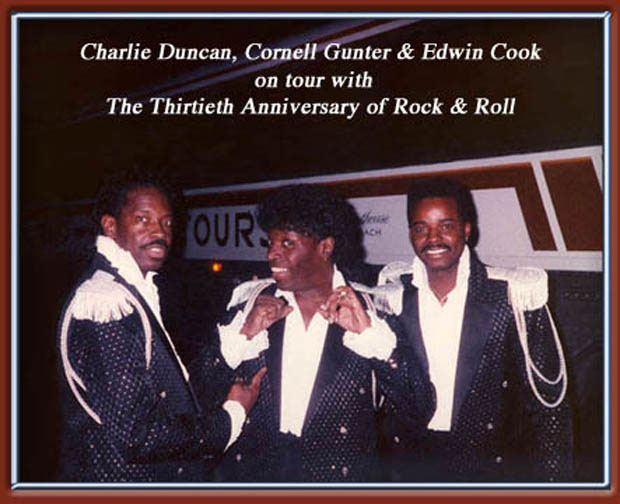

Edwin Cook's great web-site with lots of images of Cornell.
The Charlie Duncan /Gunter/ Coasters.
The Flairs
(by Marv Goldberg)
Reading on the Flairs:
Group Harmony - Echoes of the Rhythm and Blues Era
by
Todd
R. Baptista - new edition (Collectables,
www.oldies US
2007)
Cornell Gunter at Wikipedia
The Flairs at Wikipedia
The Ultimate Flairs (on
Ace, UK)
|
The Flairs - singles on Flair
Records (1953 - 1955)
1012 I Had A Love (aka When I Was Young) - She Wants To Rock
1019 You Should Care For Me - Tell Me You Love Me
1028 Getting High - Love Me Girl
1041 Baby Wants - You Were Untrue
1044 This Is The Night For Love - Let's Make With Some Love
1056 Hold Me, Thrill Me, Chill Me -
I'll Never Let You Go (aka Tell Me You' re Mine)
1067 My Darling, My Sweet - She Loves To Dance
(note: The Flairs recorded for other labels later and are featured
on several other recordings issued under pseudonyms
or as by Young Jessie and Richard Berry).
|
|
Photo below from the 1987 Rock and
Roll Hall of Fame Inductions
(from Cornell Gunter´s Coasters Inc. - Gunter, Guy, Gardner, Jones,
and Veta Gardner).
|
| |
From Tony Watson´s Obituary
in "Blues & Rhythm" Number 51:
The world of West Coast R&B vocal groups were robbed of another
of its father figures on February 26 (1990), when Cornelius Gunter was reported gunned
down in Las Vegas. The 53 year old former vocalist with the Coasters was found dead from
gun shot wounds in his car. He had been shot twice in the chest through his car windscreen
as he was driving, the car then crashed to a wall. Lt. Gary Rainey of the Vegas police
homicide squad said they had no motive or suspects. Witnesses reported seeing a tall, thin
man running from the scene shortly after the killing. Gunter was scheduled to open at the
Lady Luck casino-hotel on the first weekend in March billed as Cornell Gunter and The
Coasters. Born in 1938, Cornell will be best remembered for his work with The Coasters
during their golden years.... Up until his death Cornell had remained active both as a
solo and group singer...
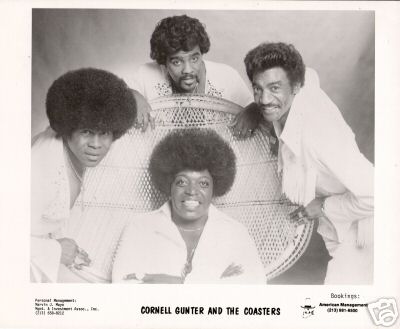
|
|
|
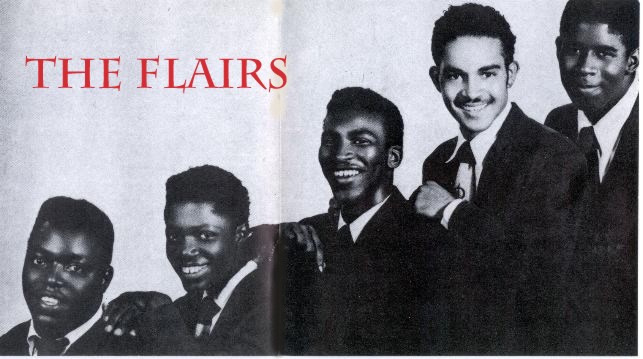
Cornell Gunter, Young Jessie, Thomas Fox, Beverley
Thompson, and Richard Berry
The Story of The Flairs
At best, California groups are
complicated . . . then there's The Flairs. So go slow and try to take it all in. It's
worth it!
Our story begins in the halls of Los Angeles' Jefferson High, where a
vocal group was formed in 1953. Composed of Arthur Lee Maye (tenor), Thomas
"Pete" Fox (2nd tenor), Obediah "Obie" Jessie (baritone), and A.V.
Odum (bass), The Debonairs didn't even last long enough to enter a recording studio. Maye
and Odum left, to be replaced by tenor Cornell Gunter and bass Richard Berry. From Fremont
High came a fifth member, Beverley Thompson (tenor, and "the guy who had the
car"). This as yet unnamed group auditioned for Recorded In Hollywood, and
label owner John Dolphin released "I HAD A LOVE" under the name "Hollywood
Blue Jays". (All confirm that the other Hollywood Blue Jays release "CLOUDY AND
RAINING", was by a different group.) Despite a raw, unrehearsed sound, "I HAD A
LOVE" started to sell. Unfortunately, though, the group was disenchanted with Dolphin
and sought another label. Playing hookey from school, they rode around in Beverley's car
until they spied a sign for Modern Records. Here, they auditioned for some of the many
Biharis who owned the label. Impressed by what they heard, the Biharis took down all the
members' address’s and phone numbers. Assuming that the group would call them, the
Biharis set up a date for a recording session. Assuming that the Biharis would call them,
the group went back to school. Ultimately, the day of the session came and the Biharis
found themselves at Jefferson and Fremont High Schools, rounding up personnel who were in
class instead of their studios. At this point, the group got its name when they saw some
labels for Modem's not-yet-released Flair subsidiary and decided that the monicker was
different enough to click. At their first session, The Flairs re-recorded "I HAD A
LOVE" - this time turning in a very polished performance. The Flairs turned in such
fine efforts as YOU SHOULD CARE FOR ME, LOVE ME GIRL, THIS IS THE NIGHT FOR LOVE and
LONESOME DESERT. Aside from The Flairs, Richard Berry also sang with The Dreamers, a
female quartet from Fremont High that Beverley Thompson introduced him to. Later to become
The Blossoms, The Dreamers consisted of Fanita Barrett (soprano), Gloria Jones (alto), and
twins Nannette and Annette Williams (alto and second alto) and appeared on many Richard
Berry sides. Friction developed because Berry was dividing his time between The Dreamers
and The Flairs, and he finally left The Flairs (shortly after Beverley Thompson departed)
to form another group called The "5" Hearts. This group consisted of Berry,
Arthur Lee Maye, Little Johnny Morris (tenor), Odell Cole (second tenor), and Johnny
Coleman (baritone). After cutting PLEASE PLEASE BABY, Odell Cole left. Now a quartet, the
group recorded as The Rams and as Arthur Lee Maye and The Crowns. Occasionally, Maye's
brother Eugene (2nd tenor) and Charles Holm (bass) would fill in at appearances. In early
1956, Richard Berry broke with both groups, continuing to write material for The Dreamers.
With Arthur Lee Maye, Jesse Belvin, and Mel Williams, Berry recorded remakes of earlier
R&B classics for an album which appeared on the Johnny Otis "Dig" label.
Meanwhile, back at The Flairs .....
Richard Berry's replacement had been bass Randolph (Randy) Jones, and for recording
purposes only, tenor Charles Jackson filled the gap left by Beverley Thompson. The Flairs
appeared around the Los Angeles area, with scattered gigs in West Texas, Colorado, and
Oregon. They were on the bill of "Cavalcade of Jazz," an annual show at Wrigley
Field; also, the group had the distinction of being on the cover of the first TV Guide
ever printed in the L.A. area. A somewhat more dubious moment occurred on Hunter Hancock's
radio show, when they were made to declare that SHE WANTS TO ROCK was about dancing and
nothing more intriguing. At one point, the group needed cash fast, so they did a session
for Tampa Records. Tampa protected the moonlighters by changing their name to the
"Jac-O-Lacs," attempting to disguise their sound, and not immediately releasing
the record. Internal conflicts among the group's personnel arose when Cornell's sister,
Shirley Gunter, joined as a sixth member. Soon, Obie Jessie left to start his solo career
in earnest as "Young Jessie" (on MARY LOU, he was backed up by The Cadets). Pete
Fox also left, and Randy Jones saw ample reason in these departures to leave himself, and
join The Penguins. By the time Buck Ram had expressed an interest in managing The Flairs,
the group had disintegrated. Cornell Gunter left to sing with The Platters for a couple of
months. 1957 found Young Jessie on Atlantic, where Coasters' manager Lester Sill tried to
persuade him to give up his solo career and join the group. He refused to make appearances
with the group, but did record with The Coasters on their second through fifth sessions
(February-December 1957). He replaced Leon Hughes (of the Hollywood Flames) on these
sessions, but Hughes did all the group's live appearances. Subsequent Young Jessie
releases appear on Capitol, Vanessa, Mercury and Bit. Richard Berry had been busy
too, forming The Pharaohs. Codoy Colbert (1st tenor), Robert Harris (2nd tenor), and Noel
Collins (baritone) were behind him on many Flip releases, including the original LOUIE
LOUIE. Pete Fox remained active in music, too. Following his departure from The Flairs, he
replaced Lloyd McCraw in the Jacks/Cadets line-up. Fox appears on HOW SOON, CHURCH BELLS
MAY RING and was just in time to ride the crest of popularity accorded to STRANDED IN THE
JUNGLE (on which session-man Prentice Moreland offered the immortal exhortation,
"Great Googa Mooga, LEMME OUTTA HERE!"). The last member of the original Flairs
to have a subsequent career was Cornell Gunter. He organized an unknown Flairs group which
recorded Flair 1067, Modern 965, Antler 4005, and Kent 304. (Neither Berry, Jessie or Fox
was on any of these sides and Cornell did not mention them as being done by his next
group). Gunter had switched from Jefferson High to Manual Arts by this time and had begun
singing with another group consisting of his cousin, Kenneth Byle ( 1 st tenor), Thomas
Miller (baritone), and George Hollis (bass). They recorded as The Ermines for Zeke
Manners' Loma label and then for ABC Paramount as The Flairs (under Buck Ram's
management). On June 1, 1956, this group appeared at The Apollo with Shirley Gunter,
Screamin' Jay Hawkins, and The Cadillacs. In 1958, Cornell Gunter left The Flairs to join
The Coasters along with Dub Jones from The Cadets. Aaron Collins and Willie Davis then
left The Cadets for The Flairs, who then recorded as The Peppers, The Cadets, and The
Flares. One would unquestionably be hard-pressed to find another group which had such a
storehouse of talent.
- (ctsy Tuneman56)
Check his site: The Rhythm and Blues
Highway
for all the pioneer vocal groups!
Flairs discography and album covers
Recommended Reading:
Group Harmony: Echoes of the Rhyhtm
and Blues Era - by Todd R. Baptista (2007, Collectables Records)
- It features a.o. great articles on The Flairs and on The Cadets/Jacks
- www.oldies.com
Cornell Gunter discography at
Soulful Kinda Music
CORNELL GUNTER'S SINGLES (according
to Wikipedia)
- "True Love" / "Peek,
Peek-A-Boo" (Loma #701) (1955) (as The Ermines)
- "You Broke My Heart" / "Pretty
Baby I’m Used To You Now" (Loma #703) (1956) (with The
Ermines)
- "Keep Me Alive" / "Muchacha,
Muchacha" (Loma #704) (1956) (with The Ermines)
- "I'm Sad" / "One Thing For
Me" (Loma #705) (1956) (with The Ermines)
- "She Loves To Rock" / "In
Self Defense" (ABC Paramount #9698) (1956) (with The Flairs)
- "You Send Me" / "Call Me A
Fool" (Dot #15654) (1957)
- "Baby Come Home" / "I Want
You Madly" (Eagle #301) (1957)
- "If We Should Meet Again" /
"Neighborhood Dance" (Liberty #55096) (1957) (as Cornel
Gunter)
- "Lift Me Up Angel" / "Rope
Of Sand" (Warner Brothers #5266) (1962)
- "It Ain't No Use" / "In A
Dream Of Love" (Warner Brothers #5292) (1962)
- "If I Had The Key To Your
Heart" / "Wishful Thinking (Challenge #59281) (1965) (as
Cornell Gunter and The Cornells)
- "Love In My Heart" / "Down
In Mexico" (Together #101) (1976)
ALBERT
"SONNY" FORRIEST 
May 21, 1934 - January 10, 1999
(hired early 1959 - c:a late 1961)
guitarist
|
|
|
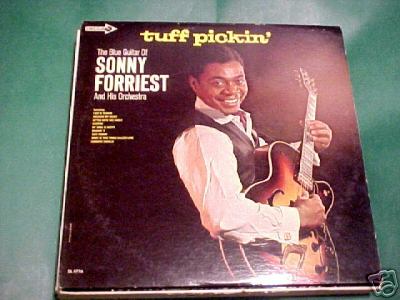 Born Elbert
McKinley Forriest May 21, 1934 in Pendleton, North Carolina, also known as Albert Forrest
and as Sonny Clarke (not to be confused with the pianist). A much talented artist, who
worked with Sil Austin, Dee Clark and Big Jay McNeely, and Jackie Wilson before his studio
and stage work with the Coasters. Later made own recordings for Atco, Verve and other
labels and became touring stage guitarist with Ray Charles & his Orchestra from 1962.
Forriest recorded with Hank Crawford for Atlantic and played vibes on a 1966 album. Turned
to jazz and cut an album, "Tuff Pickin´", for Decca. Forriest - unlike Jacobs
and Palmer, was never a member of the Coasters (worked as a contracted guitarist). Sonny
died on January 10, 1999 in Capital Heights, Maryland. Born Elbert
McKinley Forriest May 21, 1934 in Pendleton, North Carolina, also known as Albert Forrest
and as Sonny Clarke (not to be confused with the pianist). A much talented artist, who
worked with Sil Austin, Dee Clark and Big Jay McNeely, and Jackie Wilson before his studio
and stage work with the Coasters. Later made own recordings for Atco, Verve and other
labels and became touring stage guitarist with Ray Charles & his Orchestra from 1962.
Forriest recorded with Hank Crawford for Atlantic and played vibes on a 1966 album. Turned
to jazz and cut an album, "Tuff Pickin´", for Decca. Forriest - unlike Jacobs
and Palmer, was never a member of the Coasters (worked as a contracted guitarist). Sonny
died on January 10, 1999 in Capital Heights, Maryland.
Sonny
Forriest at Wikipedia |
EARL
"SPEEDO" CARROLL 
November 2, 1937 - November 25, 2012
(member June 1961 - late 1979)
tenor vocal

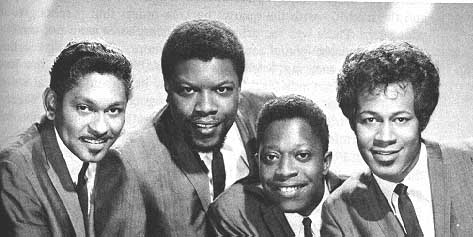
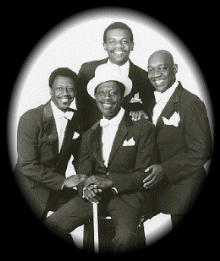
Speedo & his
Cadillacs of 2000
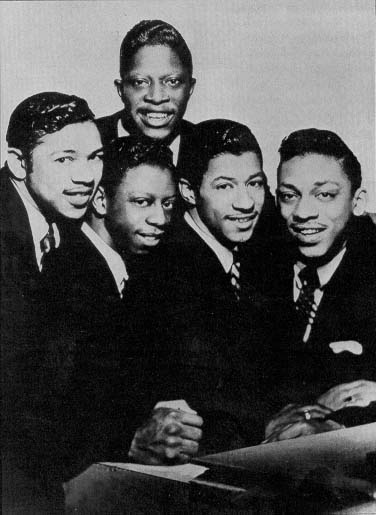
The origins & today
The
Cadillacs | The
Cadillacs
|
|
 Born November
2, 1937 in New York City (his first name is Earl - not Gregory, as mentioned in several
files - although thre is one Gregory Carroll, who sang in several groups and became
producer). Earl was well established in the Harlem "street corner" inner circuit
and created the Carnations in Sugar Hill. This group became famous as the Cadillacs (on
Josie), for which Earl sang lead on a.o. their debut "Gloria" in 1954. He also
led the hit "Speedoo" (1955-56). Earl continued to lead the Cadillacs, who
became very popular in teenage America, on and off through 1958, with come-backs in 1959
and 1960 (when he did some Drifters-inspired string-arranged titles with his group, still
on Josie). Earl gladly took the offer from Lester Sill´s successor Pat "Lover"
Patterson, who was closely associated with several early New York groups, to replace
Gunter (since the Cadillacs had declined), but came too late to enjoy any real huge
success, although he was a true and very useful Coaster for many years. He left the
Coasters in late 1979 and joined Earl Wade (of the early Cadillacs) and later teamed up
with half-brother Bobby Phillips (who had been original bass singer with the Cadillacs).
Earl was also the model for the ´80s TV-character "Speedo". In 1982 he and his
brother started a revival Cadillacs group, which received new popularity in New York and
toured Britain and Europe. In 1997 the Cadillacs recorded a new CD titled "Have You
Heard The News!", featuring Carroll, Phillips, John Brown, and Gary
Lewis. Later they were a trio with Carroll, Phillips and Lewis (and had a great new web site).
In October 2004 the group recorded a whole new album titled Mr. Lucky
(featuring guitarist and composer John Michael Hersey). Bobby Phillps died
March 6, 2011 and Earl November 25, 2012 (in New York). Born November
2, 1937 in New York City (his first name is Earl - not Gregory, as mentioned in several
files - although thre is one Gregory Carroll, who sang in several groups and became
producer). Earl was well established in the Harlem "street corner" inner circuit
and created the Carnations in Sugar Hill. This group became famous as the Cadillacs (on
Josie), for which Earl sang lead on a.o. their debut "Gloria" in 1954. He also
led the hit "Speedoo" (1955-56). Earl continued to lead the Cadillacs, who
became very popular in teenage America, on and off through 1958, with come-backs in 1959
and 1960 (when he did some Drifters-inspired string-arranged titles with his group, still
on Josie). Earl gladly took the offer from Lester Sill´s successor Pat "Lover"
Patterson, who was closely associated with several early New York groups, to replace
Gunter (since the Cadillacs had declined), but came too late to enjoy any real huge
success, although he was a true and very useful Coaster for many years. He left the
Coasters in late 1979 and joined Earl Wade (of the early Cadillacs) and later teamed up
with half-brother Bobby Phillips (who had been original bass singer with the Cadillacs).
Earl was also the model for the ´80s TV-character "Speedo". In 1982 he and his
brother started a revival Cadillacs group, which received new popularity in New York and
toured Britain and Europe. In 1997 the Cadillacs recorded a new CD titled "Have You
Heard The News!", featuring Carroll, Phillips, John Brown, and Gary
Lewis. Later they were a trio with Carroll, Phillips and Lewis (and had a great new web site).
In October 2004 the group recorded a whole new album titled Mr. Lucky
(featuring guitarist and composer John Michael Hersey). Bobby Phillps died
March 6, 2011 and Earl November 25, 2012 (in New York).
The Cadillacs presented by
Claus Röhnisch with the Josie singles
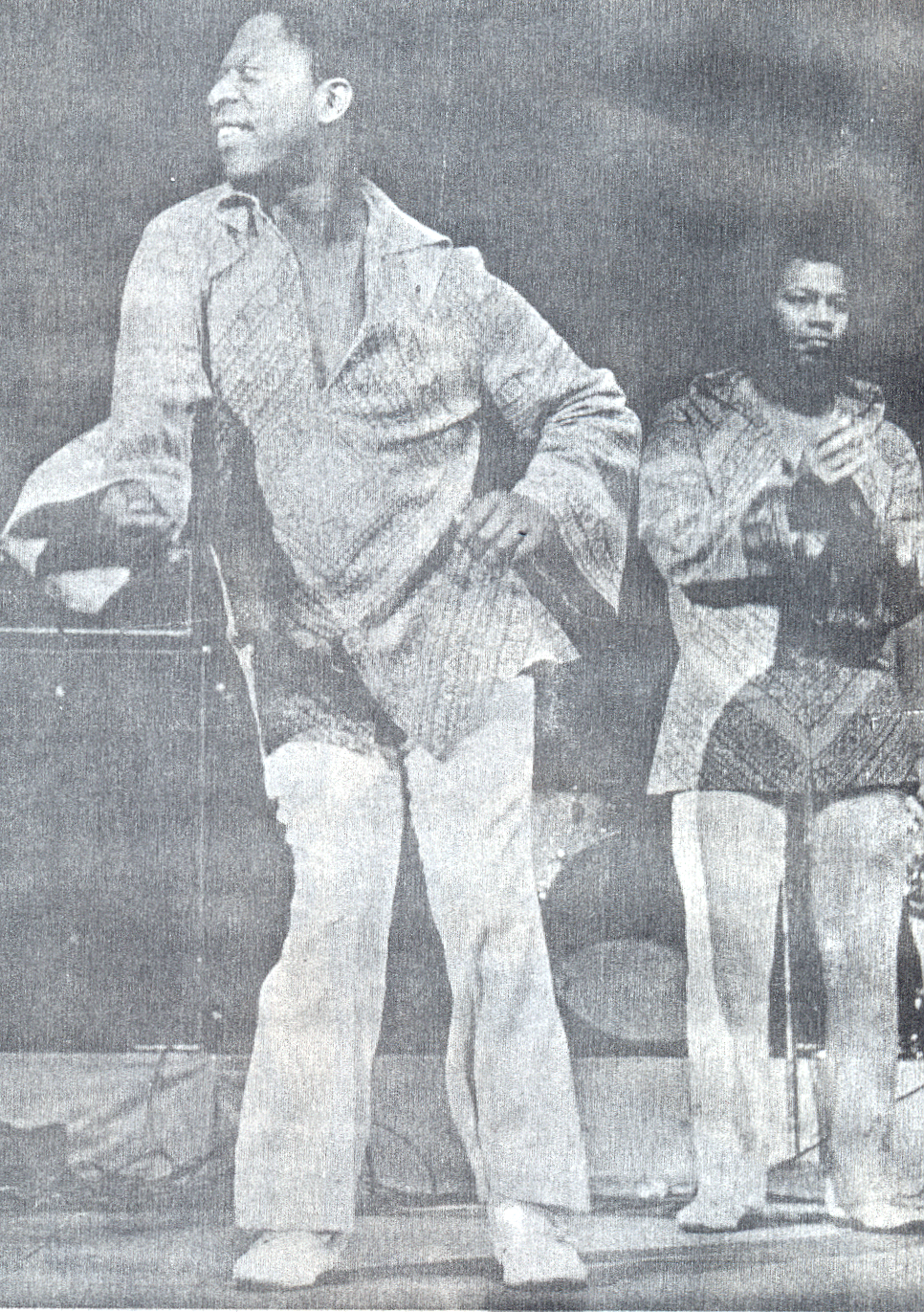
Earl and Billy Guy in 1969 (with
Ronnie Bright and Carl Gardner).
Speedo and the Cadillacs
story
The
Cadillacs at Wikipedia
Earl Carroll at Wikipedia
|
Friends-
Vocal group harmony pioneer Earl "Speedo"
Carroll, lead singer of the Cadillacs and a long time member of the Coasters,
died this morning, November 25, 2012, in a New York City skilled nursing
facility after a long illness. He was 75. In recent years, Earl endured
the loss of his wife, his longtime singing buddy Bobby Phillips, suffered a
heart attack, struggled with uncontrolled diabetes and, ultimately, lost his
vision. At his peak, he was a fantastic entertainer and comedian, a great
singer, a precise dancer, and a sharp businessman. We will remember him
with love.
Todd & Kristen Baptista

Ronnie Bright, Carl Gardner, Earl Carroll, and Thomas Palmer in 1979.
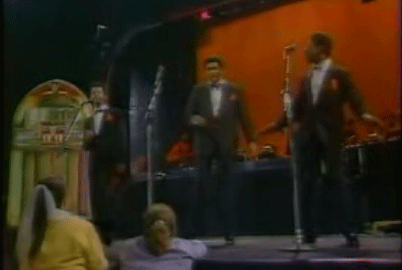
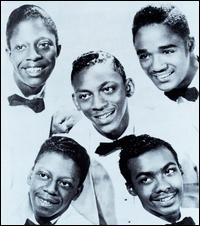
1979: Ronnie Bright, Carl Gardner, and Earl Carroll.
Right: with his original Cadillacs (1956).
THOMAS
"CURLEY" PALMER 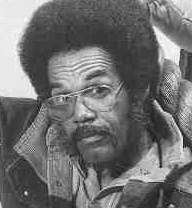
Born August 15, 1929
(member from c:a February 1962 - August 2011, when he joined Carl Jr's new group)
guitarist
|
|
Born Thomas
J. Palmer in El Paso, Texas on August 15, 1929. "Curley" (or "Curly"
as Thomas himself prefers it) has been a New Yorker for most of his life - although he has
worked in Detroit and Chicago too. Veteran guitarist and music stage arranger. Worked with
jazz- and R&B-composer/pianist Sonny Thompson and with Lloyd Price during the ´50s
and has been the Coasters´ regular guitarist ever since he joined them (the second only
to Gardner, in being a consistent Coaster for almost 50 years). Responsible for the
Coasters´ stage orchestral back-up as musical director and arranger. He left
the true Coasters to join
Carl Jrs new group in
August 2011.
Below edited from from Carl Junior's web site:
Curly yook up trumpet in the El Paso, Texas high school. Realizing that
there was more work for a guitarist than a trumpet player Curly switched
instruments. He caught his lucky break as he stood by the side of the stage
watching well-known Jazz/R&B pianist Sonny Thompson and his band perform in
Texas. Thompson's band was missing their guitarist that fateful night and
Curly just happened to have his guitar in his car…volunteering to play,
Curly got on stage, and his career was on its way. He joined the band and
moved to Chicago where Sonny Thompson was based, continued performing in the
late '50s and early '60s with Thompson's band, and with Sonny's guidance
also learned how to write and arrange music. Curly reminisces, "Sonny
Thompson was my mentor, he got
me on the road and helped set me on my musical path."
Thompson had several R&B hits at the time and shared a booking agency with
another hit-making group, The Coasters; the two groups toured on the same
bill, with Sonny's band playing back-up for The Coasters. With a few years
experience under his belt, Curly moved on and went to New York where had the
opportunity to freelance and perform with many musical greats. He became a
prominent member of the Apollo Stage Band, and when the Band took their
summer breaks, he performed with the extremely popular Paul Williams'
Cavalcade of Stars Orchestra.
In the early '60s, Curly's good friend Billy Guy invited him
to play with the group; it wasn't long before Curly Palmer was an integral
part of The Coasters and became their Music Director, a position he held
until his departure. Prior to Curly joining The Coasters, there was no music
written down to give to the bands they worked with on the road. Curly Palmer
wrote all the music charts for the group's live performances, television
appearances and movies. Although talented, he felt he needed to know more
about writing music and wanted the formal training he lacked. In the '80s,
Curly took a special test for musicians that allowed him to enter City
University of New York (CUNY) as a Music Major – he achieved his B.S. and
M.A.T from this prestigious institution. Curly Palmer and the founder of The
Coasters, Carl Gardner, Sr. were close friends for almost 50 years.
|
RONNIE BRIGHT 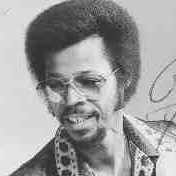
October 18, 1938 - - November 26, 2015
(member April 1968 - November 2009)
bass vocal
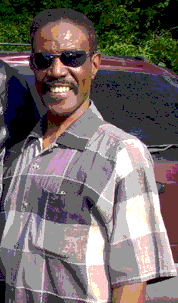
In November 2009 Ronnie was replaced by
"Fast" Eddie Whitfield.
JIMMY NORMAN 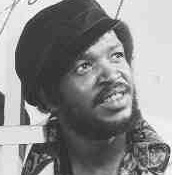
August 12, 1937 - November 8, 2011
(hired occ. from 1969; member 1973 - c:a February 1998; absent 1979)
baritone vocal
Jimmy Norman in 1998.
More on
Jimmy Norman
Read about his early years
|
|
Born James Scott Norman on August 12, 1937 in Nashville, Tennessee. As a young
teenager, he moved to Detroit and later to St. Louis. In 1957 he ended up in Los Angeles.
Los Angeles in the '50s was a true vocal harmony home. Bobby Day's house was a meeting
place, as was Cornell Gunter's. But most well-known was Jesse Belvin's, where a couple
of friends got together to harmonize in early 1958. Belvin persuaded some guys to
form a group, which was named the Chargers, where Jimmy sang tenor. Jimmy, who soon
dropped his second surename (Scott), later probably recorded as Jimmy Norman & The
Hollywood Teenagers and another early life experience was that he sang with the Dyna-Sores
(who with H.B. Barnum and Ty Leonard of the Robins made a cover of "Alley Oop"
for Leon René in 1960). Jimmy then turned solo and had a regional success with "Here
Comes The Night" in 1961; and a hit, "I Don´t Love You No More", on H.B.
"PeeWee" Barnum´s Little Star label in 1962 and he also wrote several songs for
other R&B artists - one even with Young Jessie (for the Chargers). Jimmy later moved
to New York and recorded "Love Is Wonderful" in 1963 and "Can You
Blame Me" for Samar in 1966. Cut around 20 singles for different labels during the
´60s and early ´70s. Jimmy is listed with 149 songs in the BMI songwriters´ database.
Worked for Lloyd Price in Norman´s own "reggae" studio in New York during the
´60s, met Bob Marley in 1968, and replaced Vernon Harrell, who worked on stage with the
Coasters, substituting for Billy Guy during the ´60s. Harrell, by the way, made many solo
recordings for a.o. Lescay, Decca, and Score in the ´60s, and United Artists and
Brunswick during the ´70s.
He also was
lead singer in Eddie Palmier´s group The Harlem River Drive He was never a
member of Gunter´s Coasters but from 1973 Norman became a true touring and
recording Coaster. He left to work as a producer for Columbia in 1979, but
returned to the group around 1980 and toured with Carl Gardner, Bright and
Norman in the longest lasting lineup. Norman recorded an album of his own in
1987 titled "Home" on Badcat. In early 1998 (after a disagreement with
Coasters’ then road manager John Valano, he left the Coasters (who had
recruited Alvin Morse as fourth singer in late 1997) to start as a solo act
and producer again, recording a new album in 1998 - "Tobacco Road". He was
replaced by Carl´s son Carl Gardner, Jr in time for Gardner´s 70th birthday.
In 2004 Norman released his first national distributed CD, "Little Pieces"
on WildFlower. He died in New York City November 8, 2011.
The Jimmy Norman Homepage
(terrific site with great audios)
Jimmy
Norman Discography (printerfriendly)
Time
Is Still On His Side (Norman in 2004)
Jimmy Norman interviewed in 2002 (The
Jamaican Observer).
The
Chargers on Japanese site
Jimmy
Norman at Wikipedia |
ALVIN
"AL" MORSE
Born February, 1951
(member November, 1997 - September, 2008)
baritone vocal
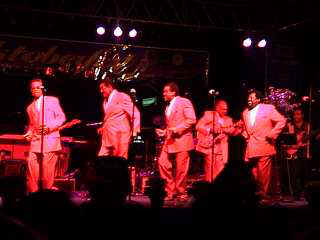
|
|
Alvin Morse
is born in February, 1951. Al (as he prefers to call himself) was recruited as fourth
singer to the group in November, 1997 and turned from tenor to baritone when Norman left
in February, 1998. He has a wonderful and talented voice, adding an extra
"dimension" to the group. He often sings the former Billy Guy-led songs on stage
and has a great baritone (and also tenor) voice when he leads "Searchin´" and "Poison
Ivy". Morse is a Florida resident. |
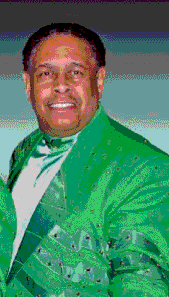
In October 2008 Alvin was replaced by
Primotivo "Primo" Candelara
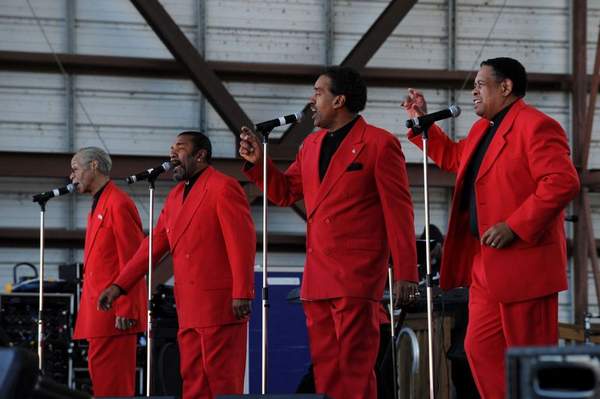
The Coasters at Cypress Gardens Farewell Party Nov 16, 2008:
Bright, Gardner Jr, J.W. Lance, and Primotivo Candelara.
(photo ctsy Scott Wheeler, The Ledger.com)
CARL
"MICKEY" GARDNER, JR. 
Born April 26, 1956
(member early 1998 - June 2001; returning in November 2004)
with the group up to his father's death in June 2011, when he
started his own new group, The Coasters ft. Carl Gardner Jr.
tenor vocal
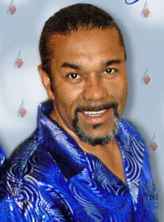
lead singer from November 2005 up to 2011.
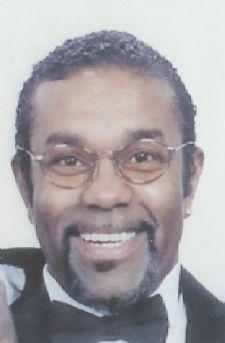
 |
|
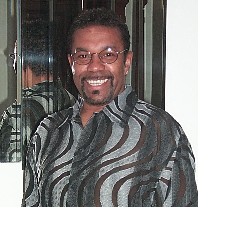 Carl Gardner´s and
Ladessa Richards´ (Gardner´s first wife) son - Carl Junior - (nicknamed
"Mickey") was born in Bullard, Texas on April 26, 1956. He entered the Coasters replacing
Jimmy Norman just in time for Gardner Sr´s 70th birthday, approximately half a year after
the Coasters again had become four singing members in late 1997, when Alvin Morse had
joined the group as second tenor. "Mickey" toured with the group until July,
2001, when J.W. Lance replaced him. In 2002 Carl Jr formed a Coasters´ Review in Daly
City, California (with Greg Griffin, Anthony Lee, and Michael Vincent). In late 2004 the
Review members were Carl Gardner Jr., Donald Seastrunk, Kearney
Seastrunk, Orlando Seastrunk, and Michael Vincent. In November 2004 Jr. returned to his
father's group - sharing leads with his father and doing a great version of "Young
Blood". On November 5, 2005 he officially took over from his father, who
semi-retired (and acts special coach). |
Listen to
Jr talking to the press. | Carl Gardner´s and
Ladessa Richards´ (Gardner´s first wife) son - Carl Junior - (nicknamed
"Mickey") was born in Bullard, Texas on April 26, 1956. He entered the Coasters replacing
Jimmy Norman just in time for Gardner Sr´s 70th birthday, approximately half a year after
the Coasters again had become four singing members in late 1997, when Alvin Morse had
joined the group as second tenor. "Mickey" toured with the group until July,
2001, when J.W. Lance replaced him. In 2002 Carl Jr formed a Coasters´ Review in Daly
City, California (with Greg Griffin, Anthony Lee, and Michael Vincent). In late 2004 the
Review members were Carl Gardner Jr., Donald Seastrunk, Kearney
Seastrunk, Orlando Seastrunk, and Michael Vincent. In November 2004 Jr. returned to his
father's group - sharing leads with his father and doing a great version of "Young
Blood". On November 5, 2005 he officially took over from his father, who
semi-retired (and acts special coach). |
Listen to
Jr talking to the press. |
Carl Jr. sometimes still did some shows with a Coasters Review in California
during 2006 and 2007 (featuring Artrix Thomas, Dartagnan Baxter, and John "Poncho"
Jones). In later years up to his
father's death he was a true Coasters,
(then came the
bout)
check
this
Carl Gardner & The Coasters (with Jr center and the
Rockin´ Robin band).
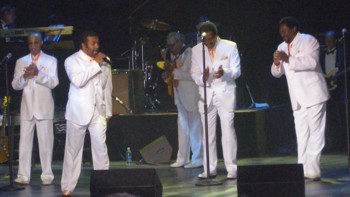
Carl Gardner's Coasters of 2008
(with Ronnie Bright, Carl Gardner Jr, Thomas Palmer, J.W. Lance, and Alvin
Morse).
|


In June 2011 Dennis Anderson replaced Gardner Jr.
Junior's new Coasters tribute group.
J.W. LANCE 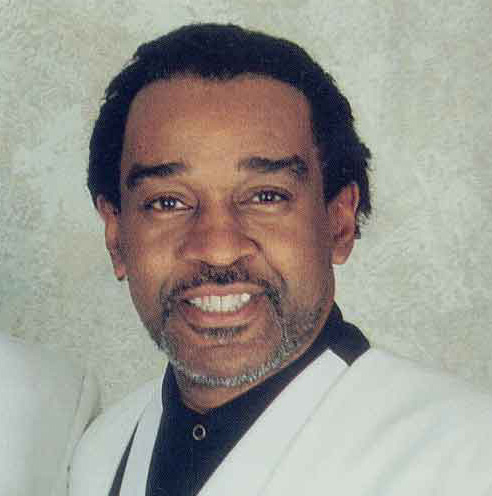
Born June 16, 1949
(member since July, 2001)
tenor vocal
|
|
Born Joe
Lance Williams in New Orleans on June 16, 1949 - nowadays living in Bronx, N.Y. Talented,
versatile vocalist, musician and songwriter. A new face to both country and contemporary
music. Lance has performed with such names as Ben E. King, Fantastic Violnaires of Detroit
Michigan, the Original Five Blind Boys of Mississippi, and the Gospelaires of Dayton,
Ohio. He has toured throughout the United States, Australia and Virgin Islands. J.W.
Lance’s album entitled “Sounds of J.W. Lance”, has something for everyone.
J.W. quit the Larry Marshak Drifters and Coasters to join the true Coasters, where he
nowadays leads "Love Potion Number Nine" and also sometimes "Smokey Joe's
Cafe".
|
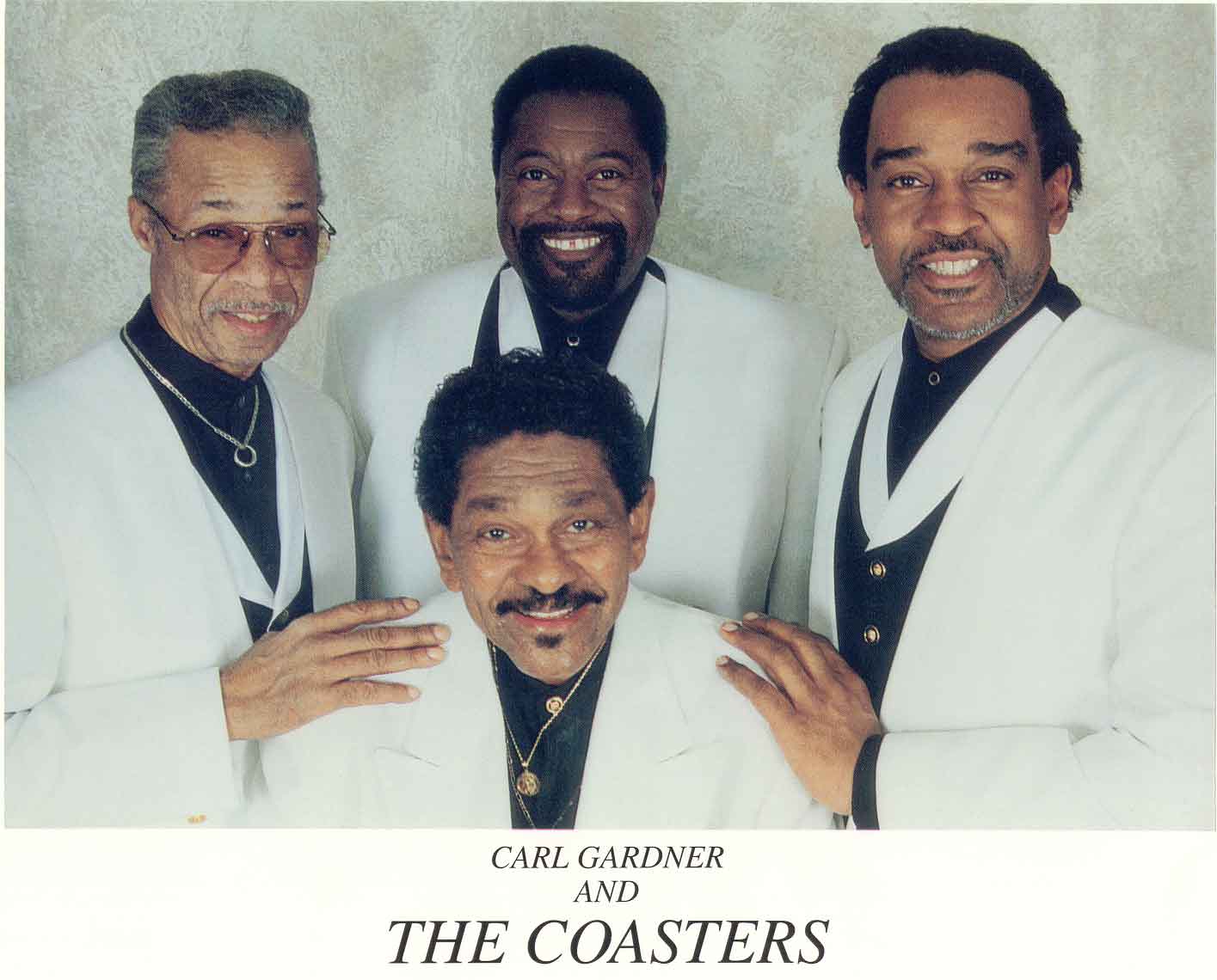
| The Coasters of Today |
read more about the members; and their lifes
and music with the early vocal groups of R&B on:
The Rhythm and
Blues Highway
| The Coasters Recording Line-Ups |
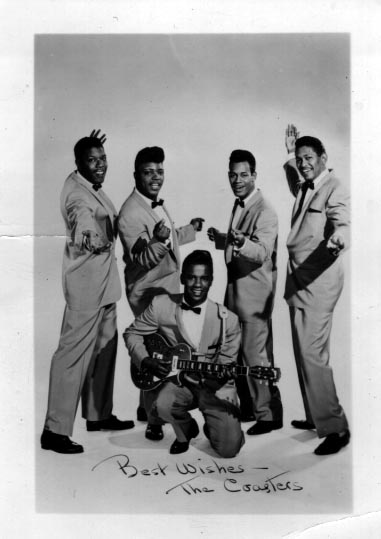
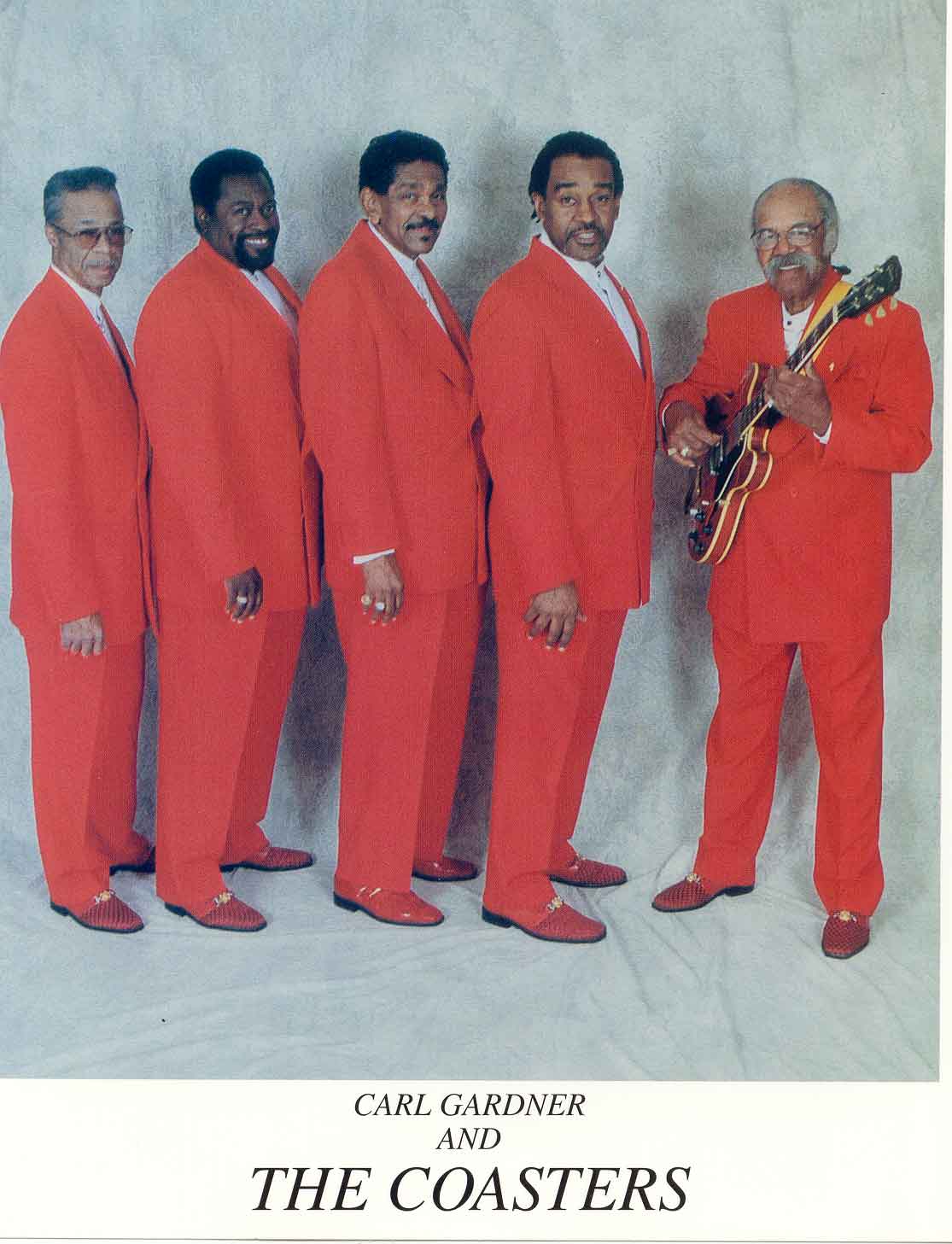
|
To enter The Coasters
Web Site
(if you´re on a one-frame page, please click) |


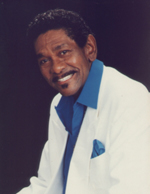
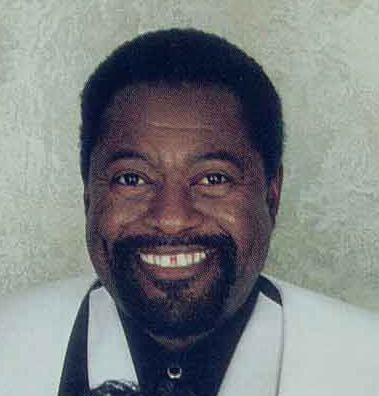
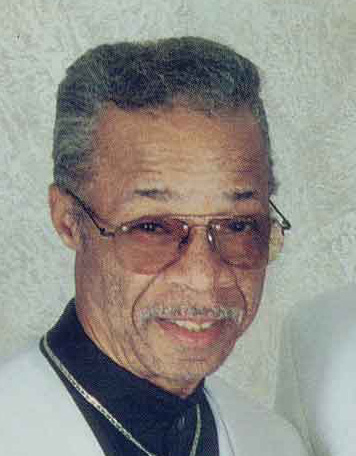
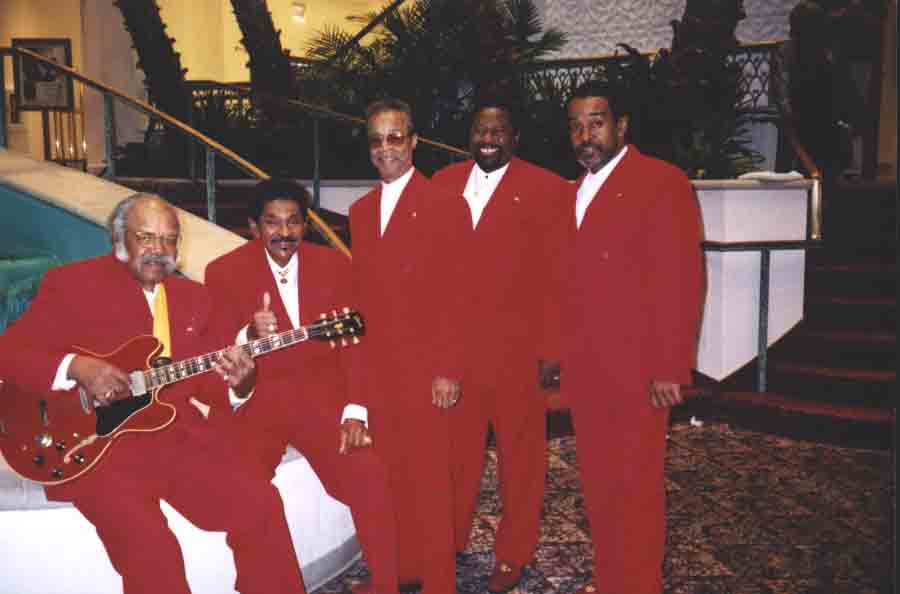
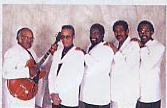
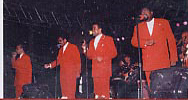
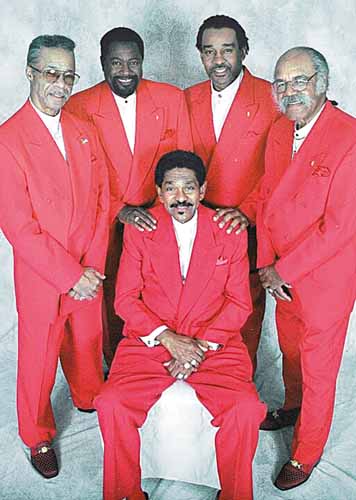
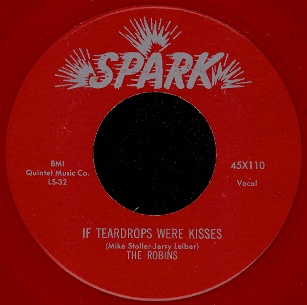


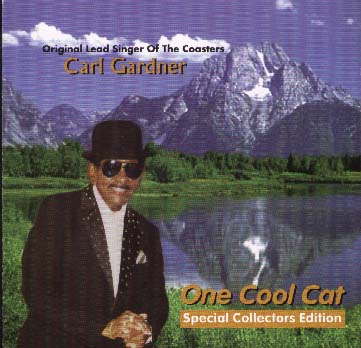
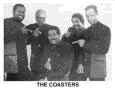

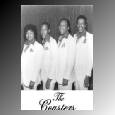
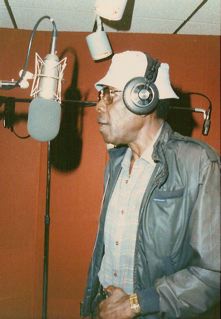
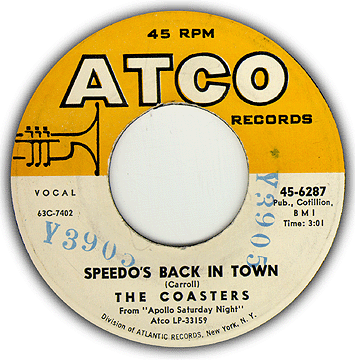
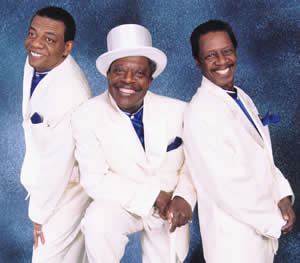
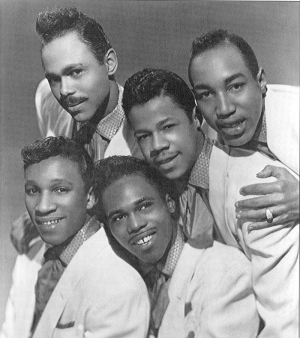
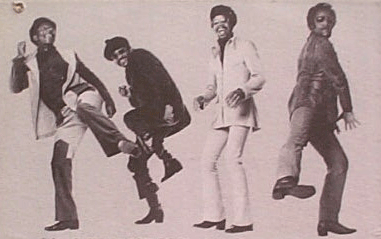
 Born Ronald
David Bright October 18, 1938 in New York and like Earl, an early member of the
"street corner" circuit in Sugar Hill. He became the Valentines´ first bass
singer as a youngster in 1954 (on Old Town) and sang and recorded with that group for Rama
through 1957. Was a member of Earl Carroll´s new Cadillacs´ group in 1960. During the
early ´60s Ronnie was heavily engaged as a studio bass vocalist, a.o. on Jackie Wilson´s
"Baby Workout" and Barry Mann´s "Who Put The Bomp", and was "Mr.
Bassman" on Johnny Cymbal´s pop hit. Ronald also recorded as "Ronnie & The
Schoolmates" and toured the world with the Deep River Boys in the late ´60s, before
replacing "Dub" Jones in the Coasters. Bright has been a true Coaster ever
since. Ronnie was featured on Peter Gabriel´s "Sledgehammer" album
"So" in 1986. Still a New Yorker, and leading the live-versions of "Zing!
Went The Strings Of My Heart" (in later years with Carl Gardner, Sr. or
J.W. Lance doing the former
Gunter/Carroll second lead).
Born Ronald
David Bright October 18, 1938 in New York and like Earl, an early member of the
"street corner" circuit in Sugar Hill. He became the Valentines´ first bass
singer as a youngster in 1954 (on Old Town) and sang and recorded with that group for Rama
through 1957. Was a member of Earl Carroll´s new Cadillacs´ group in 1960. During the
early ´60s Ronnie was heavily engaged as a studio bass vocalist, a.o. on Jackie Wilson´s
"Baby Workout" and Barry Mann´s "Who Put The Bomp", and was "Mr.
Bassman" on Johnny Cymbal´s pop hit. Ronald also recorded as "Ronnie & The
Schoolmates" and toured the world with the Deep River Boys in the late ´60s, before
replacing "Dub" Jones in the Coasters. Bright has been a true Coaster ever
since. Ronnie was featured on Peter Gabriel´s "Sledgehammer" album
"So" in 1986. Still a New Yorker, and leading the live-versions of "Zing!
Went The Strings Of My Heart" (in later years with Carl Gardner, Sr. or
J.W. Lance doing the former
Gunter/Carroll second lead).