Coastin´
with The Coasters
Edited by Claus Röhnisch
The Coasters to
perform at Indiana Grand
Posted:
Thursday, August 20, 2015 2:25 pm
The Coasters to perform at Indiana
Grand
Alex Krach Staff writer
ShelbyNews.com
The Coasters, who
are celebrating their 60th anniversary, will
perform this Saturday at Indiana Grand
Racing & Casino, at 8 and 9:30 p.m., as part
of their free ‘Legends of Entertainment’
concert series.
The original lineup of the band, including
Carl Gardner, Billy Guy, Bobby Nunn, Leon
Hughes and Adolph Jacobs, was started in Los
Angeles in 1955. Guitarist Adolph Jacobs
left the group in 1959. The band had 11 gold
records and many well-known songs, which
were written by the famous song-writing duo
Jerry Leiber and Mike Stoller, who also
wrote songs for Elvis Presely and Will Mae
“Big Mama” Thornton. Some of songs The
Coasters will perform at the show include
“Yakety Yak,” “Charlie Brown,” “Love Potion
#9” and “Poison Ivy.”
“The Coasters’s music is forever because
it’s not like a regular song. People
sing a sad song, ‘My boyfriend left me’;
this was happy times. Even today, when
we do concerts, kids will line up for
their autograph and I’ll say, ‘You don’t
even know them,’ and they’ll say, ‘Yes,
my grandma played (them).’ They know the
songs and it’s catchy,” said Veta
Gardner, the band’s manager and widow to
founding member Carl Gardner.
She added that the show is filled with
humor and that audience members will
find themselves laughing along with the
band often.
“My guys are very funny. Of course,
they’re known as the 'Clown Prince of
Rock and Roll.' I always wondered why
they call them that and he explained to
me, ‘We don’t just sing, we perform.’
And that’s what they do today; they
perform and they entertain,” Veta
Gardner said.
The group is no longer the original line
up, though JW Lance, one of the current
members, played with Carl Gardner from
2001 to 2005, the year he retired.
According to Veta Gardner, it was
important that the band’s legacy
continue, and with the current members,
including Dennis Anderson, Primo
Candelara and Eddie Whitefield.
In doing that, the lineup has been
living up to The Coasters’s name,
including the Broadway tour of the 20th
anniversary of “Smokey Joe’s Café,” with
two performances or more a month. The
band has also been working on two
albums, including the band’s first ever
Christmas album and “Magical Favorites,”
which was the first album released by
the band in over 30 years and was
recorded over the course of two years.
The songs are a mixture of music
released in the late 1950s and early
1960s.
The band has also been working on some
newer material, which may be included in
the performance on Saturday, if there is
enough time.
“With a 45-minute show, it’s very
unlikely that we can do anything but the
hits. Remember, The Coasters have hits
and could do two days of songs, I can
tell you, without anybody else’s song.
The concert is free to attend. For more
information on The Coasters, visit
www.TheOriginalCoasters.com
“If they don’t come, they’ll miss
something. They will be in for the time
of their life. They’re going to have
fun; they’re going to want to get up and
dance because all of The Coasters’s
music is music they can dance to,” Veta
Gardner said. “It’s funny and they’ll be
getting a lot of laughter. If they don’t
come, they’re going to miss a great
show.”
Alex Krach is a staff writer for The
Shelbyville News. Follow him on Twitter
@AlexKrach_TSN.
It's showtime!
The arts in Lake -
Orlando, Florida - Mount Dora Community Showtime Concert Series
Debbie Manis, Orlando
Sentinel Staff Writer
July 7, 2008
The new year (2009) will bring The
Coasters to the stage Jan. 16.
The Coasters, originally formed in 1955 with members Carl Gardner,
Billy Guy, Leon Hughes and Bobby Nunn, had such hits as "Searchin',"
"Yakkety Yak," "Charlie Brown" and "Poison Ivy." The group combined
doo-wop rhythm-and-blues with an upbeat rock sound and was best
known for comic, narrative songs such as "Charlie Brown."
Performers were occasionally replaced through the 1950s, and some
began their own Coasters touring groups. The latest lineup of the
Coasters includes Gardner's son, Carl Jr., Ronnie Bright, J.W. Lance
and Alvin Morse. The elder Gardner, 80, retired from performing in
2005 and now acts as the group's official coach.
A Summary - Outline of Carl Gardner´s book
" Yakety Yak I Fought Back
- My Life With the Coasters "
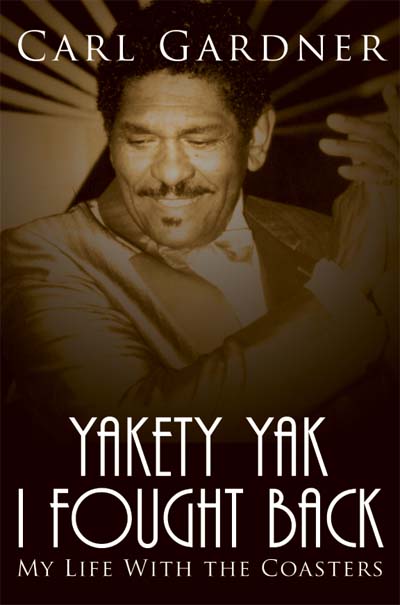
Yakety Yak I Fought
Back: My Life With the Coasters
An Autobiography
(by Carl Gardner, leader & founder -
with Veta Gardner).
ORDER
Carl Gardner with Veta Gardner
at AuthorHouse (authorhouse.com)
or at:
amazon.com
Barnes & Noble

HARMONY
LANE:
COASTERS FOUNDER GARDNER PENS MEMOIR
Todd Baptista
reviews YAKETY YAK, I FOUGHT BACK
From Goldmine magazine
With the
assistance and support of his wife of 20 years, Veta, Coasters founder Carl
Gardner's autobiography, Yakety Yak, I Fought Back, was published through
AuthorHouse and issued in June. The 180-page paperback as penned by Veta traces
the now 79-year old Rock and Roll Hall of Fame inductee from his birth in Tyler,
Texas to international stardom, to content retirement in Port St. Lucie,
Florida. Although Claus Röhnisch's 27-page discography and timeline gives the
reader a great deal of information on the group's history and output, the
premise of this book is not names, places and dates. For that, fans should
visit Rohnisch's website,
www.angelfire.com/mn/coasters/,
not only the best Coasters site, but unquestionably the most authoritative and
well-researched internet site for any vocal harmony group from any era. Instead,
the book reads like an engaging chat with the singer himself, as Gardner
recounts the segregation and racism he encountered growing up poor in the Deep
South in the late 1930s and early 1940s and yearning to find success in
California as a "sophisticated crooner", a solo singer in the Bill Kenny, Billy
Eckstine, Nat "King" Cole vein. Once in Los Angeles, Gardner found to his
dismay that rhythm and blues groups and combos had captured the country's
tastes, and through his association with bandleader Johnny Otis, he wound up
sitting in with the Robins in late 1953 while their regular lead, Grady Chapman,
was incarcerated. It was a stint that lasted until Gardner and bass Bobby Nunn
left to form the Coasters with Leiber and Stoller in the fall of 1955. To R&B
fans who hold the Robins in high esteem, Gardner's tales of the group's
extra-curricular activities may come as a shock. In order to be able to earn
extra cash to send home to his wife and two children, the singer recounts how he
worked as a pimp for fellow Robins member Billy Richard's wife, Helen, who ran
an exclusive L. A. prostitution house. Readers will find Gardner's
matter-of-fact explanation of the Coasters' founding, the firing of fellow
originals Bobby Nunn and Leon Hughes, and manager Lester Sill's filing of a
fictitious business statement assigning the Coasters' name to himself, equally
compelling.
Carl doesn't mince words when addressing some of the individuals he's been
associated with through the years, either. Of the late Cornell Gunter, who
eventually left the fold and started a rival touring group, the Fabulous
Coasters, in the 1960s, the author asserts that Gunter, the victim of an
unsolved 1990 murder, was "one of the biggest liars who ever lived". When
discussing entrepreneur Dick Clark, who regularly bypassed Gardner's original
group and booked Gunter's group for cheaper money, Gardner writes "Mr. Clark is
many things, and a ruthless, phony promoter is one of the many faces he wears".
Particularly poignant are Gardner's introspective statements, briefly touching
upon a long battle with alcohol and providing insight into the loneliness that
many entertainers feel on the road and attempt to quench with liquor and drugs.
At times, he's bitter. In other instances, he's remarkably astute, noting "I
was a pioneer, until the Beatles changed the sound, and then they became the
pioneers." Carl's bitterness resonates with the reader as he details a long and
costly crusade against fake Coasters groups, culminating in lawsuits involving
fellow pioneer Billy Guy and Billy Richard's nephew, who was astonishingly
awarded a stake in the group's trademark and licensed the group's name to a New
York promoter who booked multiple variations of non-original Coasters groups.
The singer's devotion and appreciation of his wife's efforts ring through as he
recounts his life in a Mount Vernon, New York apartment in the early 1980s when
the Coasters would split $1,500 four ways per show, and were only averaging one
gig a month. With Veta, an astute businesswoman, taking over as the group's
manager, publicity increased considerably, their salary climbed into the
five-figure range, and the number of live dates climbed to 15 per month.
After winning a slim chance for survival against throat cancer in 1993 and
suffering a mild stroke in 2004, Gardner turned over the reigns in the Coasters
to his son, Carl, Jr., in late 2005. "My mobility is not so good (and) there
comes a time when you know it is time to quit," he writes. My only quibble with
the finished product is in the editorial process. Some misspellings (Paul
McCartney as McCarthy, Doc Pomus as Primus, and Willie Mae Thornton as Willie
May Thorton) and occasional grammatical errors ("Billy song lead on Searchin'")
apparently slipped through the cracks before the book went to print. That being
said, Yakety Yak, I Fought Back is still a thoroughly enjoyable and easy read.
I have always believed that the histories of our pioneering artists are best
told through the words of the men and women behind the music themselves.
Happily, Carl and Veta Gardner have taken the same approach. There's also a
generous assortment of photos, including a shot of the Robins I had never seen
before, as well as a wonderful montage of the Coasters on stage at the Apollo
Theater in 1956. The book is available online from the publisher at
www.authorhouse.com
for $18.70 per copy.
-- Todd Baptista
SUMMARY OUTLINE
Please note that the chapter list below is from the
manuscript. The book is now published (June 6, 2007) and has 24 Chapters
plus Introduction features and appendixes.
Prologue/Introduction....
This is my story, straight forward and explicit. My name is Carl Gardner, and I am lead
singer and founder of THE COASTERS. Here´s a list of some of the stars that Carl will be
talking about in his book: The Beatles, Chuck Berry, Ruth Brown, Nat King Cole, Dick
Clark, The Crystals, Michael Douglas, The Drifters, Billy Eckstine, Duke Ellington Aretha
Franklin, Michael Jackson, Mick Jagger, Johnny Otis,
Carl Perkins, Lester Sill, Leiber & Stoller, The Shirelles, Elisabeth Taylor, Ike
& Tina Turner, Jackie Wilson...
 Chapter 1: "Young Blood" The
reader is introduced to a five year old Carl Gardner, living in Tyler, Texas. At that time
this small town had just become the oil center of the world and is known as the rose
garden of the world. A young and talented Carl seeks to find himself a solo career, while
wondering how and why the blacks of Tyler let the whites cheat them out of their land
rights for peanuts and cadillacs. Carl´s family is extremely poor. Carl tries out his
first radio appearance only to be let down. He signs on to the army at the age of 16 and
leaves his pregnant girlfriend behind. (Photo left: Carl's
father Robert)
Chapter 1: "Young Blood" The
reader is introduced to a five year old Carl Gardner, living in Tyler, Texas. At that time
this small town had just become the oil center of the world and is known as the rose
garden of the world. A young and talented Carl seeks to find himself a solo career, while
wondering how and why the blacks of Tyler let the whites cheat them out of their land
rights for peanuts and cadillacs. Carl´s family is extremely poor. Carl tries out his
first radio appearance only to be let down. He signs on to the army at the age of 16 and
leaves his pregnant girlfriend behind. (Photo left: Carl's
father Robert)
Chapter 2: "Searching"
At the age of 16 Carl is not prepared for the hard training of the army so
he plots a way to be dismissed by failing is I.Q. test. However, while in the army he has
his own singing group and performs for the other soldiers. After being released Carl goes
back to his home in Tyler and gets back with his old school band, which is comprised of
school teachers. He later marries Ladessa Richardson from Bullard, Texas, who is a school
teacher, who he leaves behind with his young baby girl.
Chapter 3: "The Fine Arts of Pimping"
Not finding any success in his hometown, Carl venturies out in the
big city of Los Angeles to find fame and fortune. Carl struggles through some very hard
times, even has to resort to shoe shining and detailing cars for movie stars. With over a
hundred tunes and keys in his head, Carl is good enough to sit in with the likes of some
great performers, like the jazz pianist Carl Perkins. It is in these clubs that me
meets a popular R&B singing group called The Robins, and is asked to replace their
lead singer Grady Chapman, who is in jail. Billy Richards, of The Robins, quickly helps
Carl gain extra money by teaching him the art of pimping. Billy, as Carl explains, owns a
big fabulous house in L.A. that is actually used as a sort of sexual theatre, in which
prostitutes work, and Carl sometimes performs sexual acts to help support him while
looking to make it as a singer. The Robins take off big with Carl as their lead singer. It
is during this time that Carl meets the famous Jack Warner of Warner Bros., when Ty
Terrell of The Robins and Carl provides him with unsuspecting girls, who want to become
stars. Only Jack Warner was just seeking these young girls to fill his sexual appetitee.
Chapter 4: Leiber & Stoller - "Let´s Grab
Gardner" Two young Jewish
writer/producers from the North, Jerry Leiber and Mike Stoller, back the young bucks and
the climb to fame and fortune begins. We find that Leiber and Stoller take to Carl and his
talents, but not to the control that the Mob has over The Robins. So they come up with a
legal plot to free Carl from The Robins and grab him all to themselves. Threatened by the
Mob for leaving the group, Carl also gets Bobby Nunn of The Robins to escape with him.
Carl is asked by Leiber and Stoller to form another group.
Chapter 5: Reluctantly "The Coasters"
The Coasters, Jerry Leiber and Mike Stoller are signed
to Atlantic Records with Leiber and Stoller as independent producers, along with manager
Lester Sill, who is the manager for The Coasters. Although Carl really desires a solo
career, he senses that with L&S, his success is but a song away and very reluctantly
agrees to form The Coasters group. L&S agree to give Carl top billing, but when the
first record is released, instead of Carl Gardner and the Coasters, it reads "The
Coasters". This is very disappointing to Carl. The production and writing of L&S
hits the charts in a big way and Carl Gardner and his group The Coasters change the
musical culture forever.
Chapter 6: The English Invasion
In Virginia, in the middle of the booked solid two year tour, the million selling
Coasters begin to fall apart. Drinking day and night, bitter, nasty, and highly abusive,
Carl Gardner begins to loose his grip on any situations for the first time in his life. He
briefly returns to his family in Tyler, Texas, as two of the original group members get
fired by Lester Sill, the group´s manager, who hires two new - very talented young men -
for the a soon-to-be world famous classic Coasters line-up. One of them turned out to be
none other than the flamboyant Cornell Gunter who is very ambitious, and gay. Cornell,
after causing much trouble will later leave to form his own group of Coasters. The
Coasters meet The Beatles, who had just invaded the United States. This causes The
Coasters along with other 50´s groups to be placed on the back burner. The Coasters find
themselves in a deep financial situation. Carl decides that rather than giving up, he
takes very low paying jobs in order for him and The Coasters to survive. 1968 finds Carl
looking for a replacement for Will "Dub" Jones, who decides to return to
California due to the fact that there is not sufficient work to keep him financially in
New York. Ronnie Bright (formerly of the Valentines and the original Mr. Bassman) is
chosen to replace Dub.
Chapter 7: The Coasters financially paralyzed Carl meets Malcolm X, who he becomes very friendly with
and who gives him a new outlook on religion. He becomes very fascinated with the teachings
of Malcolm X and actually embraces the teaching and starts to study the Holy Coran Bible.
With very little work Carl moves in with his girlfriend in Brooklyn, who gves birth to a
son. Carl names him Ahilee, which was a Muslim name.
Chapter 8: Down and Out but far from Over Carl meets his second wife Veta and starts to battle for
the rights of The Coasters´ name and unpaid royalties. Carl and The Coasters are inducted
into the Rock & Roll hall of Fame in 1987, joining other greats, such as Chuck Berry,
Little Richard, Elvis Presley, Fats Domino, and Jerry Lee Lewis, who were inducted in
1986.
Chapter 9: Devastated by throat cancer Here Carl discovers that he has prostate problems,
luckily it is not malignant, but later learns he has throat cancer with only a 10% chance
of survival. Carl is very scared. Not of dying, but if he should survive, would he be able
to sing again? That is the only life he knows. Thank God, with hope and prayers he makes
it and is still here with us. He continues to perform all over the country in Casinos,
Concerts, Corporate parties, Cruise Ships, and Fairs.
Chapter 10: Legal problems Continue Carl and other R&B artists go to Congress to
plead for a change in the trade-mark laws, that will prevent other people from infringing
on their trademarks. Some of the artist that attend are Beverly Lee of The Shirelles,
Delores Kennibrew of The Crystals, John Bauman of Sha Na Na, Charlie Thomas and Bill
Pinkney of The Drifters, Herb Reed of The Platters, Peggy Davidson of The Angels, Danny
& The Juniors, and Sam Moore of the duo Sam & Dave. Carl sues New York promoter
Larry Marshak and gets a judgement awarding him $190,000. In spite of a court order Mr.
Marshak refuses to pay Carl. Carl also sues Dick Clark, who is American Bandstand founder
and an icon of national music, for infringing on the Coasters Trademark. Carl is awarded
an undisclosed settlement and a consent Judgement against Dick Clark.
- edited by Veta Gardner (with slight additions by Claus Röhnisch and Tony
Turner).
| The Coasters Story: Short Year-By-Year
Re-Cap |
50 years with
Carl Gardner & The Coasters
Carl Gardner Tribute - a
play-list
(yellow = the mustbeplayeds)
Los Angeles, California:
1. Just Like A Fool - The Robins with Carl Gardner, lead -
Spark 1955
2. Riot In Cell Block Number Nine - The Robins - Spark 1954
3. That´s What The Good Book Says
- The Robins featuring Bobby Nunn
- Modern 1951
4. Loop De Loop Mambo - The Robins with Carl Gardner, lead -
Spark 1954
5. Smokey
Joe's Cafe - The Robins
with Carl Gardner, lead - Spark/Atco 1955
6. Down In Mexico - The Coasters with Carl Gardner, lead - Atco 1956
7. One Kiss Led To Another
- The Coasters with Carl Gardner, lead - Atco 1956
8. Searchin' - The Coasters featuring Billy Guy - Atco
1957
9. Young
Blood - The Coasters with Carl Gardner, lead - Atco
1957
10. Idol With The
Golden Head - The
Coasters with Carl Gardner, lead - Atco 1957
11. Sweet Georgia Brown - The Coasters featuring Gardner, Guy &
Nunn - Atco 1957
New York City:
12. Dance! - The Coasters with Carl Gardner,
lead - Atco 1958
13. Yakety
Yak - The Coasters featuring Carl Gardner - Atco
1958
14. Zing! The Strings Of My Heart - The Coasters featuring Will "Dub" Jones & Cornell Gunter
- Atco 1958
15. Three Cool Cats - The Coasters with Carl Gardner, lead - alternate arrangement
Mr.R&B 1958
16. I'm A Hog For You - The Coasters -
undubbed master Rhino/Mr.R&B 1958
17. Crocodile - The Coasters - Mr.R&B
1958
18. Charlie Brown
- The Coasters - Atco 1959
19. Sexy (Hey Sexy) - The Coasters with Carl Gardner, lead - alternate arrangement Mr.R&B
1958
20. That Is Rock & Roll - The Coasters with Carl Gardner, lead -
Atco 1959
21. Medley: Along Came Jones / Poison Ivy / What
About Us - The Coasters - Atco 1959
22. Keep On Rolling - The Coasters featuring Carl Gardner - Atco 1960
23. Satin Doll - Carl Gardner
with The Coasters "One By One" - Atco 1960
24. Thumbin' A Ride - The Coasters with Carl Gardner, lead - Atco 1961
25. Little Egypt (Ying-Yang) -
The Coasters featuring Billy Guy (with
Carl Gardner intro) - Atco 1961
26. I Must Be Dreaming - The Coasters featuring Carl Gardner & Billy Guy - Atco 1964
27. Soul Pad - The Coasters featuring Billy Guy and Earl
"Speedo" Carroll - Date/King 1966
28. Talkin' 'Bout A Woman (She Can) - The
Coasters - Date/King 1966
29. D.W. Washburn - The
Coasters featuring Guy, Gardner & Carroll - Date/King 1967
30. Zing! Went The Strings Of My Heart (live in Boston) - featuring Ronnie Bright & Earl Carroll - TimeMachine 1969
31. Love Potion Number
Nine - The Coasters
with Carl Gardner, lead - King 1971
32. The In Crowd - Carl
Gardner solo ("The Coasters On Broadway") - King 1973
33. Hush Don't Talk About It - Carl Gardner &
The Coasters - Wicked 1976
34. Little Egypt (live in Orlando) - The Coasters
featuring Jimmy Norman - Lindy Lake/K-tel 1988
35. Smokey Joe's Cafe
(live in Texas) - Carl Gardner
& The Coasters - Veta Gardner Prod 1992 (unissued)
36. Stormy Monday - Carl Gardner from "One
Cool Cat" (Port St. Lucie, Florida) - Cee Vee 1996
37. Young Blood (live in Detroit) - The
Coasters featuring Carl Gardner - Classic World 2003 (2001)
NEWS LETTER
(Todd Baptista inspired me for this section)
| |
- On December 12, 2007 a 4CD-set on Rhino Handmade with the Complete
Atco Recordings, "The Coasters On Atco – There’s A Riot Goin’ On”
(Limited Edition) was issued, featuring 113 recordings in sessionography
order 1954-1966 (Rhino
RHM2 7740).
Compilation is produced by James Ritz with annotation by Claus Röhnisch.
- On August 28, 2007 Varèse Vintage issued the Coasters' Date/King sides
(the "On Broadway" LP) – the tracks now chronological and with a new
title, "Down Home" (Varèse Sarabande CD 302 066 844-2).
Collection is produced by Cary E. Mansfield with annotation and liner
notes by Claus Röhnisch.
check them!
|
|
2013
January 26 – Port St Lucie Civic Center, Florida
Please note: The show featured
The Coasters managed by Veta Gardner.
The Coasters are J.W. Lance, Dennis Anderson, Primo Candelara, and Eddie
Whitfield.

On December 7, 2000 Veta Gardner & Claus Röhnisch started
THE COASTERS FAN CLUB
and made it possible for this web site visitors to order
Coasters merchandise.

Carl Gardner, Bill Pinkney and Herb Reed on
March 19, 2005.
THE TRUTH IN MUSIC
Announcement:
Carl Gardner's and The Coasters' story is to
become a movie. Shooting will commence within the next 8-10 months
(today: November 2008) as soon as all the actors and all the people that will be
in the show are recruited.
The film will be produced by Treasure Coast Films with award winning director
Jose Garofalo.
Oldies groups go to court
to challenge 'truth in music' law
By DAVID PORTER
| Associated Press Writer
- 9:31 AM EDT, September 8, 2007
NEWARK, N.J. - The
question of who is The Great Pretender and who is merely an impostor
has moved from the stage to the courtroom.
Promoters of several rock 'n' roll oldies groups charged in court
Friday that the state overstepped its authority when it served
subpoenas on the Atlantic City Hilton Casino last month over a
series of performances by bands billing themselves as offshoots of
rock 'n' roll legends the Platters, Drifters and Coasters.
The lawsuit against state Attorney General Anne Milgram is believed
to be the first legal challenge to the so-called "truth in music"
laws designed to prevent the unauthorized use of the names of
existing groups like the Platters, who recorded "The Great Pretender"
and other hits in the 1950s and '60s.
Seventeen states have passed similar laws in recent years, according
to Jon "Bowzer" Bauman, former singer in the revival band "Sha Na
Na" and a member of the Vocal Group Hall of Fame Foundation, which
has lobbied for the legislation. New York Gov. Eliot Spitzer signed
a bill into law last month.
"With these older groups there's a lot more confusion because people
aren't familiar with the original members," Bauman said. "Take a
group like the Platters, who sold more records than anyone until the
Beatles came along. Compare them to U2 now: You can't put any four
people up there 50 years from now and call them U2. People will
laugh them off the stage."
In arguments on Friday before U.S. District Judge Dickinson R.
Debevoise, attorney William Charron, representing plaintiffs Singer
Management Consultants and Live Gold Operations, said his clients
hold unregistered trademarks on the names and are legally entitled
to use them, even though the groups don't feature any original
members.
The three groups perform under the names The Cornell Gunter Coasters,
The Elsbeary Hobbs Drifters and the Platters. Gunter was an original
member of the Coasters who was shot to death in Las Vegas in 1990,
according to the Rock and Roll Hall of Fame's Web site, and Hobbs
sang with the Drifters in the late 1950s and died in 1996 of natural
causes.
The groups were scheduled to play several concerts at the Hilton
between Aug. 18 and Aug. 30. In late July, the state Attorney
General's office served a subpoena seeking advertising and marketing
materials.
The Hilton subsequently discontinued advertising and ticket sales to
the shows, then reprinted tickets that billed the show as "a tribute
to" the Coasters, Drifters and Platters. Charron filed a restraining
order on Aug. 16, and the shows went on as scheduled.
The state contended that since the group's trademarks are
unregistered, they are subject to a subsection of the law that
requires them to obtain further authorization or else refer to
themselves as a tribute group.
But in court Friday, Deputy Attorney General Lorraine K. Rak
conceded, as did Debevoise, that an unregistered trademark can
confer the same rights as a registered trademark. Rak said the state
would continue its investigation into the validity of the groups'
trademark claims.
Debevoise said he would reserve ruling on the lawsuit until he
decides a separate case involving the use of the Drifters name.
Charron said Milgram's action could affect his clients in the future
since some of the groups have shows scheduled in New Jersey later
this year.
"She should be directing her attention at us, not at other people,"
Charron said, referring to prospective venues like the Hilton. "This
is having a direct, concrete effect on our business."
Copyright © 2007, The Associated Press
THE COASTERS -
HERB REED & THE PLATTERS - THE ORIGINAL DRIFTERS
Golden Oldies Cabaret October
13, 2006 - October 14, 2006 8:00 pm
Okay, let’s just say it:
Take a stroll down memory lane as these authentic kings of nostalgia fill your
night with music from the ’50s and ’60s. You’ll hear solid-gold hits like the
Coasters’ “Poison Ivy” and “Yakety Yak,” not to mention the Drifters’ “There
Goes My Baby,” “Save the Last Dance for Me,” “Under the Boardwalk,” “This Magic
Moment,” and the Platters’ boffo hit-singles, “Only You,” “Great Pretender,” and
“Smoke Gets in Your Eyes.”
CABARET: Dinner, Dessert & Cash Bar $3–10. Doors open at 7 pm.
Pricing:
Regular: $37, 32, 27
UConn Student Hot Seats: $14-20 (2 per ID)
$2 discount for Senior Citizens
Jorgensen
Center for the Performing Arts
Hillside Road
Storrs, CT 06269
(860)486-4226
THE COASTERS TOURING SCHEDULE 2016
January
2nd Orlando, Florida (Pending)
January 23rd Lehman College, Bronx, N.Y.
February 4th Clear Lake, Iowa
February 27th Coconut Creek, Florida (Private Party)
February 28th Kings Point, Florida
March 20th Westbury, N.Y.
April 16th
Myrtle Beach
April 9th Flushing, Queens
May 21st Proctor Theater, Schanecty
May 26th Unavailable
June 5th Newark, N.J. D.N.
June 18th Lancaster, Pa. DF
July 30th
Pittsburgh, Pa
October 1st Myrtle Beach
October 15th Roslyn, N.Y.
November 4th Canton, Mich.
November 5th Maumee, Ohio
THE COASTERS TOURING SCHEDULE 2015
February 27th Somerset, Kentucky
April 10th Patchauge, L.I.
April 17th Altoona, Pa.
April 25th Myrtle Beach, S.C.
May 8th Riverhead, L.I.
May 22nd Port Washington, N.Y.
May 29th Holmdel, New Jersey
July 3rd Peterburg, West Virginia
July 10th Akron, Ohio
July 17th Port Jefferson, New York
August 15th Union, Pennsylvania
August 29th Coasters 60 anniversary Gala
September 19th Deerbourne, Michigan
September 24th & 25th Somerset, Kentucky
October 10th Coral Springs, Florida
October 17th Myrtle Beach, Florida
October 21st Niagara Falls, N.Y.
November 4-8th Cruise
November 10th DeLand, Florida
November 15th/22nd West Point, N.Y. (pending)
November 21st Wilkes Barre, Pa.
December 12th Rahway, N.J.
December 30-31st New Mexico
Touring Schedule
2014
Jan 19 Kings Point, Florida
Jan 25 Namee, Ohio
Feb 1 Rockville Center,
N.Y.
Feb 15 Alabama Theater,
Myrtle Beach, S.C.
Mar 14 Pompano Beach, Florida
Mar 22 Westbury, N.Y.
Apr 5 Bishop Ford High
School
Brooklyn, N.Y.
May 3 Meyerhoff Symphony Hall,
Maryland
May 10
Swartz Creek, Michigan
May 17
Rivera Theater, Towanda, N.Y
May 22 Pocono,
Pennsylvania
May 24 Pitman
Theater, N.J.
May 28-29
Mount Airy Resort
and Casino Poconos,N.Y.
Apr 12 Las Vegas,
Nevada
May 9 Syracuse,
N.Y.
July 19 Greensboro, Pa
Aug 30 Ocean Grove,
New Jersey
Touring Schedule
2013
Jan 23 Naples
Jan 26 Civic Center, Port St. Lucie, Florida
Feb 15 Staten Island, St. George Theater
Apr 6 Tarry Town Music Hall, N.Y.
Apr 13 Alabama Theater,
Myrtle Beach, S.C.
Apr 19 Marion Palace, Ohio
Apr 26 Union County Art Center, Rahway, N.J.
May 18 Warner Theater,Torrington, Conn.
Jun 9 Akron Civic Center,
Ohio
Sep
21 Bristol. Pennsylvania
Sep 28 Alabama Theater, Myrtle Beach, S.C.
Oct 3
Perry Georgia
Oct 5
Grand Opera, Wilmington, Delaware
Oct 6
Wimberly, Texas
Oct 19 Coral Springs Center, Florida
Oct 26 Queens College,N.Y.
Nov
15 Strand Theater, Lakewood, N.J.
Dec 6 Glenside, Pennsylvania
Dec 21 Brooklyn College, Brooklyn, N.Y
Touring Schedule 2011-2012
|
Baton Rouge, Louisiana
December 3, 2011 |
|
Years Eve Arizona
Dec 31, 2011 |
2012
January 28 - Lehman College, Bronx, N.Y, |
|
March 2 - Florida |
|
March 3 - West Virginia |
|
March 17 - Florida |
|
March 24 - Myrtle Beach. S.C. |
|
April 7 - Leland, Michigan |
|
June 16 - Lancaster,
Pa |
|
July 20 & 21 - Liberty
Opry, Liberty, Texas |
|
August 12 - Washington,
Pa. |
|
August 25 - Detroit,
Michigan |
|
September 1 - Ocean Grove,
N.J. |
|
September 29 - Myrtle Beach, S.C. |
|
October 1 - Ocean Grove, New
Jersey |
October 29 to November 3 -
- Royal Caribbean Cruise
(Malt Shop)
November 11 - Kissimee, Florida
2013
January 26 – Port St Lucie
Civic Center, Florida |
Touring Schedule 2010
March 20th Alabama Theatre, Myrtle Beach,
S.C.
March 27th Civic Center- Port St. Lucie, Florida
April 9th St. Petersburg, Florida
April 10th Nova University, Davie, Florida
April 16th Spring Hill, Florida
May 22nd Pittsburgh, Pa
June 12th Richard Nader DooWop Show Izod Center E. Rutherford, N.J.
June 27th American Music Theatre, Lancaster, PA
Sept 25th Alabama Theater, Myrtle Beach, S.C.
Nov 13th Richard Nader Doo Wop Show, Mesa, Arizona
|
Touring Schedule 2008
January 19 - Harrah's Casino - Atlantic
City, N.J.
March 1 - Alabama Theatre, Myrtle
Beach, S.C.
March 22 - Spring Hill, Florida
March 29 - St George Theatre, Staten Island, N.Y.
April 5 - Royal Coachman Resort, Nokamis, Florida
May 10 - Kent Stage, Kent, Ohio
June 13 - Alabama Theatre, Myrtle Beach, S.C.
June 28 - Baton Rouge River Center, Baton
Rouge, Louisiana
July 12 - Alys Robinson Stephens Performing
Arts Center, Birmingham, Alabama
July 18 - Camden Park Festival, Charleston, W.V.
August 23 - Harlows Casino Resort, Greenville, Mississippi
October 11 - Alabama Theatre, Myrtle Beach,
S.C.
October 17 - Bellaggio Clubhouse Boyton Beach, Florida
October 18 - Villa Borghese, Delray Beach, Florida
November 11 - The Waterfall Conference
Center, Calymont, Delaware
November 16 - Theme Park Rangers, Orlando, Florida
December 13 - Boston, Mass
|
Touring Schedule 2009
April 4th: Fort Pierce, Florida
April 25th: Plant City, Florida
June 5th: Cypress Bayou Casino, Charenton, Louisiana
June 13th: Civic Center, Port St. Lucie, Florida
June 18th: Coco Beach, Florida
June 28th: American Music Theatre, Lancaster, Pa
July 2nd: Myrtle Beach, S.C.
October 17th: Myrtle Beach, S.C.
November 21st: New Jersey
December 5th to 12th: C. Cruise
December 31st: Plant City, Florida |
|
Touring schedule 2007
January 13-14 - Connecticut, N.Y.
February 17 - Alabama Theatre , Myrtle
Beach, S.C.
March 3 - State Theatre, Uniontown, Pennsylvania
March 10 - Herando County Park, Brookville, Florida
March 31 - Count Basie Theatre, Red Bank, N.J.
April 14 - State Theatre, Easton, Pa
April 21 - Warner Theatre, Torrington, Connecticut
April 28 - Hauppaugh High School.Hauppaugh, N.Y.
June 16 - Continnental Airlines
Arena, East Rutherford, N.J.
June 29 - Alabama Theatre, Myrtle Beach, S.C.
September 8 - West Virginia
October 6 - Alabama Theatre, Myrtle Beach, S.C. |
Touring schedule 2006
January 28 - Victorville, Calif
February 10 - Tallahasse, Florida
February 25 - Fort Myers, Florida
April 8 - Myrtle Beach, S. Carolina
May 20 - Chicago, Ill.
May 25 - N. Little Rock, Akr
June 2-3 - Alabama
June 15 - Amelia Island, Florida
July 25 - Brunswick, Maine
July 28 - Myrtle Beach, S.C.
October 7 - Maryland
October 10 - Dallas, Texas
October 13-14 - Connecticut
December 16 - Connecticut
|

The Platters, Ben E. King, and The Coasters in circa 1993 - photo from
Ravenna Miceli.


Carl Jr's group - and the late Sr's group at the
Shake Rattle & Roll concerts (on May 18 and July 21, 2012 at Liberty Opry
near Houston)
News
(from
site visitors, trade papers and e-mail)
News of 2006 and 2007
on main page
- and
here (Topix.com) -
or here (Google News)
CONCERT on
Sat, September 3, 2005

Beach music at Barefoot venues
The Alabama Theatre and House of Blues have beach music
icons Bill Pinkney's Original Drifters and Chairmen of the Board crooning out the official
music of South Carolina at Barefoot Landing. Bill Pinkney's Original Drifters, Herb Reed
& The Platters and Carl Gardner's Coasters perform at the Alabama Theatre at 7
tonight - and
May 1, 2005
The Coasters' 50th Anniversary
will be celebrated on November 5, 2005. It will be a black-tie affair
and if anyone is interested in attending the cost is $50.00 per person and includes
dinner. Contact Veta Gardner at 772-380-9607 It is strictly by invitation. It will be
held at Club Med in Port St. Lucie, Florida.
April 16, 2005
Robert Christgau (of the Village Voice) writes (and talks) about
"The Coasters Revisited" at the 2005 Pop Conference at Experience Music Project
(emplive.org).
| Interview with Christgau | Christgau on The Coasters at EMP |
January 1, 2005
The following are booked dates for
THE COASTERS in 2005:
Jan 14 & 15 -
Connecticut
Jan 29 - New Orleans
Feb 26 - West Palm Beach
March 19 - Myrtle Beach
April 10 - Long Island, N.Y.
April 15 to 18 - Hawaii
May 21 to 25 - Cruise
August 13-14 - Alabama Theatre, Myrtle Beach, S.c.
August 22 - Laudon, Virginia
September 25 - San Diego, California
October 8 - Biloxi, Mississippi
October 22-23 - Alabama Theater, Myrtle Beach, S.C.
December 2 - Knoxville, Tenn.
November 14, 2004
Carl Gardner, Jr. back with the true Coasters!
Veta Gardner has just given me the very good news that Carl Gardner, Jr is back with his
father and the true current Coasters! Great!!!!
January 1, 2004: Touring Schedule
2004
January 29 to February 2 - Delta Queen River Cruise
February 10 - State Fair Tampa, Florida
February 14 - Orlando, Florida
February 27 - Albuquergue, New Mexico
April 16 & 17 - Myrtle beachm S.C
April 26 - Naples, Florida
May 19 - Raleigh, N.C.
June 29 - Sacramento, California
June 26 - St. Thomas
July 2 & 3 - San Jacinto, California
July 17 - Lexington, Kentucky
July 30 & 31 - Deerborne, Michigan
August 13 & 14 - Myrtle Beach, S.C.
September 5 - Memphis, Tenn.
September 25 - San Diego, California
October 7 & 8 - Biloxi, Miss.
October 22 & 23 - Myrtle Beach, S.C.
December 4 - Knoxville, Tenn.
May 8, 2003
Veta Gardner tells us that Carl Gardner´s birthday
party (75 years of age) was a huge success, and the following are the booked dates for The
Coasters in the near future:
May 17, 2003
Brissell park, Oakridge, Tennessee
June 20, 2003
Alabama Theatre, Myrtle Beach, S.C.
July 5, 2003
Casino Magic, Biloxi, Mississippi
July 12, 2003 Plymouth, Mass.
Sept 12, 2003 New Rochelle, N.Y.
Sept.13, 2003 Greenwich, Connecticut
November 5, 2002
Billy Guy
dies in his sleep at home in Las Vegas, Nevada. The news about his death is brought
to us by Veta Gardner (via The Artists Rights). He went to sleep at night and never woke
up (probable heart attack). Guy was 66 years old in June.
| check for more |
June 9, 2002
Manager´s party
Veta Gardner, manager of The Coasters, has a great birthday party (born
1932) and she gives a special back-present to her group presenting them the following
touring schedule for the season to come:
7/13 Sterling Heights, Michigan
7/20 Stanton, Pennsylvania
8/24 Marshfield, Mass
8/30 Harrah's Casino, Arizona
8/31 Harrah's Casino, Arizona
9/1 Harrah's Casino, Arizona
9/2 Harrah's Casino, Arizona
10/5 Myrtle Beach, S.C.
10/21 Palm Springs, California
April 28, 2002
New Official COASTERS website
Just in time for Carl Gardner´s 74th birthday a new and terrific The Coasters
Official Website hits the net!
and
check this too!
January
6, 2002:
The Coasters in Detroit
Gardner´s true Coasters made the Motor City together with Dennis
Edwards´ Temptations and The Contours (8,000 spectators) last week. Meanwhile Larry
Marshak´s bogus groups The Platters, Cornell Gunter´s Coasters and Beary Hobb´s
Drifters are beeing booked for New Jersey in a couple of weeks - as you know both Cornell
and Beary (The Drifters´ bass singer from late 1958) are no longer with us.
July 29, 2001:
New Coasters member
By the end of July, 2001 Joe Lance Williams debuted
as a Coasters member and started to substitute for Carl Gardner, Jnr. (baritone). Joe was
born on June 16, 1949 and reported to be a very talented singer. Stage name: J.W.
Lance.
The Coasters of Today.
December 13,
2000:
Vocal Group Hall of Fame
From (baypath): Hi to all. Just a few lines to let
everybody know about the recent induction's and show at the Vocal Group Hall of Fame in
Sharon, Pa. (October 20, 2000; ed.note). The induction's were filmed by PBS and will be
aired in Jan. or Feb. of 2001. The induction's were hosted by Mary Wilson of the Original
Supremes and she did an outstanding job. Present at the induction ceremony were; Joe
Jackson, Michael Jackson's father, Mary Wilson, Tony Butalla of the Lettermen, Lou Martin
of the Memories, Ben E. King, Bill Pinkney and Charlie Thomas of the Drifters, The
original Modernairs, Chuck Negron of Three Dog Night, Harvey Fuqua and the Moonglows,
Tommy Hunt of the original Flamingos, The Belmonts, The Soul Stirrers, Frankie Lymon's
Teenagers, Duke Fakier of the Four Tops, Carl Gardner of the original Coasters and more.
The induction ceremony and outside show were held at the Vocal Group Hall of Fame Museum
building. This museum is fantastic and anybody who loves Doo Wop should pay a visit there
as it is devoted to the vocal groups who made Doo Wop famous. The outside concert was
viewed by several thousand people and it too was outstanding. Almost all of the acts
mentioned above performed for the very enthusiastic fans who enjoyed a great fall day as
well as the talented performers who gave their all. There were several "special"
moments that occurred during the concert such as the standing ovation given to the
Memories for their performance. Also, the appearance of Bill Pinkney, Charlie Thomas and
Ben E. King of the original Drifters, together after almost 30 years of not appearing
together, brought the house down. After the above mentioned performances, that lasted over
three hours, Jr. Walkers All Stars provided additional music for the fans to enjoy. This
was one of the best concerts that I have ever had the pleasure to attend and I hope all
you fans get a chance to see some of these performers in or near your area.
From Gary, Oldies Newsletter #46
November 25, 2000:
Editor speaking
Today I once again completely changed the layout - Hope you like it and at
least I think its much easier to follow all the pages via this "clean" new
design. Great news: You will be able to buy CDs and other Coasters merchandise - just be
patient the details will come soon! Tell you more later on.
October 25,
2000:
E-mail from Samuel Hill
Hello Claus,
I told you earlier that I was obtaining more Coasters pictures from a friend. I will add a
new page dedicated to local performances by groups from Arizona and nationally known
groups performing here. The Coasters pictures will be the first to go online. They were
all taken by a local photograper named Johnny Franklin. I´ll let you know when the page
is online and you can download them.
Sam
September 2000:
The Platters (and Larry Marshak again!)
Phony Platters group halted
in Lawrence, MA
Just days after the Press Release concerning Mr. Reed obtaining the
Trademark for the exclusive rights of the service mark of the Platters, it seems that two
entertainment / booking agents attempted to test the resolve of this office to enforce our
Press Release concerning Mr. Reed's rights. A bogus group of Platters was sold to a
charitable organization as part of a reported $15,000.00 deal involving a free concert.
After losing the case to Mr. Reed the show reportedly went on. As if by magic, the
"Platters" became the "Coasters", and were coupled with a bogus
"Drifters" group.
From Herb Reed´s Platters
site
June 9, 2000:
New CD arriving at the editor´s!
I´ve got it now! The "Charlie Brown" CD - and what a surprice - Catalogue
number identical to my own "half-bootleg" Mr R&B CD but just superb true
stereo alternates and several never-before-issued things - how about "Hey Sexy"
with Gardner solo-lead! WOW and the unissued and just wonderful "Crocodile" - I
just can´t understand why it was not issued back-then. You simply got to have this one -
even if it is a bootleg!
Claus - your editor
May 20, 2000:
E-mail from Tuneman 56
Relic Record Shoppe announces a new Coasters CD: "Charlie Brown" - not yet
another Coasters compilation. Contains alternate takes, unreleased takes, session talk,
and outtakes. From the original recording sessions! Write to Relic Record Shoppe, 136 Main
Street, Hackensack, NJ 07601 or phone (201) 342-4848 to get it.
Tuneman56 (of
The Rhythm and Blues Highway)
March 16, 2000:
Larry Marshak again!
Marshak looses his case against Gardner to use the name of "The Coasters" (and
Billy Guy retires). That does not scare Marshak. He finds Shirley Gunter (sister of the
late Cornell Gunter) and signs her to "coach" his bogus Coasters
group.
Claus
If you wanna book the real Coasters -
Contact
Veta Gardner's Management
Phone (772) 380-9607
Fax (772) 380-9618
February 24, 2000:
Photo Gallery
The site is now enhanced with a special photo gallery. Take a look at it!
Claus Röhnisch
January 31, 2000:
Will "Dub" Jones died January 16
e-mail to the editor from Todd Baptista
- and from Eric LeBlanc
Claus,
Will J. "Dub" Jones died Sunday Jan 16, 2000 in Long Beach, CA., at age 71. He
was born May 14, 1928, Shreveport, LA. He was actually two years older than he ever
claimed to be! He was survived by his wife, 1 son and 4 daughters. ... Kindest regards,
Todd Baptista & Eric LeBlanc
- separately |
|
|
|
Comments
(from site visitors and e-mail)
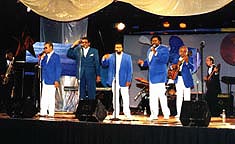
Gary/Oldies Magazine - January
2004
From Abe Mittleman: Here's some information (from your DOO WOP
SURVEY I am broadcasting), on #70 "Rainy Day Bells" by The Globetrotters.
I thought this would be a good time to clear up the rumors that the singers were members
of the basketball team. Hanna/Barbara produced many gems over the decades, but this
wasn't one of them. As others have said, it was supposed to be "so-weird-it's
cool", but it came off racially offensive at times. THE SUPER GLOBETROTTERS was
worse--"Spaghetti Man?" "Sphere Man?" Yikes! However, there was one
good thing to come out of this show. In 1970, DON KIRSHNER, the man
behind THE ARCHIES and THE MONKEES, supervised (with Jeff
Barry) a record album called "THE GLOBETROTTERS",
showing the HG's cartoon likenesses on the cover. The only Globbie who sang on the album
was MEADOWLARK LEMON, but the other singers included former members of
THE COASTERS, THE PLATTERS, THE DRIFTERS
and THE CADILLACS, all classic Doo-Wop groups of the 1950s! Commercially,
the album didn't do well, but it has since become a pretty big collector's item.
It's kind of like a cross between THE COASTERS, 40's jive king Louis
Jordan and early '70's Funk. One song, "Rainy Day Bells", actually has
a cult following among East Coast Doo-Wop freaks.
February 21, 2001
THE COASTERS WEB SITE
Hello Claus, let me introduce myself to you. My name is Ken Wojdyla, I´m a
promoter and producer of legendary 50s and 60s rock and roll shows, I was looking at The
Coasters Web and want to tell you I was very impressed, it´s a fine site. Carl and Veta
are friends of mine. it´s really nice that the site goes into detail on the "Phony
Coasters" and how the public can be so easily deceived by these groups. being in the
business of promoting we know the good from the bad, it´s nice to see that millions have
the opportunity to read and be informed. We did a show with Coasters, the Drifters and The
Platters. We billed the concert "The Real Deal Tour". It sold out two shows in
one night to the total of 2000 seats each show. It was one of our most popular shows. Who
says the original artists can´t draw the fans in? We are constantly going to bat for all
the original artists. On my business card it says "If they weren´t on the record,
they won´t be on our stages". We mean that also. So in closing I´ll say god job!
Also the art work that appears on the merchandise came from my partner and myself and we
gave it to Veta. it shows good! You created one of the best sites I´ve seen for an artist
in a long time. Keep the music alive and ROCK-ON!
Ken Wojdyla
- "The Legends of Rock and Roll Concerts"
October 21, 2000
News on the way
There is soon more to come at this site! More photos - from Arizona 1958 and
from the Vocal Group Hall of Fame induction ceremony recently (October 20, 2000).
Claus
July 2, 2000
New CD
The Charlie Brown CD compilation discussed here is not available at the sites
mentioned in your review. I was able to get copies of all the Sequel CDs and the Charlie
Brown CD at Midnight Records in NYC. Thanks for a great web site!
Alan Parrott
Claus here:
Here´s the link to Midnight
Records!
June 16, 2000:
"Old Pals"
Claus - Hello again after 40 years. We corresponded in the beginning of the
60's & if you remember I spoke to you of the Coasters who just happened to be my
favourite group, & of course still are. Do you remember I also told you about Jerry
Lee Lewis & a few others, some great names, a few of which that you had not heard of.
I just happened to be checking the web & up came your name. Keep up the good work,
it's good to know your still rocking on.
Terry Mchugh
May 19, 2000:
"The Secret & the Sequel CDs"
Hi. I recently surfed into the Coasters web page. It's an
amazing site, packed full of information. Thank you for putting it up. I have many of the
Coasters records and have now ordered the four Sequel CDs, based on your recommendations,
so that I'll have all the alternative versions, too. I searched for The Coasters at www.gemm.com and found the Sequel CDs being
offered by Rockhouse. They don't have them in stock, though--I got a notice that
Rockhouse was backordering them from the distributor for me.
I also found out that it is because of you, in a way, that I got started as
a Coasters fan. About 1982, when I was in college, I knew of the Coasters only
through a cheap LP I had with 5 re-recordings of Coasters songs--Yakety Yak, Poison Ivy
and three others (plus 5 Drifters re-recordings). I was in a used record store in
Philadelphia (where I went to college) and saw the Mr. R&B collection that you, I just
found out, put together. Not knowing that it wasn't representative of the Coasters
hits, I bought it (if I recall correctly, it cost $3.58) and fell in love with it.
Because I got to know the Coasters from this LP, rather than from their traditional hits,
I got a different view of them. Besame Mucho was just as much a part of my view of
the group as Lady Like was. Eventually I collected all four original LPs and several
CDs, and some other things.
I quickly became a fan of Leiber and Stoller, and have since collected their
works, too. I recently started a personal campaign to collect all their songs.
I know of about 300 and have about 210--not bad. I've collected songs recorded
by not only the Coasters, Drifters, and Presley, but Jimmy Witherspoon, Dino and Sembello,
Frankie Marshall, Perry Como, Eddie Fisher, Ruth Brown, Julius La Rosa, Frances Faye,
Chris Connor, the Honey Bears, Willy & Ruth, and others. I think the least
written-about group Leiber and Stoller worked with for more than one or two songs has to
be the Cheers. I can't find any information about them at all. As far as I know,
there has never been a Cheers LP or CD! At least, I can't find mention of one.
Strange, since they did have a hit or two. Not only is Black Denim Trousers a
classic, but the follow up, Chicken, is hilarious. Also, they did a couple of remakes of
songs from the Robins' Spark catalog--Whaddaya Want, and I Must Be Dreamin'. These
records, which I recently got, are interesting. They're not as good as the Robins'
versions, but they seem to be trying to reach out to white audiences. Do you perhaps
have any information on this group, or know of where I could get some? I would love
to know more.
Thanks again for the great site, and for introducing me to the Coasters and
Leiber and Stoller. P.S. Have you ever heard the song "Tired and Emotional and
Probably Drunk"? It's a great tune by Billy Bremner about being thrown out of a
Coasters oldies show. The chorus is just a string of titles of Coasters songs.
Lawrence A. Herman
April 8, 2000:
"Charlie Brown"
Have you ever heard about Charlie Brown's Tribute to The Coasters? It
features Richard "Charlie" Brown and Earl Worsham who was with The Turbans and
another man. I see you are very complete on "other" Coasters groups out there,
so I thought you may want to add this group.
CORD COSLOR
February 21, 2000:
E-mail from Now Dig This magazine
Hi Claus, Just visited your site for the first time. It´s really excellent. Well done!
Trevor Cajiao, "NOW DIG THIS"
February 3, 2000:
The Coasters Web Site
e-mail to the editor from Steve Propes
Claus!
Very nicely done web site, I´m impressed. I especially appreciate the comprehensive
Robins discography.
Steve Propes (West Coast doo wop author)
February 5, 2000:
WEBSITE SPOTLIGHT
The Coasters Web Site
Congrats to Gun & Claus Röhnisch for putting together one of the most thorough artist
profiles on the 'Net ...this has everything!
Bob Shannon´s "BEHIND THE HITS"
| wwww.bobshannon.com |
February 13, 2000:
"New look" at The Coasters Web Site
This site today has undergone a real shape-up - thereby given a "new look",
which I hope will please the visitors.
Claus Röhnisch
January 18, 2000:
IN COURT - BOGUS versus TRUE
- two interesting appeal decisions -
By now the Court is trying the case Billy Guy (read Larry Marshak) versus Carl Gardner
concerning who may have the right to tour as "The Coasters". Recently court
appeals decisions have been issued concerning "The Drifters" and "The
Platters". In August Faye Treadwell won against Larry Marshak concerning the right -
meaning the old hit-making group are right - even if the group has not toured for several
years. In the case of the Platters the fight was between Herb Reed´s group and the
remnants of Paul Robi´s group. Reed won the case - but the editor of this site will tell
you that if Monroe Powell´s group (that is the old Buck Ram group) have to say something
concerning that matter, they would probably ask why they not are the only ones to be
called "The Platters". If one can draw any conclusion of the before mentioned
there has to be - The only one who truly can call themselves "The Coasters" are
the ones touring with Carl Gardner as lead. In both appeal cases now ruled, the plaintiffs
were the ones to loose.
Claus Röhnisch
October, 1999:
From "Blues & Rhythm"
"NEW COASTERS WEB SITE:
Fans of The Coasters/Robins and all things related to vocal group(s) should take a gander
at Claus Röhnisch´s new site. It features tons of information, biographies,
discographies, news items and rarities. You can visit the site at www.angelfire.com/mn/coasters".
December 11, 1999:
E-mail from Peter Dean,
editor of the R&B Music Primer
Hi Claus
Took a nice long look around your site and it's absolutely superb. Congrats on a superb
site. Thoroughly enjoyed my visit and will definitely be back.
Peter | R&B Music Primer |
From a web
presentation on arranger Jeff Barry:
It isn't widely known that in addition to The Archies, Jeff Barry produced
another cartoon studio group for Don Kirshner. Hanna-Barbera's Globetrotters was an
animated take-off on the famous Harlem-based exhibition basketball team. The series ran on
the CBS network during its 1970-71 season. However, the singing voices heard on the
Globetrotters' soundtrack album were not those of the actual team members. Instead, the
voices belonged to vocal group stars like The Platter's Sonny Turner, The Drifters' Johnny
Moore, The Coasters' Carl Gardner and Billy Guy, and Earl "Speedo" Carroll of
The Cadillacs. In The Globetrotters, intended as nothing more than a one-off project,
Barry had his own all-star version of The Coasters. As had been the case with Leiber and
Stoller's famous comedy group, they played everything strictly for laughs (tough soul
grooves like "Lillian Peabody" notwithstanding).
Here is the truth from The Jeff
Barry official web site:
Few people remember that Don Kirshner tried to follow up his success with The Archies by
turning an exhibition basketball team into a cartoon rock group! He actually signed the
Harlem Globetrotters to his label as recording artists, and then designated his own star
player, Jeff Barry, to produce them. For years, rumor had it that The Globetrotters'
recording sessions featured vocals by members of various well-known New York R & B
groups. In reality, members of the actual Globetrotters basketball team were augmented in
the studio by Sammy Turner (of "Lavender Blue" fame) and session singers James
"JR" Bailey, Rudy Clark and Kenny Williams (who turned in uncannily good
impressions of The Coasters' Carl Gardner and Billy Guy, The Cadillacs' Earl
"Speedo" Carroll, and The Drifters' Johnny Moore). This comedy-oriented
soundtrack, which boasts specialty material written by Neil Sedaka and Howie Greenfield,
is immensely fun to listen to.
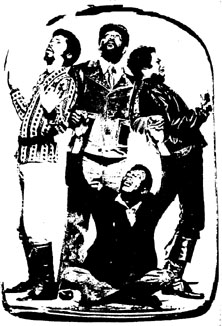
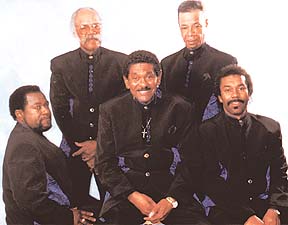
The Coasters in 1971 ...
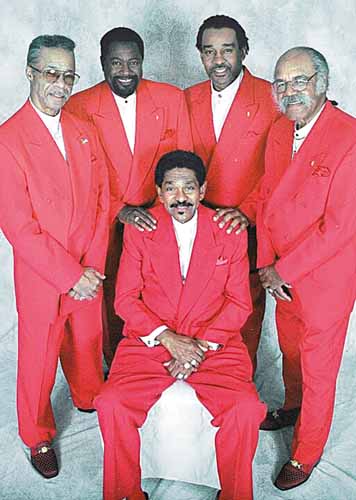
... and in 2003.
|
From the
Touring Schedule of
The Coasters 1956-1959
ctsy Bernd Hermoneit, Bernd Kratochwil, Karl Platten, and
Manfred Günter
- Rockin´ Fiftes (German magazine, No. 83, March, 2002)
www.rockinfifties.de
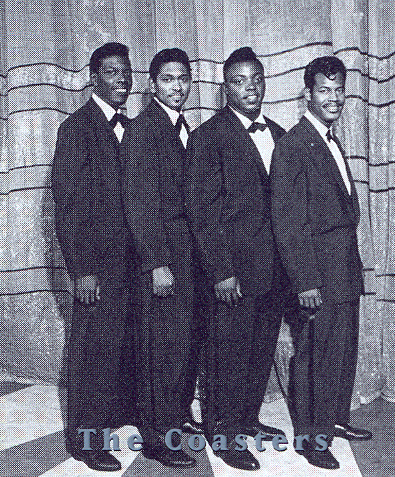
1956
April 20:
one week revue, Chicago Palace with Mickey & Sylvia, Ella Johnson with
Buddy Johnson Combo.
May:
one week at the Regal Theatre, Chicago.
May 11:
one week at the Apollo Theatre, New York with Al Hibbler, and Mickey &
Sylvia.
July 28:
Blues Jubilee at the Los Angeles Shrine Auditorium with Fats Domino, Clyde
McPhatter, The Six Teens, The Teen Queens, The Turks, and Oscar McLollie.
August:
guests at Leroy Connely´s live show at the 54 Ballroom in Los Angeles.
September 28:
the Hollywood Shrine Auditorium with Gene Vincent, Alis Lesley, The Six
Teens, The Dots, Jerry Wallace, The Turks, The Gassers, and the Ernie Freeman Orchestra.
November 9:
the Apollo Theatre, New York with The Cardinals, Gloria Lynne, Della
Reese, and Erskine Hawkins.
1957
April 26-28:
the Broadway Capitol Theatre, Detroit with Faye Adams, Jack Scott, Johnny
& Joe, Amos Milburn, Johnny Janis, and the Red Prysock Combo.
May 17:
one week at the Howard Theatre, Washington, D.C. with Shirley & Lee,
The Cleftones, Bobby Marchan, and Huey Smith.
June 7:
the Apollo Theatre, New York with LaVern Baker, The Heartbeats, Johnny
& Joe, Johnny Mathis, and the Red Prysock Band.
June 14:
five weeks with the "Fantabulous Rock and Roll Show ´57"
(touring Charlotte, North Carolina; Knoxville; Birmingham; Louisville; Chattanooga;
Greenville; and Kinston, North Carolina; also Chicago) with Ruth Brown, Bo Diddley, The
Five Satins, The Drifters, The Schoolboys, and Smiley Lewis:
June 22:
the Municipal Auditorium, Charleston with the show above plus Bobby Parker, Johnny
Hartman, The Spence Twins, and the Paul Williams Orchestra.
July 10:
the Municipal Auditorium, New Orleans with the show above and Dave Bartholomew´s
Orchestra.
July:
six to ten weeks from the Midwest to California (including July 26 in
Milwaukee and July 31 in Denver) with The Five Satins, The Cellos, Gene & Eunice, Lulu
Reed, and the Sonny Thompson Orchestra.
August 25:
TV appearance at the Steve Allen TV-show ("Searchin´").
September:
the Mammoth Gardens, Denver, Colorado with The Five Satins, and The
Cellos.
October 18:
travelling Revue in Oklahoma City with Lowell Fulson, Lillian Offitt, The
Cadillacs, Johnny "Guitar" Watson, and the Ernie Freeman Combo.
November 15:
one week at the Howard Theatre in Washington, D.C. with The Hollywood
Flames, and the Ernie Freeman Combo.
1958
April:
the Apollo Theatre, New York with Fats Domino, the Flamingos, the
Spaniels, the Dells, and dj Tommy Smalls.
June 13:
the Apollo Theatre, New York with Frankie Lymon, Lee Andrews & The
Hearts, Robert & Johnny, Jerry Butler & The Impressions, The Kodaks, Ed Townsend,
and The Storey Sisters.
July 22:
the Armory in Klamatch Falls, Oregon with Ernie Freeman and his orchestra.
August 5:
TV appearance on the American Bandstand ("Yakety Yak").
August 16:
TV appearance at the Dick Clárk Show with Frankie Avalon, Patrick Wayne,
and Mary Swan.
September 19:
the Apollo Theatre with The Spaniels, The Danleers, The Olympics, Bobby
Hendricks, The Quintones, and Sil Austin´s Combo.
September 26:
the Howard Theatre, Washington, D.C. with The Danleers, The Dubs, and
Wynona Carr.
October 2:
17-days tour with "The Biggest Show of Stars for 1958 - Autumn
Edition" (Massachusetts, Connecticut, Quebec, Ontario, Ohio, Indiana. Pennsylvania,
New York, and Virginia) with Frankie Avalon, Bobby Darin, The Olympics, Dion & The
Belmonts, Bobby Freeman, The Elegants, Jimmy Clanton, The Danleers, Clyde McPhatter, Buddy
Holly & The Crickets, Jack Scott, and the Sil Austin Orchestra:
October 25 & November 4:
Fantabulous show at Memorial Auditorium in Sacramento, Calif with Sugar Pie and
Pee Wee plus Johnny Fuller.
December 25:
the Howard Theatre, Washington, D.C. with The Chantels, and Buddy and Ella
Johnson.
1959
March 7:
The Dick Clark TV Show with Dale Hawkins, Paul Anka, and Jaye P. Morgan.
March 13:
one week at the Howard Theatre, Washington, D.C. with Clyde McPhatter, and
Nina Simone.
March 27:
five days tour with "The Biggest Stars of ´59" (Richmond,
Charlotte, Norfolk) with Lloyd Price, Clyde McPhatter, The Chantels, The Crests, Bo
Diddley, LaVern Baker, Frankie Lymon, Wade Flemons, Bobby Hendricks, and Little Anthony
& The Imperials.
May 19:
the Auditorium at Klamath Falls, Oregon with Ernie Freeman and his orchestra.
July 3:
one week at the Apollo Theatre, New York with The Falcons.
August 7:
one week at the Howard Theatre, Washington, D.C. with Milt Buckner, Tiny
Topsy, and the Jesse Powell Combo.
September 4:
four days at the Michigan State Fair, Detroit with Frankie Avalon, LaVern
Baker, Billy & Lillie, Jack Scott, Anita Bryant, Freddie Cannon, Bobby Rydell, Rusty
York, Skip & Flip, Jan & Dean, Santo & Johnny, Duane Eddy, and Dick Clark.
September 18:
44 one-nights up to October 31 with the "Dick Clark Caravan"
(including Syracuse, Montreal, Toronto, Rochester, Richmond, and Norfolk) with Paul Anka,
Duane Eddy, Lloyd Price, LaVern Baker, Annette, The Skyliners, Bobby Rydell; and the first
week also The Drifters, and Phil Phillips.
November 26:
TV appearance on "American Bandstand" ("What About
Us").
Multiple
/ Bogus Coasters
|
|
ORLANDO BUSINESS JOURNAL
February 1, 1999
A rock ´n' roller Coasters ride
Jill Krueger Staff Writer
WINTER PARK--Will the real Coasters please take a
bow? Or at least decide who they are? Like a broken record, a series of legal disputes
over who owns the rights to the famed singing group's name is repeating itself in clubs
across the country.
The most recent venue: Winter Park's Langford Resort Hotel. There, on a recent Friday
night, a hotel banquet room filled up with 40- and 50-somethings who shelled out $20 each
to hear The Coasters perform such hits as "Charlie Brown," "Love Potion No.
9" and "Poison Ivy." After the show, the amiable four-member group sold
pre-autographed photos as well as Coasters T-shirts and CDs. Only John Villano was unhappy
with the performance. "I knew it wasn't The Coasters performing there," he says.
That is because another The Coasters was playing that same night 1,017 miles away in
Alton, Ill. Villano, a promoter whose JP Productions represents The Coasters, should know:
He had made the booking for the rhythm and blues band -- and was livid that the Langford
refused to cancel its Coasters show.
The Langford's confusion may be understandable. There are at least four separate singing
groups now traveling the country, all identifying themselves as some version of The
Coasters. All of them -- The Coasters, Billy Richards' Coasters, Billy Guy's Coasters and
Cornell Gunther's Coasters -- claim a degree of trademark protection. And all of them are
tangled in a web of sometimes conflicting legal decisions. It's an odd chapter to the Los
Angeles group's 44-year history. Formed in 1955, the five member group -- Carl Gardner,
Leon Hughes, Billy Guy, Bobby Nunn and Adolph Jacobs -- churned out a series of Top 10
hits, including "Love Potion No. 9," "Yakety Yak" and "Poison
Ivy." In 1987, the group was inducted into the Rock and Roll Hall of Fame. But by
1990, ownership of The Coasters' name had touched off a federal lawsuit in California.
At issue was a trademark on the name obtained by Gardner. The judge ruled Gardner did not
enjoy exclusive rights to the name. The ruling, though, hasn't stopped the legal
wrangling. For instance, one judge ruled Cornell Gunther's Coasters was a legally
acceptable name under the existing trademark. The New York agency that booked Billy Guy's
Coasters into the Langford Resort Hotel insists Gardner tricked the trademark board into
transferring it into his name -- and that it has been canceled twice before. However, U.S.
Patent and Trademark Office records show Gardner still holds exclusive rights. And new
Coasters keep popping up. There's Billy Richards' Coasters, which a Nashville agency
insists is legally authorized to use The Coasters' name. And the four Billy Guy's Coasters
who appeared at the Langford are not the same four Coasters who appeared in newspaper ads
announcing the Langford engagement. In fact, The Coasters who played at the Winter Park
hotel were 30 years younger than the now-graying Gardner. "Here are these young guys
posing as him," says Gardner's wife and manager, Veta Gardner. "It is damaging
the good name of the real Coasters." It also is eating into profits. Veta Gardner
points out that The Coasters have not been able to book acts because other Coasters are
booking the same venues -- at lower prices. Legal or not, she says, "This is my
husband's livelihood (and) they are taking bread out of his mouth." That's one reason
why the Gardners are now considering filing a civil suit against the Langford Resort Hotel
and the company that booked the recent Coasters' act there. But even as the couple
considers another round of legal action, other Coasters continue to roll into town:
Melbourne will host a Coasters concert soon. Which Coasters? Gardner doesn't know.
Week of February 1, 1999. Leading Stories, Top of the page. |
.. and the tuff story continued - here´s a
court decision vs. vs.
Dick Clark.
In 'Doo-Wop' Case, 3rd Circuit to Consider 'Prevailing
Party' Fees Issue
A court battle over modern-day rights to the names of two
1950s doo-wop groups -- The Platters and The Coasters -- has
now sparked an appeal that could have far-reaching effects
in civil rights litigation. In Singer Management Consultants Inc. v. Milgram,
the 3rd U.S. Circuit Court of Appeals
has granted en banc rehearing before a 16-judge court to
decide on the proper test for determining when a plaintiff
is entitled to attorney fees as the "prevailing party." The vote to rehear the case en banc was a swift one, and
it vacates
an Aug. 5 decision that said plaintiffs may be entitled
to fees even when a case is declared moot if the presiding
judge played a role in persuading government officials to
change their legal positions.
A dissenting judge, however, said he believes that a
plaintiff never enjoys the status of prevailing party unless
he emerges from court with an enforceable order. Apparently
that dissenting view has now swayed a majority of the
court's judges to vote for rehearing. The underlying court battle started when New Jersey
officials threatened to take action against a music promoter
who was selling tickets for an August 2007 concert series in
Atlantic City featuring The Platters (best known for "Only
You" and "The Great Pretender") and The Coasters (whose
greatest hit was "Yakety Yak"). The officials warned that New Jersey's Truth in Music Act
prohibits advertising such concerts without identifying it
as a "tribute" or "salute." But Live Gold Operations Inc.
insisted that it had every right to advertise the two
musical groups however it saw fit because it was the
rightful owner of the trademarks for both names.
At an emergency injunction hearing, U.S. District Judge
Dickinson Debevoise of the District of New Jersey sided with
the promoter and issued a TRO that enjoined the state from "interfering
in any way" with the concert. The case was poised to proceed to further injunction
hearings, and it seemed at first that the state would be
defending its right to enforce the law. In its brief, the
state argued that an unregistered trademark satisfied the
Truth in Music Act only if the performing group obtained
express authorization from an original group member, or
included an original member. When Debevoise made clear that he was rejecting the
state's arguments, the state capitulated, effectively
adopting Live Gold's interpretation of the law. Live Gold's lawyer said in the hearing that the state had
made "a 180-degree shift in position." Debevoise agreed and declared that the state would now be
"bound" by its newly announced interpretation of the law.
But when Live Gold's lawyers petitioned for attorney fees,
Debevoise refused, saying the state's decision to concede
the case had left the plaintiff without a judgment in its
favor and therefore unable to claim the status of "prevailing
party." On appeal, Live Gold won a ruling on Aug. 5 that
said it should be entitled to fees when the 3rd Circuit,
by a 2-1 vote, declared that Debevoise was too strict in his
reading of the U.S. Supreme Court's 2001 decision in
Buckhannon Board and Care Home v. West Virginia Department
of Health and Human Resources. In Buckhannon, the justices declared that a "voluntary
change in conduct" lacks the necessary judicial imprimatur,
and that a plaintiff does not become a prevailing party
solely because his lawsuit causes a voluntary change in the
defendant's conduct. Writing for the majority, Senior Judge Jane R. Roth
concluded that Buckhannon did not control because
New Jersey did not concede its position until Debevoise made
clear that he was poised to rule in Live Gold's favor. "As a practical matter, the state's unilateral actions
mooted Live Gold's claims just when it appeared that the
District Court would enter an order in Live Gold's favor,"
Roth wrote in an opinion joined by Senior Judge Ruggero J.
Aldisert. But in a lengthy dissent, Judge Thomas L. Ambro said he
believed his colleagues were wrong to ignore the clear
mandate of Buckhannon. "Because no enforceable judgment on the merits was issued
in this case, and the state's actions that mooted the case
were voluntary, I believe Buckhannon tells us that Live Gold
was not a prevailing party," Ambro wrote. Live Gold is represented in the appeal by attorney
William L. Charron of Pryor Cashman in New York. Assistant
Attorney General Jeffrey Koziar argued the appeal for the
state.
Charron could not be reached for comment. Koziar declined
to comment on the court's vote.
CARL GARDNER´S
DILEMMA !

Bobby Nunn´s Coasters of 1963
with: Billy Richards Jr, Nunn, and Bobby Sheen.
Photos ctsy Charles Sheen
|

Bobby Sheen with a Coasters group in 1992 -
fr l:
Tony Ruiz, Billy Foster, Randy Jones, and Bobby Sheen. |


Billy Richards´ Coasters


Grady Chapman´s Fabulous Coasters
(bottom photos ctsy Joy Stewart-Evans)

Unknown fake Coasters group (can anyone
identify - Marshak´s?)


Two different line-ups of Larry Marshak´s fake Coasters.
Leit image shows J.W. Lance far right (circa 1999)
the right image shows an early Larry Marshak fake group, featuring Early
Clover (far right).
and
check this


Larry Marshak´s fake "Cornell Gunter´s Coasters" and bottom b/w image far right featuring Charles Diamond, left.


Cornell Gunter´s Coasters Inc. of the late ´90s (after Cornell´s death):
Charlie Duncan, Edwin Cook, Lionel Pope. Note: This is not the Larry Marshak
managed bogus group,
but the group with members of Cornell Gunter's group at the time of Cornell's
death.


Cornell Gunter's Coasters featuring Edwin Cook - and the Charlie
Duncan-.led group of today.


Can anyone identify these "Coasters" groups? The last
one is Charlie Brown & The Coasters.
Article on
the bogus Coasters at SuperOldies.com

Even the "serious" can
sometimes fail:
Charlie Duncan's "The Original Cornell
Gunters Coasters" advertised as just "The Coasters"
OFF-SHOT,
FAKE & BOGUS
COASTERS SHEET
Billed as:
|
aka:
|
incl.
ex-member:
|
The Coasters
1957-58
The Coasters, Mark II
´60s, ´70s
|
The Drifters
1957-58
The (West) Coasters
or later:
Billy Richards´ Coasters
´80s, ´90s, 2000+
plus:
Grady Chapman´s Coasters
or The Fabulous Coasters
´80s, ´90s, 2000+
|
featuring Bobby Hendricks
and Tommy Evans
Bobby Nunn
- fronted by Billy Richards after
Nunn´s death and still operating
Guested by several original Coasters.
Bobby Sheen also led the group
with Grady Chapman out (Grady is still
active using "The Robins" name)
Randy
Jones led a group in the ´90s.
|
The Fabulous Coasters
´60s, ´70s
|
Cornell Gunter´s Coasters,
(Inc)
´80s, ´90s and 2000+
Cornell Gunter's Coasters
featuring Edwin Cook
and:
The Original Cornell Gunter's
Coasters
2004+ |
Cornell Gunter
(Edwin Cook and Charlie Duncan
touring after Gunter´s
death; today two groups;
(note: not the bogus Marshak group)
click this for more
Today
and
Today
|
Billy Guy & The Coasters
mid ´70s
|
Billy Guy´s Coasters
late ´90s
|
Billy Guy
(Guy coach and cameo ´90s with the
Larry Marshak bogus Coasters)
|
World Famous Coasters
late ´70s |
The Coasters
´80s, early ´90s |
Will Jones & Leon Hughes
and later Will Jones & Billy Guy
|
The "Original" Coasters
´80s |
Leon Hughes - one of the
original Coasters ´90s plus |
Leon
Hughes check
here |
The Coasters
´70s, ´80s, ´90s
|
Cornell Gunter´s Coasters or:
The Cornell Gunter Coasters
2000+
|
no-one - several bogus lineups
(promoted by Larry Marshak,
not including any ex.member,
Cornell Gunter´s Coasters "authorized"
by Gunter´s sister Shirley);
check
here here too
|
The Robins
|
The Robbins
|
(often referred to as being transformed
into the Coasters, only presented as
"The Robins" - but including Coasters
recordings in presentations; or vice
versa!)
|
above charts compiled by
Claus Röhnisch.
Note:
Larry Marshak originally managed Billy Richards´ Coasters, and when
Richards cancelled that contract, Billy Guy sold his name to Marshak - when Guy settled
his differences with Gardner, Shirley Gunter sold the Cornell Gunter Coasters name to
Marshak. There were more acts using The Coasters´ name:
check this: ( Terry
Evans
), and this
( Charlie Brown´s Coasters Tribute
). Even Young Jessie sometimes acts with a "Coasters" group.
 Charlie Brown's Tribute group.
Check the Coasters, plus Drifters, Platters,
and Marvelettes at the Rotary District 6600 Conference 2003;
and
check here for an article on the recent fake
Platters/Coasters/Drifters in Las Vegas.
Check this
intereresting article by Gary James,
based on this site
and
interview with Carl Gardner Sr. with Gary
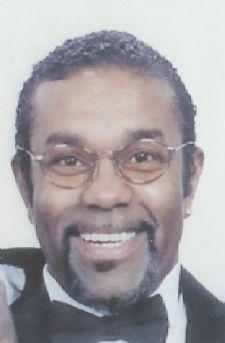

Carl
Gardner, Jr
A Tribute group - The Coasters Review featuring Carl
Gardner, Jr. was active in California during 2002 - 2004.
Late 2004 Jr returned to Sr's real Coasters group, and took over his father's
role as lead on November 5, 2005.
THE REAL COASTERS
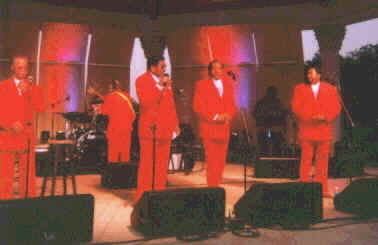
"Truth in Musical Advertising Bill"
Under the law (nowadays past in several States in U.S), a band can
use an original act's name only if it includes at least one member of the group
that released a recording under that name; the performers own the rights to the
name; or the performers have permission from the group to use the name.
Otherwise, the group would have to advertise itself as a tribute or salute.
The Coasters at
the Eldorado Hotel
- Millennium Swing
|
|
Welcome to the Coasters of the 21st Century
courtesy of Billy Guy; founding member, Rock and Roll icon,creative force behind these
Rock and Roll legends, as well as the comedy inspiration that made the group the
"Clown Princes of Rock and Roll," and the first group inducted into the Rock and
Roll Hall of Fame. And today, more than forty years after the Coasters stormed the pop and
R 'n' B charts with their first million seller, "Searchin'," it is still Billy
Guy's touch that makes the Coaster's show a "Nostalgic treat for the senses,"
"A rock and roll comedy riot," and "As exciting in the nineties as it was
in the fifties," to quote three recent reviews. Billy Guy still inspires their team
of comedy writers, oversees their choreography and of course, blends their unique vocal
arrangements, not to mention occasional cameo appearances that still bring down the house.
Billy performed as the baritone lead on all of the Coaster's hits including their
million sellers, "Searchin'," "Yakety Yak," Charlie Brown," and
"Poison Ivy." The famous writing team of Leiber and Stoller was the creative
force that led the Coasters (as well as such other rock and roll icons as Elvis Presley
and the Drifters) to the top of the charts in the fifties and sixties. So great was the
magic of the team of Leiber and Stoller and so inspirational was their collaboration with
Billy Guy and the Coasters, that the nineties saw a show business honor reserved for only
a few special greats - a hit roadway show inspired by the collaboration and based on the
hit "Smokey Joe's Cafe." That song was an early hit for the Billy Guy led
Coasters and is still a show stopper every night as Smokey Joe's Cafe is now not only one
of the top running shows on Broadway, but also one of the most successful road shows
touring the country. And if this isn't honor enough, the Coasters will be appearing in
"Love Potion #10," a multimedia rock and roll extraaganza with a cast of 26 and
magic, special effects, and original choreography and a score by a variety of legendary
Broadway talents. But their greatest honor of all was the choice of the Coasters as the
first group inducted into the Rock and Roll Hall of Fame in 1987. Those inductees included
Billy Gy, Carl Gardner, Cornell Gunther and Dub Jones. Unfortunately, since that time,
Gunther has passed on, Gardner has contracted throat cancer and Dub Jones has
semi-retired. But under Billy Guy's direction, the Coasters have scoured the country to
find top talent to keep their show young and fresh. Watch the Clown Princes of Rock and
Roll and prepare to "laugh 'till you cry."
From The Eldorado Hotel Home Page, Santa Fe, New Mexico
(writing about the Billy Guy "semi-coached" Coasters and acurtally spelling
Gardner - Gardener)).
 |
 |
|
Posted at 03:31 a.m. PST;
Tuesday, March 23, 1999 '50s rockers fight against imposters
by Katherine Rizzo
Associated Press writer
WASHINGTON - Yes,
indeed, rock 'n' roll is here to stay. And in some cases, it's not only lasted, it's
multiplied, with several sets of Platters, Drifters and other '50s favorites performing at
the same time in different cities. Carl Gardner, an original member of The Coasters, has
been irritated by what he considers impostors for more than 20 years. Now he's one of
about a dozen golden-oldie performers who've asked Congress to protect them from
competitors using the same names and singing the same songs. "These guys are making
like they're the real Coasters. They're in their 20s and 30s and I'm 70 years old,"
said Gardner. "This trademark law must be changed." "We are all affected by
bogus groups because there is only a finite amount of work for people from our time
period," said Peggy Davison, who sang the lead on the Angels' hit "My
Boyfriend's Back." "We are national treasures," added Mary Wilson, who
along with Davison, Gardner, two Drifters, one Shirelle, one Letterman and other rock
originals performed at a Capitol Hill news conference last week. "We need to have
that respect." Wilson was one of Motown's original Supremes, along with Diana Ross
and the late Florence Ballard.
Reps. Dennis Kucinich, D-Ohio, and
Charles Norwood, R-Ga., were introducing legislation that would help old chart-toppers
defend their crowns. If they sue for damages under trademark law and win, the law would
allow higher damages. "You have to pay a $50,000 bond just to start a court case, in
case you lose. That's a lot of money," said Gardner. "I'm working, but
sporadically. These other guys, they don't even charge the kind of money I charge. If I
charge $10,000 a night they'll charge $2,000 a night." The groups that climbed the
Top 40 in the 1950s and 1960s often had rosters that changed through the years. Sometimes,
later-year replacements took the material on the road with their own groups, even though
some members of the core group were still performing. Other times, dispute over the
ownership of the group's name made it possible for entire new bands to be hired to
re-create the music without any direct link to the original group.
Larry Marshak of RCI Corp. in New
York, who packages East Coast and West Coast versions of the Platters, Drifters and
Coasters, said he has valid, legal rights to those names, and does nothing deceptive with
his troupes of young singers performing old hits. "We make no illusions to be
otherwise than what they are. Nobody expects to see the original members when they see
us," he said. Kucinich, who takes seriously his home town's role as host of the Rock
and Roll Hall of Fame, said he was pushing for a change in a 1947 trademark law because
both artists and consumers need protection. "The knockoff groups should not be
permitted to pass themselves off as the real thing," the Cleveland congressman said.
Copyright © 1999 Seattle Times Company
From
Las Vegas SUN - June 15, 1999
A legal battle erupts over bands using
original names without original members
By Melissa Schorr
LAS VEGAS SUN
In a makeshift showroom in the Sahara hotel-casino, a couple
hundred baby boomers are thrilling to the sounds of yesteryear. The band -- four men
snazzily attired in black pants and white jackets, and billed as "Billy Guy's Coasters" -- launches into hit after hit, from
"Love Potion No. 9" to "Yakety Yak," earning a standing ovation. Near
the end of the set, the lead singer finally introduces himself and his fellow band
members. But where is Billy Guy? It seems the billed member
of the original Coasters is nowhere in the bunch. How strange. Next up on the evening's
triple bill: The Platters. A keen eye will note that there isn't a gray hair in the bunch,
and that lead singer Curtis Michael probably wasn't even alive in 1956, the time the group
was scoring hits such as "The Magic Touch" and "The Great Pretender."
Ah, well. Last, but not least, the emcee introduces The "Mighty, Mighty"
Drifters. As singer Rick Shepherd launches into one of the band's biggest numbers --
"Under the Boardwalk" -- he confides to the crowd, "As the Drifters, we
went on to have hit after hit." There's only one problem: The "we" he
refers to are not the three other singers on the stage with him. Shepherd is, in fact, the
only singer on the Sahara stage who can legitimately claim to have performed as an
original artist in the headlined acts. Consumers beware: Oldies revival acts frequenting
Las Vegas showrooms may not be what -- or who -- you think they are. These so-called
"imposter" acts are actually put together by savvy booking agents who have come
to control the band's trademark name. Often they don't include any of the artists who made
the songs memorable. This infuriates the remaining original artists who are starting to
fight back, saying these imitation groups hurt their careers by charging much less to
perform and devaluing their market worth. Even worse, they gripe, the imposters often do a
lousy imitation, costing them fans and future bookings to boot. Others in the industry say
that the fight is more one of sour grapes: "The guy who
was smart enough to own the name is being harassed because he had the money and guys to
put it together," observes one local promoter, who prefered to go unnamed. "I
think he's going to win."
Congress lends an ear
The debate has made its way to Congress, thanks to the 2-year-old Artists & Others
Against Imposters (AOAI), a nonprofit group of musical artists who have banded together,
including Gladys Horton of The Marvelettes ("Please Mr. Postman"), Mary Wilson
of The Supremes ("Stop! In the Name of Love") and Herb Reed of The Platters
("Only You"). "Imitation is supposedly the sincerest form of flattery --
(but) not when it robs you of your ability to earn a living," Arizona activist Joyce
Moore, the wife of Sam Moore of Sam and Dave, and AOAI's founder, notes. "We've done
more to protect our historical landmarks and endangered species than these artists."
That may soon change. The group brought the issue to the attention of Capitol Hill last
summer and the resulting "Truth in Rock" bill is widely expected to pass the
House and Senate unopposed this session. The proposed law would create a
federally-chartered registry called the Association to Preserve Authenticity in Music
Groups, which would certify which acts are authentic -- and which are not. "We're not
trying to drive imposters out of the market," explains Fred Wilhelms, AOAI's counsel,
who is helping draft the legislation. "We just want them to be honest. Right now the
consumer is being sold grape juice in wine bottles." For example, the AOAI contends
that management groups such as Larry Marshak's RCI Corp. in New York currently stages
duplicate Drifters and Coasters acts on the road at any given time. On April 4, "Billy Guy's Coasters" were scheduled to play both the Sahara
showroom and the Baltimore Arena simultaneously. Other acts commonly passing
through Las Vegas, such as the "Legends of Motown" at Caesars Palace, feature
The Marvelettes -- another Marshak group featuring no original members. "There is a
falsity and a fraud being committed on the consumer," Moore says. "If they had
billed these shows as what they are, a salute or a tribute, we'd have nothing to say to
them. That would be honest, that would not be consumer fraud." Marshak says the
original members are mainly unhappy that they're not working. "If they had a good
act, they'd be able to," he counters. "These people are spending too much time
in legislation and not enough time putting their act together." The AOAI has no
probem with impersonation acts such as "Legends in Concert" at the Imperial
Palace, the Stratosphere's "American Superstars" or the Gold Coast's tributes to
Patsy Cline and Neil Diamond, because each clearly labels its act a "tribute."
"I wouldn't have a problem if we had 20 'salutes' going on around the country,"
Moore says, "but I have a terrible problem with the lie that these groups are real.
They're a bunch of wannabes who are now sort-of-bes." But Marshak, who owns the legal
rights to the names (and went bancrupt in 2002 after beeing ordered not to use the names;
Claus´ notes), recently told the Los Angeles Times that "the public is well
aware that there are no original members of these groups." Marshak cites a survey he
conducted of a Las Vegas audience in which 87 percent of the members said they were aware
the act wasn't comprised of originals -- or didn't care. "I don't keep it a
secret," Marshak said. "It's not deceptive. We make it clear that's what we
do." Marshak likens his changing roster of musicians to a baseball team, a Broadway
musical or the New York Philharmonic. "These musical groups have always had multiple
members," he explains. "Managers decided to hire and fire people and, usually,
there's no tie to the individual's name. The groups are more associated with the producer
who put them together. It's like what Menudo does. It's something that has gotten a lot of
publicity, but it was always common." Still, after negative media accounts, the acts
have learned to be more careful in their wording on stage, never directly making a
reference that implies they were around during the pivotal years. Instead of "we
recorded this song in 1962," they'll tell the audience, "We're going to take you
back to 1962." Linda Crane, senior vice president of entertainment for Caesars
Worldwide, says her main consideration in booking such acts is the legality and the
quality of them. "You book the act (that) has the legal right to the name," she
says. "That's what I worry about because I don't want to get in trouble." As for
whether the practice can be misleading to customers, she replied: "Sure, if they
knew, it would bother them. But I think the quality of the show is (most) important."
It may not have mattered to the audience, but it mattered enough to Mary Wilson of The
Supremes, who irately complained to People magazine about performing at Caesars'
"Legends of Motown" show last October alongside the new Marvelettes and not the
old friends she expected to see. Nevertheless, Crane has booked the act for a return
appearance in August -- minus Wilson -- adding, "it does very well for us."
Other casinos attempt to bill these acts more precisely. Last July the Hilton booked an
act featuring singers who at one time had sung with the band, carefully billing it as the
"Former Ladies of the Supremes." But when the same act made a side appearance in
February at Sun City's Pinnacle Community Center, it was billed on fliers only as The
Supremes.
Splitting legal hairs
The battle over who legally owns the name can cause some confusion.
For example, in April, Caesars Palace featured The Temptations with former lead singer and
trademark holder Otis Williams and three fill-ins. A few weeks later the Flamingo Hilton
billed "The Temptation Review," featuring two of the original singers, Ali
Woodson and Richard Street, who say they are also are entitled to use The Temptations
moniker. "Are they legally The Temptations? Who knows?" says the show's promoter
(again, the unnamed promoter), with a sigh. "It's all by what the attorneys figure
out." "It gets kind of crazy," Foster Wilson, vice president of
entertainment at the Las Vegas Hilton, says. Although he is sympathetic to the original
artists' plight, he says that "at some point, if you've got two groups squabbling
over who has the most original group member, I'd probably go on and book somebody
else." Wilson points out that even if these groups hold the legal right to the name,
whether or not to book them can become an ethical problem for an entertainment director.
"Usually, we rely on the agencies and managers to tell us what is true, in terms of
the group's originality and so forth," Wilson explains. "Even if the group
doesn't care, we do. It becomes a thing of responsibility -- how do you get the message
out so you're not deceiving the public?" But the promoter points out that:
"People don't care, that's what's really amazing. "In my opinion, I don't think
anybody could tell the difference," he says. "I saw the show, and I've been in
the business since I was 13, and I couldn't tell the difference. People know the
songs, they don't know the acts that well." Indeed, audiences at the Sahara show seem
indifferent to the artists' cause. When told these acts basically didn't feature original
band members, no one is very disturbed. "I knew that, but they still do a great
job," says Joseph Ferreira, a tourist from Ft. Lauderdale who used to watch the
originals on TV in his youth. "The music is still the same." Moore snorts at
responses such as these, likening them to saying that the artistry of a Picasso painting
is "just the paint." She has contacted the Consumer Fraud Division of the Nevada
Attorney General's office, hoping to launch an investigation. This tactic has worked
before: Two months ago, she contacted the Arizona Attorney General's office after spotting
a Drifters booking being plugged at an upcoming music fair. The Arizona office stepped in
and asked the concert promoter to alter his advertising to make it "A Tribute to the
Drifters." Tracey Brierly, a deputy attorney general in the Bureau of Consumer
Protection in Las Vegas, declines to comment on whether the office is investigating, but
adds that they haven't received any complaints to date. "We're interested in
protecting the consumers -- if we can substantiate it," she notes. "Anyone who
feels they've been taken advantage of should contact the Attorney General's office."
Firsthand knowledge
The Moores' own experience makes them a perfect example of the artists' concerns. After
the Grammy-award winning band Sam and Dave ("Soul Man") broke up, Sam Moore's
ex-partner, Dave Prater Jr., simply took on a new "Sam" and went on tour,
promoting the act as "Sam and Dave." "Never, ever did they tell anyone that
Sam was a fake," Sam Moore testified before a congressional subcomittee earlier this
month. "(He) did his best to sound like me and look like me. He autographed records
that I had sung on, many of which went gold. Arkansas declared a 'Sam and Dave Day' in the
mid-'80s, but that wasn't me at the ceremony with then-Gov. Clinton." "Agents
would say, 'If you would only get another Dave, we could get Sam hundreds of jobs,' "
Joyce Moore recalls. "How insulting, how condescending, to just get some guy and pawn him off as Dave." Instead Sam Moore took the
opposite approach, chasing his ex-partner through several jurisdictions, attempting to get
injunctions and citations against his advertising campaigns, encountering
"staggering" legal bills in the process. In 1988 the personal fight ended for
the Moores when Prater died in a car crash. But soon they turned what they learned into a
larger crusade for their fellow artists. Using her contacts in Washington (she planned
President George Bush's inaugral party), Moore founded the artists' association in
September 1997. The group got Rep. Dennis Kucinich, D-Ohio, and Rep. Charles Norwood,
R-Georgia, to co-sponsor the legislation, which drew the support of the Recording Industry
Association of America and, eventually, the Association of Intellectual Prpoerty Lawyers
of America. On May 5, the House Judiciary Intellectual Property Subcommittee held
hearings, and on May 26 the House Judiciary Committee passed it by voice vote. A vote is
expected in the House soon. Aside from establishing the credentialing group with a unique
hallmark label, the group also hopes to add wording to the bill to beef up the amount of
damages for which artists can sue. "I'm very confident that when this process is
over, we're going to have an association in place, and it's going to separate the sheep
from the goats, the real from the fakes," Wilhelms, the AOAI's counsel, says.
"It's been an amazing civics lesson." Perhaps. But the consumers' lesson still
seems incomplete. After the show the crowd at the Sahara congregates in the lobby for a
"meet and greet" with the singers. One woman shows off a CD she has bought of
one of the groups. It is not an original label recording, but a cheaply produced demo of
the band's live shows. Inside, she is thrilled to display, she has gotten an autograph
from each member of the band..
 
The Platters, Beary Hobb´s Drifters, Cornell Gunter´s
Coasters; plus on stage in 2003.
Sunday, September 3, 2000 - Eagle Tribune
Who is really playing that rock n´ roll music?
By Will Courtney
Eagle-Tribune Writer
As a consumer, Maxine Porter says if she buys a can of Coke, there
shouldn't be 7-Up inside. Likewise, she says when you buy a ticket to see The Drifters,
you should get to see the last surviving Drifter. However, Mrs. Porter isn't just a
consumer, she's the business manager for 75-year-old Bill Pinkney, who was with the
original band from the start. Mr. Pinkney is on his 47th Anniversary Tour with three
others as Bill Pinkney's Original Drifters, a trademarked name that he owns. The trademark
for The Drifters is owned by U.S. Federal Court while litigation over its true ownership
continues. In the meantime, a band going by the name The Drifters played the Feast of
Three Saints in Lawrence Friday night, and in all likelihood, other bands called The
Drifters drew crowds in a handful of venues across the country, many of them with members
younger than the songs they were singing. The Platters did not play Lawrence Friday night
as scheduled because Herb Reed, an original Platter, was awarded the trademark to the name
on Aug. 8 and enforced his right to it in Federal District court. So The Platters
imposters were replaced by The Coasters imposters, because the owner of The Coasters
trademark, original member Carl Gardner, was powerless to do anything about it. For the
surviving members of classic '50s doo-wop bands such as these, their senior years have
been spent battling for the right to make money off a name they brought to fame. They
spend as much time in court and with lawyers as they do on stage. Mr. Reed won a small
battle, but the imposters are winning the war. "The sad thing about our justice
system, as wonderful and effective as it is, is that the wheels grind so slowly,"
Mrs. Porter said. "The perpetrators are making a fortune while the original artists
are waiting for a decision." Mr. Reed still tours, and in fact, Topsfield Fair
publicity indicates Herb Reed and the Platters will be playing the fair Oct. 8 and 9 this
year. He was able to fight his battle on the front lines, because he lives in Arlington.
Reached at his home in Florida, Mr. Gardner, the last performing member of The Coasters,
was incensed to hear that a knock-off of The Coasters was taking the place of the imposter
Platters. He could fight it or sue, but that would mean hiring a Massachusetts lawyer that
would take the case and get it into a Commonwealth court. "I'm trying not to let it
stress me out," said Mr. Gardner, getting more and more frustrated as he spoke.
"But right now, I'm getting a little stressed out about it. They're making money off
of my fame. I started The Coasters in 1955 and I want it to continue." To put a stop
to all the imposters, Mr. Gardner would need to pursue litigation across the country and
Canada, too. "I'm 72. I can't sue for the rest of my life just to get all the money I
have coming," Mr. Gardner said. The Gardners have been in court fighting for The
Coasters name for 10 years, they estimate. They recently sued Larry Marshak, a promoter of
imposter bands who has become the true oldies bands' worst nightmare. Over the last
decade, Mr. Marshak has reportedly made millions promoting knock-off versions of the
Coasters, Platters and Drifters. He swooped in and grabbed The Drifters trademark when the
group stopped touring in 1976, but Faye Treadwell, the wife of the band's original
manager, won the name back in Federal District Court. Mr. Marshak has appealed, so the
court holds the trademark.
In a 1997 television interview with ABC's PrimeTime Live, Mr. Marshak told Diane Sawyer
that on any given night, he might have three different Coasters bands playing in different
venues. "The Coasters are no longer a show where individuals matter," Mr.
Marshak said in the interview. "The only thing that matters about the individuals is
that they are top quality." He told the Associated Press in 1999 that there was no
deception going on, even though he often billed The Coasters as being members of the Rock
N' Roll Hall of Fame. The Hall of Fame said they inducted only the four original members,
including Mr. Gardner. Mr. Gardner won a judgement for $190,000 from Mr. Marshak in
February, of which he says he's seen only $75,000. In February, 2001, the Gardners are
scheduled to be in court with the legendary Dick Clark, who according to the couple,
introduced imposter Coasters as "the legendary Coasters" on more than one
occasion. "He knows me like he knows his son," Mr. Gardner said. But Mr. Gardner
alleges that on at least three different occasions, including once on national TV, Mr.
Clark introduced "phony" Coasters as the real thing. The Gardners, along with
former members of The Supremes, The Shirelles, The Crystals, The Chantelles, The Platters,
Danny and the Juniors, and The Drifters have formed the Truth in Rock Foundation which is
trying to get the federal government to step in. Before his death, California Congressman
Sonny Bono was working to get a Truth in Rock bill passed into Congress. The official
Danny and the Juniors played the Festival of Three Saints on Friday, though
"Danny" is no longer living. Joe Terry, an original member, owns the trademark
and still tours with the group. He has also been in fights with groups which perform under
the same name. "Even though we own it, there are still some problems with groups that
come out because of the way the laws are structured," he said. He said the copyright
laws don't do a good job protecting bands who own trademarks.
The Gardners said the people who can best fight against imposter bands is the paying
public. "Is the American public so stupid that they can't see that there's a
difference in age group of the guys and that they're not The Coasters?" Mr. Gardner
said. "Carl Gardner, the original Coaster, is very alive and well, and still performs
today. I wish that my fans would think about that for a moment when they go see a former
group. Think about how these guys have given so much. We're depending on the fans to help
us." In Lawrence Friday night, opinions were mixed. Some didn't realize they weren't
seeing the real thing, others didn't care. Most had no idea that the original bands didn't
get a piece of the pie. "I would think they'd have to pay royalties," said Larry
Smith of Hampstead, N.H., who watched The Drifters on Friday but was disappointed The
Platters, or their impersonators, weren't playing. As Mrs. Porter said, it's about
consumers caring what they are paying for. "I have a right not to be deceived, not to
have anything misrepresented to me," she said. "There are people out there
singing songs, saying, 'This is one of our greatest hits,' and the person making the
statement isn't as old as the record." |
Mail from Scott Schinder April 9, 2006
Hello Claus, I
very much enjoyed your Coasters website, particularly the information regarding
fake Coasters groups.


Several pics of what I assume to be the East Coast version of Larry Marshak's
fake "Cornell Gunter's Coasters," who performed at a free outdoor show (sponsored
by the NYC retailer J&R Music) last August at City Hall Park in Manhattan. Also
on the bill were Marshak's bogus Drifters and (the real) Percy Sledge. The only
group member I can identify is lead singer Dave Revels, who apparently has
performed with the Marshak Coasters for several years. Coincidentally, a few
days after this performance, the Las Vegas-based versions of Marshak's fake
Coasters and Drifters (different guys wearing suits identical to those of the
groups on the City Hall Park bill) performed on Jerry Lewis' Muscular Dystrophy
Telethon. A few hours later, Lewis introduced yet ANOTHER Drifters group,
performing in New York...
best,
Scott.
Thanks Scott - and you are right these are the East coast Marshak bogus Coasters.
Put a stop to doo-wop imposters, states urged
Wednesday, January 11, 2006
By Tracie Mauriello, Post-Gazette Harrisburg Bureau
HARRISBURG -- Musical groups shouldn't call themselves The Platters
unless they include some of the original tableware.
That's the premise of a group of doo-woppers campaigning
nationwide to stop imposter bands from passing themselves off to concert-goers as the real
deal.
The group is starting its crusade in Pennsylvania,
where lawmakers are poised to authorize fines and injunctions to prevent performances by
imposter bands that advertise false, deceptive or misleading affiliations with a recording
group. "There's a two-fold problem. One is the identity theft of the artist and the
second is consumer fraud, misleading the public. Those are serious issues," said Nate
Silcox, legislative director for Sen. Robert Robbins, R-Mercer, sponsor of the bill. The
truth-in-music legislation, which already was passed in the state Senate, yesterday
received unanimous approval from the state House Committee on Tourism and Recreational
Development. It now heads to the House floor.
North Dakota and South Carolina have similar laws
already, but those don't protect trademark holders enough or provide high enough fines for
violators, said Jon Bauman, who is better known as Bowzer, the former leader of the rock
'n' roll group Sha Na Na. Mr. Bauman is a member of the Truth in Music Committee of the
Vocal Group Hall of Fame in Sharon, Mercer County. Pennsylvania's legislation could become
a model for the rest of the country, say Mr. Bauman and other musicians behind the
legislation. They intend to press for similar legislation in at least 10 other states.
"Pennsylvania is a key state to start in. It's always been a real strong oldies
state," said Joe Terry, a founding member of Danny and the Juniors, which originated
in Philadelphia in 1956. "Pennsylvania cares about nostalgia music and that's a good
reason to start this there and kick it off there."
The legislation would prevent groups from using
trademarks they don't own -- unless at least one member of the group was a member of the
original recording group and is legally entitled to the name. The legislation also allows
for tribute bands if concert advertising does not mislead. The legislation would allow
Pennsylvania Attorney General Tom Corbett to stop performances and to impose fines of
$5,000 to $15,000. Bill Pinkney, the only surviving member of The Drifters, said the fines
should be even higher. "People are going around calling themselves The Drifters, The
Platters and The Coasters when it's not the truth. It's not fair to the ones who paved the
road, the ones who laid the foundation and made it possible for these young up-and-coming
groups," Mr. Pinkney said from his home in South Carolina. At 80, he is still
performing. He heads to Connecticut this weekend for a doo-wop show Sunday at Mohegan Sun
casino. Another group, billing itself as Beary Hobb's Drifters, is slated to perform the
same night across the country at the Sahara Hotel in Las Vegas. They aren't The Drifters,
Mr. Pinkney assures. "I don't think that's fair. It's not fair to the artists and
it's not fair to the public. The public is being misled," he said.
That's one reason Veta Gardner, wife of Coasters
original Carl Gardner, is eager to see the Pennsylvania bill pass. "The name 'The
Coasters' is a legacy that belongs to the people who created the music," Mrs. Gardner
said. "I would like to secure the legacy of my husband. He has given 50 years of
hardship and it wasn't easy." The Coasters were making music before the civil rights
movement took hold and when racism was rampant. "They could work in the fancy hotels,
but they couldn't sleep in the hotels. They couldn't go in restaurants to eat, so the bus
driver would buy crackers and cheese for them to eat on the bus or the managers, who were
white, would go get them hamburgers," Mrs. Gardner said. "Why should they have
to fight for their trademarks now?" she asked. "Why should people be making
money off their talents after all that?" The sentiment is that when people pay good
money to hear "Yakety Yak," Carl Gardner ought to be the one yakking. Instead,
imposter Coasters take the stage -- probably 10 times a night in different parts of the
country -- said Bob Crosby, president of the Vocal Group Hall of Fame. "They stand on
stage and say things like, 'When we recorded these songs,' and 'When we won our Grammys.'
They completely fool the public into thinking they're the real groups and then the real
guys can't get any work because the fakes are so well promoted," Mr. Crosby said.
What's worse, said Mr. Bauman, is that imposters are
basking in applause meant to recognize aging musicians' longevity, song-writing and
legacies.
Truth In
Music (read this interesting article).
Vegas Concert Goers Duped by Fake Band Members
Chip Yost
KTLA-News
May 22, 2008, 9:25 AM PDT
When you drive into Las Vegas, it's hard to miss the billboard for the big show
at the Sahara Hotel. Advertised as a chance to "experience rock and roll
history," the show features the Platters, the Marvelettes and Cornell Gunter's
Coasters. The hits put out by the groups on the bill include "Please Mr.
Postman" and "The Great Pretender."
Now, critics say the show itself is a pretender – putting out people who had
nothing to do with the original acts and passing them off as the real thing.
When KTLA called the ticket office to inquire about the show, we were twice told
that each group on the ticket included at least one original member of the
group.
In person, a lady at the ticket office told us that all of the Marvelettes were
originals and that one of the Platters had been with the group for 38 years.
That claim was repeated on stage later that evening at the show.
Last week, we took Sonny Turner and Charlie Duncan to the show with us to find
out if any of those claims were true. From 1959 to 1970, Sonny Turner was the
lead singer on a number of the Platters hits. For more than a quarter of a
century, Charlie Duncan performed with Cornell Gunter in Cornell Gunter's
Coasters – a spin-off of the original Coasters. Charlie and Sonny recognized
nobody on stage as having anything to do with their groups. As for the
Marvelettes, none of that group's singers even looked old enough to be alive
when "Please Mr. Postman" topped the charts in 1961.
When Sonny confronted the "38 year" Platter after the show, story-line changed.
In Sonny's presence, the performer 'he' had never claimed to be a member of the
Platters, but instead claimed he had only worked for a former member of the
group.
The day after the show, we stopped by the Sahara to try to get an explanation.
When Andrea Sun, a hotel spokesperson, came down to talk to us, she repeated the
claim that each group contained at least one original member and said the hotel
was unaware of any dispute over that statement.
However, she later said she couldn't make any more comments after learning that
the hotel was facing litigation over a previous act that was once part of the
same show. The hotel referred us to the show's promoter, National Artists, Inc.
for further comment. Sun said National Concerts, Inc. is responsible for booking
the acts in the show.
National Artists' Bill Caron admitted to us that none of the performers we saw
on stage were part of the original recording groups. Caron said that nobody
should have ever made claims otherwise, but he defended the authenticity of the
show by claiming that the promoters of the show owned the trademarks to the
groups' names, and therefore had the right to put up any group of people it
wanted to on stage.
People connected to the original groups challenge the trademark claims made by
the promoter. Such claims have been part of a lot of much litigation, and more
is likely in the near future. There's also been requests made that the Nevada
Attorney General step in and apply a recently passed "Truth in Music" law, that
some feel gives the state the authority to step in and try to have the show shut
down.
Copyright © 2008, KTLA
From the Corsicana Daily Sun, Texas newspaper.
Published: July
10, 2007
Motown act not all smooth sailing
New Texas law could shut down similar concerts around
state
By Janet Jacobs
The music, not the
original performers, is the star of the ‘50s music
concert scheduled for September at the Palace Theater.
However, while the music may hearken back to a happier
time, it’s not without controversy. The rights to
perform under those legendary groups’ names is being
contested by various heirs and other performers. It’s
not as clear-cut as it would be with the Beatles, for
example, which had few members and ownership of the
music. In the early ‘50s, bands were often created by
record companies and provided with the line-up, music,
look and managers to make them successful. Singers were
considered interchangeable, and could be fired or
replaced at whim. “The sad part is that most of those
groups that were pre-television were recording groups
prior to the civil rights movement, and very little
consideration was given to the groups,” said Bob Crosby,
president and CEO of the Vocal Music Hall of Fame
Foundation. “When they signed contracts, they signed
their names away and any chance for royalties in the
future.
“How many times have you heard ‘Under the Boardwalk’
‘Yakety Yak’ and ‘Charlie Brown?’ Those artists never
received a dime from those. The record companies made
money.” When movies like “American Graffiti” and
“Grease” helped create new interest in ‘50s music,
dozens of groups formed under the Platters, Drifters,
Marvelettes and other famous names, according to The
Coasters Web site, compiled by Claus Rohnisch. Lawsuits
and appeals spent years working their way through the
courts, often resulting in decisions that allowed
original members to “brand” their own groups and
continue performing, according to articles in the
Detroit Free Press and Los Angeles Times. Thus, the
groups performing at the Palace are very specifically
Cornell Gunter's Coasters, Elsbeary Hobbs' Drifters, and
The Platters. And although Gunter and Hobbs are dead,
their rights were obtained from family members,
according to Leah Blackard with the Palace Theater in
Corsicana.
“Most of these groups it’s just been so many years.
There are going to be deaths and retirements, especially
with Motown. You see it under Motown more than anything
else,” she said. The groups set to perform in Corsicana
have already won fans around Texas, in Grapevine, Austin
and other venues, which is why the Palace booked them,
Blackard said. “The audiences loved them, and we’ve
heard nothing but rave reviews,” she said. Not included
in that camp of fans are other members or heirs of the
groups, who claim exclusive rights to the names.
Specifically, Carl Gardner Jr., whose father, Carl
Gardner, was a member of the Coasters and who claims to
hold trademark on the Coasters name, and Herb Reed of
Herb Reed and the Platters, who claims to be the only
living Platter left performing. Bill Pinkney, the last
member of the 1953 Drifters, claimed to have the rights
for that group’s name. He died last week in Florida.
Still, with so many of the performers, and their heirs
out there, one solution being proposed is to tighten up
the laws on advertising. The law supported by the Vocal
Music Hall of Fame limits a group’s rights to perform
under that name to original, living members, or those
who hold the trademark. A Texas version of the law, HB
54, passed the Texas Legislature this past spring, and
was signed by Gov. Rick Perry. The law takes effect
Sept. 1, 2007. The Corsicana concert takes place Sept.
15.
“The value of the law is that now it can be enforced by
the attorney general’s office, which can insist on the
show being shut down because they’re in fact breaking a
consumer law, fooling the public into believing its
legendary artists when it’s not,” Crosby said. However,
enforcement of the law is still in its infancy, even in
states which have had the law awhile, Crosby said. It’s
unclear how long it will take Texans to begin to enforce
the new law, or if it would affect the Corsicana concert.
Blackard said she isn’t worried about the Corsicana show
because the ads have been clear about Cornell Gunter's
Coasters and Elsbeary Hobbs' Drifters, rather than just
billing them as the Coasters, Drifters and Platters.
“It’ll be interesting to see what changes happen,”
Blackard said. “You hate it because these Motown groups
are so good. They put on a fabulous show.”
Myles Save and the Stars from ......
MEMBER OF THE COASTERS MAKING A
"REAL-LIFE" COMEBACK AFTER EXPERIENCING AN ANEURYSM TWO YEARS AGO
|
|
..... (Billy) Richards (Jr.) began his professional singing career
at age 17 when he started performing with the rock and roll group, The Robins, created by
his uncles, Roy and William Richards, and also featuring Carl Gardner and Bobby Nunn.
Gardner and Nunn left to form the Coasters. Nunn eventually moved to the West Coast,
recruited Richards as the lead singer and formed his own Coasters group. For more than two
decades, the aggregation toured the world and helped keep appreciation for '50s music
alive. After Nunn died, Richards became owner and manager of the group, renaming it Billy
Richards' Coasters...
Cedars-Sinai Medical Center, Los Angeles March 11, 1999
(in a report of Richards Jr. recovery from an aneurysm).
Billy Richards (Jr) joined the Robins (not Coasters) around 1960, substituting (and later replacing) his
uncle Billy (William) - and was featured with Bobby Nunn, Grady Chapman et all - and is
nowadays fronting the (West) Coasters (ed. mark).
Billy and Roy Richards
Hi Claus,
I wonder if you can help us confirm the dates of the original Rob(b)ins.
According to the U.S. Social Security files, a Roy Richards died in Santa Monica, CA. on
11 Dec 1996 (and was born on 24 Apr 1923) and a Roy D. Richards in October 18, 1975,
Orange Cty, CA. (and was born on 11 Nov 1933). I don't think it's the 1923-1996
entry. Could the twin brothers have been 13-14 when they joined the group in 1947? Today I
understand Billy is not very well & has not answer our letters. Are you in contact
with Billy Jr. as he may know? I've included what I have on the early members in hope
that you may have more complete dates. Notice Bobby Nunn's DOB which you may want to
include on your website. HAND (Have A Nice Day)!
ERIC - Eric LeBlanc-CISTI
(Thanks Eric - I will; ed.mark - and concerning the dates of births - Roy Richards
was not alive in 1994, when the R&B Foundation issued the Pioneer Awards to the living
legends of the Robins and the Coasters.)


The
Robins, not Coasters.
Billy Richards´
Coasters. |
Cornell Gunter's Coasters
New Year's Eve Dinner Show at the Edgewater
From Lauglin Nevada
Entertainer
Published: Tuesday,
December 25, 2012 7:05 PM MST
The double bill at the Edgewater's E
Center dinner and dance parties,
December 29-31, features Monroe Powell and
The Platters Revue
and Cornell Gunter's Coasters (see page 4
for times/tickets).
We got in touch with Charlie Duncan with
Cornell Gunter's Coasters,
so here is a closer look at his group...
It was Cornell Gunter, Carl Gardner, Dub
Jones and Billy Guy who, in 1958, first
“coasted” through novelty hits like “Yakety
Yak,” “Along Came Jones,” “Charlie Brown,”
“Little Egypt,” “Poison Ivy,” “Searchin’”
and more.
The Coasters were one of the most prolific
R&B groups to emerge from the ‘50s with a
storied career that eventually led to their
induction into the Rock and Roll Hall of
Fame.
Cornell Gunter continued performing with his
Coasters when the original group disbanded.
The torch was passed to Charlie Duncan, when
Gunter died in 1990. At the time, Duncan had
been a member of the group for 27 years,
ever since joining in 1963. He toured the
world with the Coasters in the high profile
spot as the designated “Charlie Brown” of
the group.
After Gunter’s death, numerous legal battles
ensued as to ownership of the Coasters name.
Duncan finally prevailed and obtained legal
rights to the name of the The Original
Cornell Gunter’s Coasters. Current members
of this group are Duncan, long-time member
Lionel "Z" Pope and recent addition, Ron
Stevenson.
Here's Charlie Duncan's take on things from
our interview:
The show...
Duncan: Of course we do all the Coasters'
hits including “Charlie Brown” and “Yakety
Yak”—people ask for it over and over, so
we’ve got to do it. But we also do ballads
from guys like Louis Armstrong and Frank
Sinatra—and some of the songs we just
recorded like “Baby This Time” and a remix
of George Strait’s song, “The Chair.”
The good thing about working with guys with
years of experience is the harmonies are
still there. If one of us can’t hit a
particular note on a particular night for
whatever reason, the other guys can. As long
as it blends together, that’s all that
matters. When people hear our voices, it
sounds like one person. We don’t want one
guy standing out or showing the others up.
That’s why we call it a group.
People come to be entertained and they come
to have fun. We could get up and just sing
our 12 songs and get off the stage, but we
come to interact and have fun, too.
The musicians..
Duncan: We have a live back-up band made up
of Denny Cole on keyboards and bass; Mike
Bowl on guitar; Cliff Workman on drums; and
Johnny “JC” Johnson on alto and tenor sax.
JC played in a band with me and James Brown
44 years ago.
On today’s music..
Duncan: Some of it’s okay, but too much of
it sounds like you’re hearing the same song
over and over. If there is anything out
there that has potential to become a classic,
I’m not hearing it.
Legal battles...
Duncan: We battle it every day. It’s an
ongoing project. I’m a member of the Truth
in Music group with Jon “Bowzer” Bauman (of
Sha Na Na fame). Every other week we’re
stopping a group. A lady called me in New
Jersey about a “Coasters” group that said
they were 34 years old. People are buying
that and it messes with our livelihood. We
spend a lot of money in legal fees because
people just want us to turn our heads. They
think “it’s just for one night or two days.”
They’re lining their pockets and they don’t
care about equity.
The magic of entertaining..
Duncan: I get joy from seeing people’s faces
when they’re smiling, laughing and having
fun. I might not be having a good night
personally, but when I go out on stage and
see people having a good time and smiling,
it makes all the aches and pains disappear.
That makes all of this worthwhile.
I’ve been an entertainer since I was 15
years old so obviously if I didn’t do this
any more, I would miss it.
His own Coaster history...
Duncan: I was a 15-year old drummer playing
for Wilson Pickett and Ike and Tina Turner.
I became the drummer for The Coasters
before I became a singer.
The only reason I became a singer was the
bass singer didn’t show up one night. We
were headed to St. Louis and he didn’t make
it. Cornell comes to me and says, “you know
the routines, you can fill in.” So I put on
a tux that was two sizes too big. We were
performing with The Drifters and Danny and
the Juniors so we got drummers to replace
me from each of those groups.
I came out on the front line and people
loved me. The next night, Cornell says, “we
have a singer”—which upset me because I
loved my drums. Ever since then I’ve been
singing. Sometimes I get to play the drums
in our current show.
Latest projects...
Duncan: I’m in the process of writing a book
about Cornell Gunter and my time spent with
him.
I’m also recording the theme song for a new
reality show coming to the air called,
“Living it up in L.A.” It’s a nice little
catchy song—and what I like most about it,
they’re paying me for it.
|
|
The Coasters - Greatest Hits (Sequel
869)
|
|
A
mainstay of my childhood record player, the Coasters' Greatest Hits album documents one of
the hippiest
and certainly one of the most hilarious pop groups ever. I recently found this UK reissue
of the album on CD, including the original ten tracks from the LP and adding 14 bonus
tracks not originally included, and it's a serious hoot. The Coasters were probably best
known for "Yakety Yak" ("Don't talk back!") and "Charlie
Brown" ("He's a clown"), both staples of "Wacky Classics" type
compilations and countless episodes of "Happy Days." That said, it's likely that
this disc may not appeal to everyone, but my gol-dang, what a different and better world
it would be if every idiot Blur fan on the planet would start listening to the Coasters
instead. Sorry if I like my music to be good, Blur fans.
There's
a couple other Coasters anthologies to choose from (Rhino put out a comprehensive 2-disc
set awhile back), but for my money you can't beat this one, even though it doesn't include
certain songs ("Smokey Joe's Café" and "Down in Mexico" are not
present, for example, but those are far from my favorites). It's just a great collection,
programmed with lots of love and representing easily the Coaster's coolest sides. For
those not aware of the group, they were the primary proponents of the songs of Jerry
Leiber and Mike Stoller, who specialized in great 50's pop, but really shined on hilarious
productions that hinged on clever vocal interplay and especially baritone vocal hooks
(i.e. "Don't talk back!"). The liner notes point out that everyone involved
would be pretty much rolling on the floor in laughter while recording these songs, and
it's not hard to see why. They're not funny in the way, say, an Adam Sandler album is
(fewer dick jokes, for one thing), but the over-the-top crazy voices and inflections put
across by the group are truly something to marvel at. But the result does not become
outright comedy or even simple novelty, because they pull off the harmonies with real
power. What emerges is a group that knows how to laugh, but doesn't need to preen.
The DEF favorites on
Greatest Hits are "Along Came Jones" (truly one of the funniest songs ever,
makes me laugh pretty much every time), "I'm a Hog For You Baby" (extremely
cool, especially for the line "One little piggie ate a pizza, one piggie ate potato
chips" ---blatantly aiming at the teen market without being exploitative) and
"That is Rock And Roll" (featuring Jerry Leiber himself singing on the bridge
because no one else in the group could get it right). The great thing about these tracks
is that they're fun but not half-assed---the bands are full of great players (King Curtis
plays sax on almost all the tracks; Milt Hinton makes an appearance; Phil Spector (!) is
on guitar on one track), and the arrangements are hugely inventive. A few of the tracks
even have a rhythm banjo player, but totally mixed in with the band so you hardly even
notice why it sounds so unique. The guitars (most notable tracks featuring George Barnes)
are very inventive, and the drums throughout are amazing (check out the cover of Louis
Jordan's "Saturday Night Fish Fry" for some of the best fills you've ever
heard).
At twenty-four
tracks, this is a whole lot of coastin', but every track is utterly solid. I'm torn
between giving it six or seven l'il puppies, but I feel that to most people, a little of
the Coasters sound goes a long way, like Spike Jones or black cherry soda --- very cool,
but best in smaller doses. But regardless of the arbitrary rating, this is highly
recommended --- sh*t man, it was good enough for the Beatles! Wait, but so was Carl
Perkins, scratch that.
Loud Bassoun, 1999.
- from Loud Bassoun, www.polyholiday.com web
site.
|
|
|
| THE COASTERS GREATEST HITS Sequel CD with bonus
tracks. |
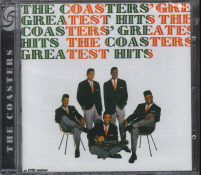
Poison Ivy (edited)
Along Came Jones
The Shadow Knows (unissued
stereo master)
I´m A Hog For You Baby
Charlie Brown (unissued
stereo master)
Yakety Yak (unissued stereo master)
Zing! Went The Strings Of
My Heart
(unissued
stereo master)
That Is Rock And Roll
Young Blood
Searchin´
|
BONUS TRACKS:
She´s A Yum Yum
Saturday Night Fish Fry
What About Us
Run Red Run
Keep On Rollin´
Three Cool Cats (unissued stereo
master)
Bad Blood (alternate)
Little Egypt
Girls Girls Girls Pt 1 (alternate)
Sorry But I´m Gonna Have To Pass
(unissued stereo master)
Besame Mucho Pts 1 & 2 (two
tracks)
Shoppin´ For Clothes
Bad Detective
Lovey Dovey |
The
Coasters Biography
as told at roughguides.com
|
|
THE
ROUGH GUIDE TO ROCK
THE COASTERS

Formed Los Angeles, 1955;
ended in the late 60s, though 'Coasters'
groups still surface on the oldies circuit.
The received wisdom has it
that rock'n'roll was dying on its feet during the period between Buddy Holly's death and
The Beatles' invasion of the USA. However, the music that came out during this time - the
first rumblings of Berry Gordy and Motown, the infectious New Orleans rhythms of The
Showmen and Huey 'Piano' Smith, and especially the comedy of The Coasters - was perhaps
more joyous and more intensely rhythmic than anything by Elvis, Chuck Berry or Buddy
Holly. The neglect of this music is perhaps down to subconscious racism, but probably has
more to do with the fact that this music was producer's music par excellence, lacking an
even remotely iconic presence. Nowhere is this more apparent than with the remarkable
Coasters. The Coasters evolved out of The Robins, a Los Angeles-based R&B vocal group
who recorded for Jerry Leiber and Mike Stoller's Spark records. The Robins had several
regional hits in California, most notably "Riot In Cell Block #9" (sung by
future "Louie, Louie" composer Richard Berry) and "Smokey Joe's Cafe".
Impressed by the songwriting talents of Leiber and Stoller, who not only wrote The Robins'
hits, but the R&B staples "Hound Dog" and "Kansas City" as well,
Atlantic offered the duo an indepenent production deal. Carl Gardner (vocals) and Bobby
Nunn (vocals) from The Robins decided to join Leiber and Stoller and recruited vocalists
Billy Guy and Leon Hughes to become The Coasters. Their first single, "Down In
Mexico" (1956), contained almost all of the elements that would characterize their
style: novel rhythms, a prominent, honking sax, and a lyric that told a comically
mysterious story in an exotic setting. After a few lacklustre singles, The Coasters hit
their stride with "Searchin'" (1957). Leiber and Stoller's lyric brilliantly
combined a detective story with poetic boasting, but it was the music that pushed the song
into the American Top 3. The feel was reminiscent of Fats Domino with a slightly less
funky New Orleans rhythm and drunken piano, played by Stoller himself. Although Leiber and
Stoller are now recognized as one of the greatest songwriting partnerships in pop history,
it was their instinctive musical and rhythmic feel that was reponsible for their success.
The flip side, "Young Blood", went into the Top 10 in its own right and was the
first example of the comedic style that The Coasters are best remembered for. "Yakety
Yak" (1958) justly went straight to the top of the American charts on its release and
has since become one of the classic rock'n'roll songs. The lyric itself was hilarious but
it was Nunn's (actually Jones´; ed.mark) basso profundo 'Don't talk
back' and King Curtis's sax solo that made the song. This sax embodied the rock'n'roll
horn sound and would reappear on "Charlie Brown" (1959), the utterly bizarre
"Along Came Jones" (1959), whose rhythm was based on a banjo riff, and
"That Is Rock & Roll" (1959), which was also based on a banjo. By this time,
Hughes and Nunn had left and were replaced by a succession of singers including Will Jones
and Obie Jessie. The Coasters closed out 1959 with a string of remarkable songs.
"Poison Ivy" abandoned the sax in favour of a harder, guitar-based rhythm and
was constructed around a dazzling extended metaphor filled with over-the-top internal
rhymes, while "What About Us", along with Chuck Berry's "Brown Eyed
Handsome Man", pioneered rock'n'roll's exploration of race and class issues.
"Run Red Run", meanwhile, was perhaps their best song. On the surface it was
another one of Leiber and Stoller's comic playlets, but underneath was an extraordinary
political statement. As Leiber puts it, 'once the monkey knows how to play [poker], he
knows how to understand other things. And once he understands that he's being cheated and
exploited, he becomes revolutionary.' After 1959, the hits dried up with the exception of
"Little Egypt" (1961) and the wonderful "Shoppin' For Clothes" (1960),
whose depiction of cool was so perfect that it's been sampled by both Barry Adamson and
The Jungle Brothers in their portraits of hipness. The Coasters continued until the late
60s with little success, and numerous versions of the band continue to play the 'oldies'
circuit. Leiber and Stoller continued writing and producing hits for The Drifters, Ben E.
King, The Dixie Cups and Elvis - they were not only early rock'n'roll's greatest
songwriters, but its greatest producers as well. In the unwritten history of popular
music's miscegenation, Leiber and Stoller, two Jewish kids from the Bronx, occupy a
central role, for they created rock'n'roll's metaphors and lingo, and its rhythmic
language too.
The Very Best Of The Coasters (1994; Rhino/Atlantic). The cream of the
crop from Rhino's 50-song retrospective, Coastin' Classics. This shows off Leiber and
Stoller's enormous talent for mixing the comic and the political, and suggests why things
like Red Wedge and Rock Against Racism are such abject failures.
Peter Shapiro |
THE COASTERS
(as shown pre 2002 on AMG - All Music
Guide on the Internet)
|
|
Possibly the
most popular doo wop group of the '50s, the Coasters started on the West Coast as the
Robins, scoring hits under the writing-and-production helm of Jerry Leiber and Mike
Stoller. When Atlantic signed Leiber and Stoller as a production team, the group split
into two factions; the core of the group became the Coasters and moved to New York to
record, while the Robins continued on the West Coast to diminishing acclaim. The Coasters'
hits, some of the most finely crafted, well written, and hilarious in the genre, continued
throughout the rest of the decade. Carl Gardner's sly leads and Bobby Nunn's bass singing
defined their sound through numerous personnel changes. When their time on the charts came
to an end a number of "Coasters" groups suddenly proliferated (much like the
Drifters, many of them still dotting the landscape of a million oldies shows and still
singing those classic songs).
-- Cub Koda, All-Music Guide
Hard core doo-wop fans will forever remain divided on the musical merits
of the Coasters. Were they really a great vocal group or merely the core remnants of a
much better one (the Robins) being manipulated as so many spare parts by
producers-songwriters Jerry Lieber (sic) and Mike Stoller? Was their lack of solid ballad
material in their discography done by design or did it mask a far more serious musical
deficiency in the group's makeup? Were the jokes and comic nature of their material all
part of Lieber and Stoller's master plan to sell a Black doo-wop group to White America
via the minstrel approach or were the Coasters the first vocal group since the Ink Spots
to truly possess crossover appeal? There's no easy answers to any of these questions, but
certainly the majority of the answers can be found on Rhino's excellent two disc
anthology, 50 Coastin' Classics. The set starts with their
final records as the Robins with Lieber and Stoller at the production helm and shows how
early in the game, the producers were not above bringing in a ringer like Richard Berry to
do the bad-ass narration work on "Riot In Cell Block #9" if the group's regular
singer wasn't getting the job done. The group became a cleaner, leaner and less of a
'street' group when its core membership moved to the East Coast and started recording in
New York under their name. Their sound became bluesier and almost gospel in nature on
material like "Idol With The Golden head" and positively eerie on pieces like
the minor keyed "Three Cool Cats." Lieber (sic) and Stoller's penchant for
arranging the group's vocals and assigning each member a segment of the lead part was
already pronounced by the flip side of their first Coaster single "Searchin'"
with the one line at at time reel off at the end of each verse on the seminal "Young
Blood." This tune became the blueprint for later entries like "Along Came
Jones" and "The Shadow Knows" while it perhaps even further refined on hits
like "Charlie Brown" and "Yakety Yak." Although the group recorded
almost no ballad material of any kind, it wasn't for lack of vocal power, as a quick
listen to either "Besame Mucho" or "Zing! Went The Strings Of My
Heart" will quickly attest. No, the Coasters simply were too talented, adaptable and
moldable as entertainers to be worried about getting a hot version of "Gloria"
on one of their LPs to prove to the local crowd that they could croon as good as the local
homeboys. Although the preponderance of comedic and novelty material keeps the group out
of the pantheon of names normally associated with the tops in doo-wop vocalizing, the
Coasters were certainly one of the very best the genre ever produced on a multitude of
levels.
-- Cub Koda
Check Jay Warner´s
presentation of the Coasters as published in "American Singing Groups"
and Steve Huey´s presentation on the All Music Guide of today here:
The
Coasters - Summary
|
Biography on The Coasters as told at yahoo.com
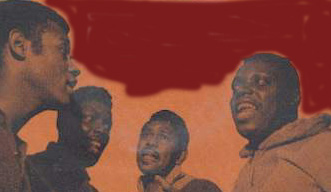
| |
|
This R&B
vocal group hailed from Los Angeles, USA. The illustrious career of the Coasters, the
pre-eminent vocal group of the early rock 'n' roll era, was built on a remarkable body of
cleverly comic R&B songs by their producers, Leiber And Stoller. Under their
direction, the Coasters exchanged the crooning of ballads favoured by most groups of the
era for robust and full-throated R&B shouting. The group came together in 1955 from
remnants of the Robins, who had a dispute with their producers/songwriters, Leiber and
Stoller. The original Coasters consisted of two ex-Robins, Carl Gardner (b. 29 April 1928,
Tyler, Texas, USA; lead) and Bobby Nunn (b. 1925, Birmingham, Alabama, USA, d. 5 November
1986; bass), plus Leon Hughes (b. 1938; tenor), Billy Guy (b. 20 June 1936, Itasca, Texas,
USA; lead and baritone) and Adolph Jacobs (b. Oakland, California, USA; guitar). Hughes
was replaced in 1956 by Young Jessie, who in turn was replaced by ex-Flairs Cornell
Gunther (sic) (b. 14 November 1936, Los Angeles, California, USA, d. 26 February 1990). In
1958 Nunn was replaced by ex-Cadets Will 'Dub' Jones (b. 1939 )not correct, ed.mark), Los
Angeles, California, USA). Ex-Cadillacs Earl Carroll (b. Gregory (actually not Gregory;
ed.mark) Carroll, 2 November 1937, New York, New York, USA) replaced Gunther in 1961. The
Coasters first charted with 'Down In Mexico' (US R&B Top 10) in 1956, but the
double-sided hit from 1957, 'Searchin'' (US R&B number 1 and pop number 3) and 'Young
Blood' (US R&B number 2 and pop Top 10) established the group as major rock 'n' roll
stars (in the UK, 'Searchin'' reached number 30). Three more giant hits sustained the
Coasters' career, namely 'Yakety Yak' (US R&B and pop number 1 in 1958), 'Charlie
Brown' (US R&B and pop number 2 in 1959), and 'Poison Ivy' (US R&B number 1 and
pop Top 10 in 1959). In the UK, 'Yakety Yak' went to number 12, 'Charlie Brown' to number
6, and 'Poison Ivy' to number 15, the group's last chart record in the UK. By this time,
they were generally regarded as one of the wittiest exponents of teenage growing problems
to emerge from the rock 'n' roll era. By the early 60s the lustre had worn off, as the
hits increasingly emphasized the comic lyrics to the detriment of the music. The group
continued for decades as an oldies act, and fractured into two different groups playing
the oldies circuit. Bobby Nunn died on 5 November 1986; Cornell Gunther was shot dead on
26 February 1990. The group was inducted into the Rock And Roll Hall Of Fame in 1987.
Based on Colin Larkin´s presentation
in Guiness´ Encyclopedia on Popular Music.
This article was featured in The Oak Ridger on April
15, 2003:
Oak Ridger, TN
Yakety Yak, The Coasters are back
by R. Cathey Daniels at the Oak Ridger staff
"Why's everybody always pickin' on me?"
The Coasters, in one way or another, have been trying to figure that one out since the
1950s and Oak Ridge will watch them try again May 17, at A.K. Bissell Park. The group,
still touting one original member, lead singer and founder Carl Gardner, is slated to
headline the Secret City Festival's entertainment tab. From Salty Sam and Sweet Sue in
"Along Came Jones" to a young woman who can give a guy "Poison Ivy"
(and other assorted ailments), the group will bring its special brand of humor and rhythm
to festival participants. "The Coasters are an excellent headliner for the Secret
City Festival," said Joye Montgomery, entertainment coordinator and Arts Council of
Oak Ridge executive director. "They are sure to appeal to all ages and will
definitely put on a great show. We are excited to add them to our long list of excellent
entertainment throughout the two-day event." Will Minter, community outreach co-chair
and director for the Small Business Program Office at Oak Ridge National Laboratory said,
"Music from the 50's and 60's helped many people get through their awkward teenage
years and into adulthood. The most significant events in our lives are remembered through
the fabric of music, and The Coasters helped us laugh our way through them."The
evening's entertainment begins at 5 p.m. with the bluegrass band High Altitude followed by
Mitzi Hubb, an award winning country artist. LB1 Band, a 70's disco group will play, as
well as The Invaders, a 60's British invasion band, playing tunes by the Beatles, Rolling
Stones and others. Prior to The Coasters taking center stage, they will give a backstage
party at the Oak Ridge Mall for senior citizens who are members of the Covenant Health
Passport Program. Members of Passport can apply to attend by calling 481-1811. Attendance
is limited to 950. The Coasters' performance is sponsored by Covenant Health Passport
Program, Methodist Medical Center and Cariten Healthcare.
The Coasters at
Wikipedia
The Coasters were an American doo wop and
early rock and roll group, evolving from The Robins, a Los Angeles based doo wop group.
After The Robins signed with Atlantic Records (1955, after the massive chart success of
"Smokey Joe's Cafe"), the group split up. Carl Gardnr (tenor) and Bobby Nunn (bass) formed The Coasters. The Coasters continued their association with the Robins' legendary
songwriters, Leiber & Stoller. They soon added Billy Guy
(baritone), Leon Hughes (tenor) and Adolph Jacobs (guitar), releasing their first single "Down
in Mexico", a major R&B hit in 1956.
In 1957, The Coasters crossed over with "Young
Blood"/"Searchin'". This was followed by a dry period, and the group
relocated to New York City. Nunn and Hughes left, replaced by Dub
Jones (bass, of The Cadets) and Obie Jessie. Jessie
was soon replaced by Cornell Gunter (The Flairs). This new line-up released "Yakety Yak",
which included King Curtis on tenor saxophone. The song was a huge mainstream hit, as was
the follow-up "Charlie Brown". This was followed by "Along Came
Jones", "Poison Ivy", "Shoppin' for Clothes" and "Little
Egypt". A series of line-up changes contributed to a lack of hits in the 1960s.
The Coasters signed with Columbia Records, but were never able to regain their
former fame. The Coasters last hit was "Love Potion No. 9" in 1971. Several
groups used the name in the 1970s, touring throughout the country, though Gardner held the
legal rights to it. Nunn died in 1986, the group was inducted into the Rock and Roll Hall
of Fame one year later. Gunter was murdered in Las Vegas in 1990. The group was inducted
into the Vocal Group Hall of Fame in 1999. Jones died in 2000 and Guy in 2002. Gardner
continues to tour as The Coasters and has made many attempts to stop bogus groups with no
connection to the original group from using the name.
January 2005 (Wikipedia is an open encyclopedia, freely edited by viewers),
check the
present
text. |
http://www.classicbands.com/coasters.html

This is from classicbands.com with information collected
from the editor of The Coasters Web Site.
"Those Hoodlum Friends" - "The Clown Princes of
Rock ´N´ Roll", The Coasters were the first vocal group to be inducted into the
Rock and Roll Hall of Fame on January 21, 1987. They have appeared in 6 major
movies and have amassed over 100 million record sales in their career. The
foursome was created in October, 1955 from the nucleus of the Los Angeles,
California based vocal sextet "the Robins". It was the young producing-composing
team of Jerry Leiber & Mike Stoller, who with manager-salesman, Lester Sill,
persuaded Bobby Nunn and Carl Gardner, to leave that group and launch the
Coasters.
Attracted by the success of "Smokey Joe's Cafe" with
Gardner on lead vocal, Atlantic Records signed an independent producer-composer
contract with Leiber & Stoller. Two hand-chosen Californians, Billy Guy and Leon
Hughes, completed the original Coasters line-up. They were contracted to
Atlantic´s new subsidiary, Atco Records. Through the Coasters, Leiber-Stoller
launched some of the most entertaining songs of the ´50s. The first Coasters´
recording was "Down In Mexico" on January 11, 1956. The record became a sleeper
R&B hit - followed by the minor Pop hit, "One Kiss Led To Another". The group
now hit the road for national promotion and produced R&B´s most famous
double-sided smash in 1957. "Young Blood" (the original A-side) was an R&B Juke
Box No. 1 hit (acutally No. 2 - but #1 on the R&B Best Seller chart - the
old infomation is from a wrongly presentation on an old Joel Whitburn summary;
ed.note), and a No. 2 hit on the R&B Disc Jockey chart, while the flip
side, "Searchin´", which occupied the No. 1 spot on the R&B Best Seller chart
for thirteen weeks (actually 12 weeks, succeeding its flip; ed.note), and lasted No. 1 on the R&B Disc Jockey chart for seven
weeks. Both titles also became national Pop Top Ten hits, staying on the charts
for half a year.
After three less successful releases, the Coasters
reformed and moved from the West Coast to New York. Bobby Nunn and Leon Hughes
stayed in California, where Nunn later launched his own "The Coasters, Mark II".
Nunn died of heart failure on November 5, 1986 in Los Angeles. His group, now
led by Billy Richards Jr, continued to tour as "Billy Richards´ Coasters".
Hughes also started his own Coasters tribute group - "The Original Coasters".
Tenor, Cornell Gunter and bass, Will "Dub" Jones, replaced Hughes and Nunn, and
in 1959, The Coasters rattled off a string of hits that included "Yakety Yak" (a
No. 1 Pop hit in 1958), "Charlie Brown" and "Along Came Jones" (1959) and the
double-sider "Poison Ivy" b/w "I´m A Hog For You". The classic Coasters had a
fifth member in guitarist Adolph Jacobs from Oakland, California, who was
succeeded by a Coasters´ employee, Sonny Forriest, on "What About Us", which was
the last single of the highly successful year of 1959.
The productions of the Coasters´ Atco recordings were far
superior to any contemporary group efforts (using the best musicians available,
especially King Curtis´ sax breaks) with the lyrics neatly deriding aspects of
teenage and/or black ghetto life. The group also worked out hilarious stage
routines and became the most professional act in late ´50s Rhythm & Blues and
early ´60s International Pop. In 1960, the Coasters had a few more minor hits
with "Wake Me, Shake Me" and "Shoppin´ For Clothes". In 1961 they hit with "Wait
A Minute" (recorded in 1957). After the group´s last U.S. Pop Top 30 hit entry,
"Little Egypt", Cornell Gunter left the group in June, 1961. He formed his own "Fabulous
Coasters" a couple of years later. Gunter died in his car by a gun shot from an
unknown person in Las Vegas on January 26, 1990.
Leiber-Stoller had left Atco/Atlantic in 1963, and the
hits quickly dried up, but the vocal quartet renewed their collaboration with
the team in late 1966, recording for the CBS subsidiary Date Records. By this
time however, doo-wap music was hopelessly out of style, and despite releasing
several new records, The Coasters were unable to repeat their earlier success.
The group continued to perform all over U.S. and toured Europe several times.
They even made a brief come-back on the U.S. Hot 100 Chart in 1972, with a
re-rendition of "Love Potion Number Nine". By the early ´80s, Carroll had left
to reform his Cadillacs, and Guy and Jones sporadically acted with a special
"World Famous Coasters" in California. In the late ´90s yet another fake
Coasters, "Billy Guy´s Coasters", emerged on the scene, semi-coached by Billy
Guy.
In 1987 the Coasters, Gardner, Guy, Jones, and Gunter (the
line-up that made the hits) were inducted into the Rock and Roll Hall of Fame -
the first vocal group receiving that honour. Carl Gardner & The Coasters were -
despite competition from bogus and off-spring Coasters groups - heavily engaged
in live bookings during the late ´80s and the whole of the ´90s (even performing
at the Carnegie Hall).
All of the early members launched their off-shoot Coasters´
recording groups during later years. Billy Guy has issued records as Billy Guy &
The Coasters, and there were Bobby Nunn´s Coasters, Mark II - later touring as
Billy Richards´ (West) Coasters; Leon Hughes´ Original Coasters; Cornell
Gunter´s Fabulous Coasters (nowadays; ed.note) acting with fake members as Cornell Gunter´s
Coasters Inc. There also was Will Jones´ World Famous Coasters (which often
featured Billy Guy, who later semi-coached Larry Marshak´s fake group, which
toured (and toures with the Buck Ram Platters and Berry Hobb's Drifters; ed.note) as
(yet another; ed.note) Cornell Gunter´s Coasters with Shirley Gunter as mentor. The true
Coasters though, were led by Carl Gardner (until late 2005, when his son Carl Jr
took over the lead role and Sr. semi-retired; ed.note).
The Coaster's Top Ten Hits
1957 YOUNG BLOOD - #8
1957 SEARCHING - #3
1957 POISON IVY - #7
1958 YAKETY YAK - #1
1959 CHARLIE BROWN - #2
1959 ALONG CAME JONES - #9
Be sure to read Gary James' Interview
With The Coasters'
Carl Gardner
TRIVIA
CONNECTIONS

Fats
Domino
New Orleans pianist/organist James Booker, who was pianist on some of Domino´s
later recordings, accompanied the Coasters on "Soul Pad" and "Down Home
Girl" (the latter originally recorded by N.O. guitarist Alvin Robinson).
Peggy Lee
Jerry & Mike wrote several records for Peggy Lee, a.o. "I´m A
Woman", which the Coasters revived as "She Can"- later issued as
"Talkin´´Bout A Woman".
Dinah Washington
Cornell Gunter toured with Dinah for almost a year (after leaving the
Coasters).
Ruth Brown
Jerry & Mike wrote several popular songs for Ruth Brown (a.o. the
Coasterish "I Can´t Hear A Word You Say").
The Clovers
Inspired the Coasters in many ways (and lost in popularity when the
Coasters started making hits). Carl et co. thanked them when reviving their "Love
Potion Number 9".
Elvis Presley
Covered two Coasters´ originals for the movies in the early 1960s -
"Little Egypt" and "Girls Girls Girls".
Johnny Otis
Bobby Nunn, Carl Gardner, and Billy Guy all made their early stage debuts
at Johnny´s Watts, California dance clubs.
The Drifters
When the Drifters went for their first decline in the late 1950s this
group often masqueraded as "The Coasters".
Lloyd Price
Both Billy Guy and the Coasters (with Carl Gardner and Jimmy Norman) were
associated to Lloyd during the 1960s (and later they paid tribute by recording his
"Personality").
Ray Charles
Recorded a novelty titled "At The Club" in the early 1960s in a
typical Coasters manner, and later revived the Coasters´ original "Let´s Go Get
Stoned".
Sam Cooke - Lou Rawls
Sam´s successor in the Soul Stirrers (and the one who duetted with him on
"Bring It On Home To Me"), Lou Rawls, once deputized for Carl on a tour in the
early 1960s. |
|
|
|
The Platters
Just as the Coasters, the Drifters (and nowadays also the Temptations), this group
has struggled with the problem of bogus name-sakes thruout later years.
Little Richard
One of the Beatles´ favorites, just like the Coasters - and a rock ´n´
roll survivor.
Joe Turner
The hit "Honey Hush" original pressings had
"Yakity-Yak" as alternate title. One of Joe´s old friends (and hit record
composer), Doc Pomus, co-wrote "Young Blood" with Leiber-Stoller.
LaVern Baker
Another favorite of Leiber-Stoller´s who toured with the Coasters´
package shows and used The Cues, who recorded their own "Charlie Brown" in 1956
(compl. diff.) as back-up singers with the name The Gliders.
B. B. King
Shares a blues favorite of Carl Gardner´s - fellow Texan, T-Bone Walker.
Jackie Wilson
Cornell Gunter was the first to be at hand, when Jackie collapsed (to be
hospitalized for the rest of his life) on stage at Dick Clark´s Latin Casino Supper Club
in Cherry Hill, N.Y. on September 29, 1975.
Joe Tex
Has been inspired in many ways by the Coasters (recorded an answer to
"Charlie Brown", "Charlie Brown Got Expelled" in 1959, and used a
stage humor just like the Coasters).
Chubby Checker
Used "Charlie Brown" and other famous rock & roll titles for his
interesting 1959 debut pop hit "The Class".
The Temptations
Used the same famous stage choreographer as the Cadillacs and the
Coasters, namely Cholly Atkins.
Wilson Pickett
Issued a 1970s Coasters recording on his Wicked label.
The Impressions
Recorded several late 1950s songs heavily inspired by the Coasters.
Chuck Berry
The great rock ´n´ roll poet has kept on rockin´ just like the Coasters
are keeping on. |
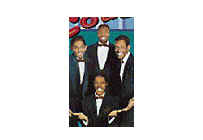
|
To enter The Coasters
Web Site
(if you´re on a one-frame page, please click) |
|