|
In regard to links throughout this Site, you may see a word that is underlined but NOT highlighted blue like a link, It IS a link and these are words that can be found in our Dictionary. In case you're unfamiliar with some of the fishing lingo.
Other Websites
FUNdamentals
of Baseball
|
Fishing Reels
What Is A
Fishing Reel
A Fishing Reel is the mechanical device mounted to the handle end of the fishing rod. It is a pulley-like arrangement to store large amounts of fishing line which are attached to a rod. Fishing Line is threaded along the fishing rod; one end terminates in a hook for catching the fish, while the rest of the line is wound around a reel at the base of the pole. Fishing Reels allow you to cast your bait or lure at great distances and for fish to be "reeled in" once caught. They also allow you retrieve lures correctly, fish in deeper water, and battle larger fish more easily. When looking for your ideal fishing reel, it's important to understand your fishing preference and level of experience. It's also essential to keep in mind the size fish you are looking to catch. Freshwater reels are designed to land fish found in lakes, rivers and streams, while saltwater reels work best in bays and oceans. Fishing Reels come in three basic styles: casting, spinning and fly reels.
The
easiest ones to use are called Spincast Reels. Most novice anglers find spin cast reels are easier to use than spinning reels. They may not hold as much line or cast as far as a spinning reel, but if you plan to fish two or three times a summer, or if you're buying a rod and reel for a youngster, you really can't go wrong if you buy a brand name spin cast outfit. Each reel uses a different type of rod; make sure you match the Reel to the right Rod.
We
will talk about each Reel further down the page, but for now let's
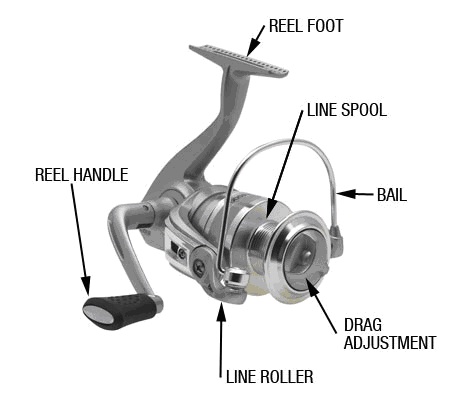
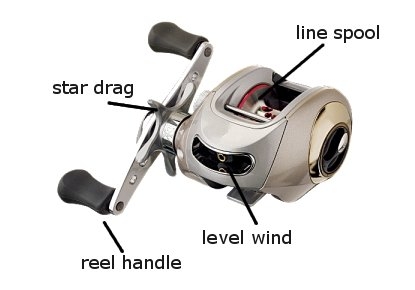
look at the . . . Parts of The Reel
Spool
Line
Capacity Level
Winds Bail
Handle
Gear Ratio
Ball Bearings Even though each reel is different, all reels share some major components. Spool
This
part of the reel holds the line. Line Capacity Line capacity is vital for selecting a reel. Reels can handle as little as 15 yards to as much as 900 yards. The amount of fishing line you'll need depends on your fishing. For example, fishing in a pond or stream will require only minimal line capacity. If you plan on fishing in a lake, you may need more line capacity to handle the water's depth and the type of fish that may run with your line.
Printed
on the reel or it's package is a guideline of the amount of fishing
line that the spool of the reel will hold. This chart is based on the
use of monofilament line and may look like this: 8/(175) 10/(155)
12/(130) the first number is the lb test followed by the amount of
yards. This indicates the line rating set by the manufacturer for
8-12 lb test line to work correctly without either stressing parts or
making it difficult to use. Sometimes the reel may just give the
maximum lb of test per yards that will fit on your reel.
By
varying the pound test line on the reel such as placing 40lb on a
reel rated for 8lb-12lb will give you an inadequate amount of line
due to the increased line thickness making the reel difficult to cast
as well as increasing the stress and eventual failure on the drag (By
setting the drag too tight) With the advent of new fishing lines with
increased lb test and reduced diameters we still recommend that you
follow guideline placed on the reel by the reel company. Level Wind
A
level wind makes it so that when you reel in your line, it is
distributed evenly over the spool. Level winds found on baitcasting
reels will evenly guide the line back on to the spool after casting. Bail
It's
the mechanism that either prevents or allows line coming off the spool.
When
casting your line, one of the things you do is open the bail. After
the cast is completed, the bail is closed by turning the handle.
Sometimes you'll hear the bail click after you've just turned the
handle. This click is the bail closing and is normal. Handle
The
handle is what is used to retrieve the line back onto the spool. Gear Ratio With a fishing reel, turning the handle on the reel engages gears that turn a shaft on the spool. The faster the handle is turned, the faster the spool rotates. Lower ratios provide more power for bringing fish from deeper depths, while higher gear rations benefit when pulling fish from closer to the surface. To explain it simply, the higher the ratio, the faster the retrieve of the bait becomes without racing the handle on the reel and wrenching your wrist.
The
higher gear ratio reels are excellent if you are fishing a
Rat-L-Trap in summer and fall. This is a time when the bass want
faster moving baits. Lower gear ratio reels require less effort when
fishing deep-diving crankbaits. The most often used gear ratios are
5.3 and 6.0 to 1. This means the spool turns 5.3 times every time you
turn the handle of the reel 360 degrees (one time). Ball Bearings
All
conventional fishing reels contain either ball bearings or bushings
built within the reel to operate the spool smoothly. It is the
generally thought that the greater amount of bearings in a reel the
smoother the operation and the higher the cost. But one must consider
that the amount of bearings does not necessarily mean that the reel
is smoother than others with less. Reel companies only list the total
number of bearings for the reel, not the type or quality of the
bearings. In other words a 2 ball bearing reel machined with tight
tolerances and high quality factory sealed stainless steel bearings
will perform longer and smoother than a reel with 6 ball bearings
made of brass. The deciding factor when it comes to purchasing a new
reel should not be limited to just the number of bearings but the
overall performance, (smooth cranking, machining & bearing
qualities ) as comparing to other reels in determining which is the smoothest. Anti Reverse
The
anti reverse function on fishing reels is so the handle does not
turn backwards when the line is pulled from the reel as the drag is
used. Spinning reels have an anti reverse on/off lever that will
allow the angler the choice of engaging the drag or back reeling when
fighting a fish. Most baitcasting reels today have anti reverse as a
standard feature. High quality reels that feature the number of
bearings on models followed with a single number such as 7+1
indicates a anti reverse bearing which with tighter machining
tolerances provides the angler with a "no play in handle"
giving the angler complete control during stop and go retrieves and
solid hook sets. For larger game fish some bait casting and trolling
reels use a additional anti reverse gear along with the bearing this
adds security if the bearing can not handle the strain of hard
running fish. Crank This is the handle of the Reel. There are single-grip cranks and double-grip cranks. They are designed to crank in (reel in) the line into the reel. Drag
Drag
is a mechanical means of applying variable pressure to the turning
spool in order to act as a friction brake against it. Older model
reels traditionally have a fixed drag that cannot be adjusted. The drag mechanism is a very important component on modern reels as it allows for a wide range of fish sizes to be caught on one set-up. It is not uncommon for 20-40 lb fish to be caught on 10-13 lb or even smaller tackle. The drag mechanism on your reel is designed to allow line to peel off from your spool before the weight or fight of a fish causes the line to break As a fishing reel stores line on a spool; an adjustable friction device inside the reel (known as a drag) helps the angler fight a fish. The drag creates tension on the line as it is pulled off the reel spool. When the fish pulls line off the reel, the constant tension tires it and keeps the line in order. Without a drag system, the fish would take out too much line, causing the line to tangle. The opposite situation; not releasing any line from the reel, would cause the line to snap. Properly set drag allows larger and more powerful fish to be safely landed, with the drag slipping below the breaking point of the line. In combination with rod flex, drag will tire a fish by converting energy it expends into heat in the drag system. Drag is set as high as possible without risking tearing the fish's mouth. When the specified gauge for a given reel is used most will not be able to apply enough drag to break the line. Here's an example: Small fish in open water, you can tighten down the drag and just crank the fish in with little worry that the line may break. With a big fish in open water, you may want to lighten the drag to let the fish run and tire out.
Therefore,
with every fish you hook, you should be aware of the drag
"setting" and the environment you hook them in. STAR DRAG OR LEVER DRAG REEL There are two basic types of drags available.
Either
of two drag systems is used on a reel; lever
and more commonly, star. Star Drag A number system 1-10 or an arrow pointing to the words less or more located near the handle. The basic design of a star drag typically incorporates several smaller fiber and metal drag washers that are compressed against the gear when the angler tightens the star wheel. The drag disengages from the spool when the reel is clicked out of gear, allowing the spool to spin freely.
Star
drag systems, with their lack of multiple drag controls and presets,
are simpler in design than lever drags. Just turn the star wheel one
way to increase drag, and the opposite way to decrease pressure.
Because star drags have been around seemingly forever, most anglers
are more familiar and comfortable using this type of system. For this
reason, a star drag reel is usually a better choice for a novice
angler, who may find a lever drag system, with its pre-set dial and
various "stops" along the arc, more confusing to use. With
a star drag reel, you're either in gear, or you're in free spool -
there's no in between. Lever Drag Lever drag reels feature drag washers that are actually attached to the spool. While this design allows the diameter of the drag washers in lever drag reels to be larger (approximately the same diameter of the spool), it also adds weight to the spool. The extra inertia make it harder for the spool to accelerate and decelerate, reducing casting distance and increasing the likelihood of backlash. As a rule, lever drag systems are more powerful, durable, consistent and precise than star drag systems. The downside to lever drag reels is that they're also typically more expensive. They also don't cast as well as star drag reels, although improved design and engineering is narrowing the gap somewhat in this area. Drag is something you'll need to understand and know how to use. Take some time and learn how to adjust the drag for your reel. Adjusting it will either make the fish fight harder or it will make it easier on him to pull line from the spool. We suggest playing with this setting so you'll get comfortable making the proper adjustment when the time comes. Keep in mind; it's something that may need to be changed several times a day depending on how the fish are fighting. You may be wondering, "If setting the drag tires out the fish, why not just tighten it down all the way to begin with"? There are a couple of reasons why you don't want to do this: It will increase the tension on the line causing it to possibly break Adding too much pressure could cause the lure to be ripped from the fish's mouth during the fight. Either way the fish is getting away from you. On the flip side, if it's set too loose: The fish will run taking your line around stumps, rocks etc. until it breaks. The fish could simply shake his head, and because of the slack on the line, the lure comes free. The line must stay tight at all times. For more information about fighting the fish click here.
Drag
is something you'll learn to use over time, and unfortunately, the
lessons can be heartbreaking knowing that one got away because it
wasn't properly set. The difference between front and rear drags Basically, this refers to the location of the drag controls, but there are some additional differences between the two styles. Front-drag systems generally feature multiple, large drag washers that offer increased durability and performance in comparison to rear-drag models. Rear-drag controls are easier to access (especially when fighting fish) yet they don't stand up as well to large, hard fighting fish species. Adjusting the drag is done in various ways depending on manufacturer and model. You'll want to look at the instructions for you're reel to determine how to operate the drag. How to Set the Drag on a Reel How to find the correct drag setting for a reel The drag should be set to 25% of the breaking strength of the line you are using. The breaking strength is the line's pound test, which should be clearly labeled on the package and spool.
test
strength ÷ 4 = correct drag setting
Many spinning and spin-cast reels have a numbering system that lets the fisherman know at a glance where his drag is set. Usually, the lower the number the lighter the drag. Under normal fishing conditions you would never tighten the drag down all the way. The best method of setting drag is to run your line through the rod so you have about four feet hanging from the tip. Grab the end of the line and gently pull down. This forces the rod tip to bend. Keep your eye on the bend in the rod. If you feel the rod tip is becoming too stressed, lighten the drag until line strips freely from the reel. If line begins to strip from the spool as soon as the rod tip begins to bend, tighten the drag slightly. By following this procedure you will soon establish the proper drag setting for every rod and reel you own. Go through this procedure anytime you suspect your drag may be set improperly, and especially after you've readjusted the drag while fighting a big fish. If you don't, you'll soon find yourself purchasing an awful lot of lures.
Spinning Reel Drag Setting the tension (drag) of the line on the reel is easy to do. Spinning reels are the simplest to adjust. Merely tighten or loosen the screw top holding the spool in place. The more you tighten, the harder it is to pull line off the spool when the bail is closed. Remember, the fish will fight against the line, so don't tighten the drag to the point where the line can easily break. Before you tighten the drag, be sure to check the anti-reverse switch located at the bottom of the spinning reel. The switch stops the reel handle from going backward. When the handle goes backward, it allows the line to come off the spool. Some people use this switch when fighting fish rather than relying on the drag. Spinning reels have two types of drag: front or rear. Front drags are generally seen on higher end reels and are considered superior to rear drags because the larger washers in front systems allow for more control over the fish. Drag knobs on front systems are generally found atop the reel, rear drag knobs are below.
Manufactures stamp a series of numbers on their reels. The first number refers to the size of line the reel can hold. This is given in pounds, referring to pound test of the line. The second number is yards, meaning how many yards of line can be spooled onto the the reel.
There
are other features of some reels but we'll leave that up to you to
ask a salesman, such as Line Counters, Line Out Alarm, On / Off Free
Spool Lever, etc. Types of Reels Spincast Reel Spinning Reel Bait Casting Reel Fly Reel Centerpin Reel
Spincast
Reel
A basic spincast system with its push button release is easy for kids to operate.
Spincasting tackle is often used while fishing for bluegill, crappie and other panfish. The Spincast Reel is typically an inexpensive type of reel and by far the easiest reel to use! I recommend it for a beginning fisherman's first reel.
The
Spincast Reel fits onto a Spincast
Rod. The Spincasting Rod has eyelet guides running along the top
of the rod and the spincasting reel mounts on top of the rod's
handle. The spincasting reel has a cover over the spool and a hole
through which line passes. This construction keeps the line clean and out of the angler's way. There is no bail inside of a spincasting reel. Instead, metal teeth attached to the spool gather the line in neatly. Spincast reels also generally have narrow spools with less line capacity than either bait casting or spinning reels of equivalent size. However, this tends to reduce line snare issues. Like other types of reels, spincast reels are frequently fitted with both anti-reverse mechanisms and friction drags, and some also have level-wind (oscillating spool) mechanisms. Most spincast reels operate best with limp monofilament lines The Spincast Reel is fine for typical pan fishing and casual weekend bobber watching but if you think that you're going to get fairly serious about fishing, you might want to consider the next 2 types of reels. Advantages and Disadvantages of Spin-Cast Reels These are some advantages to using spin-casting reels: Spin-casting reels are cheap so they're not a big loss if children break them or throw them in the lake. It's easy to learn to use spin-casting reels. They can be either right or left handed, and some have handles that can be moved from one side to the other. A good-quality spin-casting reel will last a long time. Spin-casting reels can handle extremely light line and are a good choice for two and four pound test ultralight fishing. These are some disadvantages to using spin-casting reels: Spin-casting reels are not good for heavy line or fighting strong fish. You're limited to light line, and the drag system isn't as good as it is on other kinds of reels. It's hard to keep the line tight on the spool. Twisted or loose line will jam the reel and you have to take the cover off to correct the problem. How To Use A Spincast Reel To use a spincast reel, you press the button on the back of the reel during your forward cast. The line peels out, when you let go of the button the line stops. It's very easy to get the hang of this reel. Spincast reels can be used for a variety of fish, but they lack high-capacity spools and, as such, cannot hold large amounts of line, yet they have more than enough for a beginner. The drag systems on spincast reels also are not particularly reliable. However, spincast reels are easy for novice fishermen to use and there is not a lot that can go wrong with them. Upon cranking the handle, the pickup pin immediately re-engages the line and spools it onto the reel.
Learn how to
Cast a Spincast Rod & Reel
Spinning
Reel
The Spinning Reel is the most popular reel, as it is easier to use than a baitcasting reel and more accurate than a spincast reel, however, it is not recommended for a beginner. Spinning reels hold more line and will cast farther than a spin cast outfit. However, you do have to hold onto the line with your index finger to cast (on most models) and a few folks have trouble with this. Spinning rods are also excellent for slip bobber fishing. If you don't know what slip bobber fishing is you probably do not need a spinning rod. Borrow one first, and get the hang of it. When purchasing an open face spinning reel; generally, your best value is to purchase the rod and reel combo. Most often these combos have a good reel to rod match and come in a wide variety. However, we recommend combos which do not come pre-spooled with line. Check the reels recommended line size and pick-up a good quality line; this will promote smooth tangle free casting. Spinning reels can cast farther than spincast gear. Spinning reels cast quickly and can cast long distances, making this rod suitable for all types of freshwater and saltwater fishing. The Spinning Reel fits onto a Spin Rod. The Spinning Reel Rod has its eyelet guides running along the bottom of the rod and the reel hangs below the handle grip. Spinning reels have a stationary spool (fixed spool) reel set on the underside of the rod and the fishing line is exposed. A curved bar, or bail, acts as a guide on the outer lip of the spool. The index finger is used to release the line and to control the line. As the reel handle is turned, the bail also turns, winding line neatly onto the spool. Spinning reels can handle practically any size line, but they are preferred for lightweight lures and line lighter than 10-pound test. They also perform better than baitcasting reels for casting into the wind. A disadvantage of spinning reels is that they eventually twist the line, creating loops, knots and tangles. When these occur, it is best to replace the line. To help prevent line memory and tangles, drop your spool in a glass of water the night before you go fishing and let it soak overnight. One thing that needs to be noted about an open face reel is its design which allows the reel's handle to rotate either clockwise or counter clockwise. An anti-reverse lock or switch usually located on the back of the reel should be set to permit rotation in only one direction (clockwise). Normally there is no need to turn this anti-reverse lock off. Some anglers have made the mistake of spooling the line backwards onto the open face reel because the anti-reverse lock was off. All open face spinning reel should be labeled with the recommended line size. The ultra light version often holds about 100 yards of 2 to 4 pound test line and cast lures as light as 1/16. Freshwater to light saltwater reels use line ranging from 8 to 20 pound test and hold about 200 yards. While some heavy duty surf reels will hold 250 yards of line with strength as high as 40 pound test and can easily cast 6 ounces of weight.
With
spinning reels, you can change the handle to the right or left side
by simply unscrewing and removing the handle from the reel. Unscrew
the cap cover from the right side, place the handle in the opposing
slot, and screw the cap cover into the left side. Spinning Reels have a star drag that looks like a wheel on the right hand side, attached to the handle. Turn the star clockwise and it tightens the line. Counter clockwise turns will of course loosen the line. If the line is too loose, you may not get the fish you catch into the boat. How To Use A Spinning Reel
To
make a cast with the open face spinning reel, grip the reel with two
fingers on each side of the post.
Swing the rod in the direction in which the bait is intended to land while relaxing the index finger allowing the weight of the bait or lure to uncoil the line. If there is a need to control the distance of the cast, finger the line as it uncoils from the spool. Once the cast is complete, the bail can be closed by rotating the reel's handle or closed by hand. The line can now be retrieved when desired.
Learn how to
Cast a Spin Rod & Reel Bait Casting Reel
The Baitcaster Reel mounts to the top of a bait casting rod (this has smaller guides attached to the top side of the rod). Baitcasting reels are typically the most expensive reel type, as well as the most difficult to use. Borrow one first, and get the hang of it. It is recommended that beginning anglers start with a spincast or spinning reel. This is the probably the most difficult reel to master, because the spool turns when you cast. Bait casting reels have a covered frame and a revolving, horizontal spool that winds in line when the handle is turned. One turn revolves the spool four or five times, bringing in several feet of line quickly. The spool must be kept under control so as not to turn into a nasty nest of line. The line comes off these reels from the top, so it doesn't twist, however, the angler's thumb is used to help control the speed the line unwinds off the reel when casting. Basically, if you forget to put your thumb down over the line on the reel, or don't use enough pressure, the reel spins faster than the line can go through the guides, so it creates a big mess of snarled, tangled line called a backlash, or a "woof" or various other descriptive colorful metaphors. As it is the most difficult to cast with, it comes in the widest variety of sizes, and can handle a lot of abuse day in and day out. There are models for light-weight use, and bigger models for catching huge fish such as Marlin.
Baitcasting
is used anytime heavy cover is going to be targeted. It's ability to
handle heavy line, lures and fish is unmatched as is its strength to
weight ratio. Bait cast equipment is NOT meant to be used with light
lures; anything under ¼ oz. would be better fished with spinning
tackle. Baitcasting tackle is the goto tackle when big fish and big
lures meet thick, nasty cover. Also, because you control the cast
with your thumb, pinpoint accuracy is possible. Once you become
proficient with a bait cast reel, it's possible to drop a lure in a
6-inch circle at 50 feet, with hardly a ripple on the water. That
kind of accuracy and "touch" is rarely possible with
spincasting or spinning tackle. How To Use A Baitcast Reel To cast, disengage the spool and hold your thumb on the spool. Release thumb pressure on the spool when you want the lure to move forward. It is crucial to learn to control spool revolution speed with your thumb.
Learn how to Cast
a Bait Cast Rod & Reel Fly Reel Often used for fly fishing the fly reel or fly casting reel has traditionally been rather simple in terms of mechanical construction. Fly fishing is an art requiring a specialized technique of casting a lightweight fly to a specific location. To achieve an accurate cast, you must learn how to use the fly-fishing reel. A fly reel is normally operated by stripping line off the reel with one hand, while casting the rod with the other hand. Modern fly reels typically have more sophisticated disc-type drag systems made of composite materials that feature increased adjustment range, consistency, and resistance to high temperatures from drag friction. Most of these fly reels also feature large-arbor spools designed to reduce line memory, maintain consistent drag and assist the quick retrieval of slack line in the event a hooked fish makes a sudden run towards the angler. Automatic fly reels use a coiled spring mechanism that pulls the line into the reel with the flick of a lever. Automatic reels tend to be heavy for their size, and have limited line capacity. Automatic fly reels peaked in popularity during the 1960s, and since that time they have been outsold many times over by manual fly reels. Saltwater fly reels are designed specifically for use in an ocean environment. Saltwater fly reels are normally much larger in diameter than most freshwater fly reels in order to provide a large line and backing capacity designed for the long runs of powerful ocean game fish. To prevent corrosion, saltwater fly reels often use aerospace aluminum frames and spools, electroplated and/or stainless steel components, with sealed and waterproof bearing and drive mechanisms. Choosing a fly-fishing reel can appear overwhelming with the wide range of sizes and styles to match the fishing conditions. The best fly-fishing reels combine a functional design with durable materials. Size: Larger spools offer quicker line retrieval, better line handling and enhanced drag pressure control. If you're palming, which is a technique where you press the palm of your hand against the spinning reel of the spoon as the fish takes line, make sure the reel also fits your hand as comfortably as possible as well. When looking for your ideal fly fishing reel, it's important to understand your fishing preference and level of experience. It's also essential to keep in mind the size fish you are looking to catch. Below are the Fly Reel types available: Single-action: This is the simplest and most common, a good choice if your a beginner. The fly line is stored on a spool and the handle attaches directly to the spool rather than a gear system found on most fishing reels. One crank of the handle provides one revolution of the spool. Automatic: This reel allows you to simply flick a lever to retrieve line, a big plus when you have a lot of line out in the water, helping with line control. Mid-Arbor: This style spool is a great compromise between a large arbor fly reel and a standard arbor design. Anglers can take advantage of the over-sized multi-disk drag systems that are mounted through the center of the spool arbor, yet they still get the advantage of a slightly larger diameter spool for line retrieval and additional line capacity. A mid-arbor design gives you a large line capacity plus the added benefits of rapid retrieve and reduced line coiling. Large-Arbor: The main advantage is that the overall diameter of the reel is large so you can increase your line retrieval and gain line capacity. For anglers targeting larger fish or venturing into saltwater, the large arbor design incorporates a very efficient, over-sized multi-disk drag system. Fly fishers are able to consistently strip off long lengths of slack line for casting, and then reel it up quickly when playing a fish or moving to a different spot. Bigger coils of line coming off the reel allow for easier casting with fewer tangles. Also, a large arbor reel's drag works more soundly, as a fish pulls out line, the effective spool diameter remains nearly constant. Saltwater fly reels: Designed specifically for use in an ocean environment. Saltwater fly reels are normally much larger in diameter than most freshwater fly reels in order to provide a large line and backing capacity designed for the long runs of powerful ocean game fish. To prevent corrosion, saltwater fly reels often use aerospace aluminum frames and spools, electroplated and/or stainless steel components, with sealed and waterproof bearing and drive mechanisms. Fly Reel Operation Fly reels are normally manual, single-action designs. Rotating a handle on the side of the reel rotates the spool which retrieves the line, usually at a 1:1 ratio (i.e., one complete revolution of the handle equals one revolution of the spool).
Learn how to Cast
a Fly Rod & Reel Centerpin reel In many ways it is simply an oversized large arbor fly reel that rides on bearing races and plays fish without the use of a mechanical drag. The centerpin reel is one which runs freely enough on its axle (its "centerpin") to permit distance casting by allowing the line to be drawn off by the momentum of the cast from the rotating reel. The centerpin reel is currently used for coarse fishing, it is undergoing a strong revival amongst contemporary coarse fish anglers, typically used in circumstances which don't demand long distance casting, a centerpin has the visceral advantage over a fixed spool reel in that it puts the angler in contact with the fish without the involvement of a slipping clutch. The angler's thumb typically, is instead used to control the fish. Fishing in the margins for carp or other heavy fish with relatively light tackle is very popular with a 'pin' and it is unbeatable as a tool for trotting on slow and fast flowing rivers. Centerpin reels remain popular with anglers in Australia for all forms of fresh and saltwater fishing. Most common is the use of centerpin reels in Australia for surf casting off the beach. A large diameter spool centerpin reel is attached in a low mount position on a 12-17 foot surf casting pole by way of a bracket that allows the reel to be rotated 90° to the pole for casting and returned to a position to retrieve line. In the casting position the spool is perpendicular to the pole, opening the face of the reel allowing the line to run off the side of the spool when released in the cast. The surf casting poles specifically designed for use with these reels have the reel low mounted as the line is held and released during the cast by the lower hand on the rod, unlike fixed spool or multiplier surf reels, and the lowest ring is of large diameter and around halfway along the poles length. How To Use A Centerpin Reel To use a center-pin, one casts the offering (using whatever casting method you choose) to a slightly upstream position and follows the float downstream while the water current (because of hydraulic pressure against the float) pays out line off the reel. Occasionally, it may be necessary to slightly brake, feather, or apply slight resistance to the spool rim to slow a drift down. This feathering of the spool results in your float "trotting" through the swim. Ideally, you are aiming for the offering to be the very first thing that the prey sees. And you want to slow the offering to subsurface current speeds so that it is presented as natural as possible. When the float goes down, thrusts upward, or tilts side to side it is time to set the hook. If the depth of the offering is correct, these float movements are a direct result of a fish strike. When in doubt set the hook! Hooksets can be made by momentary clasping the spool tight, braking, and a slight upward or side twitch of the rod. Be ready to begin palming the reel and applying drag because this is typically when the resulting fish run begins. Buying A Reel Balance is an important factor. Some reels can be heavy; especially cheap versions and can upset the rod's balance. Take your rod with you when you buy a reel. Finally, look for a model with a comfortable handle and a handle that the palm can grip will be easier to use. Check the gear ratio. This refers to the number of revolutions made by the spool at each complete turn of the reel handle. Fishing Reels with high gear ratios work best when you need to quickly retrieve the Fishing Lure back to you. On the other hand, Fishing Reels with lower gear ratios are suitable for bottom fishing and trolling because of their greater cranking ability.
Every
reel you pick up and spin at the tackle shop will feel smooth and
silky as it turns. The test is how will it perform over time. Cheaper
reels (and I mean that both from a quality and price view point) will
work well for a while. But, because they use brass or plastic shims
as opposed to bearings, they wear and become sloppy over time.
If
you fish only occasionally, a cheaper reel may suit you. We have a wide selection of Fishing Reels at Our FUNdamentals Fishing Store. Buy one today! Visit Our Care For Your Fishing Reel Page to keep your Reel in tip top shape for years to come!
Okay!
So we learned about the Fishing Rod and now the Reel.
If
you have
any hints, suggestions, techniques or anything that you would like to share
or
have me put onto this web page,
Copyright
© This website is the composition of many hours of research. Information contained within this site has come from numerous sources such as websites, newspapers, books, and magazines. No animals were harmed in the making of this site.
DISCLAIMER: PLEASE READ - By printing, downloading, or using you agree to our full terms. If you do not agree to the full terms, do not use the information. We are only publishers of this material, not authors. Information may have errors or be outdated. Some information is from historical sources or represents opinions of the author. It is for research purposes only. The information is "AS IS", "WITH ALL FAULTS". User assumes all risk of use, damage, or injury. You agree that we have no liability for any damages. We are not liable for any consequential, incidental, indirect, or special damages. You indemnify us for claims caused by you. Please be advised that the content of this site is a source of information only. The FUNdamentals of Fishing Website cannot take responsibility for animal welfare or actions taken as a result of information provided, and if in doubt you should seek the advice of a qualified physician or veterinarian.
I do not suffer from insanity; I enjoy every minute of it! |
||||||||||











 Jon's Images, Inc.