|
In regard to links throughout this Site, you may see a word that is underlined but NOT highlighted blue like a link, It IS a link and these are words that can be found in our Dictionary. In case you're unfamiliar with some of the fishing lingo.
Other Websites
FUNdamentals
of Baseball
|
Learn To Cast A Fishing Rod
Using spinning or spincasting (closed faced) takes all of about 2 minutes to learn the basics. You can also ask the clerk in the FISHING STORE, they should be able to teach you. Places like Walmart and whathaveya will probably not know a thing about casting let alone have any knowledge of the Fishing Gear they sale. Before using a fishing rod, new anglers should understand body position and hand and arm action.
•
Start with your feet and shoulders square to the target.
•
Next, toss a tennis or ping pong ball overhand (action similar to
throwing a dart) a few feet for accuracy. you can also practice
better accuracy by tossing toward a target. This is the desired body and arm action for accurate casting. Release of the ball is at a similar position as thumb release when casting. Now transition to fishing rods, with spincast rods recommended. Casting For Beginners
This
cast is intended for spincast
rods. How to Cast The Spincast Reel When learning to cast a fishing rod for the first time, you can first practice casting in your yard by tying on a casting plug or a small non-sharp weighted object without hooks to your line, using knots that you can learn at our Fishing Knots Page. Get a feel for the equipment . . . Hold the rod out in front of you to get a feel for how the spincast reel works. Reel up the line until the bobber is about four inches from the tip of the rod. Now, press down firmly on the release button and hold it there.
Notice how the bobber stays in the same place. Now let the release button go. The bobber should fall to the ground.
If
line does not come out, pull line slightly to start.
You
have just learned how to release the line from the reel,
To
prevent loops that can become tangles from forming in the line,
carefully add tension to the line with your thumb and forefinger
while reeling in the line. Final Check Place your bobber 6-12" from your rod tip and make sure your line is not wrapped around your rod. As safety is an important habit to establish, you should check the immediate area around and above you to be sure you have plenty of space.
Before
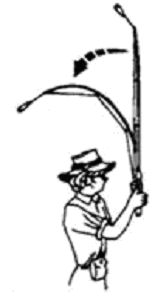
you cast, look behind you to be sure no one else is there. Casting Face the target area with body, with your feet and shoulders square to the target. This is accomplished by pointing the toes of both feet at the target area. Aim the rod tip toward the target, an object on the horizon with the hands comfortably at the waist. (Some youth may have difficulty holding the pole with one hand, so the rod may be held with one hand or two.) This is the 3 o'clock position. Press and hold down the reel's release button with your thumb. Swiftly and smoothly, bend your arm at the elbow, raising your hand with the rod until it almost reaches eye level. You should still be holding down the release button with your thumb at this time. When the rod is almost straight up and down, it will be bent back by the weight of the practice plug. As the rod bends, move your forearm forward with a slight wrist movement. You should still be holding down the release button with your thumb at this time.
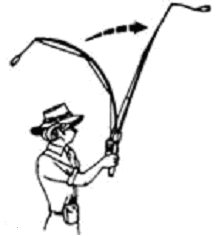
Next, gently sweep the rod forward, causing the rod to bend with the motion. You should still be holding down the release button with your thumb at this time. As the rod moves in front of you, reaching eye level, about the 10 o'clock position, release your thumb from the button.
The bend in the rod casts the bobber and bait out. Stop the fishing rod with it pointed slightly above the original target. You have just made a cast!
Advanced Casting
When
you are ready to advance from spincasting
to spinning
or baitcasting,
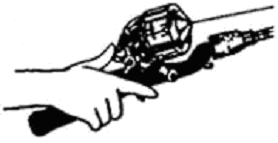
the overhead cast is the easiest cast with which to start. How to Cast The Open Face Spinning Reel The best way to hold a spinning reel for casting is to slide your rod hand around the reel seat, with two fingers in front of the reel stem and two fingers behind it. This gives you a good casting grip and more importantly, leaves your forefinger free to trap the line as the casting swing is made. A suitable amount of line is allowed to hang from the rod tip (between 5 and 15 inches should do it). The first finger of the reel hand is extended down toward the spool to pick up the line ahead of the bail arm and the line is then pulled back up against the rod grip, where the finger traps it. The bail arm is opened with your other hand and the reel is now ready for casting. It's important to get this sequence right. If you open the bail arm before you trap the line, line will spill from the spool and you'll get into a mess. With the line trapped and the bail open, swing the rod back past your shoulder and then forward again in a swift, smooth arc. This forward casting stroke should start slow, accelerate, and then finish by drifting forward so the rod points horizontally in front of you. At the appropriate moment (while rod is still moving forward) the finger holding the line is straightened, and the casting weight is thrown forward, towing the line behind it. You need to get this release timed right though, as if you release too early in the swing, the bait will fly up into the air and land who knows where. If you release the line too late in the swing, you will know where the bait lands all right because chances are it will go into the ground or water by your feet. A useful way to get the timing of this release right, is to swing the rod forward and as your casting arms begins to extend, point the line holding finger straight at your casting target. Most times, this will release the line at the correct moment and also direct the cast where it should go. The technique works with short and light single-handed rods, such as you might use for trout, bass, bream and so on, and with big, heavy, two-handed rods, suitable for beach or rock-fishing. With the single-handed rod, your free hand and arm does not come into play very much, but when casting with a two-handed rod, your other hand is needed, to anchor the rod butt and provide a fulcrum for the cast. During the cast, this other hand holds the butt down and in front of your body to act as a pivot point, while the reel hand swings and pushes the rod through the casting arc.
How To cast The Bait Casting Reel Bait-casting describes a fishing technique and its associated tackle that originated in the early 1800s. It took its name from its initial purpose, which was to cast live bait. Modern bait-casting reels utilize a revolving-spool reel to cast artificial lures and live bait. Basically, the weight of the lure or bait pulls line from the spool until it reaches the intended casting target. The objective is to offer a tempting lure or bait to fish from a distance. Bait-casting is one of four basic categories of fishing tackle. The other three are spin-casting, spinning, and fly-casting. They differ from one another in popularity, ease of use, fishing styles, spool type, and strength. There are no great differences between the four casting techniques, with the exception of fly-casting, in which the weight of the line (not the lure) delivers a near-weightless fly. Spin-casting is probably the most popular because it is easily used by children and novices who do not want or need to spend much time learning to cast. Spin-casters are willing to sacrifice accuracy for ease of use. Spinning is also popular among beginners, though widely used by anglers at all levels of experience. While bait-casting is similar to other casting techniques in its purpose and methods, it is a distinct and unique style of fishing. It is generally used for freshwater fishing, mostly large species like largemouth bass, catfish and northern pike. But bait-casting tackle is well suited to saltwater species such as tarpon and snook. Why Bait-casting? Beginners, or anglers with only spinning or spin-casting experience, may wonder why they should bother learning the bait-casting technique. The main strength of this technique is that, when mastered, it allows for a high degree of accuracy in the placement of a bait or lure. Conversely, it is more difficult to learn than other types of casting and requires a higher level of skill to achieve desired results. But learning and mastering the technique will make the angler a more complete fisherman. For the freshwater fisherman pursuing any species larger than small trout or panfish, bait-casting gear is considered standard equipment. This is due to the tremendous versatility of bait-casting tackle. Lures such as crankbaits (plugs), large spinners and spinnerbaits, heavy jigs, large soft plastics, topwater and other lures are fished most effectively with bait-casting gear. Expert and serious anglers prefer bait-casting because it offers the combination of high line capacity, cranking power and greater casting accuracy from both short and long distances. The mechanics of a bait-cast reel are strong, durable and less prone to failure than spinning or spin-cast reels. While spinning tackle definitely serves a valuable purpose, especially when using small lures, light line (10-pound test or lighter) and/or live bait, bait-casting gear gives the angler unmatched versatility for a variety of lures and fishing methods. Most experienced anglers have at least one, if not more, of both spinning and bait-casting outfits. Casting a Bait Casting Reel There sure is a fair amount of miss-information flowing around on baitcasters or overheads. Many fishing enthusiasts believe they are difficult to use, yet this is not really the case, because in fact they are easy to master. If you use the correct technique, and are prepared to spend a bit of time practicing so that it becomes a natural process, a baitcaster will become a dream machine to use.
A
golf swing requires hours of repetitive practice to perfect. In
contrast, an overhead baitcaster requires nothing like the time the
golf swing needs. However, it does require a little repetitive
training. For those prepared to put in the hour or two, the rewards
will be fantastic and you'll find accuracy and distance with every
cast. And you won't get those embarrassing line twists, or bird-nests.
To
begin, hold the rod and reel tilted so that the handles are higher
than the spool of the reel. Secondly, the grip should be similar to holding a tennis racket. The "V" developed between the thumb and the index finger should be virtually at top dead center. The grip should be relaxed. You will find that in holding the rod as described in rules 1 & 2, the index finger is all that is required to stop the rod falling to the floor. The weight, or balance of the rod will cause the butt to push up into the palm of the hand. Actually it will be pushing up into the palm area beneath the thumb known as "the mount".
And
last but not least, the area between the side of your thumb and the
flat of your thumb should rest across the line on the spool. These three rules of thumb are the basis for making overhead baitcasting a dream.
Too
many angler's
attempt to hold the reel in the upright position. This forces the
thumb to lie straight north south, and this in turn cause a whole
host of problems which are sure to result in over-runs
If
you have
any hints, suggestions, techniques or anything that you would like to share
or
have me put onto this web page,
Copyright © This website is the composition of many hours of research. Information contained within this site has come from numerous sources such as websites, newspapers, books, and magazines. No animals were harmed in the making of this site.
DISCLAIMER: PLEASE READ - By printing, downloading, or using you agree to our full terms. If you do not agree to the full terms, do not use the information. We are only publishers of this material, not authors. Information may have errors or be outdated. Some information is from historical sources or represents opinions of the author. It is for research purposes only. The information is "AS IS", "WITH ALL FAULTS". User assumes all risk of use, damage, or injury. You agree that we have no liability for any damages. We are not liable for any consequential, incidental, indirect, or special damages. You indemnify us for claims caused by you. Please be advised that the content of this site is a source of information only. The FUNdamentals of Fishing Website cannot take responsibility for animal welfare or actions taken as a result of information provided, and if in doubt you should seek the advice of a qualified physician or veterinarian.
I do not suffer from insanity; I enjoy every minute of it! |
|||||||||||||||||||











 Jon's Images, Inc.