|
The "Favorite Flies" series started a few issues back with a relook
back to the flies that our contributors have submitted and several
new submissions. This issue, with the approaching summer steelhead
season, we take a look at surface flies for steelhead with a
heavy concentration on Bombers. Bombers were developed in the 1960’s for Atlantic Salmon fishing
on the famed Maramichi River in New Brunswick, Canada - during a period of time when there was quite a lot of experimentation going on there with new designs.
According to Trey Comb's in his book,
Fly Fishing for Steelhead, the original Bomber was
developed by the Rev. Elmer J. Smith.
Eventually they caught on as a Steelhead dry fly and became so
popular that they come in an endless number of colors and styles
these days. These flies are not fished to ride on their hackles like
a traditional dry, nor does the wing help it as a floater. They are
often tied, without hackle at all and with a deer hair body clipped to a flat
belly to improve its stability on the water surface. Bombers are
fished in a variety of ways but very often as a waking fly, on the
downstream swing.
Bombers
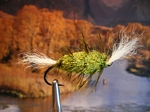 Green
Bomber is shown here because in form, it most
closely resembles the original bombers tied for Atlantic Salmon
- tied with a tail of deer body hair or white calf tail,
spun deer body hair, clipped to shape; tapered at both ends and palmered with brown saddle hackle; a wing of a single bunch of
deer body hair or white calf tail. The Green Bomber is a typical
variation - that of modifying the body color, hackle and wing. This fly
can be be found in
Flies for Alaska, by Anthony J. Route Green
Bomber is shown here because in form, it most
closely resembles the original bombers tied for Atlantic Salmon
- tied with a tail of deer body hair or white calf tail,
spun deer body hair, clipped to shape; tapered at both ends and palmered with brown saddle hackle; a wing of a single bunch of
deer body hair or white calf tail. The Green Bomber is a typical
variation - that of modifying the body color, hackle and wing. This fly
can be be found in
Flies for Alaska, by Anthony J. Route
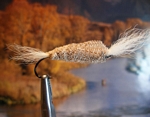 Cigar
Butt, is a variation originated by Keith Stonebreaker of Lewiston,
Idaho. It is perhaps the simplest form and easiest tie yet, no less effective.
Trey Combs writes in
Fly Fishing for Steelhead that Mr. Stonebreaker likes
this tied in a #8 or #10 because larger sizes do not seem to move steelhead as
well. Dick Stewart and Farrow Allen write in
Flies for Steelhead
that by eliminating the hackle, this fly plows through the water
rather than skating on it. Cigar
Butt, is a variation originated by Keith Stonebreaker of Lewiston,
Idaho. It is perhaps the simplest form and easiest tie yet, no less effective.
Trey Combs writes in
Fly Fishing for Steelhead that Mr. Stonebreaker likes
this tied in a #8 or #10 because larger sizes do not seem to move steelhead as
well. Dick Stewart and Farrow Allen write in
Flies for Steelhead
that by eliminating the hackle, this fly plows through the water
rather than skating on it.
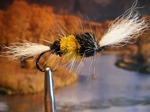 Bumble
Bee Bomber shows how Bombers can be modified to look
more buggy by changing the colors to a bee-like coloration. It is
hard to imagine any fish not being enticed by this a fly as
it skates across the water like a downed bee. Trey Combs
writes writes, as a matter of fact, that when this type of fly was
first introduced the "Results were immediate and Spectacular." Bumble
Bee Bomber shows how Bombers can be modified to look
more buggy by changing the colors to a bee-like coloration. It is
hard to imagine any fish not being enticed by this a fly as
it skates across the water like a downed bee. Trey Combs
writes writes, as a matter of fact, that when this type of fly was
first introduced the "Results were immediate and Spectacular."
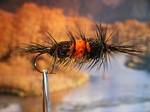 Just
like the fly above, the
Orange and Black Bomber is an extremely
buggy-looking fly. This one, in the orange and black color
combination, with the black tail, wing and hackle, looks
remarkable like a caterpillar. The originator, Don Hathaway probably
intended for it to look just like that - imitating caterpillars that he had
observed in British Columbia. Just
like the fly above, the
Orange and Black Bomber is an extremely
buggy-looking fly. This one, in the orange and black color
combination, with the black tail, wing and hackle, looks
remarkable like a caterpillar. The originator, Don Hathaway probably
intended for it to look just like that - imitating caterpillars that he had
observed in British Columbia.
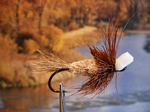 The
crazy-looking Pooldozer
to the right is another example of the endless variation out there
in bomber-type flies. There is a useful purpose in this
fly however, as crazy as it looks. This skater fly was designed by Dr.
Wes Terasaki of Issaquah, Washington with a full deer body hair head
and collar to plow across the surface while the foam head keeps it
from diving under. The
crazy-looking Pooldozer
to the right is another example of the endless variation out there
in bomber-type flies. There is a useful purpose in this
fly however, as crazy as it looks. This skater fly was designed by Dr.
Wes Terasaki of Issaquah, Washington with a full deer body hair head
and collar to plow across the surface while the foam head keeps it
from diving under.
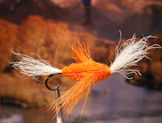 Air
BC again shows the amount of variability in bomber
flies, but as always, with a purpose. This one, according to Dick
Stewart and Farrow Allen in
Flies for Steelhead
was designed by Bill McMillan. The story goes that it was unsuccessful
with Mr. McMillan's first attempts at fishing it, but it found
great success on the Dean River after he gave it to British Columbia
anglers Jim Abbott and Don Collis. The name Air BC came from the
Canadian airline that uses the same colors. Air
BC again shows the amount of variability in bomber
flies, but as always, with a purpose. This one, according to Dick
Stewart and Farrow Allen in
Flies for Steelhead
was designed by Bill McMillan. The story goes that it was unsuccessful
with Mr. McMillan's first attempts at fishing it, but it found
great success on the Dean River after he gave it to British Columbia
anglers Jim Abbott and Don Collis. The name Air BC came from the
Canadian airline that uses the same colors.
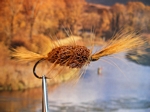 Ok,
back to flies that follow the traditional Atlantic Salmon bomber
model. After tying this, however, I see two errors.
Rusty Bomber
can be found in Trey Comb's fine book,
Fly Fishing for Steelhead and he writes that "the Rusty
Bomber is a marvelous pattern if the wing is not tied too long."
This one is. The other error is that the body should have been
clipped flatter at the bottom, giving it more stability on the
water's surface. Ok,
back to flies that follow the traditional Atlantic Salmon bomber
model. After tying this, however, I see two errors.
Rusty Bomber
can be found in Trey Comb's fine book,
Fly Fishing for Steelhead and he writes that "the Rusty
Bomber is a marvelous pattern if the wing is not tied too long."
This one is. The other error is that the body should have been
clipped flatter at the bottom, giving it more stability on the
water's surface.
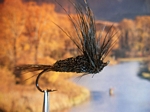 Lemire's
Irresistible was originated by Harry Lemire and has
reportably been responsible for many steelhead throughout the
Northwest. It is as you can see, yet another example of the
variation in form and color of bomber flies. For this one, the
designer specifies that the body and hackle be trimmed flat across
the bottom to give it stability. The entire bottom surface of the
fly should be able to rest on the water. Lemire's
Irresistible was originated by Harry Lemire and has
reportably been responsible for many steelhead throughout the
Northwest. It is as you can see, yet another example of the
variation in form and color of bomber flies. For this one, the
designer specifies that the body and hackle be trimmed flat across
the bottom to give it stability. The entire bottom surface of the
fly should be able to rest on the water.
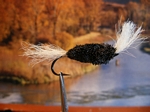 Here
is another
fly that is simple in form and easy to tie, but not lacking in
originality, at least as far as the name is concerned.
Moose Turd
is another bomber originated by Bill McMillan, author of
Dry Line Steelhead and other Subjects during a period
when their was a lot of experimentation going on with the surface
flies. The curled tips of the wing is also clipped to help give
the fly more of a "waking" action on the water and keep it from
diving. Here
is another
fly that is simple in form and easy to tie, but not lacking in
originality, at least as far as the name is concerned.
Moose Turd
is another bomber originated by Bill McMillan, author of
Dry Line Steelhead and other Subjects during a period
when their was a lot of experimentation going on with the surface
flies. The curled tips of the wing is also clipped to help give
the fly more of a "waking" action on the water and keep it from
diving.
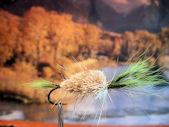 Finally
we'll finish with one more variation in form.
Green Wing Bomber,
originated by Sean Gallagher of Enumclaw, Washington, is an example
of how the wing can be varied in bombers. The squirrel wing, aside
from being green on this fly is divided, adding more stability by
keeping it from rolling over on the water. That could make a
big difference in keeping the "waking" action of the fly from
becoming erratic. Finally
we'll finish with one more variation in form.
Green Wing Bomber,
originated by Sean Gallagher of Enumclaw, Washington, is an example
of how the wing can be varied in bombers. The squirrel wing, aside
from being green on this fly is divided, adding more stability by
keeping it from rolling over on the water. That could make a
big difference in keeping the "waking" action of the fly from
becoming erratic.
Dennis Dickson Surface Flies
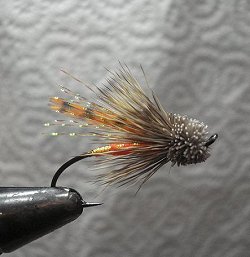 Northwest
guide Dennis Dickson introduced his
Dickson's Crystal
Caddis to us in the Jul-Aug 2008 issue. But clients who
went on one of his fall
wilderness
steelhead trips to the Grande Ronde in remote
southeast Washington already knew that this was a deadly surface
fly. Now as another fall steelhead season approaches, I
thought it might be appropriate to take another look at the fly and
the story behind it. Northwest
guide Dennis Dickson introduced his
Dickson's Crystal
Caddis to us in the Jul-Aug 2008 issue. But clients who
went on one of his fall
wilderness
steelhead trips to the Grande Ronde in remote
southeast Washington already knew that this was a deadly surface
fly. Now as another fall steelhead season approaches, I
thought it might be appropriate to take another look at the fly and
the story behind it.
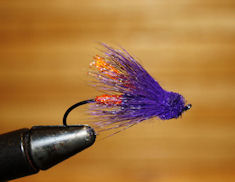 Lights
Out is the low light variation of Dickson's Crystal
Caddis - at least it was developed for that reason. But there were
surprises with this fly as the story will tell. This surface fly is
tied with the same materials, but with purple instead of natural
deer body hair. It has proven equally successful for Dennis and his
clients on his Grande Ronde trips, so you might want to consider one
of two things - You can try your luck out by tying a few and
fish them on your own, or you can get in touch with Dennis Dickson to
book a trip. I have already booked my trip and I can't wait. Lights
Out is the low light variation of Dickson's Crystal
Caddis - at least it was developed for that reason. But there were
surprises with this fly as the story will tell. This surface fly is
tied with the same materials, but with purple instead of natural
deer body hair. It has proven equally successful for Dennis and his
clients on his Grande Ronde trips, so you might want to consider one
of two things - You can try your luck out by tying a few and
fish them on your own, or you can get in touch with Dennis Dickson to
book a trip. I have already booked my trip and I can't wait.
That's it for another month. Each month, we'll be presenting new "Favorite
Flies" and targeting different species, so there will always be new
flies and fresh ideas to look forward to in addition to the ones
submitted by contributors. As always, Salmonfly.Net
invites other contributors to submit their flies or ideas. That can be
done by filling out and submitting the form on the page,
Showing Your Flies or Photos on
Salmonfly.Net.
Happy Fly Tying,
SPB
 |