'...found so much misery from hunger, he taught the
people to get food by fishing. For, although there was plenty of fish in
the seas and rivers, the people had no idea about fishing, and caught
only eels. So the Bishop's men got together eel nets from all sides. and
threw them into the sea. By God's help they caught three hundred fish,
of all different kinds.'
The use of hook and line to catch great quantity of fish is an
unproductive method to use. However, this is a method that was used in
pre-conquest times for many of the same reasons as it is used today: it
is less demanding upon materials. Today the use of rod, reel, line and
hook is mainly employed by the sporting fraternity whilst the early
medieval period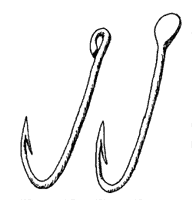 the use of hook and line was part of ones' livelihood.
Although there is some evidence to suggest that reels were employed in
China c. 3000BC they were not in common use in this country until late
13th-early 14th century.
the use of hook and line was part of ones' livelihood.
Although there is some evidence to suggest that reels were employed in
China c. 3000BC they were not in common use in this country until late
13th-early 14th century.
To angle is to fish with rod and hook and, in fact, the use of a pole
or rod was not introduced into this county until the 13th century. The
first recorded account of an angler was of an abbess fishing for carp
and by 1496 the art of angling had produced its first book written in
English; Treatise of Fysshynge with an Angle by Dame Juliana Berners.
There is, however, a Byzantium illustration depicting what appears to be
a fishing rod or pole. It is, of course, possible that the use of
lengths of wood to aid in the practice of fishing actually took place,
but this has not been documented as being a common exercise.
The catching of fish on a larger scale at sea involved the use of
fishing nets and from evidence of finds at Birka and Ribe these too were
made from nettle-hemp. It would also appear that the nets that were made
were not exclusively for the use of fishermen; they would be used for
trapping and be a convenient method as bags for storage and carriage.
The construction of fishing nets is similar to that of recent years
and it is only necessary to master the use of only two knots: the
clove-hitch and the sheet-bend. First of all a heavier duty line is
positioned at a convenient working height and running the estimated
length of the intended net.
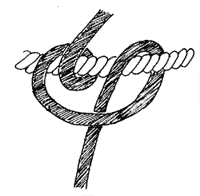 A long
quantity of nettle-hemp is then tied to the main line using the
clove-hitch knot; these need to be equally spaced along the main line.
After the length of the main line has been completed it is then that the
hemp is tied together, using the sheet-bend, to form the mesh. The most
difficult and important part of the operation is the ability to make
sure that the mesh is kept to the same dimensions: fingers or a piece of
scrap wood may be used as a rough guide. To help hold the nettle-hemp a
netting needle may be used. The netting needle can be made out of wood,
bone or antler.
A long
quantity of nettle-hemp is then tied to the main line using the
clove-hitch knot; these need to be equally spaced along the main line.
After the length of the main line has been completed it is then that the
hemp is tied together, using the sheet-bend, to form the mesh. The most
difficult and important part of the operation is the ability to make
sure that the mesh is kept to the same dimensions: fingers or a piece of
scrap wood may be used as a rough guide. To help hold the nettle-hemp a
netting needle may be used. The netting needle can be made out of wood,
bone or antler.
















 The
consumption of fish was an important part of life in the early medieval
period and therefore the catching, preparation, storage
The
consumption of fish was an important part of life in the early medieval
period and therefore the catching, preparation, storage