
[Home] [How To Move The Pieces] [Rules]
[Strategy] [How To Take Notation]
At the beginning of the game, white's pawns are lined up on the second rank, and black's are on the seventh:

From this position, you can chose to move any pawn one or two squares forward:

After they leave their initial position, pawns are restricted to moving directly forward one square at a time. If the square immediately in front of a pawn is occupied by another piece, then the pawn cannot move:

The pawn on the left can move forward to the white square directly ahead of it. The one on the right can't.
Pawns are the only pieces that move differently than normal when they capture. Pawns capture by moving one square diagonally forward, and not by moving straight ahead:

The pawn can capture the knight or bishop, but not the rook.
The knights are easily recognizable as the pieces that look like horses. At the beginning of the game, they are to be found one square in from the corners:
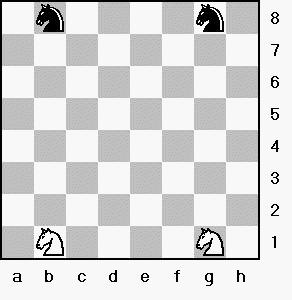
While the other pieces slide from one spot to another in straight lines, knights are the only ones that jump from one spot to another. And when they jump, they don't follow a straight line or a diagonal.
It's easiest to use a picture to show how the knight moves. The knight in the image below can hop to any one of the squares with an X on it:

To try to put it in words, knights can move two squares forward or back, and then one square to the left or right, or, two squares left or right, and then one square forward or back.
Because knights hop, they are the only pieces that aren't stopped by other pieces in their path. However, they can't land on a square that's occupied by another, same-colored piece:

So, in the picture above, the knight can leap over the wall of pieces to get to the square with the green X, but it can't land on the square with the red X, since it already has a pawn on it.
At the beginning of the game, the bishops are to be found here:
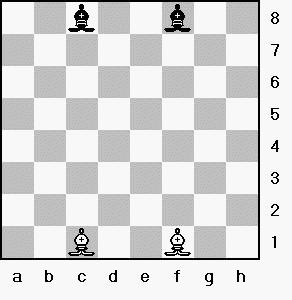
Bishops can move an unlimited number of squares diagonally. This means that a bishop that starting the game on a dark square will only ever be able to operate on the dark squares. Similarly, a bishop that begins on a light square will never sit upon a black square:

A bishop cannot jump over its fellow pieces. Here the bishop is blocked, and can only go as far as the green X:

Rooks are the pieces that look like the turrets of a castle. At the beginning of the game, they are to be found here:

Rooks can move an unlimited number of squares to the right, to the left, straight forward, or straight backward:

The rook cannot jump over its fellow pieces. Here the rook is blocked, and can only go as far as the green X:

The queens are the large pieces topped with crowns. At the beginning of the game, the queens are to be found here:
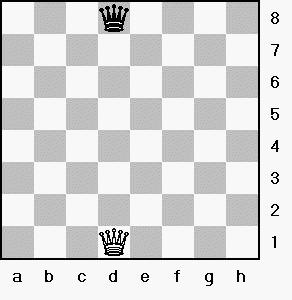
Queens move with the combined power of bishops and rooks. They can move an unlimited number of squares diagonally, plus they can move an unlimited number of squares forward, backward, left or right. This makes the queen the most mobile piece of all:

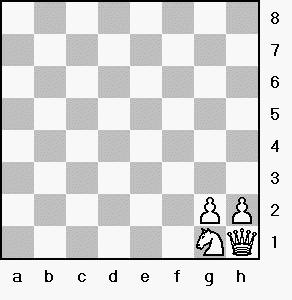
For all its power, a queen cannot jump over its fellow pieces. Here the queen is blocked, and can't move at all:
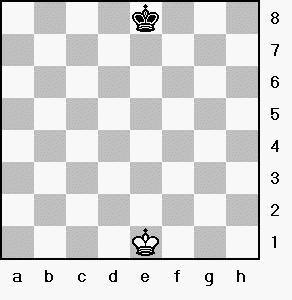
The kings are the large pieces topped with crosses. At the beginning of the game, the kings are here:
Kings can move one square at a time in any direction:

Kings can't move when they are blocked by their own pieces. In fact kings spend most of their time hemmed in with little mobility. In the image below, the king can only move to one square:
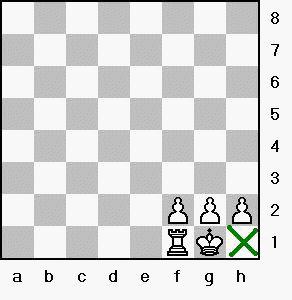
Note that the two kings are not allowed to sit on adjacent squares. Neither king can move to the squares marked with red X's:

When your piece captures an opponent's piece, the enemy unit is removed and your piece stops on the square the captured piece occupied.
Here the queen can capture Black's rook. The rook will come off the board, and the queen will sit on the square marked with the "x":

© David Leckner 2002
