

The Home Page · The Integral Worm · My Resume · My Show Car · My White Papers · Organizations I Belong To

Technical Writing · Exposition & Argumentation · Non-fiction Creative Essays · Grammar and Usage of Standard English · The Structure of English · Analysis of Shakespeare
Analysis of Literary Language · Advanced Professional Papers · The History of the English Language · First Internship: Tutoring in a Writing Workshop · Second Internship: Advanced Instruction: Tutoring Writing
Visual Literacy Seminar (A First Course in Methodology) · Theories of Communication & Technology (A Second Course in Methodology) · The Writer's Guild
UMBC'S Conservative Newspaper: "The Retriever's Right Eye" · UMBC'S University Newspaper: "The Retriever Weekly" · Introduction to Journalism · Feature Writing · Science Writing Papers


Communicative Objective #1 (CO1): A re-contextualization of the Oxford English Dictionary (OED)
Blackboard Weekly Posts (A Bulletin Board Community)
An Explanation of How to Read "This" Presentation/Activity · The Original Presentation/Activity Parameters for "Back to the Little Red Schoolhouse": The task order sheet · The Original Readings that Frame and Inspire the Presentation/Activity
Photos of the "Back to the Little Red Schoolhouse" Artifacts · Audio Tape of the Presentation/Activity "Back to the Little Red Schoolhouse" · The Initial Index Card Ordering (Before) and the Index Card Ordering by Each Group (After)
Flow Chart of the Presentation/Activity "Back to the Little Red Schoolhouse" · The Rolling Credits for Back to the Little Red Schoolhouse: Who Contributed to "This" Objective
Back to the Little Red Schoolhouse Blackboard Community Post
The Goals and Choices Narrative · The Process Narrative
What was the goal of this activity?
One goal was to demonstrate the advantages of using index cards when performing research and constructing any long text document. Dr Carpenter is fond of this method for journal articles and it is a long standing method taught somewhere back in grade school and reviewed more than a few times throughout the K-12 years. The purpose of this activity is to demonstrate the power of an old method most writers in the digital age never use or completely forget about. Most writers think the use of index cards is arcane, antiquate, and a useless kindergarten exercise.
It is a known fact that 70% of people are visual learners. Using the cards creates a visual display of one's argument and allows the author to constructively move around text exploring the possibilities of different structured arguments easily. When the entire argument is on paper and on the computer screen it becomes difficult to visualize the structure and order of the argument. That is to say, having to scroll down causes the mind to loose focus; therefore, concentrating on organization becomes difficult. There are software programs that will allow authors to do the same thing on the computer screen without index cards but as students, most of us cannot afford another extra expense; therefore, the old school method of index cards is a more affordable solution. Dr. Carpenter recommended this method in her Visual Literacy class last semester and no other professor has suggested this method in my 20 year academic experience. Wait a moment, that's not true. While attending SUNY Farmingdale in the Fall of 1975, "some old guy" (an ongoing joke by Professor Diane Putzel that some old guy no student ever remembers teaches the first college entrance courses in grammar and composition) recommended or insisted the use of index cards for research paper organization. In some ways, suggesting the use of index cards in a senior seminar may be way too late in a student's career. Then again, Dr. Carpenter's class was a graduate level course and this would be an excellent time to consider forgotten writing tools in preparing to write one's thesis paper and dissertation.
For some of us within the "Shipka Spaces," our ultimate goal is to publish. Publishing will entail a great deal of editing and experimentation in the structure of articles. There is no better place to practice than in school. Within the university one is in a position where one can still recover from mistakes. The restructuring of an argument using index cards as an exercise also adds to the learning experience of writing and demonstrates alternative means in creating structure in publications other than hard outlines. One is less likely to experiment with alternative structures using an outline.
The second goal of the activity is open communications between my peers. By giving my peers an activity to perform, this activity should open channels of communication by having them work together toward an obtainable goal. In addition, I hope that my peers will share their organizational methods with each other so we all get an idea of what works and what doesn't.
Why was the color of the paper folder containing all the paperwork changed from its
original black to bright yellow?
The black paper folder containing all the paperwork contributed to the theme of the death penalty. The folder was changed as per an email with Shipka to somehow re-purpose the entire project. Everything within the original plan including the folder was changed in order to reflect a lighter more grade school approach to the entire presentation.
What is the purpose of the little school stickers in the plastic portfolio? The purpose of the little school stickers is for a High School audience to brighten up the entire presentation. The intent is for the presenter to place one of the little school symbols on their lapel to reduce some of the negative connotations of the death penalty argument that was extracted and re-purposed for the presentation.
Why is the entire project being delivered in a plastic portfolio?
After reading Geoffrey Sirc in Writing New Media: Theory and Applications for Expanding the Teaching of Composition, discussing the artist Joseph Cornell and his "box art" of collected disposable items. I want illustrate to Shipka how purposefully engineered this activity was and how the activity changed. I decided that I wanted Shipka to have all the artifacts that went into designing this presentation as though I was delivering it to a client to reproduce the activity from school to school and classroom to classroom. I am designing the package as a portable kit. The advertising sticker of the portfolio was re-purposed as a "Traveling Rhetorical Proof Card Kit." Inside are all the contents necessary to re-perform the entire presentation for the purpose of demonstrating that some old school methods of organization still have a place within the "digital age."
The color of the portfolio has no meaning as all the colors available were actually quite disgusting therefore my choice became a matter of choosing a folder that was the least putrid.
I am in agreement with E. Piccirillo's position that the cards are a waste of time and also create an additional unnecessary expense. My writing process on the computer is iterative. I develop a bibliography initially. I scan documents for useful information and then look at the conclusion for work or studies that may be open or other scholars say need to be researched. If possible I will delve in these areas unless scope, time, and cost are beyond my present constraints. I examine for positions to find out what direction the data is taking. I then create a section where I dump other scholars' quotations that will support my position or argument. This assists me in formulating my thesis. The other section I develop is the counterargument. In many cases after having created these lists of texts I will perform more research examining the bibliographies of the research first collected and scan these documents for more data. This data I add to the argument and counterargument lists. In essence I am collecting index cards digitally on sheets of digital paper. Later, these lists are printed and examined. From these lists I will begin to construct an outline and develop a thesis. I will begin bringing the quotations into the headings of the outline. As new data comes in it will be placed into the lists and into the outline. If the data does not fit the outline, the outline is modified to make it fit. I will then weave my text, analysis, and synthesis around the scholar's quotations. Many times the data takes unexpected turns causing me to reconsider the thesis resulting in modifying the thesis to fit the data. As I said this is an iterative process and I will rewrite at the paragraph level and down to the sentence level word by word until I have the text I want within a paragraph. High order processes are usually done last such as sentence transitions and organization. The conclusion is always created last because the thesis may change several times in the process and the organization of the article may change several times also.
The only thing I have not tried, which I will in the future, is Donald M. Murray's and E. Piccirillo's method of organization: cutting up the text into paragraphs, laying them out on a card table, and physically sort and shift paragraphs to visually experiment with different types of organization.
There is also the J. Deane School of Organization and Editing: "Where's the Fat Black Magic Marker?" Slaughter the "little darlings."
Why did the presenter wear a light colored suit and bright, cheery tie?
In our group meeting for our ENGL 324 Presentation we discussed dressing well for the presentation. At the time I explained to Steven that I have always worn a suit in class for my presentations because this sends a message to the audience that I am not only on stage and being expected to perform, but that I am a professional and take my presentation seriously. The expectation is the audience in turn will take me seriously as a presenter.
In a discussion April 19, 2006 with Steven Norfolk about our dress for the ENGL 324 asked me if I owned a dark suit. I said yes. We were discussing the fact that Steven will be the host and that Naphtali and I during the course of the game
Steven said that he was going to wear a light color suit. Why? Because all game show hosts wear light color suits not only so the focus is on them but because we associate lighter colors with happier moods. A game show host wants the audience to have fun. A light color suit removes any negative connotations associated with a dark colored suit. The semiotics of a dark colored suit send a message of seriousness and a black suit would send a message of darkness and morbidity. That was it! This was the support I needed for my plan. In the first plan was to produce that atmosphere around the fact that we were working with the death penalty. Shipka had her reservations about my design bringing people down and was really against me using the death penalty as the argument to re-construct as she had avoided this argument in her eight year teaching career because of its morose implications. Somehow the fact that I was planning to use this argument slipped under her radar and now two days before the presentation with everything in place and ready to go I was being asked to re-design the presentation. One simple way was for me to wear a light color suit with a bright tie to brighten the atmosphere of the presentation. Steven's statement and reasoning added support to my re-design decision.
Why did the actual presentation change from the game plan?
The actual presentation changes from the game plan probably because right from the beginning I become sidetracked by Caitlin's entering while I am setting up. As I am distracted by her questions a few other peers enter so I figure at this point there really is no reason to maintain a strict structure to the exercise. By loosing restrictions my peers never knew were built into the original plan of the presentation, no one knows that my peers are actually molding the presentation around themselves like a glove. As a salesperson for over ten years, reducing the structure creates a more relaxed atmosphere and my peers can perform the task being more at ease. I end up running the activity as though this was my "proving ground" for a teaching experience. I have been in enough classrooms to know which I perform in best and worst. By reducing the restrictions I create a space in which we can all lean from each other and create a personable atmosphere which is important to me as a presenter.
Why audio record the question answer period of the presentation and why cannot the data be
reproduced?
The purpose of recording the question/answer period was to capture any data that occurred. Audiences are unpredictable and unexpected turn might occur other than what the presenter expected. This is exactly what had happened. The audience was reporting to me how they were making sense of this presentation and what sense they made of the activity. This was not my intent in the Question/Answer session. Recording the session would allow the presenter to reflect on the session and make adjustments to the entire presentation in order to reflect on the audience's meaning-making of the presentation. This reflection would allow for fine-tuning of the presentation. This recording would help the presenter in evaluating the session producing a Lessons Learned, which could be used for further improvement. Quality of the tape is not the greatest but does help me as a presenter to find the areas that require improvement.
Right now, I don't have the time to transcribe the tape. The presentation was recorded on a micro-tape and I no longer have a tape-based micro-recorder. when I have a chance, I'll purchace one on eBay to transcribe the tape and also provide a .wav file of the recording.
The organization of the arguments created in class
Group 1: Y. Martin, S. Kibler, and D. Wentworth
Against the death penalty
No appeal to logic, ethos or pathos
Card order: 1, 5, 7, 14, 10, 16, 18, 15, 9, 6, 17 Group 2: A. Sheikh and B. Chewning
Against the death penalty
No appeal to logic, ethos or pathos
Card Order: 5, 1, 18, 4, 15, 7, 9, 12, 3, Group 3: B. Bauhaus, P. Hartman, D. Panchwagh
Against the death penalty
No appeal to logic, ethos or pathos
Card order: 1, 18, 7, 4, 14, 15, 9, 12, 8, 16, 13 Group 4: E. Piccirillo, E. Sanchez
Against the death penalty
No appeal to logic, ethos or pathos
Card order: 17, 9, 2, 8, 12, 14, 7, 5, 15, 13, 6 Group 5: C. Wychgram, S. Natvoitz, G. Masters
Against the death penalty
No appeal to logic, ethos or pathos
3+14, 17, 18+16+10, 7, 11+5, 6, 4+15
NOTE: Group 5 has chosen to make 3+14 one card, 18+16+10 one card, and 4+15 one card. There was nothing said in the instructions that they could not make this arrangement.
How were the groups designed?
We have more women than men in this class. Even though this is not a sexist issue there was the possibility that the two sexes might think differently about this social issue. I could not allow for an all male or all female group so I had to break them apart. Groups of three usually work best in exercises like these because there is a tendency for a group of four to slip into groupthink. Groupthink is a phenomenon where one person does all the thinking for the entire group. Even with groups of three, groupthink could possibility occur. Therefore I tried to balance the groups as best I could with 2 women and 1 man in each group. This did not work because I have one extra man and had to place two together. The only way this one group could be balanced out is if Shipka plays, but this creates another imbalance of having four in a group. No matter how I try to set this up I have an imbalance.
Next, I wanted to break apart clicks. Some of us have spent a great deal of time with each other and are at the point of actually knowing each other's body language. By breaking up these clicks I would place people in unfamiliar work groups to reduce this form of communication. I formulated the groups by remembering who worked with who so far, who I have seen associating together outside of class, who is in 324 and 407, in addition to seating position. Those on the left side of the room are going to be less familiar with those on the right side of the room. To this day I am sure that some of us do not even know all the names and faces within the class. I decided to combine people that are the least familiar with each other. I also arranged the groups by those who communicate orally the least in class and those who communicate the most orally in class. This might be a mistake, but I was attempting to place extroverts with introverts. The problem that might occur is the extrovert may take over in a particular group skewing the results. The more vocal peers may have stronger wills but then again the wills of the non-speakers may be just as strong as they will assert their opinions in different ways other than through oral discourse. Silence also has strength.
I also tried to position people in areas of the room where they normally do not sit. The goal was to create as much friction as possible to get people to genuinely argue over the death penalty and the structuring of the argument.
 |
Why leave it up to my peers to decide who comes up for the group cards?
This would indicate to me who is likely to attempt to take charge of the group and the final outcome of the structured argument. In other words, they may think they are assuming the role of group leader.
Why tell the people who came for the cards their only purpose is to call out the group’s data at the end of the structuring?
To explicitly express that this is the only role they have as a lead.
Why explain that the floor is open to discussion?
The main purpose is to reduce control of the environment and turn control back to my peers. This will permit open discussion of various questions they may have.
Why was the blueprint done as an MS Word document?
This was the easiest way to communicate what the game plan will be for the day. I do not see a need for getting creative with this and working in a familiar program is the best way to have more time to concentrate on other aspects of design.
Why was a hand drawn flow chart created detailing the process of the presentation and activity?
The reason for the flowchart is the presentation or activity in my mind is a process. When working on large or complex processes, flowcharts are extremely helpful and are rarely used. While I was studying Computer Science at Drexel, I had a professor who worked as an intern on the ENIAC computer project in University of Pennsylvania and worked for IBM (Big Blue) for twenty years. He was from the old school and said that nothing was done in IBM without a flow chart. Every program and every project we did for him was accompanied with a flow chart. His purpose for teaching and requiring flowcharts was a flowchart allows the designer to pick up steps they may left out or did not consider. Using a flowchart visually indicates there is a problem in one’s design logic if one cannot proceed to the next step. A flowchart slows the mind down and forces one to make a conscious decision for every step. A flowchart provides logical structure, organizes the mind, forces one to consider missing steps and creates a visual of one’s logical decisions. This also guides the designer in design because one can quickly see whether a process will work or not and if there is a way to simplify the process. The flowchart is a tool for me as a designer.
The second reason for the hand drawn flow charts is because of the reasons explained in the next section “Why was the flowchart hand drawn and not done with Microsoft Visio?”
Why was the flowchart hand drawn and not done with Microsoft (MS) Visio?
The reasons why Microsoft Visio was not used for this presentation are several. One, MS Visio is only available in the Information Systems building on the computers on the fourth floor of the Information Systems (IS) department of the UMBC campus. These are the only computers on campus that have MS Visio loaded on them. Anyone can use these computers but mostly IS student’s use them because few people are aware the lab exists and few are aware that these computers have extra software on them for IS students.
Second, I did not use this program because for some peculiar reason these computers are not connected to a network printer. In order to print one must take the file to another computer that has a printer. This creates a problem using MS Visio. One cannot print without the program being loaded to the computer.
Third, I do have a copy of Visio but it is an old version, created before Microsoft bought the company. The two programs are not compatible. The old program will not read files created in the new version.
Fourth, I do not have my copy of Visio loaded on this computer. The computer that had Visio blew up after ten years of use. I am using a computer that is just as old as the one that I replaced. This computer is quite finicky and fragile. I refuse to load any program onto it that I am going to use twice in a year. This computer is unpredictable, has no backup software and if I crash it, I cannot afford to run out and replace it. I am using this computer as is because most of the primary programs I need are already on it. I do not want to disturb it for something like this. I do not deem the flow chart being in Visio as important enough. The fact that the computer functions is good enough right now until I can replace it.
Why choose the “Strategies for Using Sketching, Speaking, Movement, and Metaphor to Generate and
Organize Text” by P. Dunn reading and not the other reading by P. Dunn?
As a writing tutor I am familiar with the argument in the Dunn’s second paper but could not visualize a way to construct an activity around this particular reading. Dunn’s “Strategies for Using Sketching, Speaking, Movement, and Metaphor to Generate and Organize Text” reading had the same problems. This reading did provide me with new unconventional techniques to use in the Writing Center but again because of the nature of the topic, even as a writing tutor, I found it difficult to visualize an activity that could be created. P. Dunn lays out an excellent blueprint for an activity to perform and by applying some creativity I could make some changes in Dunn’s plan to make the activity not only more interesting but my own design considering all the design space we are provided within the Shipka Spaces.
The death penalty argument is being used because this was the argument used in the reading. The particular paragraphs are right there in the text. Copying and pasting them into Word and breaking up the paragraphs was easier than giving my peers one of my own arguments and asking them to reorder this. P. Dunn has given the reader topic sentences and I am not so sure my arguments work as simply as what Dunn provided.
Why have my peers perform the exercise at home first?
First, I wanted to be kind to them and give them a heads-up as to what to expect when they entered my black box experiment on Thursday, April 20th.
Second, I wanted to have a real argument. By having my peers first formulate their own argument this would force them to seriously think about the death penalty issue and construct their own individual argument. By having them construct their own argument at home, when they entered into the black box and had to construct a second argument as a groups they would be forced to discuss their decisions in their own designs. The new task was designed to encourage arguments and to force members to either persuade group members to their position or construct a new argument that agreed with the opinions of all. I also wanted everyone to show my peers the changes in position so we could discuss why this happened.
My hope is that my peers will learn something about how positions change within a social environment. This is not only an exercise in structuring an argument but also practice in the art of an oral argument thereby playing to the theme of the course which is communication within societies.
Why the invitations?
The invitations permitted me to distribute the exercise, to give my peers a heads-up, to generate a theme, and to control the test environment.
Why the boarder around the text of the invitations?
The boarder was placed around the text to give the document the look and feel of a formal invitation.
Why use the default settings of top and bottom margin 1” and left and right margin 1.25”?
The document looks elegant with the default settings and provides enough whitespace on the page without overcrowding therefore why mess with a good thing.
Why choose Veranda font in 12 point for the entire document?
The purpose of choosing this font was to extenuate the formality of the occasion and to make the document easy to read.
Why is the language within the invitation inviting yet formal?
The purpose of the language used is to ease some of the formality of the occasion but to suggest that this is a serious occasion we have gathered for as we are deciding whether someone should live or die for a crime they may or may not have committed. The reason I have said may or may not have committed is there have been occasions of mistrials and this should be considered when making a hard line decision on the death penalty.
Why are three specific instructions bolded in the invitation?
These paragraphs are the most important aspects of the exercise and by bolding them this will draw the readers eyes to these paragraphs first emphasizing my points.
Why the use of the word “IMPORTANT:” in capital letters and bold?
This is so no one can say, “I didn’t know. This is my presentation and social experiment. I expect my guests to show me some respect as I in turn will respect them. Also because I was respectful to my peers requirements and requests within their presentations for it is not my place to interpret the methods of the researcher within these experiments but to perform dutifully as a test subject. Presentations and experiments are stressful enough therefore I expect my peers to show me the same respect in my black box experiment as I showed I theirs.
Why the separate sheet within the invitation package requiring my peers to construct an individual
argument?
One, this functioned as their admittance pass. It was a way to control who would be allowed to participate in the black box activities. If they did not consider the argument or had not done the exercise on their own then they would have screwed up the experiment. By creating a highly structured form for them, all they would have to do is follow my instructions and just circle. By constructing the form, I have done most of the work for them. All they have to do is provide the brainpower and a position. Once the sheets were turned in, the individual data would be chalked on the chalkboard and then the group decision would be placed next to it so we could discuss why the change or lack of change in the argument structure.
Why is the tone of this document so authoritative?
The authoritative tone is to evoke a serious response from my peers in making a decision in the death penalty.
Why is each guest’s name in Veranda font in 14 point?
Two reasons
One, so the document appears more formal and to introduce the authoritative tone of the document.
Two, for me as a presenter to be able to quickly look at the name and write it on the board. This is meant to reduce my stress as a presenter to not have to figure out who this argument belongs to.
Why is the document broken into chunks of information?
This is for my purposes as a presenter. This will allow me to quickly obtain the information necessary for the exercise and quickly post it for my peers within a reasonable time.
Why are portions of text that could have been displayed as paragraphs displayed as single line sentences
or in blocks of text?
By placing each sentence on a separate line it slows the reader down and forces them to read word for word, line by line. This way no one can say I did not know that.
Why are certain words in bold font?
This is so the reader does not have to determine what this document says. There is no room for interpretation. I want to be able to look at the paper and quickly extract the information so my peers are not waiting for me to write the data on the chalkboard.
Why “this” particular document structure?
I will be entering the data on the board so we can all see if there was a change in our answers in a group environment. Structuring the document this way makes it easier for me to extract the information quickly so my peers do not have to wait for all the data to be displayed. I am under the impression that I will be able to post all the data within 30 minutes.
Why was there supposed to have been an usher at the door?
I needed to control the environment in setting up the groups and I needed to collect the individual sheets to be sure my peers did their own work because the data from these sheets was to be displayed for all and this was necessary for comparing the new group arguments constructed in class. This way we could discuss why changes in position occurred or did not occur. The doorman’s function was also to escort each participant to their particular group.
Why not let them know what groups they were in before arriving to class?
This would have given them a heads-up and they could secretly communicate with each other to formulate a pre-argument. I was not going to allow for this in the experiment. Also by doing this they probably would not consider their own individual argument and would just go along for the ride.
Whatever happened to the Tinkertoy activity?
I had seriously considered creating an exercise using Tinkertoys. The activity would have consisted of my peers writing an original two-page text, any text and bringing the text in on activity day. The focus of the activity would have been to construct the structure of the text using Tinkertoys and then to explain how the object created using Tinkertoys related to the text. I checked the price of Tinkertoys the week I thought of this particular exercise. This was immediately dismissed as a small set in Wal-Mart was almost $20 and there was no way I could occupy 14 people with one set. Five sets of Tinkertoys was out of the question as this would come to $105, something I could not afford at this time. I still would really like to try this to see what my peers make of the Tinkertoy structure of an argument.
Why request a post-presentation
Blackboard post?
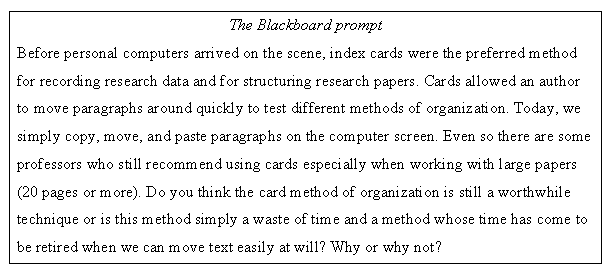 |
The Blackboard post serves three purposes:
- There are those who can articulate their thoughts better in writing than through oral speech therefore having a Blackboard post provides all my peers the opportunity to participate, say what they mean, and have a voice within “this” community.
- There are those who do not speak in class because of their own various and personal reasons. I cannot elaborate on these reasons because one, the reasons are numerous according to other academic scholars and my research in this phenomenon is inconclusive. Two because I would be making assumptions that may not necessarily true. In other words, I would be putting words into my peers mouths and not allowing them to have a voice within “this” community.”
- The Blackboard post will provide my peers with more time to articulate their answers and expand their answers if they choose to do so.
Why ask the same question in class and within the Blackboard post?
The purpose of using the same question in class and the Blackboard post is to emphasis the point that there is a useful purpose in using an old method of organization in the digital age.
The second purpose is to allow those who are better with oral communication than with written communication to share their thoughts within “this” community.
Why was the Blackboard question the last question that was asked in the presentation?
The last thing said in any reading or presentation is the one thing people are most likely to remember as cited in the reading by P. Dunn. I wanted my peers to consider the advantages of using an old method of organization as I have learned since ENGL 488 that this method does substantially help in the organization of large papers. The main purpose of “this” presentation is to pass an important writing tool to my peers that has been overlooked in the digital age.
Lessons learned
The purpose of lessons learned is a space to allow me to reflect on the presentation and analyze what went well, what went poorly, and how future presentations may be improved.
The purpose of the bulleted list is for future reference so I can quickly scan for various problems and attempt to improve these problems as a presenter in the future.
- Get a good night’s sleep the night before the presentation. This will help me to be more relaxed the next day when presenting and also with a rested mind, when unexpected changes occur before and during the presentation my mind can adjust quickly to the changes.
- Have a good meal the night before the presentation such as pasta. Pasta provides a long-term energy source necessary when presenting or performing on stage.
- Arrive early to set up and expect the unexpected.
- Try to have a back-up and a back-up plan for every step especially when it comes to computers, visual aids, and papers.
- Dress well and wear a suit. The suit sends a message that one takes themselves seriously as a presenter. If one conveys the message to the audience that one takes themselves seriously the audience takes the presenter seriously.
- Respect your audience, the respect usually comes back in return.
- During the question/answer period if one becomes flawed with an unexpected question admit you don’t know the answer. An audience respects an “I don’t know” more than a “bullshit artist” and the audience will remember.
- Rehearse one’s speech. This will reduce stammering and “um’s” and “ah’s.” If you loose your focus just pause, the audience will hang on your words and will never realize you lost your focus. Consider this purposeful dear air space. Dead air space is more effective than um’s” and ah’s.”
- Take whatever stance you will while presenting. For myself some motion is necessary, as standing in one place is too painful.
- Make very motion count and serve a purpose.
- Follow the audience. Many times the meaning-making I make of the presentation is not the same as the meaning-making the audience makes of the presentation. Clarify when necessary and if necessary repeat statements for emphasis.
- Conclude by summarizing your main points and delivering your main point last as this will be the most likely thing the audience will remember.
- Always thank your audience for their time and sign off with something to the effect that they were a wonderful audience.
What’s your process?
The background for this presentation begins in the Fall of 2005 when I am taking ENGL 395 the Writing Tutor Internship. Here I observe, study, and reflect on my own writing process and the writing processes of others. I learn a host of cookbook skills to aid me in tutoring others through the writing process. Little do I know what we are being taught only scratches the surface of the writing process description. Shown in the cell are my peers who are currently within the Shipka Spaces (fig. 1).
I read the assigned texts for the presentation introducing me to some alternative methods of the writing process. On the first read, I do not see how I can make an activity out of the particular reading and hope that my group members see something different. I do not know the two guys in my group and I know all too well as the semester wears on that things can and will quickly get out of control with other competing obligations and deadlines. Soon as the assignment is handed out I gather my members email addresses from their Blackboard posts and contact my group members via email introducing myself and requesting a day and time to meet so we can begin brainstorming (fig 2).
Eleven days later I receive an email from Hartman who tells me that he cannot meet this particular week. Nothing more is said. Wentworth never responds to his email. Now you say to yourself, "why not grab them in class?" I never get the opportunity. Both Hartman and Wentworth ALWAYS arrive late and split quickly when the session is over. Wentworth also has a tendency to not come to class. (fig 3).
The next day in class Hartman and Wentworth approach me after class and both say that they do not have time right now to get together and they have not read the article (fig. 4).
For the next week or two I hear the same message that they have not read the article and this is not a good time to meet. At this point I have a sneaky feeling that I am working with two slackers but there is nothing I can do because the presentation is nearly two months away. For now I just let it slide. Sunday, March 26, I have finally cleared off my desk of the following projects as they have been "passed forward": The Patent and the OED. The Food History of “This” Space, and the Culture History of “This” Space are no longer at a critical point and are proceeding forward on time. I need nothing from my peers on the Food "History" and the Culture "History" will require their involvement but we are all (myself and my peers) on data gathering. Now that these communications are out of the way I see the due dates for my 324 class presentation, my 407 class presentation, the next 324 assignment is to be handed out, in addition to the next 407 assignment. The 407 Presentation is the first coming up real fast with due dates. first is a meeting with Boss Shipka to discuss our presentation/activity design to detect problems, roadblocks, special needs, and red flags. We can't walk into a meeting having discussed nothing and not having even a half-baked plan. After the meeting and before presentation day we also need to submit a "blueprint" detailing exactly how the presentation/activity is suppose to work for a last quality/reality check. I send out an email to Hartman and Wentworth informing them now is the time to meet (fig 5).
We have no particular plan of what we are going to do and the instructions we have are to meet with Shipka at a minimum a week before our Heads-Up date to brainstorm. I get a response quickly this time from Hartman informing me this week is bad and he cannot meet. This is exactly why I wanted to do this over the course of the past two months. D. Wentworth never responds to my email. What else is new. Now I am becoming livid because this is 20% of my grade, I am starving myself to pay tuition, I am extremely close to graduating, and I am knocking myself dead to get the grades I need to go to grad school to get a better job and get out of Baltimore (fig. 6).
I do not have the time to play games with people. I read the text again and all I see as an activity in the exercise is the reordering of the Capital Punishment argument. I do not see other alternatives and decide I cannot waste time with all these deadlines looming over the horizon.
[Editors Note: Reflecting back on this project and this process narrative-sketch eighth years later, there was an alternative: I could have cut up an old argument paper of my own into individual index cards, handed it out, and had my peers make sense of that text versus the Capital Punishment argument. When you’re working under deadline and don’t have a second set of eyes to look at things it can sometimes be difficult to find new ways of seeing a solution. End of Editors Note.]
I create cards for six groups from the 18 cards McCarthy has suggested. I then break up the class into five groups. What I am attempting to do is have one man in every group and prevent from having an all women group. Gender may not have anything to do with how people think about organization, but I can not take this for chance. I am trying to balance the groups as evenly as possible. Next, I decide to break apart people who know each other in other classes and outside of class. I am trying to create groups of people who have never worked together and may not even know each other’s names. I am trying to eliminate any possible non-verbal communication. People who are somewhat familiar with each other may pick up on non-verbal clues that may influence the ordering of the group’s argument. I know there are some people in class who rarely if ever speak and try to separate them out also. In each group I place a known talker, someone who always has something to say. Again this could work against me because the talkative person may actually take over and the other members may slip into group think. My objective in creating these groups is get people to really work together in deciding how the paper should be organized.
I am not having a good time right now with any of this. I have only had four hours of sleep for days and have been waking ten miles a day back and forth to UMBC because the buses were not running during the Spring Break. I can’t afford to use the MTA all the time. Monday I hit my breaking point. I go to sleep and sleep right through the time I am supposed to be tutoring on the Monday we came back from Spring Break. Monday night I only get four hours of sleep again. I am reading Wersch and finding him complicated. I have to crawl through the reading because nearly every sentence causes me to reflect on what he has said. I’m enjoying the read, but I have to read it several times as I did in Engineering, Mathematics, Statistics, and Computer Science. Tuesday I walk into class burnt out. I want to participate but cannot get in a word edgewise. My clothes end up everywhere from shifting the desk around and I just give up with the stuff figuring I will pick it all up at the end of class. The class ends, Daniel darts out of the classroom and Phil only says, “Hey is that yer coat man?” I find it futile to even talk to Phil at this moment because Daniel has left. I need both of them at the same time in the same place so I don’t have to repeat everything (fig. 7).
I know now these guys are going to push this project back to the last minute. I go up to the 6th floor of the library to reflect on the situation (fig. 8). After my reflections I decide I have to take care of myself. I send Shipka an email explaining the group dynamics; a pre-heads up if you will. I forget that Shipka is having trouble reading attachments and send her an attachment. I receive a message reminding me of the problem with attachments. I copy the text into the body of the email and ship it back (fig. 9).
Thursday, April 30, Daniel is absent. Phil, who has not responded to my emails nor taken the time to speak with me after class on Tuesday, April 28 now says, “I got your email, Hey man, are we going to meet next week?” Now I am caught in between and I shouldn’t be. Phil never answered the email that was sent twice high priority with a received and chose not to respond. I felt ignored and began working by myself. I informed Shipka about my dilemma and I was given a green light to go ahead without them and protect my own interests. I continued moving forward. When Thursday arrives, I am three quarter’s done designing the entire activity. There are so few men in the class, I have no way to balance out the groups to reduce gender bias so I need Daniel and Phil also in the work groups. All I can do is break up my peers into workgroups of three with a man in each one. Regardless of the drama, I continue designing because this is presentation/activity is due before all the others. The
Thursday, April 30, marks off two other events in ENGL 407: one planned and expected, the other a surprise to us. Shipka walks in and decides to conduct her own presentation/activity: "Guess What's in my Pocket?" based on twenty questions (this was the surprise presentation/activity.) The purpose of the activity focused our minds on the construction of a narrative. The actions and conversation among our peers in playing the game formed a narrative. When we were asked to reflect upon that narrative in a Blackboard Post after the event it was interesting to note how each author had a slightly different focus in the narrative and the choices we made in forming that narrative re-telling the event.
For the scheduled presentation/activity we were instructed to bring in a re-purposed object (an object that we were using in a way that the creator of the object never intended.) Mine was a crude sketch of what we called a "motor bike" when we were kids. when I was in my teens we had a craze among the boys of taking horizontal shaft lawn mover engine bolting it to a bicycle and then locating an old washing machine an removing the clutch and the flywheel pulley. The clutch was put on the engine output shaft, the pulley was bolted to the rear wheel with a few of blocks of wood and a fan belt ran around the clutch and the pulley powering the bicycle. These motorbikes quite close in construction to the first motorcycles built in the 1890's and 1900's. I didn't expect that anyone would guess what it was but surprisingly no one had ever seen or heard of such a thing. Any kid who was semi-mechanically inclined in my neighborhood built one and ran it on the street. I always thought that kids all over the country thought of this idea eventually. It turned out that my experience was not only regional down to the neighborhood but that when I speak to others, no one else had this experience.
Friday, March 31, I look at my groups and find they are all wrong because I have six groups but there are only 15 people. I try every possible combination to place a man in each group, break up clicks, put people in groups who do not normally speak with each other, and position people in places they do not normally sit. There are too many combinations and no matter how I try I can not seem to come up with a combination that satisfies me (fig. 11). After many tries and various scraps of paper I settle on a design and hope this design will create enough tension (fig. 12). I stay up all night and go to work at 12 noon without sleeping. Not sleeping pays off. I have the invitations, the invitation envelopes, the take home activity sheets, the wall group numbers, the blueprint, the entrance check lists, the group activity cards, and group cards to secure to the presentation desk so I may easily sort out the individual answers for performing the tally. All the various components of the presentation/activity are in place and ready to go (fig. 13).
Friday, April 14, I took over for one of my co-workers in the Writing Center and in walks Yolanda Martin. We have a little chitchat before helping her with her paper in
Later the same day I check all the documentation for this presentation/activity and also check that I have accounted for every design decision in Goals and Choices. I found some gaping holes in my accounting for decisions made and fill them in. The UMBC email is not functioning so I cannot see Shipka’s answer to my last Heads-Up statement or her advice of my design decisions (fig. 15).
Sunday I receive an email from Shipka advising me to drop some of my requirements as I am getting a little macabre in my design. Shipka never said that I was getting macabre in my design. I come to this realization myself. I have to pull back my own personal vendetta and move on with a reasonable presentation/activity design for all concerned. I'm just getting carried away with my own thought processes and Shipka's comments cause me to re-focus on the matter at hand.
Shipka also advises not providing too much of heads-up to my peers as to what to expect when they arrive at the presentation/activity so I remove the requirements as advised from the presentation/activity but retain them as design choices not utilized in Goals and Choices. I continue the process of refining the presentation (fig. 16).
Monday, April 17, I go down to the Writing Center because I know Naphtali, Steven, Matt, and Greg will be dropping in and out. This allows me to catch everyone in one place to exchange ideas and string together any loose ends. I check my email at 6:20 p.m. and there is an email from Shipka. The news is not good for either the
I really have to think this through carefully because this entire presentation/activity is entirely in place, but continues to come back to haunt me like a dead man’s ghost. I send Shipka back an email putting up the white surrender flag. The body of the email reads, “Okay, I am at a loss. Everything is ready to go. The Blueprint is written. The Flowchart documenting the flow of the presentation is done. The Goals and Choices are done. The processes portion of Goals and Choices simply gets a new paragraph added daily. In my email dated 03/28/2006 I heavily detailed that I was going to have my peers construct an argument using pre-made note cards of the death penalty argument in groups to demonstrate the useful purpose of an old method of organization in the digital age. Nothing was said at that time so I continued working on this presentation. I am at a complete loss now. I have been working across four projects at the same time. The 324 2nd communication objective is only a half-baked idea so far and the 407 2nd communicative objective hasn't even been researched. Three plates are spinning and the fourth plate is lying on the floor, which needs to be set in motion. What do you suggest? Chris.”
At 9:15 p.m. an email comes in from Shipka with good news and bittersweet news. The good news is about the 324 presentation/activity, that we have secured the Mac lab. The bittersweet news is that Shipka’s answer to this presentation/activity is “I guess if all is ready to go, it's ready to go.” Unfortunately, for better or worse “this” presentation/activity is ready to go regardless if any of us like it. There is just too much time already invested in it. Neither of us are happy with this presentation and somehow the whole thing must have fell through the cracks (fig. 18).
The next day in the Writing Center, I have a discussion with Steven Norfolk about our 324 presentation/activity about our dress when presenting. His suggestion of a light colored suit gets pulled into “this” presentation. Anything and everything possible has to be done to make “this” presentation lighter in tone because of the content of the text being used. Once again, if I had used one of my own papers for re-organizing I would have never had this design problem to begin with. (fig. 19).
As I’m putting the finishing touches on things for the night I find myself staring at the sticker of the portfolio I just bought. I begin removing the label when inspiration hits: re-purpose the label. Make the entire presentation as a marketable traveling kit to demonstrate in schools why an old school method of organization of using Rhetorical Proof Cards are still valuable in the digital age. This will draw the entire package together making it a container. At the same time this is where I get the idea of treating this as grade school and I run out and purchase some "kiddie stickers" to hand out at the presentation/activity sort of like a teacher handing out little sticky gold stars for the day to make the students feel good about themselves for the day and rewarding a job well done. Rhetorically, the stickers serve to "lighten up" the presentation further (fig. 20).
As hard as one tries, things don’t always go as planned. People are unpredictable. After the ENGL 324 class ended I began to setup for the 407 presentation/activity. Caitlin Wychgram who is usually never 15 minutes early, walks in, sees me in a suit standing at the front of the class, and knows something is up. The fact that I am in a suit and at the front of the class immediately sends a semiotic message that I am presenting today. As is usual in the “Shipka Spaces” the first question Caitlin asks is “What are we doing today?” Everyone wants a one-up on the next guy. I assure her, “If you did the readings, the presentation will be quite predictable” and I drop the conversation. Caitlin picks up a set of the cards and tries to sneak a peek at the deck of cards to get a heads-up. I inform her with a smile, “Ah, ah, ah, don’t cheat! Besides I anticipated peeking and you’ll have trouble because all the cards are turned facing against each other making it more difficult to see.” I get a “Oh, you’re no fun,” from Caitlin and reply with a smile “I know, ask my ex-wife” (fig. 21).
I wanted to seat people in their pre-arranged groups but I loose control of the room and seating people. Error in timing sets up a less formal atmosphere. I allow my peers to enter one by one and then ask them to seat in particular marked parts of the room. I do not get a chance to put up my own numbering system but this is really not important because I have a seating map on the desk. There are leftover numbering systems from other presentations and what type of designation system is used is unimportant for the task. I just let my peers enter into the room and direct them where to sit. I inform a few of my peers that we are setting up in workgroups for an activity. Some of my peers recognize that they are nowhere near where they normally sit. Some discomfort sets in for some. Two of my peers notice my directions do not agree with the numbering schemes on the walls. I point to the area to sit in and they respond, “But that has a number two?” I reply, “Oh just go over there and chat with your neighbor for a few minutes. Six of one or half a dozen of the other, after all what’s in a number?” No one recognizes that this statement is a re-contextualization from the first episode of The Prisoner “Arrival” where Patrick McGoohan gives his not so famous speech to Number Two that “I refuse to be filed, indexed, briefed, de-briefed or numbered. My life is my own.” Number two retorts, “Six of one or half a dozen of the other, after all what’s in a number? Be seeing you Number Six.
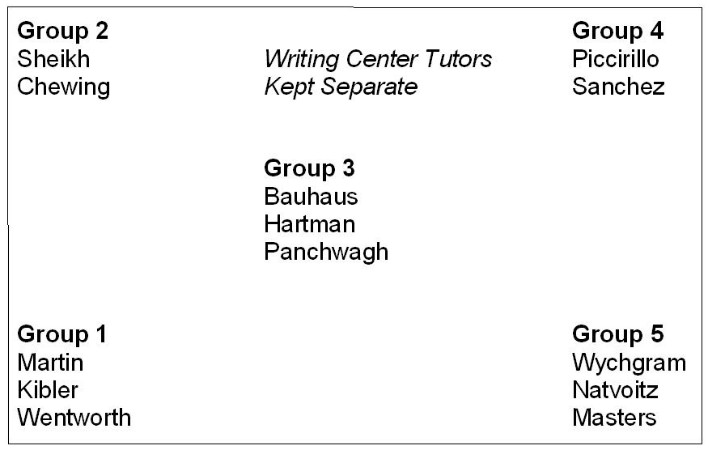
At 1:01 p.m. I find we have two people missing: Crystal Gatton who was in ENGL 324 for the day and Margaret deLauney is missing. This means I have two groups consisting of two people each. I think of combining these two groups to one group of four people but notice I would be combining two Writing Center tutors. This could become a disadvantage to the other groups and even the two remaining group members. Elizabeth Piccirillo and Bill Chewning might get so involved with the task that Amber Sheikh and Erwin Sanchez may never contribute to the task. I decide to keep the two groups apart because as two’s they will have to work with each other.
I ask Shipka if Crystal and Margaret said they would be absent but Shipka knows nothing and is a little peeved because she told all of us to let her know when we would be out. My presentation is an example of why Shipka wants a heads-up. We all need to know if someone will not be within the space to participate specifically because changes in activities may have to be changed mid-stream. The reason I asked is because I know I have to move forward so if there was no word I cannot wait. The show must go on and I begin the presentation.
I find myself a little nervous but my bigger problem is being unrehearsed so I am not in my smoothest speaking form. I really shouldn’t be nervous at all because I have worked in sales for more than ten years and I am accustomed to being the center of attention, the person every one comes to and running my own show. I am really striving not to be too formal because the argument of the death penalty is volatile enough. I make it explicitly clear twice that we are not arguing the ethics of the death penalty even though that is the premise the argument revolves around. I make sure my peers understand that the activity is about the affordances and the constraints of using index cards as a method of organization (fig. 22).
I tell my peers to begin and I observe the room for a few minutes while they work. It becomes interesting how each group decides how to approach the kinesthetics of the task. Two groups use two desks to lay out all the cards visually. I expected some might use the floor but none do. Yolanda Martin’s group takes an interesting approach. Their group has already decided what position to argue from. One person reads the card to the others and they decide whether they will use the card for support. Evidently these are auditory learners.
Also of interest is who takes the lead in a leaderless activity. I figured Yolanda would take over but she looks like I did when she came down last Friday to the Writing Center for help with her Shakespeare paper. She is not her strong self but tired and weary today. Daniel Wentworth was the person who actually performed the kinesthetic task in the exercise. I was almost sure Yolanda would take over.
Bill takes over with Amber and this I expected because of Amber’s quiet nature and maybe because Bill was a Writing Center tutor, in addition to his training to become a teacher. He seems to naturally take charge when he can in a classroom. Bill takes the kinesthetic task of shuffling the cards.
With Elisabeth and Erwin I expect Elisabeth’s strong will to take over and she does. The effort is collaborative though because Elisabeth loves input. Elisabeth takes the lead in the kinesthetic role of shuffling the cards.
Caitlin rises as a surprise. I thought Greg Masters or Sarah Natvoitz might take the lead. This comes as a surprise because Caitlin is rather quiet and spends her time analyzing people, places, and things before she leaps into anything. Greg I know tends to be laid-back and allows others to take charge because of his easygoing nature. This does not mean he does not provide input, but rather he prefers others to lead. Later, I find out that Caitlin’s argument has anything but linear structure so it appears she dominates its construction and the group.
After a few minutes I am bored so I decide to visit each group to find out how they are doing with the task. This also puts me at ease because now I feel more like a co-learner than a facilitator. People usually like when one comes around because it shows an interest in the people you are working with and puts them at ease also. I detect some tension in Yolanda Martin’s group when I speak with them. This could be because of the physical location within the classroom, the fact that Yolanda is not feeling well or that they are working on a death penalty argument. I get the feeling they are really not enjoying this exercise.
I go over to Bill and Amber, ask them how they are doing and Bill wants to know if he can ask questions. I figure why not, let’s open the structure of the presentation and allow my peers to lead me a little in what kind of sense they are making of this activity. This may also make them forget the argument revolves around the death penalty.
Bill points out that two cards have anomalies as far as their statistical considerations. I had not read the cards that well and told him they were right out of the reading but I did see his point. I think quickly and tell him not to worry about the anomalies. If you want do not use them, then just negate them.
I walk up to Brittany’s group and they are not clear as to how to position the argument. My walking around is paying off because there is now less structure and I am making myself approachable. My peers are coming to realize the constraints are not as tight as they thought. They ask if they can just use one side to the argument. I forgot that Brittany was the journalist. I think about the question and say yes, “If you want to consider it as a newspaper editorial where many times they never acknowledge the other side that would be fine.” The exercise is less about the argument and more about structuring any paper, magazine or journal article. The activity is about shoving the text around to see new arguments.
I speak with Elizabeth and they are doing well. She just hates the card thing itself and just has a strong opinion about the cards. I do not say anything because I never use them either. I tried them for my last paper with Dr. Carpenter and dropped the whole method. I later learn Elizabeth and I handle organization similarly.
When I walk up to Caitlin’s group there is a T-shaped argument on the desk. This is definitely a visual-kinesthetic learner like myself. She is in the sciences and prefers being in the lab. So do I. I am a visual hands-on person. If I could have afforded the Tinkertoys, she would have constructed something unexpected. During the summer I will have to get some Tinkertoys and Leggos to play a similar game in the "Shipka Spaces" to see how people will use them for meaning-making (fig. 23).
It was interesting to note that Liz, Bill, Caitlin, Daniel, and Brittany Bauhaus made up the 10% of the kinesthetic learners in the group. I am too, but I am the presenter so this is never revealed.
The task practically ends itself. Everyone is waiting for Caitlin’s group so I give them a few more minutes to finish up. When they are done it is a little difficult to get back on track because of the noise, but my peers settle in. I deliver some closing remarks and ask a few prompt questions.
The questions are not working all that well but I did observe different strategies and different ways of seeing in each group. I bring these points out for discussion and different strategies are discussed in handling the task. This opens everyone up. We are now talking about the writing process. Elisabeth is focused in this area and her banter gets others to speak up. I have found what the wet clay wants to become. A discussion of methods of organization. Does the paper have to be linear? Can the structure be non-linear?
The discussion continues right up to the end of class. Elisabeth stops mid-sentence and let’s us know it is 2:15 p.m. and time to end. If not for her time call the conversation would have continued. I did not even get a chance to thank them for being a terrific audience. My presentation skills may not have been that of a seasoned professional but I actually facilitated without being a facilitator. With a poke here and a poke there with a focus question, my peers told me what they made of this piece of wet clay. They saw this activity as a pre-cursor for discussing the writing process (fig. 24).
The presentation ends with the last sketch (fig. 25).
The Home Page · The Integral Worm · My Resume · My Show Car · My White Papers · Organizations I Belong To
Contact Me · FAQ · Useful Links