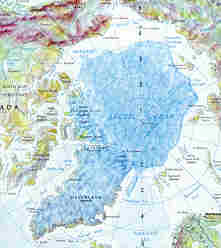
At the top of the world fall is just a few brief weeks before a very harsh winter that could last up to nine months. The North Pole is mainly water almost entirely surrounded by land. This water absorbs heat during the summer and therefore moderates the temperatures during the winter. During the fall when the salt water's temperature begins to drop to around 28 degrees sea ice begins to form. This large sheet of ice can cover an area of about 1900 to 2500 miles and be as much as 13 feet thick. Adaptations The adaptations to survive for most amimals in the North Pole act to minimize heat loss rather than increase heat production. Most of the adaptations of animals are given to them by nature but a few such as the caribou's migration are necessary in order for the animals to survive. Warm blooded animal's body temperature stays close to the same constantly, however cold-blooded animals body temperatures go up and down according to environmental temperature. For this reason many cold-blooded animals in the North Pole must migrate constantly to find heat. This includes many types of fish and invertabrates. 
The white color of polar animals furs and feathers acts as camouflage from predators as well as provide insulation to keep in body heat. This includes many animals such as the polar bear and many types of arctic birds. Other animals dig underground and sleep the winter out in dens. Most of these animals aren't exactly hibernating because their temperature doesn't drop below normal and they can be woke up. These adaptations are the key to staying alive and active in the subzero temperatures of this frigid environment. |
 During most of the winter months the sun never rises. In the darkness the temperature could drop as low as minus 128 degrees fahrenheit, or it sometimes just hovers around minus 40 degrees fahrenheit. Winds blow at speeds of over 200 miles per hour. Compared to the tropical or temperate climates the poles support relatively few forms of life. Yet what most people don't know is that life flourishes in this harsh environment. The plants and animals that have adapted exist in great quantities.