
This majestic animal lives in the barren areas of northern Canada,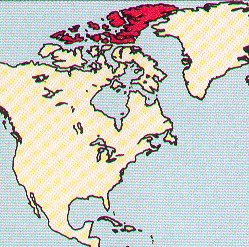 but not on the permenant sheets of sea ice. Here it hunts almost every other living animal which includes lemmings, arctic hares, musk ox, and caribou. Many of these animals are grazing animals. This means that they must roam for miles to find suitable grass to eat. For this reason the wolves must travel up to 800 miles at times while following his prey.
A full grown caribou is much to powerful for a single wolf to take down alone, so wolves always hunt together when hunting very large prey. It is almost impossible to perform a surprise attack on the wide open grassy tundra.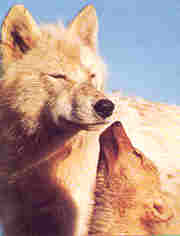 Many times the caribou or musk ox are in a defensive stance by the time the wolves get there. When they do this the strong healthy male musk ox surround the young, sick or injured members of the group. When this happens there is little the wolves can do. Most of the time they will circle the herd and attack with little quick snaps which causes the animals to shift about. When there is an opening in the group the wolves immediatly take the opportunity. After the entire group scatters leaving all of the young ones to take care of themselves the wolves single out a member and begin the chase. Once the chase is over the wolves have a very large meal that could last the entire pack for at least a few days. Many times the caribou or musk ox are in a defensive stance by the time the wolves get there. When they do this the strong healthy male musk ox surround the young, sick or injured members of the group. When this happens there is little the wolves can do. Most of the time they will circle the herd and attack with little quick snaps which causes the animals to shift about. When there is an opening in the group the wolves immediatly take the opportunity. After the entire group scatters leaving all of the young ones to take care of themselves the wolves single out a member and begin the chase. Once the chase is over the wolves have a very large meal that could last the entire pack for at least a few days.
Throughout the fall and winter the wolves keep on the move in search of sufficient food for the harsh winter. They continue in this way until the mating season begins in early March. After mating a female wolf will leave the pack to find a nursery den or, if she has no luck, she may dig one herself.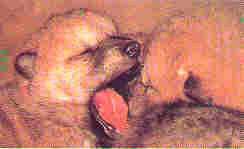 Arctic wolf cubs are born deaf, blind, and completely helpless. The mother relies on her mate to supply the food she needs. After a month the cubs are able to eat meat. When this happens it is a responsiblity of the whole pack to feed the cubs until they are able to live away from the pack. Arctic wolf cubs are born deaf, blind, and completely helpless. The mother relies on her mate to supply the food she needs. After a month the cubs are able to eat meat. When this happens it is a responsiblity of the whole pack to feed the cubs until they are able to live away from the pack.
The Arctic Wolf is one of the few wolves not threatened by humans. They are still found over it's original range. It rarely encounters men but when it does they will usually run away.
The wolf has many adaptations crucial to surviving in the Arctic such as stamina and it also has the perfect coat of fur to help keep hidden from prey or enemies. It's body also stores heat during the short summer into a fat layer just under the skin that could get up to two inches thick.
|