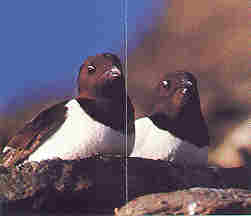
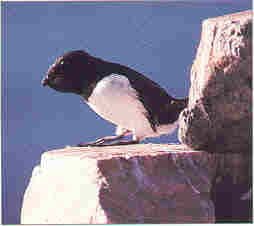
 Looking somewhat In summer, thousands of pairs of Dovekies crowd for nesting space along the rocky, jagged shore of many Arctic islands. Most of the time these very large colonies breed within ten to fifteen miles from the sea. The Dovekie's favorite nesting areas are places that are protected from the very high winds coming off of the ocean and where there isn't very much snow. The breeding season usually begins in April to early May. After coming together in large flocks offshore for a few days they fly inland to find their mate from the previous year. Most of the time they will use their old nesting place from the previous year as well. Usually this nest is located in a large crevice in a rock, under a boulder, or possibly woven into a large pile of rocky debris. The Dovekie's even line the nest with pebbles or dried grass. Dovekie's only lay one egg at a time so it is important that they protect the egg constantly. The egg is very large compared to the female's body so the chick will have more time to develop before it hatches. Both of the parents take turns incubating the egg and once the chick is born, it's parents must brood it until it can keep warm on it's own. A few weeks later the chick is guided to the sea by it's father and it will stay with him until it becomes independent. At the end of summer the colonies break up, but most of the Dovekies stay offshore of the island for a while, weaving their way through the ice flows where they feed on plankton, young fish, marine worms, and mollusks. Dovekies don't have very many of the adaptations needed to survive in the Arctic which is one of the reasons why it must fly south for the winter, but some do stay behind. However, it's webbed feet do come in handy when diving for food or swimming through ice flows. It also has a very thick coat of feathers which keeps the dovekie insulated during the long winter months. |
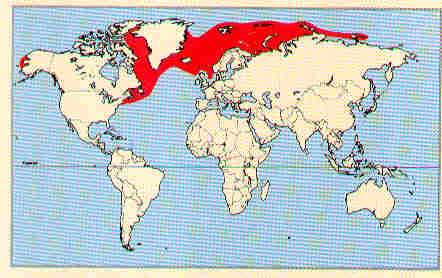 like a miniature penguin, the Dovekie spends much of it's time swimming through the ice flows where it finds plenty of plankton which is it's main source of food. The Dovekie is mainly found off the coast of Alaska, Canada, Greenland, Scandinavia, and Siberia. It is sometimes found as far south as the New England coast during the winter.