Ken Powers knew the
potential dangers of having his stomach stapled, but to a man
who had tipped the scales at 475 pounds, those risks didn't much
matter.
"I had this thought: If I die on the operating table,
having the surgery to try to better my life, I thought it was a
better thing to do than to live the way I was living, which, in
my opinion, I was kind of waiting to die anyway," he said.
By the tens of thousands, morbidly obese people who have
failed at diets, support groups and exercise programs are
turning to surgery to lose weight.
In 1998, there were 25,800 obesity-related operations, most
of them gastric-bypass procedures commonly known as stomach
stapling. This year, the American Society for Bariatric Surgery
estimates 103,200 operations.
Questions about the risks and growing use of the procedures
surfaced in recent weeks after two patients in New England died
during stomach-stapling surgeries. However, obesity specialists
say the procedure is safer than it has ever been — and that is
contributing to the growing popularity.
And for most patients, the risk of not having the surgery is
greater.
"It's an operation that helps cure people of this
disease which is life-threatening. People see it as some type of
cosmetic surgery, when it's not. More patients die waiting for
surgery than die after surgery," said Dr. Janey Pratt, a
surgeon at the Massachusetts General Hospital Weight Center in
Boston, which does about 300 gastric bypasses a year.
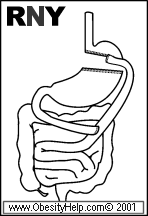
The operation involves using staples or stitches to close off
part of the stomach to form a small pouch about the size of an
egg, which limits how much food the person can eat. A part of
the small intestine also is bypassed to reduce nutrient
absorption.
Risks include wound infections, stomach leaks and
occasionally life-threatening blood clots.
The International Bariatric Surgery Registry estimates one in
1,000 patients will die within four weeks of the surgery, and
three in 1,000 will die within three months. Some surgeons in
the field put the fatality rate as high as one in 100 who have
the surgery.
Powers, 42, of Worcester, was lucky. Even carrying more than
400 pounds on his 5-foot-11 frame, he had not developed many of
the common ailments associated with obesity. Still, sleep was
fitful, and walking, particularly upstairs, was exhausting. And
he lived in a fourth-floor apartment.
Powers underwent laparoscopic gastric bypass surgery in May
2001 and now weighs 280 pounds. He believes the surgery likely
staved off the onset of diabetes, and he has had no
complications.
Surgery is not used to treat minor obesity. Candidates must
be 100 pounds above their ideal body weight and have failed at
other attempts at weight loss.
Still, an estimated 15 million people would qualify for the
surgery, said Dr. Scott Shikora, head of bariatric surgery at
Tufts-New England Medical Center in Boston. Tufts, which has the
city's largest obesity surgery program, closed to new patients
for nearly six months earlier this year to catch up with its
backlog of patients. At one point, there was a waiting list of
500 patients, Shikora said.
"It's no longer considered snake oil or some out there
treatment that doesn't work," Shikora said.
Many insurance carriers have started to cover the procedures,
finding it cheaper to pay for the surgery than treating
obesity-related health problems such as diabetes and high blood
pressure. Companies continue to feel pressure to cover more
obesity surgeries, but are cautious because of the risks, said
Susan Pisano, spokeswoman for the combined American Association
of Health Plans, Health Insurance Association of America.
"When we do read about people who do have complications,
I think that only serves to reinforce the caution," she
said.
Powers agrees. He worries that the growing popularity and the
success of celebrities such as NBC "Today" weatherman
Al Roker and singer Carnie Wilson may make it look like a
simple, convenient option, especially for young people. "I
don't think you see all the pain involved. You see the finished
product," he said. "Carnie Wilson looks great and Al
Roker looks like a million bucks, but you don't see the post-op
stuff. You eat half an English muffin and you throw up. There's
certain foods it takes you a year to eat again. It's not a diet.
You have to be ready to abandon the way that you've lived with
food for the rest of your life."