Signs of the Attack
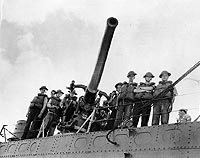
http://www.history.navy.mil/photos/images/h97000/h97446c.htm
The crew of the USS Ward, which
fired at and sank an unidentified
Japanese submarine just hours
before the attack on Pearl Harbor.
The Submarine
The first sign of anything unusual on December 7, 1941, was a submarine periscope spotted by U.S. minesweeper Condor. Three hours later the U.S. destroyer, Ward, fired at the submarine, with the second shot hitting and sinking the submarine. To assure that the submarine had sunk, the Ward fired a full pattern of depth charges. Will Lehner, a sailor on the Ward said, “We, in reality, had fired the first shot of World War II by sinking an unidentified submarine in restricted waters.” The Ward sent a message telling of its attack on the submarine to headquarters. As a standard procedure at the time, the message was decoded, paraphrased, and then sent to the Commander in Chief of the Pacific fleet, Admiral Husband E. Kimmel. This was done to avoid an exact duplicate that might assist enemy code breakers. Due to many recent reports of submarines that were false, Kimmel decided to wait for verification before doing anything about it.
After the attack, Kimmel was found guilty of “derelictions of duty” and “errors of duty.” However, at the conclusion of the war, the conviction of “derelictions of duty” was reversed.
The Planes
By the time the submarine had sunk, the Japanese already had 183 fighters, bombers, and torpedo planes in the air, and the U.S. still did not know that an attack was underway. About an hour after these planes took off, two privates at the Army’s Opana Mobile Radar Station on Hawaii saw about 50 planes on the radar screen and notified the radar hub in Fort Shafter, Hawaii. An army lieutenant got the report from Opana, but thought it was U.S. B-17 Flying Fortress bombers flying from California to Hawaii. For security reasons he could not release that information to Opana and just told them that it was not anything to be concerned about. At this point the Japanese planes were about 70 miles from Pearl Harbor.
Home
Background
Signs of the Attack
The Attack
Aftermath
The U.S. Responds
Bibliography

