











|
An integrated circuit (IC) is a piece of semiconductor material, most commonly silicon and often referred to as a chip. Circuit components are built into and on one face (monolithic) and inter-connected by metal tracks to form a complex electrical circuit. Key features are small size, high complexity, low cost and very high reliability. Penalties are limited range of component values available and unwanted interactions caused by close proximity of circuit components on the same chip. IC designer’s role is to achieve required circuit functionality despite IC limitations due to unwanted interactions. |
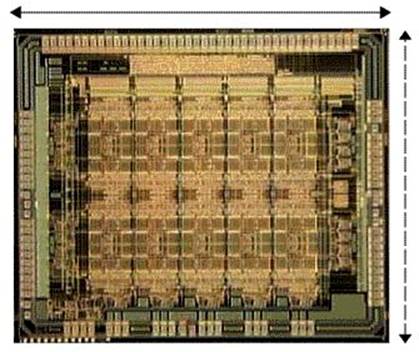
Typically 1 cm
Containing up to 1 million components |
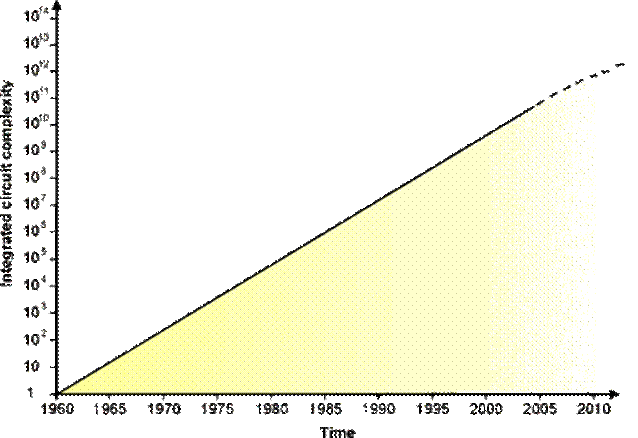
Graph 1 - Integrated circuit complexity versus time What’s CMOS ? Complementary Metal-Oxide Semiconductors (CMOS) logic devices are the most common devices used today in the high density, large number transistor count circuits found in everything from complex microprocessor integrated circuits to signal processing and communication circuits. The CMOS structure is popular because of its inherent lower power requirements, high operating clock speed, and ease of implementation at the transistor level. Students in introductory electronic circuits classes can gain insight into the operation of these CMOS devices through a few exercises in constructing simple CMOS combinational logic circuits such as AND, NAND gates, OR, NOR gates and INVERTERS. These circuits are created using both p and n-channel Metal-Oxide Semiconductor Field Effect Transistors (MOSFET) connected in complementary configurations. The complementary p-channel and n-channel transistor networks are used to connect the output of the logic device to the either the VDD or VSS power supply rails for a given input logic state. In a simplified view, the MOSFET transistors can be treated as simple switches. This is adequate for an introduction to simple CMOS circuits where switching speeds, propagation delays, drive capability, and rise and fall times are of little concern.
|