|
In regard to links throughout this Site, you may see a word that is underlined but NOT highlighted blue like a link, It IS a link and these are words that can be found in our Dictionary. In case you're unfamiliar with some of the fishing lingo.
Other Websites
FUNdamentals
of Baseball
|
Catfish
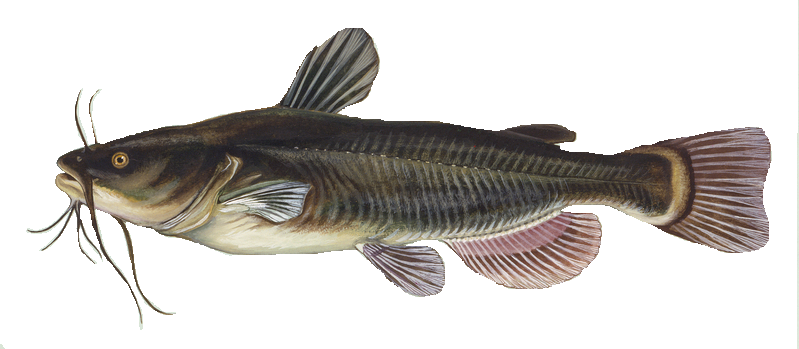
Catfish are a diverse group of ray-finned fish. Named for their prominent barbels, which resemble a cat's whiskers, catfish range in size and behavior. There are armour-plated types and there are also naked types, neither having scales. Despite their name, not all catfish have prominent barbel. Members of the Siluriformes order are defined by features of the skull and swimbladder. Catfish are of considerable commercial importance; many of the larger species are farmed or fished for food. Many catfish are nocturnal. Most catfish are bottom feeders. In general, they are negatively buoyant, which means that they will usually sink rather than float due to a reduced gas bladder and a heavy, bony head. Catfish have a variety of body shapes, though most have a cylindrical body with a flattened ventrum to allow for benthic feeding. A flattened head allows for digging through the substrate as well as perhaps serving as a hydrofoil. Some have a mouth that can expand to a large size and contains no incisiform teeth; catfish generally feed through suction or gulping rather than biting and cutting prey. However, some families have a suckermouth that allows them to fasten themselves to objects in fast-moving water
While
the vast majority of catfish are harmless to humans, a few species
are known to present some risk. Many catfish species have
“stings” (actually non-venomous in most cases) embedded
behind their fins; thus precautions must be taken when handling them. How To Catch Catfish
Catfish
always seem hungry and eager to bite.
Catfish
are widespread, abundant in many waters, grow very large and are
quite delicious, too.
If
you want to increase the odds that you’ll hook and land more
catfish it’s important to realize that while catfishing
isn’t a complicated sport, neither should it be oversimplified.
You can’t just plop down in a lawn chair by the water’s
edge, make a cast and expect to catch cats. Use the Right Bait Catfish exceeding 10 pounds primarily eat fish, so when targeting heavyweights, you’ll be more successful if you use fish baits. Some, like minnows and goldfish, can be purchased at bait shops. Others are collected using hook and line, bait traps, cast nets or specialty products like sabiki rigs (check local regulations first). At times live crayfish are an excellent bait but more often the meat from the tail is the top producer. Just remove the shell from the tail of the crayfish and place the white meat on the hook. Crayfish tails are best used still fishing with or without a bobber since they don't stay on the hook very well. They produce the best results from spring to late fall when they are readily available to the catfish. Oily baitfish such as shad, herring and suckers are tops. Others to try include carp, chubs, goldeyes and sunfish. Use live fish for big flatheads; they rarely eat anything else. Jumbo blues and channels will eat fish alive or dead, including cut-baits prepared by slicing fresh baitfish into chunks or fillets. Be sure, however, the baits are freshly caught. Fresh is best.
Unlike
heavyweight cats, which rarely eat anything but fish, eating-size
whisker fish weighing just a few pounds aren’t finicky about
food. Among the best baits are night
crawlers, minnows and crayfish,
which you can buy at bait shops or collect yourself. Commercial and homemade “stinkbaits” also work great on small catfish. The sporting goods departments of discount stores often carry a variety in the form of dough baits, dip baits, sponge baits and tube baits. Because stinkbaits are soft, you might need specialty items to fish with them, including catfish “worms” (ribbed, soft-plastic lures used for fishing dip bait), sponge hooks or spring-wound dough-bait treble hooks. Having trouble obtaining bait? Don’t fret. Head for the nearest grocery. Fresh chicken liver is one of the best catfish baits. For trophy blue cats, try Hormel Spam. A chunk of this spicy canned meat caught a former 116-pound world record. Jumbo channel cats love cheap hot dogs. Other supermarket items that work include shrimp, squid and cheese and even unusual items such as dog food, grapes, raisins and soap! Yes, they really work. Leave Hook Points Exposed Many catfish fans get frustrated when they can’t hook fish that bite. It’s a common complaint, but there’s a simple solution: Fish with the barb of your hook exposed. You may be one of the many anglers who have been told the hook must be hidden or catfish will avoid the bait. Actually, nothing could be further from the truth. Catfish aren’t smart enough to know what a hook is, and if you bury your hook in bait, especially the barbed end, the hook will have to penetrate through your bait before it can penetrate the mouth of a catfish. This results is a lot of missed fish.
When
fishing baitfish, push the hook once through the lips, back, or
narrow part of the tail, and leave the point exposed. Exposed hooks mean more rigs lost to snags. But a few lost hooks and baits are a small investment for the extra cats you’ll catch. Understand Weather Effects
Catfish
don’t feed 24/7, year-round. For example, during periods of stormy weather, catfish anglers often get frustrated trying to figure out the best fishing patterns. One day, catfish may seem ravenous; the next, they have lockjaw. This pattern won’t always hold true, but as a general rule, the best fishing is right before a storm when atmospheric pressure begins to drop. Catfish often quit feeding the day or two before a front appears and seem insatiable when it arrives. Feeding activity peaks as the front approaches and remains at a high level until it passes through. On the day after the storm has passed, fishing success is usually off considerably, but a day or two later, the cats will be back to normal feeding patterns. To enjoy the best catfishing, you should be ready to hit the water when there’s a combination of a falling barometer reading and a south to east wind, indicators of a weather change ahead. Channel Your Efforts Some of the best lake and pond structures for catfishing are creek and river channels meandering across the bottom. Most such structures must be located using sonar, but catfishing on channels and channel edges can dramatically improve your catfish catch year-round. The main channel in a lake or pond acts like a major highway, leading catfish from one part of the impoundment to another. Intersecting creek arms and smaller channels act as secondary roads leading fish toward shoreline areas. Catfish also hold in deep water that falls off into the channel. Look for fish near a feature on the ledge distinguishing it from surrounding areas: a brushpile, a point on the drop-off, an adjacent hump, a pocket cutting into the bank. Some cats relate to the upper edge of channels, but big cats prefer deeper water near the lower edge if there’s plenty of well-oxygenated water. Big catfish also like the outside turns of channel bends, locations near channel junctions and deep channel edges near dams. Tightlining with baitfish is the best method for taking catfish on channel drops. During the day, anchor in the shallowest water near the drop-off and cast to deeper water. At night, catfish move into shallows to feed. Then you should anchor in deep water and cast to the shallows. You also can work your rig directly beneath the boat, keeping your line perpendicular to your rod tip. Fishing this way increases sensitivity to strikes. Vary depth by moving up and down the drop-off, using a trolling motor, wind or current to drift along the channel. Sit, Wait, Hook and Catch Still-fishing for catfish is a sit-and-wait game. You present your bait on or near the bottom, then wait for a catfish to find it. You can still-fish from the bank, as most catfish anglers do, or from a stationary boat. When still-fishing from shore, it’s important to set up where action will be best. The area just below a river dam provides some of the best channel cat action, especially if you can cast to the slack-water areas between open gates. Many bank fishermen set up below tributaries, or at the junction of two rivers. Fishing near fallen trees at the head of a deep pool on an outside bend of the river also can lead to good catches. When still-fishing from a boat, carry two anchors to position your craft sideways in good holes. This way your rods are spread out to cover more water and avoid tangles. Try to pinpoint prime catfishing areas such as channel edges and humps, then narrow your fishing zones down to a few best spots: a stump field near the channel edge, for example, or a large snag along a riprapped bank. Position your boat for best access to the structure you’ve chosen, then cast your bait to that spot and wait for a bite. Try Drift-Fishing Drift-fishing is an active approach that helps you help the cats find your bait. You can drift-fish in a boat or drift-fish your bait below a bobber. When in a boat, use a drift rig comprised of a bottom-bouncer sinker placed on the line above a barrel swivel to which is attached a 2 to 3 foot leader with a 4/0 hook on the end. A small bobber added on the leader just above the hook floats the bait above the bottom so catfish can see it. Drift with the wind or using a trolling motor, moving back and forth over areas with catfish-attracting structure. When wading or bank fishing on a river, you can drift your bait beneath a bobber. This allows the bait to move naturally downstream, responding to the current. Use a slip-bobber on the line above your baited hook, and as the rig drifts, guide it alongside catfish-holding structure and cover. Keep a tight line at all times, and release line as the bait moves downsteam. Drift by one side of a hole, then down the other and finally right down the middle. If possible, shift sides of the river now and then to present baits in every likely spot as you move. Keep your rod tip high when drifting a bobber rig. This keeps most of the line off the water, resulting in better rig control and hook sets. Get in a Groove Tailwaters below big-river dams are among the very best catfishing hotspots. Big tailwater catfish favor churning, well-oxygenated water where baitfish are readily available, but to conserve energy, they seek slack-water holding spots within these areas. The “grooves” of slower-moving water between open gates or running turbines offer just these conditions. When gates or turbines are discharging water, the fastest flow is in the center of the discharge, and the slowest water is on the outer edges of the flow. The surface water all appears to be moving at the same speed to the casual observer, but actually, the area of water between two discharges—the groove—is slower-moving water where cats usually hold. Fishing in these grooves is more productive than fishing in the main part of the current. If the cats quit biting in one groove, reposition your boat in a similar location and try again. Water flow through a dam increases or decreases as power requirements or water levels demand. So even though water runs continuously, the flow of water released may change two or three times daily. When the flow changes, cats often move and search out more slack water in which to feed. Don’t overlook other prime tailwater fishing areas. Deep scour holes at the end of rock wing dikes, the downstream side of underwater boulders, narrow chutes skirting islands, shoreline riprap, tributary mouths and lockwall edges are all first-rate catfishing spots. Try Fishing the Morning Shift In muddy or discolored waters, you can catch catfish night and day, around the clock. When fishing clear waters, however, you may see a significant drop in feeding activity on clear days when the sun is high in the sky. Catfish move to the security of deeper, darker waters then and are more difficult to find and catch. If you can fish at night on these clear waters, you’ll probably catch many more catfish. But finding time for night fishing when you’re working a job during the day shift isn’t always feasible. When that’s the case, try fishing during the hours around daybreak. On many waters, catfish activity peaks just as the sun rises. If you fish at dawn, your catch rate could soar. Some sunrise anglers believe catfish are filling their bellies before sunshine drives them back to dark hideaways. Others think the increased light around daybreak gives clear-water cats an added visual advantage. The catfish’s heightened senses of taste and smell help it find prey at night; when the sun rises, sight feeding kicks in, too, increasing the chance a catfish will find your bait. The early bite usually starts at dawn and lasts an hour or two. Feeding activity typically tapers off by the third hour after sunrise. If you can slip away to your favorite catfish hole during the peak of this early-morning activity, you should almost certainly hook and land more fish.
If
you have
any hints, suggestions, techniques or anything that you would like to share
or
have me put onto this web page,
Copyright © This website is the composition of many hours of research. Information contained within this site has come from numerous sources such as websites, newspapers, books, and magazines. No animals were harmed in the making of this site.
DISCLAIMER: PLEASE READ - By printing, downloading, or using you agree to our full terms. If you do not agree to the full terms, do not use the information. We are only publishers of this material, not authors. Information may have errors or be outdated. Some information is from historical sources or represents opinions of the author. It is for research purposes only. The information is "AS IS", "WITH ALL FAULTS". User assumes all risk of use, damage, or injury. You agree that we have no liability for any damages. We are not liable for any consequential, incidental, indirect, or special damages. You indemnify us for claims caused by you. Please be advised that the content of this site is a source of information only. The FUNdamentals of Fishing Website cannot take responsibility for animal welfare or actions taken as a result of information provided, and if in doubt you should seek the advice of a qualified physician or veterinarian.
I do not suffer from insanity; I enjoy every minute of it! |
|








 Jon's Images, Inc.