
Artist: Felicien Rops (1833-1898)
Artist:
Felicien Rops (1833-1898)
Introduction
The text of the Missa Niger (Black Mass) presented here is clearly based on a particular, apparently older, edition of the standard Roman Catholic Latin Missal. Each and every phrase throughout the Missa Niger, is taken verbatim from this as yet undetermined edition of the Roman Missal (albeit with modifications to reflect a Satanic viewpoint). A variety of verses from the Psalms are present in the Black Mass, all of which also appear in the context of various portions of ceremonies and rites found in the Latin Missal (some found only in versions at least earlier than the 1930s). The English translations in the Black Mass are also taken from Roman Catholic English translations of a Roman Missal (it may be that the compiler of the Black Mass was working from an early dual-language Latin-English version of the Roman Catholic Missal). The creators of the text chose their verses and selections very carefully, to express in the best way possible the Satanic meanings hidden within a slight reworking of the Latin phrases. It should be noted that, although the writers of the medieval drinkers and gamblers masses had a different goal for their masses, the techniques they used to invert the Latin phrases into a parody of the Mass, are very similar to those used by the writer(s) of the present Latin Black Mass.
It goes without saying that the Missa Niger only has meaning to someone who was well versed in Roman Catholic tradition, and who is immersed in the world of the Latin writings and liturgy of the Church. In a certain sense, it can be said that the people who performed the Missa Niger were Roman Catholics, or at least were practicing a ritual which would only have meaning to one who was either Roman Catholic, or who was so deeply involved with the Roman Catholic rituals that it would be difficult to refer to them as something other than Roman Catholic. The fact that they were expressing hatred of Christ and of Christian doctrines, does not preclude the possibility that the rite of the Missa Niger sprang forth purely and naturally from within the Roman Catholic Church itself.
The methods for obtaining a consecrated host are especially significant. In order to obtain a consecrated host, the Satanic practitioner would have to somehow trick the Church into believing that they were sincere in their acceptance of the Sacrament - the body of Christ. When they were given the consecrated host by the priest, instead of swallowing it, they secretly smuggled it out of the Church and took it to use as the central focus of the Missa Niger. With the body of Jesus Christ, in the form of the consecrated host, being successfully "kidnapped" from the protection of the Church, there was nothing to prevent it from being subjected to the rites of the Black Mass and the will of the Devil.
Missa Niger - The Black Mass
The text of the Black Mass presented here is based directly on the text published by Aubrey Melech. Corrections to the text have been made only where the errors in the Latin text are obvious - as in grammatical errors or misspelled and missing words, which can be easily corrected when comparing the text with the original Latin of the Roman Missal .
Missa Nigra Missale Nigrum
Red Letter Version
(The text in white is what is found in traditional Roman Catholic sources; the text in red reflects the changes made in these sources to create the Black Mass. Note that words that were intentionally omitted in order to alter the meaning of a verse, are not marked here. For example, gladius non transibit terminos vestros (Lev. 26:6), is changed to gladius transebit terminos vestros. The word non is left out to give a new meaning to the verse. Bible verses - from the Latin Vulgate - are noted in parenthesis.)
Original Latin Texts
(These are the original portions of the Roman Mass, Vulgate, and other Liturgical writings, from which the creator of the Missa Niger drew to write their Black Mass).
A Note on the Usage of "Satanus":
Melech's Black Mass uses the unusual form "Satanus". Perhaps this form was chosen because the ending is the same as "Dominus" and "Deus", which it replaces (note that a similar technique was used in the medieval drinkers and gamblers masses, where "Dominus" and "Deus" were replaced with "Decius" and "Bacchus"). LaVey's Black Mass (see below), uses the standard nominative and vocative form, "Satanas". Neither of the two Black Masses declines these words, which, to be gramatically correct, should have been declined - as Dominus is declined in the original Roman Mass. Church Latin, including the Latin of the Vulgate, has two different approaches to declining Satan: In the Old Testament Vulgate, Satan is not declined, it is simply left as "Satan". In the New Testament Vulgate, Satan is declined as a non-Latin loan word:
Nominative: Satanas "serpens antiquus qui vocatur Diabolus et Satanas", Apoc. 12:9.
Genative: Satanae "sed sunt synagoga Satanae", Apoc. 2:9.
Dative: Satanae "ex quibus est Hymeneus et Alexander quos tradidi Satanae", 1 Tim. 1:20.
Accusative: Satanan "Et si Satanas Satanan eicit", Matt. 12:26.
Ablative: Satana "temptabatur a Satana", Marc. 1:13.
Vocative: Satanas "Vade, Satanas", Matt. 4:10.
The only variation of this unusual declension, is that in non-Vulgate Latin, the accusative "Satanan" may sometimes appear as the more Latinized "Satanam", and the vocative "Satanas" may occasionally appear as "Satana". (Satan is spoken to directly only once in the entire New Testament, in Matthew 4:10, where Jesus says to him, "Vade Satanas". This, apparently, later turned into the common 60s phrase, "Ave Satanas").
Sources:
The only sources known to me for the Latin Black Mass are those contained in these two books:
Anton Szandor LaVey, The Satanic Rituals, Avon Books, New York, 1972.
Aubrey Melech, Missa Niger: La Messe Noire, Sut Anubis Books, Northampton, 1986.
The texts of Melech and LaVey as they appear on the Internet (see below), have numerous additional errors not found in the printed versions. Here is the original Latin text of Melech's Black Mass, as it was published in the book mentioned above. Accompanying it are those portions of LaVey's Black Mass which are in Latin. Also noted are a few phrases which appear in Melech's text in Latin, but which appear in LaVey's text only in English translation:
Comparative text of the Black Masses of LaVey and Melech
(Melech's text is in white, LaVey's Latin text is in red. Latin sections which appear in LaVey's text in English translation only, are in blue).
There is less Latin in LaVey's text, than in the complete Latin version printed by Melech. It is clear, however, that both Latin texts go back to the same source, as the Latin sections LaVey brings are almost identical to the corresponding sections found in the complete text printed by Melech. The question remains: From where did LaVey and Melech get their texts? LaVey tells us:
The Black Mass which follows is the version performed by the Societé des Luciferiens in late nineteenth and early twentieth century France. Obviously taken from prior Messes Noir, it also derives from the texts of the Holy Bible, the Missale Romanum, the work of Charles Baudelaire and Charles Marie-George Huysmans, and the records of Georges Legué. It is the most consistently Satanic version this author has encountered. (p. 34).
("Georges Legué" is referring to Dr. Gabriel Legué, author of Médecins et empoisonneurs au XVIIe siècle, Paris, 1893, about which H.T.F. Rhodes writes in his book The Satanic Mass: "Since Dr. Legué wrote his classic book wherein the Guibourg Mass is partially reconstructed, information concerning the ritual has been freely available"). This is the only information LaVey gives on the source of his Latin text. He does mention that the Black Mass parodies the Lord's prayer of Matthew 6:9, rather than inverting it, while mentioning an upside down cross in the same sentence. This is an accurate reference to Coven's Black Mass of 1969, which contained both these features: "... it is easy to assume that the upside-down cross and the Lord's Prayer recited backwards* - [Footnote:] *Inaccurate assumption; the traditional Messe Noir employs a parody of Matthew 6:9 rather than a word-order inversion* - usually linked with the Black Mass are also synonymous with Satanism." Comparing the Lord's prayers in the Black Masses provides material for further investigation. For example, while Melech's and Lavey's Latin texts almost match, when it comes to the Lord's prayer, Lavey gives an English-only version, that differs quite a bit from Melech's original Latin and English translation. What does that mean? That Lavey had a portion of a Latin Black Mass, but for the Lord's prayer, used a completely different English source? Or that Melech had a complete Latin source for the Black Mass and Lord's prayer, which Lavey didn't have, or which was different from Lavey's?
Versions of the Lord's Prayer found in early Black Masses.
Melech gives even less information, merely hinting at possible sources:
In order to produce as full and complete a version of the Black Mass as is possible we have found it necessary to bypass many of its less precise and accurate historical manifestations. (p. 18).
It is thus to the Satanism of the nineteenth century which we look for details of the ritual of the Black Mass... (p20).
That there should be no overtly sexual usage attached to her presence is perhaps more due to the restraint of the C19th Satanic ritual than to anything else. (p. 62).
C19th Luciferans would possibly employ the image of a beautiful youth, ... (p. 64).
Aside from these vague references to his possible sources, Melech also mentions a number of times in his book an "anonymous French author". This author wrote a book listed in Melech's bibliography, entitled L'Amour et la Magie (Anon, Paris, 1926). However, Melech gives no reason to believe that this French author is the source for his Black Mass. Any more information as to the true source and date of the text, remains a mystery - simply because both Melech and LaVey choose not to reveal the precise sources of their texts.
Melech has one last piece of information, in his commentary on LaVey's text:
This is not the first time that a version of the Black Mass has been published in English. At least one other edition is known to the author, though it has never seen print in Great Britain. It was one of the rites given by the modern American Satanist Anton LaVey in his book The Satanic Rituals, and an examination shows that it was culled from a similar source to that used herein... (p. 67).
We learn from this, that while Melech knows of only two Black Mass texts published in English (his and LaVey's), there could very well have been a text of the Black Mass published in a language other than English - presumably French. However, if there was such a book published, apparently it is not mentioned in Melech's bibliography.
At any rate, there doesn't seem to be any doubt that the text published by LaVey in "The Satanic Rituals", was copied directly from a handwritten manuscript. Proof of this is found in the unique typographical errors in the printed text - errors which would only occur if the words were being copied from a handwritten original. The words in question are "laetificat" and "dignum". In LaVey's text, they appear as "laefificat" and "clignum". The handwritten letter "t" in "laetificat", was misread as an "f", producing "laefificat" in the printed version. (Note that this would also imply that the handwritten text was written in block letters, and not in cursive). The second word is even more obvious proof of a handwritten source: the letter "d" in "dignum", was misread as "cl", producing "clignum" in the printed version.
As we have seen, the Latin sections in LaVey's Messe Noir are almost identical to the corresponding Latin portions in Melech's Missa Niger. (A notable variation is Melech's use of Satanus versus Lavey's Satanas). That both Melech and LaVey rely on the same textual tradition can be seen from both Black Masses perpetuating a few particular textual errors, noticably "ego vos benedictio" ("I bless you"), which should have been "ego vos benedico" (a formulation that incidentally, doesn't appear in the Roman Missal), and "dominus humilim", which should have been "dominus humilium" ("Lord of the humble"). Additionally, the English directions given in LaVey's Messe Noir and Melech's Missa Niger are also very similar, and in fact they parallel each other in most cases. This raises the question: if the practical English instructions of LaVey and Melech are almost the same, then why does the English wording of the instructions differ between the two? The obvious answer would be that both LaVey and Melech were translating their instructions from a French original, and each translated in his own manner. (Melech also provides some textual criticism of his version, suggesting, for example, that the instructions to "fornicate" appear to be in an incorrect location - which would indicate that Melech himself didn't write the text). This answer will work if we take Melech's work at face value. If, on the other hand, we assume that Melech merely took LaVey's Messe Noir and reworked it in order to make a more complete Latin Black Mass, then we can only explain Melech's rewording of LaVey's instructions as being part of a clever forgery.
English Instructions
Lavey's text is in white, Melech's in red.
The only way to search for a more definitive answer on the source of this Latin Black Mass, would be to analyze in detail the Roman Catholic sources used in the Black Mass. The truth is, that the sources are very obscure sometimes, not being found in the current standard Tridentine (1960s) Latin Missal, but instead, from earlier versions of the Missal, versions which were in use in the early 1900s and earlier, but which were not in later (1960s) Latin missals. For example, the Latin Black Mass has Adquae ut ferventius corda nostra praeparentur, Flammis adure Tuae caritatis, Domine Satanus.. This is clearly taken from a version of the Feast of the Sacred Heart of Jesus (Festo Sacratissimi Cordis Iesu), which reads thus: Tuere nos Domine tua tibi holocausta offerentes ad quae ut ferventius corda nostra praeparentur flammis adure tuae divinae charitatis. However, this version ceased to be printed in Latin Missals after 1920, as it was removed by the Catholic Church. (This version can be seen in this 1920 Roman Missal, on page 1167 of the PDF).
Additionally, as the Latin portions of the Black Mass were reworkings from the Roman Missal, so also were the English translations that LaVey and Melech provide, reworkings from the Roman Catholic English translations of the Roman Missal. It can be assumed that the writers of the Black Mass used a version of the Roman Missal which included both the original Latin and the English (Catholic) translation. It would take some checking in a good library to research which particular Latin-English Missal they may have used. An example of a Roman Catholic dual-language missal such as these would be The Roman Missal, Latin and English, Dom Fernand Cabrol, New York, 1921. As of yet, many of these Missals are not on the internet in their complete form, so it's difficult to track them down.
Both Melech's and LaVey's texts have been made available on the Internet. Melech's text was first published on the Usenet in 1997 (with no English translation), and then re-published again, on a webpage (which no longer exists), this time with Melech's English translation added. (We have already noted that the transcribers of these two Internet versions, added further typographical errors to those already present in the printed versions.):
Version published by Anton LaVey (Usenet)
Version published by Aubrey Melech (Usenet)
Version published by Aubrey Melech (Webpage)
Possible Earlier Sources:
It appears that the origins of the modern Latin Black Mass (at least, as it has come down to us) began in the time around 1968. In those years, two forms of "Satanic Masses" were made available to the public, as recordings. One recording was made by Anton LaVey in the Church of Satan (which was founded in 1966), and released on a 1968 record album entitled The Satanic Mass. The other recording, entitled Satanic Mass, was made by a 1968 rock band from Indiana named Coven, and appeared on their 1969 album Witchcraft Destroys Minds and Reaps Souls. Also appearing in 1969, was LaVey's Satanic Bible. Only a few Latin phrases appear in these two early works of LaVey - Rege Satanas, Ave Satanas, and In nomine Dei nostri Satanas Luciferi Excelsi (a phrase which first appeared in a French book on Satanism in 1937). In the album by Coven, on the other hand, these phrases have been amplified to create the beginnings of a Latin Black Mass. (See the link below for the Latin originals). It should be noted that another Satanic organization in 1968, in Ohio, the Ophitic Cultus Sathanas, mentions that the ritual that Satanists (including their own organization) perform is called a "Satanic Mass". The term "Satanic Mass" that appears as a title to these early Black Masses from the 1960s, is taken from H.T.F. Rhodes' popular 1954 book The Satanic Mass, although the term "The Satanic Mass" appears only as the title of the book and nowhere else, and Rhodes uses only the term "Black Mass" throughout his book. By the time Aubrey Melech writes his book Missa Niger, the novelty of Rhodes' original book title "The Satanic Mass" had worn off.
1968 letter of the Ophitic Cultus Sathanas
The next development of the modern Black Mass seems to have been the Missa Solemnis (Latin for Solemn Mass, the full, ceremonially sung version of the Latin Mass) created for Anton LaVey by Wayne West, some time before June 1970. The complete text of this Mass is found in Appendix 7 of Michael Aquino's The Church of Satan (5th edition, 2002, available on the Internet). Wayne West was apparently an ex-Roman Catholic who had been studying for the priesthood for a number of years, before he had a change of heart. He, together with John Ferro, another Roman Catholic (and also an instructor at the Catholic University of San Francisco), were two of the most prominent members of the early Church of Satan, after Anton LaVey himself. West, however, was excommunicated from the Church of Satan in September 1971.
Latin portions of the early Satanic Masses and of the Missa Solemnis
While in the first Satanic Masses from 1968, there are only a few phrases of Latin, added on to a largely English text, in the Missa Solemnis of West there is substantially more Latin, although it is still overshadowed by English. Additionally, there seems to have been an effort to directly follow parts of the Black Mass published in Huysmans' La-Bas. A complete series of paragraphs from La-Bas is present in West's Missa Solemnis - in English translation. In LaVey's 1972 book, The Satanic Rituals, this same section from La-Bas is present in his Messe Noir, but this time together with the original French. After the French section from La-Bas (three paragraphs), there are another three paragraphs of French from another, unknown source. These six paragraphs in French also appear in English translation in LaVey's Messe Noir. These exact same six paragraphs appear in the Missa Solemnis of West, in English only, with a few additional expressions and some rewording.
Original French, and English translations, of the Messe Noire and of the Missa Solemnis
(The first three paragraphs are from La-Bas, the second three are from an unknown French source. LaVey's text is in white, West's text is in red.)
Aside from this section imitating La-Bas, there is
very little else in common between the Messe Noir published by LaVey in 1972,
and the Missa Solemnis of West published in 1970 (with a few exceptions, such as
a part of the ritual requiring a nun to urinate into a chamber pot). And
so it turns out that the Latin portions of LaVey's Messe Noir are completely
different from the Latin portions in West's Missa Solemnis - implying that a
different author may have been involved in the writing of the Latin sections found in
LaVey's Messe Noir.
Historical Development of the Black Mass:
Throughout the Middle Ages, there was sufficient evidence of fairly widespread use of the traditional Latin Mass for magical purposes - for example, saying a Mass for the Dead for someone who was still living, accompanied by burying an image of the person, in order to kill a person; or performing masses which, slightly modified, were intended to obtain the love of a person. There was no shortage of priests who were willing to perform such masses, for a certain fee.
Although the picture of the historical development of the Black Mass is shady and vague, the following personalities stand out as providing highlights over recent centuries, of any details of the Black Mass which may have come down to us:
Catherine de Medici, Queen of France - 1519-1589
Involved with poisonings at the highest levels of the aristocracy. Connected with the spread of professional poisoning from Italy to France. Took part in an Italian version of a Black Mass near the end of the 16th century, which provided influence for a French version, soon to follow. In the Medici Mass as we know it, the use of a naked woman as an altar was not present.
Catherine Deshayes Monvoisin - "La Voisin" - Executed 1680
Took over the professional art of poisoning developed in Italy during the previous century, in addition to providing abortions, fortune telling, and other services. Organized Black Masses at her house in Paris, for the aristocracy, starting in 1666. The most notable of these were those performed by the Abbe Guibourg on the naked body of the mistress of Louis XIV, King of France. The Guibourg Mass clearly followed traditions already developing in France during the previous century. During the Black Mass, offerings were made to two demons - Astaroth and Asmodeus.
Marquis de Sade - 1740-1814
Although not necessarily connected with supernatural practices or the worship of Satan, the writings of de Sade are filled with descriptions of the Host and rituals of the Catholic Church being subjected to sexual settings, such as Mass being performed by a priest upon the naked body of a girl. There is no doubt that such ideas were widespread and commonplace in the France of de Sade's time. Perhaps the most descriptive example is found in de Sade's novel Juliette (1797), parts four and five, which describe a meeting between the heroine, Juliette, and Pope Pius VI in the Vatican.
Joris-Karl Huysmans - 1848-1907
Author of the French novel La Bas (1891), which contains the lengthy description of a Black Mass in Paris. This description of the Black Mass (in chapter 19), was apparently based upon actual events going on in Paris in those years. The description of the Black Mass by Huysmans, differs in many ways from the others mentioned above, especially in that Satan is explicitly worshipped, and hatred is openly expressed against Christian symbols (such as Jesus).
Note that none of these manifestations of the Black Mass described above, can completely account for the appearance of the Missa Niger presented here. The text presented here has unique elements, and must be seen as a phenomenon in and of itself, whose source remains unknown.
Bibliography (ordered by publishing date):
The methods used on this web site to research the Black Mass are basic research methods: use a historical phenomenological approach (simply meaning to view the Black Mass as an objective phenomenon of a text (in Latin) and how it manifests, or doesn't manifest, over the centuries), and use the original texts in the original languages as the focus of all discussion. Various studies and discussions are thus important, only to the extent that they shed more light on the original source texts, which themselves remain unchanging. Researchers of this topic often make the lazy error of ignoring their original language source material, in favor of debating with other researchers who themselves have only written secondary material. The numerous textual errors and often mistaken conclusions are the all-too common results of this type of approach. To this day, for example, writers who don't take the trouble to read and even make a rudimentary attempt to examine each of the ingredients of Huysmans' Black Mass incense description in La-Bas, are perpetuating erroneous translations such as "asphalt, rue, myrtle, deadly nightshade" and so on, when the clear translation of Huysman's original De la rue, des feuilles de jusquiame et de datura des solanées sèches et de la myrrhe... is clearly Rue [i.e. Syrian rue], the dried leaves of henbane and thornapple from the nightshade family, and myrrh. When the habit of ignoring the necessity to view the original language texts as the primary material for discussion, is incorporated into so-called research works, errors and incorrect interpretations crop up and multiply endlessly.
The importance of any research studies, then, is the extent to which they either print, or point out the location of, the source texts, and then elucidate the historical influences of those texts. The following is a list of works that are significant, primarily, because they quote and or refer to the actual source texts themselves, thus giving the student the ability to view the original material first hand. From there, it is an easy step in this modern age, to use an internet search engine, type in any variety and variation of Latin source phrases, and discover quickly the original historical texts and their variations. Of course, a vast number of texts have yet to be made available, so as the years go by, the same search will yield more productive results. For example, if we search for the phrase "serpens antiquus qui vocatur Diabolus et Satanas" in quotes, we find hundreds of Roman Catholic references quoting the Latin Vulgate of the Apocalypse of John, 12:9. However, if we type in a slight variation of the spelling, "serpens anticus qui vocatur Diabolus et Sathanas", we find only one reference: the Liber de duobus principiis (the "Book of the Two Principles"), of the 13th century Cathars.
Michelet, Jules, La sorcière, Paris (1862). See here.
The first modern attempt at trying to portray the Black Masses as described in the medieval witches' sabbath.
Legué, Gabriel, Médecins et Empoisonneurs, Paris (1893). See here.
Noted by Rhodes as being the first publicly available reconstruction of the Guibourg Mass, from the primary sources.
Przybyszewski, Stanislaw, Die Synagoge des Satan - Ihre Entstehung, Einrichtung und jetzige Bedeutung. Ein Versuch, Berlin (1897). See here.
Przybyszewski easily quotes and is familiar with a wide variety of medieval Latin source material.
Summers, Montague, The History of Witchcraft and Demonology, London (1926). See here.
Writing as an ostensible believer in the realities of medieval witchcraft (a style also chosen by Aubrey Melech), Summers is noted for providing lengthy quotes of original source material.
Murray, Margaret Alice, The God of the Witches, London (1931). See here.
Murray's works, though dubious in their conclusions, provide a wealth of source material.
Rhodes, Henry Taylor Fowkes, The Satanic Mass, London (1954).
Although disagreeing with both Summers and Murray, Rhodes still perpetuates a similar approach. Source material.
Gardner, Gerald The Meaning of Witchcraft, chapter 13, The Black Mass (1959). See here.
Provides a critical interpretation of the Black Mass, and in disagreement with Rhodes, explains it simply as a Roman Catholic rite.
Rose, Elliot, A Razor for a Goat: A Discussion of Certain Problems in the History of Witchcraft and Diabolism (1962).
Provides a vastly more developed phenomenological approach to the subject than his predecessors, and makes connections between the wandering Latin clerics of the middle ages that produced the drinkers and gamblers masses and other Roman Catholic Latin parodies, and the milieu of the Cathars and witchcraft of the same period. He bases his conclusions, in part, on a knowledge of Latin, and on Helen Waddell's works that describe the wandering clerics and print their extensive Latin source material.
Zacharias, Gerhard, Der dunkle Gott: Satanskult und Schwarze Messe, München (1964). See here.
Appeared in English translation in 1980 as The Dark God: Satan Worship and Black Masses. Earlier German editions of this work provided all original source material in the original languages. Another phenomenological approach based on source texts in a variety of languages.
Bayless, Martha, Parody in the Middle Ages: The Latin Tradition (1996). See here.
For the first time, a wide variety of original Latin drinkers and gamblers masses made available, many from unpublished manuscripts.
Purdie, Rhiannon, Dice-games and the blasphemy of prediction, (in Medieval Futures: Attitudes to the Future in the Middle Ages. ed. JA Burrow; IP Wei. Boydell and Brewer, p. 167-184.), (2000).
"The idea of dicing as a direct inversion of sacred ritual is elaborated upon in the parodic Gambler's Mass contained within the Carmina Burana collection, in which the 'congregation', instead of rejoicing in the Lord, lament in Decius the god of Dice. Parts of the real mass are cleverly parodied [...] The similarity between Deus and Decius was evidently no mere convenient coincidence for this satirist: the inverse of the worship of God is not now simply satanic worship, but specifically the worship of Decius, god of dice."
Medway, Gareth J., Lure of the Sinister: The Unnatural History of Satanism, Appendix on the Black Mass. (2001).
Survey of both medieval and modern (20th century) sources.
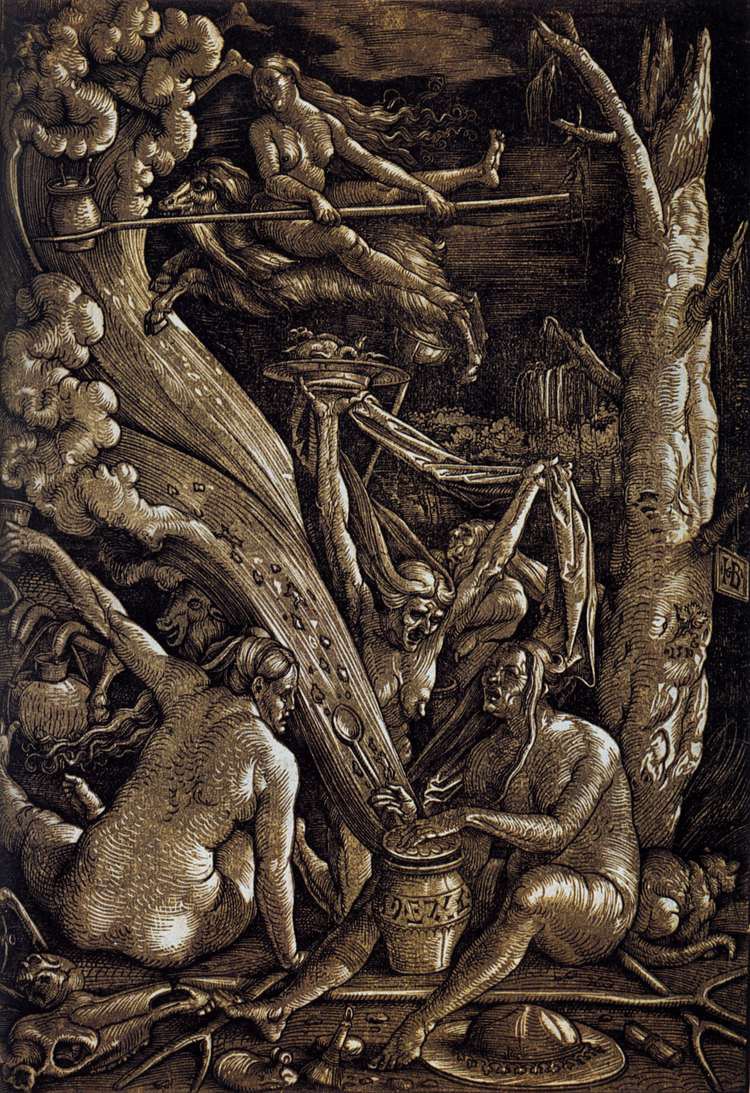
Preparing for the Sabbat, Hans Baldung, 1514.
Commentary from Missa Niger, by Aubrey Melech:
The witches, in a suitably desolate landscape, undertaking preparations for the sabbat. Included are the brewing of drugs and poisons, the by now indispensable Satanic goat, magical flight, bones of dead animals and humans, the community of old age and youth, nakedness, pitchforks, a cat, and most of the traditional paraphernalia of their alleged activities. Note especially the sausages (far left) over a pitchfork, which may well have been sliced to provide a Host that was truly the flesh of the Devil’s body.