|
|
|
|
The Mausoleum At Halicarnassus
The Mausoleum, like the Pyramids of Egypt, is the burial place of an
ancient king. Yet the Mausoleum is different - so different from the Pyramid
that it earned its reputation - and a spot within the list - for other reasons.
Geographically, it is closer to the Temple of Artemis. And it was the
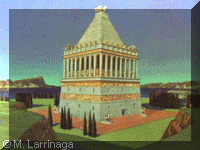
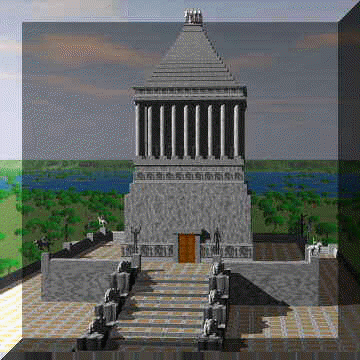
beauty of the tomb rather than its size that fascinated its visitors for years. When the Persians expanded their ancient kingdom to include Mesopotamia, Northern India, Syria, Egypt, and Asia Minor, the king could not control his vast empire without the help of local governors or rulers -- the Satraps. The kingdom of Caria in the western part of Asia Minor (Turkey) was so far from the Persian capital that it was practically autonomous. From 377 to 353 BC, king Mausollos of Caria reigned and moved his capital to Halicarnassus. The construction of his tomb was conceived by his wife and sister Artemisia, and the work of the tomb might have started during the king's lifetime. The Mausoleum was completed around 350 BC, three years after Mausollos death, and one year after Artemisia's. The structure was rectangular in plan, with base dimensions of about 40 m (120 ft) by 30 m (100 ft). Overlying the foundation was a stepped podium the sides of which were decorated with statues. The burial chamber and the sarcophagus of white alabaster decorated with gold were located on the podium and surrounded by Ionic columns. The colonnade supported a pyramid roof which was in turn decorated with statues. A statue of a chariot pulled by four horses adorned the top of the tomb. For 16 centuries, the Mausoleum remained in good condition until an earthquake caused some damage to the roof and colonnade. In the early fifteenth century, the Knights of St. John of Malta invaded the region and built a massive crusader castle. When they decided to fortify it in 1494, they used the stones of the Mausoleum. By 1522, almost every block of the Mausoleum had been disassembled and used for construction. Today, the massive castle still stands in Bodrum, and the polished stone and marble blocks of the Mausoleum can be spotted within the walls of the structure. Some of the sculptures survived and are today on display at the British Museum in London . These include fragments of statues and many slabs of the frieze showing the battle between the Greeks and the Amazons. At the site of the Mausoleum itself, only the foundation remains of the once magnificent Wonder. The beauty of the Mausoleum is not only in the structure itself, but in the decorations and statues that adorned the outside at different levels on the podium and the roof. There were statues of people, lions, horses, and other animals. The statues were carved by four Greek sculptors: Bryaxis, Leochares, Scopas, and Timotheus, each responsible for one side. Because the statues were of people and animals, the Mausoleum holds a special place in history. It was not dedicated to the gods of Ancient Greece. Since the nineteenth century, archeological excavations have been undertaken at the Mausoleum site. These excavations together with detailed descriptions by ancient historians give us a fairly good idea about the shape and appearance of the Mausoleum. A modern reconstruction of the shorter side of the Mausoleum illustrates the lavish nature of the art and architecture of the building. |