 |
 |
 |
 |
 |
 |
 |
 |
 |
 |
 |
 |
 |
 |
 |
Handover To China
 After 156 years of being a British colony, on 1st July 1997, Hong Kong reverted
toChinese rule as a Special Administrative Region of China, under a one country,
two systems rule. The Hong Kong dollar was to remain a separate currency and
English was still to be recognised as the official language. With a few exceptions
in visa requirements for some nationalities, the average person on the street
seemed unaffected by the change over. However, only time would show to most
whether Beijing would slowly implement more widespread reforms. As an Expat
living in Hong Kong there was certainly no concern for anything changing to
affect me. Steve and I had just had our work permits renewed for a further
12 months without any problem. While in the office I did not hear much talk
of reverting back to China, there were a few people who commented that they
were not looking forward to it. Many Hong Kong people, with the influx of tourists
arriving to witness this historical event, just wanted to be away from the
territory and make the most of the 5 day holiday. My landlady and her husband
actually immigrated to Vancouver a few days after the handover as many others
were doing.
After 156 years of being a British colony, on 1st July 1997, Hong Kong reverted
toChinese rule as a Special Administrative Region of China, under a one country,
two systems rule. The Hong Kong dollar was to remain a separate currency and
English was still to be recognised as the official language. With a few exceptions
in visa requirements for some nationalities, the average person on the street
seemed unaffected by the change over. However, only time would show to most
whether Beijing would slowly implement more widespread reforms. As an Expat
living in Hong Kong there was certainly no concern for anything changing to
affect me. Steve and I had just had our work permits renewed for a further
12 months without any problem. While in the office I did not hear much talk
of reverting back to China, there were a few people who commented that they
were not looking forward to it. Many Hong Kong people, with the influx of tourists
arriving to witness this historical event, just wanted to be away from the
territory and make the most of the 5 day holiday. My landlady and her husband
actually immigrated to Vancouver a few days after the handover as many others
were doing.
On the eve of the handover, security was tightened up on the China border with a greater inflow of illegal immigrants expected. On average about 50 Chinese sneak through each day even with the already tightened measures of barbed-wire fencing, sensor rays, mirrored inspection under trucks and vehicles, to stop them. The PLA passed a law after midnight on the 30th June to deny permanent residency to any illegal immigrants caught in the future. At 9.00p.m. 509 Chinese soldiers and 39 vehicles entered the territory, there were no armoured cars or tanks. China initially wanted at least 1,000 troops allowed in. A total of 464 light weapons, mainly rifles and side arms were licensed and transported in containers under strict conditions.
In the streets on the eve of the handover, Expats were walking around with oversized tops hats with the British flag displayed on the backs. There did not appear a lot of reunification signage (in English anyway) or anything to do with the handover, just a few sales which actually said handover sale/specials. Many T’shirts were being worn or displayed in shops with lettering referring to Hong Kong reverting to China. Large pictorial lights depicting the new HK SAR symbol (the Bauhinia flower), dragons, dolphins, scanned entire lengths of buildings in a bright array of colours. Taxi’s were driving around with red flags atop their aerial wires displaying the white insignia of the new Hong Kong. Television reporting was full with upcoming events as well as past historical stories and events on Hong Kong.
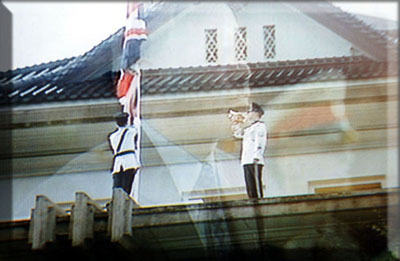 Watching the television coverage during the afternoon and more especially the Governor, Chris Patten and his family leaving the Governors Mansion for the last time, I was surprised at just how moved I was by the occasion. Having only been in Hong Kong for 15 months, I couldn’t help feel part of the atmosphere of great sadness and loss, and found that I was quite choked up by the scene I was observing. After the deploying of the British Flag which was folded and given to Chris Patten, who was obviously moved by the enormity of the significance of its removal from the Governor’s mansion, he then proceeded to make farewells to all the staff. Two of his daughters were particularly overcome with emotion, one having to also leave friends in the territory where she attended school. The cars when leaving, drove three times around the entrance for good luck which in Chinese culture means that the people will return, before leaving for the Royal Britannia.
I left home around 5.45pm to make my way towards Central to find a place in which to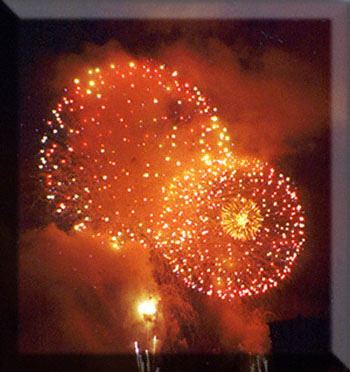 watch the British fireworks display that evening. Walking from home through Victoria Park, stages and booths were still being erected, but there was no crowd gathering to speak of. Even on the tram trip to Central, there were few people around. Travelling to and from the Star Ferry, were a few people, mainly Gweilos, in tuxedoes and black dresses making their way to various celebration events being held that evening. Crowds around that area of the harbour were already starting to gather. Standing for 1 ½ hours on the upper level walkway behind the Central Post Office, it seemed as good as I was going to get in a vantage point to watch the fireworks. Crowds could be seen congregating across all the pier areas, some braving light drizzle while they waited. The Star Ferry was stopped at 7.00pm to try and reduce the harbour traffic in preparation for the fireworks. As night fell, the kaleidoscope of pictorial lights could be seen emerging on building exteriors. The wait was long in the very warm and humid evening, and half an hour before the display was due to begin there was a heavy deluge of rain which threatened to spoil the effects with the low cloud. I was certainly thankful to be under cover. When the first explosion occurred there was an outcry of ‘oohs’ and ‘aahs’ from the largely Filipino crowd that was gathered around me which continued as every shower of light unfolded, much to the amusement of the rest of us. While I couldn’t see what was happening on the water itself, the Star Ferry terminal hid me from that sight, the aerial display was spectacular. Large fragmented showers of blinding dots sprayed out in a zooming effect, varying in colours of silver, green, blue and magenta. Perpendicular spikes of shimmering light reached for the heavens piercing the preceding bulbous flowers and giving the feel of hundreds of blinking silvery eyes. The display went on for 20 minutes ending with a surge of energy from all four igniting points on the harbour and as the last billow of smoke descended, an applause went up from the crowd around me. Millions of dollars dissipated in a spectacular sight of celebration.
The dispersing of the crowd was probably not as bad as I had anticipated and given 10 minutes you could proceed reasonably freely away from the waterside. The odd vision of a Gweilo (ghost person – used to refer to white people) draped in the British flag or donning apparel displaying the Union Jack appeared in amongst the thousands of Hong Kong people that thronged the streets. On TV. coverage there seemed to be more displays of the Chinese flag in other areas of Hong Kong. Some had their faces painted half in the Chinese flag and the other with the Union Jack. While it was still too early to see any displays of either sadness or jubilation, there was still an essence of festivity. The democracy groups were starting to assemble around Chater Garden enthusiastic for their midnight demonstrations against any future clampdown by China. The rain unfortunately dampened their attempts at posting any written displays successfully. Deciding not to hang around the 3 plus hours still to go until the midnight hour, I caught the tram on a slow ride back home. The streets were still reasonably quiet at that time, a lot of the shops electing to either not open at all that day or close early for the celebrations. Even passing Victoria Park again there were plenty of lights but very little people mingling.
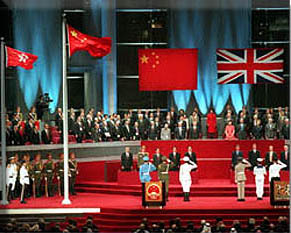 The television coverage was extensive with the celebrations and then reunification banquet at the Convention Centre. Shortly before midnight, Prince Charles gave his rather solemn speech before the British and Hong Kong flags were lowered to God Save The Queen and the new Hong Kong SAR and Chinese flags raised to the Chinese national anthem. Television reports showed a countdown not dissimilar to that of New Years eve with the same jubilation at midnight. A truly emotional sight even for the short time resident of Hong Kong, the end of an era and the beginning of uncertainty.
The first day of reunification (July 1st) started with thunderstorms at 6.00a.m. just as more than 4,000 PLA troops crossed the border from China by sea, air and road. A red rainstorm warning which progressed to a black rainstorm warning by 8.00am. (Black rainstorm warning is issued when 100mm or more of rain is predicted or recorded within two hours or less. There is usually the danger then of flash floods and landslides). For those that seemed pessimistic with the change in sovereignty, the weather somehow seemed a conceivable prediction of things to come. Dragging myself out of bed and donning the wet weather gear, I ventured out to find a newspaper. The 7-Eleven close by was sold out. Wading through flooded paths and roads I found a street seller who still had a copy of the South China Morning Post. On entering the foyer of my building, the guard on duty at the time, who really could speak no or little English, was laughing at my drowned appearance, fiercely clutching my rain-protected copy of the newspaper, the first edition in the new era of Hong Kong. One of the more amusing articles reported in the newspaper prior to the handover was manufacturers expecting a 20% surge in the purchasing of condoms with couples feeling very passionate about the change of sovereignty planning their own ‘celebrations’ on the handover eve.
The weather, while subsiding in its intensity, continued on and off for the better part of the day. Celebrations were still being conducted at the Convention Centre with most of the main official party having been up much of the night with the inauguration of the new SAR party and the abolishment of the democratic party legislative committee. The day’s events on TV. were all focused on the celebrations still continuing in Beijing and other parts of China of Hong Kong’s return to the Motherland and of the visit and final departure of the Chinese leader, Jiang Zemin. All through the day, various royal insignias were being replaced with the Chinese insignia, flags were interchanged, and the forces were changing over buttons and epaulets on their uniforms.
At 9.00pm an hour long light and sound extravaganza on Victoria Harbour began with an expectation of attracting 2 million people. I declined to join the masses especially as a lot of the visual effects were taking place on the water itself and the chances of finding an opportune spot to get a glimpse of them was fairly remote. As it turned out, the flotilla consisting of 31 brightly coloured decorated barges came down the harbour and made their turnaround right in front of my window line of sight and while they were at a distance and not close enough for any reasonable photos, the view still was spectacular. I had one eye on the TV. and one eye out my window during the entire hour. The HK$100 million spectacular concluded with a fireworks display of which I could only see the odd corner of a brilliant shower between the buildings that were in front of my apartment, but the sky was continually changing colour before me in reds and whites with the illumination. The thunder of the successive explosions was quite deafening. Laser lights were beamed across from both flanks of the harbour. The rain at least held in abeyance. It was both interesting and disappointing that the only two local English TV. programs were covering the celebrations in Beijing leaving the Chinese stations to cover Hong Kong, thus the commentary was in Cantonese.
From July 1st, mail with stamps bearing the Queen’s portrait or royal cipher were being marked “return to sender” and were being treated as unpaid items. Items stamped with royal symbols and posted before midnight on June 30 were be allowed. Old stamps could be exchanged. Two days following the handover, a large Chinese store owner (David Wang) promoted a ‘dress Chinese day’ where he encouraged and stimulated the wearing of Chinese dress. I was not aware of it until after the event, but a number of people participated (both Gweilo and local) which did a roaring trade for his Chinese apparel store (Shanghai Tang) as well as raising money for some charity. The rain was incessant over this history-making week inciting heavy flooding and landslides to many areas of Kowloon. For those on the other side of the coin, rain forecasted good luck and optimism about Hong Kong’s future under Chinese rule.
 A couple of weeks prior to the handover the English/Chinese radio station I usually
listened to (104FM) started broadcasting their hourly news in Cantonese instead
of English. An article in the weekly magazine in one of the English newspapers
reported that a lot of British Expats were getting upset with the removal from
Radio Television Hong Kong of the BBC radio drama “The Archers”, the longest running BBC radio drama. A comical ‘Times’ reporter wrote, “The Archers was the cultural cornerstone for many Expat household. Radio Television HK has decided not to continue airing the series because it is thought to be politically incorrect. But with skilled blending of government and agricultural propaganda, surely a Phil Archer (the closest the show gets to a gumboot-wearing heartthrob) with Chinese characteristics could do wonders for the propaganda department in Beijing”. Television advertising started encouraging people to think in metric. As in Singapore, when buying fruit and vegetables etc. everything was per lb and when you were not used to shopping in lb’s (pounds) you tended to think prices were inexpensive until you realised. Obviously being a British standard of weight, things had to change.
A couple of weeks prior to the handover the English/Chinese radio station I usually
listened to (104FM) started broadcasting their hourly news in Cantonese instead
of English. An article in the weekly magazine in one of the English newspapers
reported that a lot of British Expats were getting upset with the removal from
Radio Television Hong Kong of the BBC radio drama “The Archers”, the longest running BBC radio drama. A comical ‘Times’ reporter wrote, “The Archers was the cultural cornerstone for many Expat household. Radio Television HK has decided not to continue airing the series because it is thought to be politically incorrect. But with skilled blending of government and agricultural propaganda, surely a Phil Archer (the closest the show gets to a gumboot-wearing heartthrob) with Chinese characteristics could do wonders for the propaganda department in Beijing”. Television advertising started encouraging people to think in metric. As in Singapore, when buying fruit and vegetables etc. everything was per lb and when you were not used to shopping in lb’s (pounds) you tended to think prices were inexpensive until you realised. Obviously being a British standard of weight, things had to change.
While some of the older people were happy about the reunification with the motherland, others had difficult and painful memories having experienced past rulings and ramifications of the Communist Party of China. They knew that they did not always keep their promises. They believed that life under the British rule was much better in this new modern age as the Chinese tradition required those in power to be treated as master of the family, neither questioned or criticised. The young people, of course, had never known anything other than British rule and most felt they had mixed identity, with Chinese traditions being instilled from their parents and the more democratic lifestyle being brought about by British rule.
A new change in legislation giving Chinese born children the right of abode in Hong Kong providing a parent was a Hong Kong SAR resident meant that 66,000 mainland children were expected to enter Hong Kong in the next four years and possibly totally collapsing the education system. Beijing also wanted some text books to be rewritten as they did not see them conforming with China’s principles and felt that some context went against the basic law and ‘one country, two systems’ principle. Beijing saw textbooks currently used in Hong Kong as not being in accord with their history or reality and were not suited to the changes after 1997.
Many parents hiding mainland born children in Hong Kong were under the misapprehension that there was an amnesty for over-stayers and were eligible to apply for right of abode. These people when fronting up to the immigration authorities were arrested, some children being immediately deported.
Post boxes in the street which had previously been the standard red colour, slowly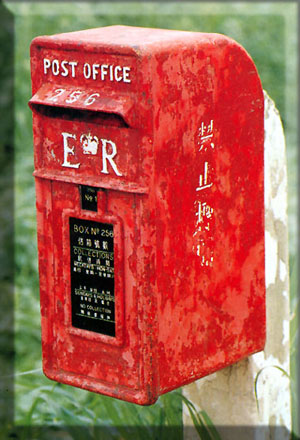 were changed to look as ‘unBritish’ as possible. The first one I saw was a nice green colour, the second one was purple. There were a few very old style where the insignia was embossed into the pillar and these had been left in the original state while decisions were made as to what to do with them.
Two months after the handover I talked with my old Chinese friend Ruth. She said the newspaper coverage had definitely changed. The free reporting and often criticising of the Chinese politicians and politics had rapidly diminished.
Burning or desecrating the Chinese flag also became illegal with a fine of HK$50,000 being imposed. The first case of this was on China’s first National Day celebrated in Hong Kong. These crimes were believed to have been committed by expatriates.
There had been a sharp rise in foreign arrives from December 1996 through to June 30th 1997 showing a 13% increase. The American community rose by 18% to 41,000, the British by 23% to 31,400, amongst increases in other nationalities. This also increased the already largest foreign community, the Filipinos who rose in that period from 128,800 to 146,400. This influx was seen not so much as former residents coming back to witness the handover but those seeking work in the booming economy with some seeing Hong Kong as an even better springboard to do business in China. At lot of US companies were setting up regional headquarters in Hong Kong.
 |
Hong Kong’s capitalist system will remain unchanged for at least 50 years. The territory will be free to continue it’s own political, social and economic systems, and will enjoy a high degree of autonomy except in foreign affairs and defence matters. |
| |
Hong Kong will be run by Hong Kong people. The government will be headed by a Chief Executive who is a Hong Kong citizen, selected by a Selection Committee comprising Hong Kong people, rather than a Governor appointed by the Queen it the UK. The Civil Service remains intact and virtually all serving principal officers are staying in their jobs. |
|
Visitors to the HKSAR will remain as they were under British sovereignty. Applications for visas can be processed through Chinese consulate offices after 1 July 1997. |
|
Hong Kong will keep its own laws (British common law system). The judiciary will remain independent with a Final Court of Appeal based in Hong Kong. |
|
English will remain as an official language and English signage will be maintained. English names of buildings, streets and attractions will not change, although some organisations and clubs will drop the “Royal” title. |
|
The same local Police Force that has made Hong Kong one of the safest cities in the world will continue to maintain law and order under its existing lines of command. Current rates are lower than 10 years ago and violent crime has been decreasing for several years. |
| |
Hong Kong will keep it’s own separate currency. The HK$ will remain an internationally recognised currency linked to the US$ and backed by one of the biggest foreign exchange reserves in the world. |
| |
Hong Kong will remain a free port and maintain its own customs controls. It will continue to manage its own trade matters, including bilateral agreements. Its participation in international trade agreements and its separate membership of relevant international organisation of relevant international organisations such as the WTO will continue. |
| |
The HKSAR will retain Hong Kong’s role as an independent international financial and banking centre with its own established regulatory controls. HK’s participation in international organisations, such as the Bank for International Settlement, will continue. |
| |
Hong Kong will maintain its existing border and its own immigration controls. Controls will be maintained on the movement of people from China into Hong Kong. |
The Hong Kong Prayer
Our Brother,
Who art in Beijing,
Xiao Ping be thy name,
United Kingdom gone,
Thy will be done, in Hong Kong,
As it is in China.
Give us this day,
Our daily bet,
And forgive us,
Our speculations,
As we forgive those,
Who speculate against us.
Lead us not,
Into Communism,
But deliver us,
From gweilos.
For this is The Sovereignty,
The Power of Authority,
Forever and ever,
Chow Mein
(Author Unknown)