

 |
 |
 |
 |
 |
 |
 |
 |
 |
 |
 |
 |
 |
 |
 |
Known as the place to buy pirate computer software. Bundy, while
on one of his trips to Hong Kong, took me out there the first time to show
me where it was. It was
a fairly unassuming local shopping plaza, but once inside and downstairs, the
amount of computer software shops was mind boggling. Bundy told me if we got
separated he would meet me back at the entrance, and I thought there was not
much chance of that, however going on deeper through the basement, I saw what
he meant. One particular shop we went into all of a sudden closed it’s doors
and we were locked inside, with a lot of others. This seemed to be the norm
when they suspected someone was policing the area. After 5 minutes the doors
were opened again. Everyone went on shopping while the doors were shut and
were obviously used to this occurrence. The software was the very latest and
priced at only around HK$40 – 50.00 per copy, normally costing about a couple
of thousand dollars to buy legitimate software. It was always crowded and smoke
filled and with the low ceilings, I found it insufferable at times. Most times
I hated going there because of the smoke, which hung in the air, and the masses
trying to squeeze around the various small shops. I was always relieved to
find what I had wanted and leave quickly. It amazed me that with all the illegal
software sold there, so many people knew about it and yet still continued to
thrive with the authorities generally leaving everyone alone. However, after
about 12 months of visiting this place, the police carried out a raid on the
shopping centre and closed 20 shops confiscating equipment used in the piracy.
Unfortunately our shop was one of those closed. Sham Shui Po was quite an old
area and there was always a lot of people around shopping in the local shops
and open air markets that lined the streets. It had a history of being one
of the red light districts of Hong Kong and to this day I believe, still is.
was
a fairly unassuming local shopping plaza, but once inside and downstairs, the
amount of computer software shops was mind boggling. Bundy told me if we got
separated he would meet me back at the entrance, and I thought there was not
much chance of that, however going on deeper through the basement, I saw what
he meant. One particular shop we went into all of a sudden closed it’s doors
and we were locked inside, with a lot of others. This seemed to be the norm
when they suspected someone was policing the area. After 5 minutes the doors
were opened again. Everyone went on shopping while the doors were shut and
were obviously used to this occurrence. The software was the very latest and
priced at only around HK$40 – 50.00 per copy, normally costing about a couple
of thousand dollars to buy legitimate software. It was always crowded and smoke
filled and with the low ceilings, I found it insufferable at times. Most times
I hated going there because of the smoke, which hung in the air, and the masses
trying to squeeze around the various small shops. I was always relieved to
find what I had wanted and leave quickly. It amazed me that with all the illegal
software sold there, so many people knew about it and yet still continued to
thrive with the authorities generally leaving everyone alone. However, after
about 12 months of visiting this place, the police carried out a raid on the
shopping centre and closed 20 shops confiscating equipment used in the piracy.
Unfortunately our shop was one of those closed. Sham Shui Po was quite an old
area and there was always a lot of people around shopping in the local shops
and open air markets that lined the streets. It had a history of being one
of the red light districts of Hong Kong and to this day I believe, still is.
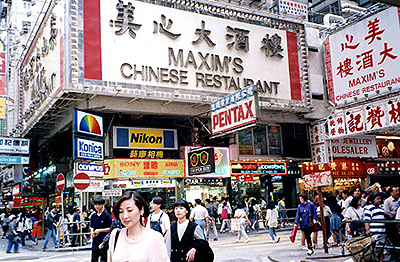 Hong
Kong had such a diverse array of shops from the local cubby-hole where the
boot mender, watch repairer set up their businesses to the top designer stores.
No matter what the level of store, it was quite common to see staff eating
their lunch/dinner, bowls of noodles or rice, in the shop, usually at the counter,
with the aroma filtrating throughout the shop. They were not generally in a
hurry at this time to serve you. The customer was usually either bombarded
with assistance or no one was interested in helping you. There was an annoying
habit of staff to follow very close behind you as you wandered through the
shop giving the impression that maybe they thought you were about to shoplift.
In shear frustration sometimes, I either stopped dead in my tracks and let
them walk right into the back of me, or turned tale and met them face to face.
In either event the purpose was lost on them. It was however, nice to see in
a lot of the chain stores such as Giordano and Bossini, staff welcomed you
into the store and farewelled you with a smile as you left. Sometimes done
on overkill as every sales person you passed walking into the shop greeted
you and you could spend more time acknowledging them instead of looking. Rudeness
in the smaller shops though was still common if it appeared you were not going
to purchase anything.
Hong
Kong had such a diverse array of shops from the local cubby-hole where the
boot mender, watch repairer set up their businesses to the top designer stores.
No matter what the level of store, it was quite common to see staff eating
their lunch/dinner, bowls of noodles or rice, in the shop, usually at the counter,
with the aroma filtrating throughout the shop. They were not generally in a
hurry at this time to serve you. The customer was usually either bombarded
with assistance or no one was interested in helping you. There was an annoying
habit of staff to follow very close behind you as you wandered through the
shop giving the impression that maybe they thought you were about to shoplift.
In shear frustration sometimes, I either stopped dead in my tracks and let
them walk right into the back of me, or turned tale and met them face to face.
In either event the purpose was lost on them. It was however, nice to see in
a lot of the chain stores such as Giordano and Bossini, staff welcomed you
into the store and farewelled you with a smile as you left. Sometimes done
on overkill as every sales person you passed walking into the shop greeted
you and you could spend more time acknowledging them instead of looking. Rudeness
in the smaller shops though was still common if it appeared you were not going
to purchase anything.
In the more local shops, you had to wonder whether there was such a thing as a stock take. They were bits and pieces everywhere, stacked floor to ceiling, some probably never having been moved in years judging by the dirt and dust accumulated. It is not necessary to go to large home centres (there were very few anyway) to find the odd electrical or plumbing pieces as several of these shops were found locally in amongst everything else. Handy if you needed to nip out to get the odd piece of pipe or washer. Many smaller local shops sold similar merchandise and you had to wonder how they all made a living here. However there were of course, 6.3 million people living in Hong Kong.
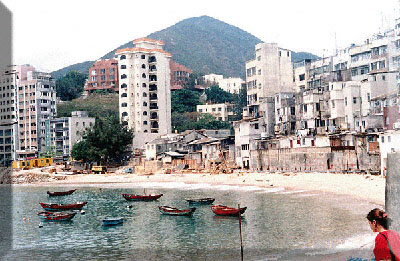 military
station. Situated around the south side of Hong Kong Island, Stanley was better
known now days for it’s market which was right on Stanley Beach. The market
displayed a varied array of goods from sportswear, souvenirs, paintings, clothing
and lace wear. Hours could be lost by just meandering in and out the shops,
lunching in one of the many restaurants or just lounging on the sea wall being
mesmerised by the waves crashing against the very rocky and quite treacherous
coastline or spying the odd passing ship sailing by.
military
station. Situated around the south side of Hong Kong Island, Stanley was better
known now days for it’s market which was right on Stanley Beach. The market
displayed a varied array of goods from sportswear, souvenirs, paintings, clothing
and lace wear. Hours could be lost by just meandering in and out the shops,
lunching in one of the many restaurants or just lounging on the sea wall being
mesmerised by the waves crashing against the very rocky and quite treacherous
coastline or spying the odd passing ship sailing by. There were regular buses that departed from Central and travelled through Wanchai and Causeway Bay before cutting through the island via the Aberdeen Tunnel. These were mostly air-conditioned double decker buses and were usually quite crowded. The bus I usually caught came from the other direction from Central and was a much more exciting experience. The bus was a blue and white double decker with no air-conditioning and I usually seated myself on the upper level to get the breeze. This level probably acerbated the feeling of being on thrill ride travelling around the hills and coastal areas of the island. The bus travelled at an almost illegal acceleration and weaved its way in and out erratically negotiating the corners. If you sat on the back bench seat there was a strong possibility you could find on the floor as the seat was never secured and easily tilted. This bus was never very crowded and sitting in the rear allowed me to secretly laugh and take delight in the ride without embarrassing myself. It was a question of hanging on tight most of the way. How there was any paint-work on the top left hand side of the bus as it scraped trees and foliage along the way on the narrow roads, amazed me. It was not wise to be seated too close to the open window, your eye might easily have been poked out It was however a great trip, very scenic and something that should be experienced. The owner of the land at Stanley, announced that he would be demolishing Stanley Market and redeveloping the land. No date was ever given though while I was still in Hong Kong and I imagine that come the time, there would be a huge outcry. Stanley would never be the same again.
 The
Star Ferry has been operating since 1898 and is still a very agreeable way
of seeing Hong Kong’s busy Victoria Harbour, crossing from Kowloon to Hong
Kong and return. What used to be a 7 minute ferry ride now took more like 10 – 15
minutes even thought the channel had narrowed with land reclamation on both
sides. The extra time was spent in taking an arc-like course to negotiate boats
and small craft that continually criss-crossed and sailed the channel. At times
it seemed there was as much traffic and congestion on the water as there was
on the road with it being difficult to work out who actually was giving way
to who. Still a very inexpensive way (HK$2.20 upper level) to cross and very
pleasant and relaxing on a warm sunny day. The lower deck was painted in green,
the upper deck in cream with brightly coloured buntings strung across from
mast to mast. In wet weather, plastic transparent sheets were rolled down on
the sides, for cover. All the ferries had ‘star’ names and with a star insignia
on their bow.
The
Star Ferry has been operating since 1898 and is still a very agreeable way
of seeing Hong Kong’s busy Victoria Harbour, crossing from Kowloon to Hong
Kong and return. What used to be a 7 minute ferry ride now took more like 10 – 15
minutes even thought the channel had narrowed with land reclamation on both
sides. The extra time was spent in taking an arc-like course to negotiate boats
and small craft that continually criss-crossed and sailed the channel. At times
it seemed there was as much traffic and congestion on the water as there was
on the road with it being difficult to work out who actually was giving way
to who. Still a very inexpensive way (HK$2.20 upper level) to cross and very
pleasant and relaxing on a warm sunny day. The lower deck was painted in green,
the upper deck in cream with brightly coloured buntings strung across from
mast to mast. In wet weather, plastic transparent sheets were rolled down on
the sides, for cover. All the ferries had ‘star’ names and with a star insignia
on their bow.
As night fell, the illumination of lights on Hong Kong Island were magical. Crossing the channel was almost like riding the sky to the stars. The colourful neon's mirrored their prismatic colours across the velvety water. The main capillaries paralleling the shore beaming with a continuous stripe of headlights. In the evening, passengers could be seen donning tuxedoes and evening dresses cruising to the other side to attend functions as it was still the easiest mode of transport which did not involve parking woes. Signs onboard the ferries stipulated, no spitting, no sermons or donations allowed. With the swell of other craft passing or at times when the seas were rough, it was difficult to keep the gangway safely down for boarding and alighting. Crewmen were decked out in the royal blue sailor uniforms with a star motif, white gloves and chrome whistles simply secured by a safety pin, performing the same predictable duties on each journey. Ferries departed approximately every 5-8 mins to and from Central and Wanchai.