I'm what's termed as a 'layman' when it comes to figure skating. I now can recognise the jumps and most of the spins, but there was a time when I couldn't tell a Lutz from a loop. If you're one of those people who wonders why Dick Button complains about so many layback spins, or why an Axel is credited as being harder than a toe loop, take a look at my guides to jumps, spins, and other moves. I try to explain everything as it looks, using as little of the confusing technical jargon as possible. I'll also have photos or drawings to help explain.
Features:
My Jump Guide is ready for viewing. There are pictures illustrating the take-offs on all of the major jumps.
My Spin Guide is also up. Some spins are illustrated in outline pictures.
There is also a guide for Other Moves, including spirals, spread eagles, various pairs moves, etc. Also illustrated.
Come and chat figure skating with others who love the sport: post a message at my forum Skate Talk
If you're itching to gab with fans of 3-time World Champion Alexei Yagudin, surf on over to http://pub1.ezboard.com/balexeidiscussiongroup.html. If you're a fan of Alexei, I guarentee you will have fun there :-)
Want to know who the 2000 World pairs silver medalists were? My News Archive has everything from the 99/00 season onward.
Also, be sure to take my polls below. Results of past polls can be found in my poll archive
News in brief: (the dates shown are those of the TV broadcast I saw, not the actual dates of competition)
 |
10/28/01 & 11/4/01--Skate America 2001
This is the first Grand Prix event of the season; it's going to be a ride this year, so fasten your seat belts.... Ladies: It was to be a four-way battle for the medal stand, between Sasha Cohen, Viktoria Volchkova, Michelle Kwan, and Sarah Hughes. Unfortunately Sasha popped her attempted quad Salchow, and pretty much fell apart for the rest of the performance. I do like her program to "Carmen" though. Cohen ended up in fifth place, behind Japan's Suzuki Arakawa. Viktoria skated well enough for the bronze, landing five triples in the end despite some major mistakes on the way. The battle for the gold was between Kwan and Hughes, and here's where the controversy set in. Before I go any further, let me state right away that I enjoyed Michelle's program. The music suits her and I like the change in choreography. Dick and Peggy seemed to disagree. I think they're still sore at Michelle for dumping Lori Nickol. I wonder how long this grudge is going to last.... Anyway, Michelle landed six clean triples, but two-footed her triple loop pretty badly and popped her triple toe/triple toe into a triple toe/double toe. Sarah stormed onto the ice and skated a beautiful program, also with six triples. But Sarah's triples were all clean, and included a perfect triple Salchow/triple loop combination. There were seven judges; two of them placed Sarah first, but five of them went for Michelle. The difference, as usual, was in the presentation score. This was not a popular decision, with either the audience or the commentators. Pairs: The only big-name competitors here were Ina and Zimmerman and Sale and Pelletier. Ina and Zimmerman skated to last year's program, with new costumes. They skated quite well, but had problems with their side-by-side triple toe loops. Sale and Pelletier won, of course, with a pleasant new program and some good jumping. I still think they're as boring as muck most of the time, but that's just my opinion. Men: Dance: |
|
3/24/01 & 3/25/01--2001 World Championships
This year's Worlds had a lot of drama and exciting performances. So, without further ado, on to the competition.... Ladies: The four top names in ladies figure skating are almost universally recognised as Michelle Kwan, Irina Slutskaya, Sarah Hughes, and Maria Butyrskaya. In the short program, Butyrskaya was first to skate, and had a so-so performance. Kwan pulled off an okay performance despite a couple of errors. She two-footed the landing of her triple flip, and flutzed her triple Lutz (for those of you unfamiliar with the term "flutz," go to my Jump Guide and look under "Lutz"). Sarah Hughes also flutzed her Lutz (two in one night--what an occasion :-), and was placed behind Kwan and Butyrskaya. Irina Slutskaya was the class of the short program, ace-ing all of her jumps and putting a lot of energy into all of her moves. Peggy even complemented her on her unusual catchfoot-layback spin (my, my :-). Irina was in first going into the free skate, followed by Kwan, Angela Nikodinov, Hughes, Viktoria Volchkova, and Butyrskaya all the way down in sixth. In the free skate, Sarah started us off, skating as well as I've seen her this season. She landed six clean triples. It would have been seven, but she cheated the landing of her triple loop, landing a quarter-turn early in the triple Sal/triple loop combo. Nikodinov followed, skating well until about 2/3 into her program, where she fell on the triple Salchow (her least favorite jump, I'm told). After that mistake, Angela just seemed to give up, doubling the rest of her jumps and falling behind Sarah in the standings. Michelle Kwan then took the ice, and landed seven clean triples, including her triple toe/triple toe combo. She easily took the lead over Sarah. Then it was Irina's turn, and she pulled off a triple Salchow/triple loop/double toe loop early in her program. She was skating very well until she suddenly tried the triple Lutz/triple loop, and had an awkward stumble on the landing. All but two of the judges placed her behind Kwan. If you ask me, if she hadn't tried for the second triple/triple she would have had the gold. Volchkova followed, with a light and airy interpretation--however, she faltered even more than usual with the jumps and was placed behind Nikodinov. Last to skate was Butyrskaya, who had the best performance of her season, managing to stand up on all of her jumps. It was enough to pull her up from sixth to fourth, but for the first time in three years she will not stand on the podium. Final order: Kwan with the gold, Slutskaya with the silver, Hughes with the bronze, Butyrskaya in fourth, Nikodinov in fifth, and Volchkova in sixth. Pairs: Elena and Anton (in the lead after the short program) wanted their title back, and skated a nearly technically flawless free skate. I still have to take issue with their program, but that's another story.... The Canadians, Jamie Sale and David Pelletier (third after short), had the home team advantage. Despite a popped double Axel on her part, this team pulled into first (even though they are as boring as muck). The Chinese team of Xue Shen and Hungbo Zhao (second after short) skated a nearly flawless performance (with only a slight stumble right at the end) which should have vaulted them into first place. However, though their technical scores were the highest of all, their presentation scores were too low to catch the leaders; they were dropped to third overall. I really have to disagree with the judges on this placement; I have heard criticisms of their spins and some of her lift positions, but that should relfect more in the technical mark (and it didn't). I feel strongly that Shen and Zhao's style of presentation, though certainly different than the others, should be given credit. Surely, not every winning program has to be choreographed by Lori Nickle (perish the thought). If presentation has anything at all to do with excitment, snap, and spark in their program, Shen and Zhao should be at the top. But enough of my bully pulpit; on to the others.... Men: What was to be a showdown between 3-time World Champion Alexei Yagudin and 2-time European Champion Evgeny Plushenko fizzled out with an injury to Yagudin's right foot just prior to the competition. Poor Alexei fell apart in the qualifying round, making it almost impossible for him to win. However, with numbing injections to aid his injured foot, he and Todd Eldridge "stole the show" in the short program. Though Plushenko was in first, Eldridge managed to skate to second place and Yagudin pulled off an amazing and flawless performance to pull up to third. Goebel was in fourth. Elvis Stojko, who was out for the entire season due to a series of injuries, was in tenth after the short and did not manage to pull up any higher than that after a mediocre performance in the free skate. When Alexei Yagudin took the ice for the free skate, most fans probably knew the odds were against him. With a gutsy performance, Yagudin struggled to hold onto his quad/triple combo, whipping around on the landing of the second jump. But his struggles began to unfold as he put his hand down on the Salchow of his triple Axel/half loop/triple Sal combination. In the rest of the program, he had some more rough landings, especially on jumps requiring a toe pick assist with the right (injured) foot. Since the right foot is also Alexei's landing foot, he had to struggle to hold onto most landings. In an interview after the competition, Alexei described his foot as half numb, making it difficult to sense where it is on any landing. Frankly, after seeing him limping around in the hallways before the free skate, I'm surprised he could even skate, let alone land a quadruple jump. Near the end of his program, realizing that he couldn't realistically win, Alexei did the slide that we saw in his interpretive free skate, as well as Trophy Lalique (to see a fuzzy picture of it, scroll down to the summary for Trophy Lalique on this page). This move is illegal because he is sliding on the sides of his boots instead of the blades (the same reason Phillipe Candeloro couldn't do his famous "Candeloro Spin" in ISU competitions). This move reminded me of the illegal backflip that Surya Bonaly performed at the 1998 Olympics. At this point, Yagudin was skating for the audience, and it showed in his final footwork sequence. Exhausted at the end, Alexei waved to the audience's standing ovation. Yagudin's technical marks were in the 5.5-5.7 range (he did, afterall, land 8 triples and one quad, though many were not perfect), and his presentation marks were 5.8's with one 5.9 (low marks for Alexei, high for anyone else). Plushenko promptly stormed through the wide open door with his best performance of the season, complete with the 4-3-2 combination. Both sets of marks were in the 5.8-5.9 range, and for the first time this season, he received all first place ordinals. Eldridge then turned in one of his best performances ever, but without a quad he was placed behind Yagudin by a very narrow margin. The commentators took issue with this, complaining that Todd should have received the silver. I'll have to review my tape to answer this conclusively, but bear in mind that Yagudin still had the best artistry of them all, along with a quad. Timothy Goebel was next, and he landed two quads but faltered on some of his other jumps, including one quad attempt. He was placed fourth overall. Final order: Plushenko with the gold, Yagudin with the silver, Eldridge with the bronze, Goebel in fourth, and Takeshi Honda of Japan in fifth (his best-ever finish at Worlds, I believe :-). Dance: Well, well, well, it came down to this...the showdown between Beethoven's Last Night and the modern Romeo & Juliet. Marina Anissina and Gwendal Peizerat have been criticized all season for not having a good enough free dance, and I've just about had enough. Yes, they lost Europeans--but that loss had absolutely nothing to do with the quality of the program; it came down to the awkward fall, and nothing else. No, their program this year is not as good as last year's Carmina Burana--but then, nothing in ice dance could be that good. None of this year's programs had even half the impact of that masterpiece, but Anissina and Peizerat still came the closest. The reigning World Champions skated with power and gusto--and passion that just would not stop. It was easily the best dance performance of the season, and but the judges, predictably, left room for the European Champions, Barbara Fusar-Poli and Maritzio Margalio. The Italians skated well also, but in my opinion were far less emotionally expressive than the French. Their program was also choreographically more simple, and some would argue that their music was "hot and cold" (good one moment and horrible the next). They took liberty with the Romeo and Juliet theme that Anissina and Peizerat had mastered so well in 1998 (the year they won the Olympic bronze), and the judges gave them the win. Actually, it was a 5 to 4 split--it doesn't get any closer than that. I firmly believe that if the French had skated after the Italians, the results would have been different (when it's that close, that's all it takes). Irina Lobercheyva and Ilia Averbukh (Russia) won the bronze, beating out Bourne and Kraatz of Canada and Drobiasko and Vanagas of Lithuania. Naomi Lang and Peter Tcherneychev of the U.S. ended up in ninth. |
|
3/3/01--2001 European Championships
Here's where the Europeans strutted their stuff...may I point out that, since the Grand Prix Final actually took place after this championship, but was aired on television first, most people probably already knew the results of this before they saw it (since Terry & company couldn't keep their little mouths shut during the Grand Prix Final). Anyway, I still enjoyed watching this a lot, even though I knew from the beginning who would win. Ladies: This was not the best showcase of ladies figure skating that I've seen--not to put the Europeans down, but they were really having problems. Maria Butyrskaya had one of the worst skates in recent history, with two falls and other awkward landings. However, her presentation marks kept her afloat for the silver medal. Viktoria Volchkova, who ended up with the bronze had her usual inconsistent jumping, and Vanessa Gusmeroli fell from 6th after the short to god knows where (I guess she's still having trouble). Irina Slutskaya did not have one of her best performances, but compared to the rest of the field, it was more than enough to win the gold. For me, the Grand Prix Final redeems Slutskaya, showing that she can still skate...but what about Butyrskaya? She's had a really tough year.... Pairs: Berezhnaya and Sikharedlitze (Elena and Anton) won with their Chaplin thing. Please, don't ask...just don't.... Dance: WARNING: YOU ARE ABOUT TO WITNESS THE UPSET OF THE SEASON. Yes, that's right: the static, unmovable, unchanging world of ice dance has changed. Yes, Marina Anissina and Gwendal Peizerat, in second after the original dance, were hoping to move up to claim their second European gold medal--and may well have done so, if not for one slight problem. They fell. Yes, they fell...and boy, did they fall. While executing a series of turns in their free dance, one of them fell slightly short of rotation and blades collided. Marina started to teeter backward, then Gwendal fell splat. Marina went down, falling on top of him with her legs sticking awkwardly up in the air. It took them several seconds to get disentangled and on their feet--and in ice dancing, that's an eternity. Not only did it look awful, it broke the flow of their program in a major way. Anissina and Peizerat were actually placed third in the free dance, but managed to hold onto second overall over the Russians Irina Lobercheyva and Ilia Aberbuch. The Italian team, Barbara Fusar-Poli and Maritzio Margalio, skated well enough to place first overall. Men: Okay, the boy wonder does it again, defending his European title from Alexei Yagudin. Stanick Jeanette of France was the surprise bronze medalist. So, you say, am I going to say more about Yagudin vs. Plushenko? You bet your life. Okay, where do I start? Plushenko is a genius with the jumps, probably the best quadruple jumper around, no matter how much the commentators call Goebel the "quad king." The jump technique is first rate, he's in terrific condition, and he hardly ever misses a jump. On the other hand, we have Yagudin, presenting the image of an aging champion, never mind the fact that he's only 20. Yagudin may be on the way out, some may say--he's had trouble with his quads and now even the triple Axel. Some say that Plushenko will be the new World Champion. To these people I say: DIDN'T YOU LEARN ANYTHING FROM LAST YEAR'S WORLD CHAMPIONSHIPS?!? If last year's Worlds taught us anything, it was that nothing in this sport is certain. This year's will in all liklihood teach us that lesson again. But last year's World Championships taught us something more than that: they taught us that when Yagudin makes mistakes, he can hold onto first place, but when Plushenko makes mistakes, he drops completely off the podium. Why, do I hear you ask? Quite simply, Yagudin is a better all-around skater than Plushenko. When you take away Plushenko's jumps, there's not much there, apart from a nice Biellman spin and some groovy footwork. But when you take away Yagudin's jumps, there's still a great variety of spins with good positions, even groovier footwork than Plushenkos, and of course, the heart of a champion. This year's European Championships showcased this fact: Yagudin flipped out of the landing on his second quad and singled his first attempt at the triple Axel. In the end, he had landed one less triple jump than Plushenko had. Did the crowd care? No. They still gave him a standing ovation, because his footwork and artistry--especially at the end of the program--were coming through so strongly. When it came to the judges' marks, Yagudin's were 5.8's and 5.9's for both technical merit and presentation--almost the same range as Plushenko's marks! A couple of the judges judges still put Yagudin in first, even with the mistakes! Imagine what the marks would have been had he not made the mistakes.... |
|
2/18/01, 2/24/01, and 2/25/01--Grand Prix of Figure Skating Final: 2000/2001
Okay, here we have the culmination of the entire Grand Prix Series. This competition brings together the best in the world in a big way--only the best six skaters (or teams) of each discipline have made it this far. In this competition, there is a short program, then a free skate; after this is the Superfinal, where the top two skate another free skate to decide the gold (the third and fourth decide the bronze and the fifth and sixth decide fifth place in similar fashion). So, here's how it broke down: Ladies: I'm not sure anyone knew who the favorite was before this competition, but they probably have a pretty good idea now. After the short program, Irina Slutskaya was ahead of the pack, leading Michelle Kwan, Maria Butyrskaya, and Sarah Hughes. Hughes had a disastrous short program, but was able to pull up to skate for the bronze after the first free skate. Slutskaya was again ahead of Kwan after the first free skate, though the judges were divided 4 to 3 on the decision. In the Superfinal, Kwan had what I like to call a "Michael Weiss-ian performance." To her credit, it was a new program that she hasn't really sunk into yet, but she made an incredible number of mistakes--probably the worst performance I've ever seen from her. Slutskaya skated last, using her Carmen program from last year. In contrast to Kwan, Slutskaya exuded confidence from every pore, coming out with one of her best performances of the season. All but one of the judges put her resoundingly in first; the one who didn't: the American judge. Go figure. Dance: The reigning World Champions (Marina Anissina and Gwendal Peizerat) weren't here because of Marina's back injury (or if you listen to Susie, because of bruised egos). This ensured a walk-over for Fusar-Poli and Margalio of Italy, who breezed past the Russians easily. Drobiasko and Vanagas of Lithuania had a fall in their first free skate, preventing them from competing for gold in the Superfinal. They ended up with the bronze instead. Pairs: The pairs field nowadays is incredibly deep, but three teams dominated the Grand Prix Final. Xue Shen and Hungbo Zhao of China skated an incredible first free skate, probably the best I've ever seen them perform this year's program. However, the judges marked down their presentation enough to allow the Russians and Canadians to move on to the Superfinal. Elena and Anton skated well (just don't ask me about their stupid program) and ended up second, right behind the boring Canadians, Jamie Sale and David Pelletier. In the Superfinal, the standings remained unchanged, with the Canadians winning over the Russians; Shen and Zhao captured the bronze. If anyone has a problem with my evaluation of the Russians and Canadians, please take it up with me on Skate Talk; I'm just sick of seeing Shen and Zhao usurped by them :-( Men: My, what a showdown! To say that Alexei Yagudin and Evgeny Plushenko dominated this field would be the understatement of the new millenium. Timothy Goebel had major problems here, starting in the short program. He fell twice, resulting in quite a few technical marks in the 4 range--not something he's used to seeing. Artistically, he's still not good enough to pull himself up. Matt Savoie, the only other American here (Todd Eldridge had to pull out on account of injury), skated consistantly to third place, which he retained throughout the competition. Now, the big guns: Yagudin and Plushenko. In the short program, Plushenko skated flawlessly and Yagudin had a slight problem on one of his landings. But Yagudin was still placed first by most of the judges (just goes to show that artistry and spins are not totally dead). In the first free skate, both faltered slightly, but Yagudin a bit more so. In the Superfinal, both skated well, but Plushenko was clean as a whistle, while Yagudin had a couple of problems. It was enough for Plushenko to win, but his victory was not unanimously agreed by all the judges; 2 of them put Yagudin in first, despite the mistakes. I think the lesson here is: artistry does still count; if Yagudin had skated a clean program, he would be the Grand Prix Champion. Another thought: anyone who thinks the Worlds are already decided in any of the 4 disciplines has a problem with reality: anything could happen, and this year's competition is going to be good....:-) |
|
2/10/01-2/11/01--2001 Four Continents Championships
Before I start, I'd just like to point out a couple of things about the location of this competition. First of all, it is in Salt Lake City, in the same ice arena that will be used for the Olympics next year (goodness, is it really that close?!). Many skaters have commented that the ice is of very good quality, giving a lot of spring. However, this is also at altitude, similar to Skate America. I really feel that something as major as the Olympics should not be at such a location. Pairs: It was a showdown of power versus charisma, and the charisma won out. Xue Shen and Hungbo Zhao of China skated the best program I've seen from them since last year's Grand Prix Final. Every element was perfect, and I felt that they showed more emotion than I'd seen from them earlier this year. But the judges still marked them down on their presentation. Jamie Sale and David Pelletier of Canada skated a graceful performance and showed more emotion, but more importantly hit all of their technical elements. The presentation marks were high, with one perfect 6.0 included, and they won the competition. The matter at hand was a question of taste: higher thows and more exciting moves, or a little charisma? Kyoko Ina and John Zimmerman took third with a much better free skate than their effort at nationals. Men: Todd Eldridge was in the lead after the short program, and probably would have won the competition, but he was forced to withdraw due to an injury to his ankle. This opened the door for many of the other skaters, including Chengjiang Li, in 2nd after the short, Matt Savoie, in 3rd, Takeshi Honda in 4th, and Michael Weiss tied for 5th. Michael Weiss had a mediocre performance, only landing a couple of truly clean triples, with hands down or two-footed landings on most of the others. But he didn't fall. So the commentators branded this the best performance of his season, and he captured the bronze medal. Matt Savoie also had a mediocre performance. He still lacks a command of the ice, and though he usually lands his jumps well, here he faltered. He was placed behind Weiss. Chengjiang Li of China skated very well, with only a small flaw on his triple Axel/triple toe combination. Never mind that though: he had two quads. He took the lead. Last to skate was Takeshi Honda of Japan, whose feeling for the music was tremendous. If he had not fallen on his quad, I feel he would have been good enough to win gold. As it was, he took the silver. Even though the gold medalist, Chenjiang Li, didn't have the same feeling for his music as Honda did, his presentation was a remarkable improvement over last year. Dance: Naomi Lang and Peter Tchernychev skated well, but not well enough to knock down Shay-Lynn Bourne and Viktor Kraatz of Canada. Both teams were red hot, and had Lang and Tchernychev skated last, they might have prevailed. Another Canadian team, Debrueil and Lauzen, took the bronze with an exciting but technically less difficult free dance. Ladies: Angela Nikodinov, the US bronze medalist and defending Four Continents champion, was favored here, but found herself in 7th place after the short program--she was not even in the final group to skate. However, she pulled off a fairly strong performance, with the only flaws being singling her last two jumps. Fumie Suguri of Japan skated well and took the lead away from Tatiana Malinina, who had been in first after the short. Yoshie Onda, also from Japan, skated a very clean program with seven triple jumps. She did not have the same quality of presentation as Suguri or Nikodinov, despite the technical merit. Jenny Kirk of the US also landed seven triples, although one of them, the second triple toe of her triple/triple combo, was cheated. After her free skate, Peggy and Peter were raving and expected her to stand on the podium--perhaps even take first. However, the judges disagreed, placing her 5th overall. The ordinals were all over the place, with one judge (the American) placing her first. Kirk does not jump very high in the air, though she turns fast, and she skates slowly across the ice. Oh well, she's only 16, and she has a long time to improve on these things :-) Overall final order: Fumie Suguri with the gold, Angela Nikodinov moving up to capture the silver, and Yoshie Onda with the bronze. Tatiana Malinina ended up fourth, with Jenny Kirk in fifth. |
|
1/20/01--2001 US National Championships
Dance: Naomi Lang and Peter Tchernechev were so much better than their closest competitors it wasn't even funny. Even though they stumbled a couple of times, their interpretation and technical difficulty were superior to everyone else in this competition. They easily defended their title. Men: What was to be a 3-way shoot-out for the men's title resulted in a surprise: 2-time US Champion Michael Weiss was knocked off completely off the podium. Matt Savoie took the bronze, Todd Eldridge took the silver, and Timothy Goebel took the gold. No one was perfect here. Eldridge skated first, and though he hit the triple Axel and several other jumps well, he popped quite a few into doubles. But he didn't fall. Weiss, the leader after the short program, was next, and right off the bat he fell on his quad attempt. Weiss had only 2 clean triples in the entire program; the rest were either badly two-footed or falls. He had no jump combination, was more sluggish than usual, and did not seem to connect with the audience at all. He was placed behind Eldridge. Savoie skated well, with a slight problem on the landing of one of his triple Axels. Although his presentation was not terrific, he had one of the cleanest skates of the evening. At that point in the competition, he was placed behind Weiss. This is because Weiss had to be defeated by at least 2 people in the free skate in order for Savoie, who was in 5th after the short program, to pass him. As it turned out, that's exactly what happened. Timothy Goebel took the ice and immediately pulled off a quad Salchow/triple toe loop combination. However, Timmy also had his problems. He did not manage to complete rotation on his quad toe loop, and fell on his second quad Salchow. His spins and overall presentation quality were not as high as Eldridge's, but he scored better with the jumps, receiving the only 5.9 in the men's free skate. Needless to say, no one got any 6.0's. Because he defeated Weiss in the free skate, Savoie moved ahead to take the bronze. Trifin Zhovonovich, the last to skate, had a chance to take first, but he faltered with the jumps. Even though his presentation quality rivaled Eldridge's, he ended up placing 5th, right behind Weiss. There were few happy faces in the kiss-and-cry area today. Michael Weiss, who had placed 5th in the free skate and 4th overall, stated that he felt like he was the best skater in the country right now, but it just wasn't there for him tonight. Hmmm...I'll leave the comments to you. Eldridge and Goebel were also obviously disappointed in their performances, but they get to be on the world team, so they can try to make up for it there. As for Matt Savoie, I'm sure he's happy to be the bronze medalist. Pairs: After the short program, the brother-sister team of Danielle and Steve Hartsel were in first. This team has been out of competition for awhile with injuries, but the last time they competed at Nationals, they won. But here, fate had something different in mind. After several mistakes in their free skate, the Hartsels were placed behind Tiffany Scott and Philip Dulebahn, last year's silver medalists. But the team that triumphed in the end was the one that took the championships last year: Kyoko Ina and John Zimmerman. Although they also had mistakes, the greater technical difficulty of their program assured them the gold medal. Ladies: Peggy and Peter were already in knipptions about Michelle Kwan before this portion of the competition was even broadcast. In the short program, she eared 7 perfect 6.0's for presentation; needless to say, she was in first. When the free program came along, Kwan was second to skate, right after a 12 year-old that set the house on fire. Kwan skated relatively well, but even Peggy and Peter started to make criticisms of some elements of her skating, including her "new improved" layback. Besides this, she popped her triple/triple into only a double/double. This should have opened the door for Sarah Hughes, Angela Nikodinov, and Jenny Kirk, but the judges promptly shut it in their faces. Kirk was scored unjustly low technically, just as she was in the Grand Prix series. For her triple toe/triple toe combo she was rewarded with marks in the low 5 range. Hughes did not skate quite as well as she had earlier this season. She attempted a triple Salchow/triple loop, but ended up cheating the second jump in the combination, two-footing it and landing a half-rotation early. This is almost identical to what Irina Slutskaya did at the Cup of Russia. Even though Hughes was not as good as she was in the Grand Prix, I still felt her program was up to Kwan's level, and perhaps a little higher. Last to skate was Angela Nikodinov, who has completely transformed this season. The place you most notice the difference is in her presentation: better extensions, positioning, and feel for the music. Before this competition, I only saw her once this year, at Skate America. You remember, the altitude fiasco? She skated poorly there, but I daresay the altitude was affecting her. Here, she skated what was probably the best performance of her career. She did not have any triple/triples, but frankly I think she out-skated both Kwan and Hughes. The judges, of course, saw it differently, and placed her third. Final order: Kwan first, Hughes second, Nikodinov third, Kirk fourth. The 12 year-old ended up in 6th; not bad for her first senior Nationals, eh? Sasha Cohen and Naomi Nari Nam were out with injuries, though Naomi could be seen in the stands.
|
|
12/24/00--2000 Grand Prix Series: NHK Trophy
In the ladies competition it was a showdown between Russia's top women: Maria Butyrskaya and Irina Slutskaya. Both gave adequate performances, though Slutskaya was not at her best. However, she still won the competition. The commentators felt that Butyrskaya out-skated Slutskaya. I must say that, although Slutskaya is normally my favorite of the two, this competition was a toss-up. I would like to point out that this is the fourth time in this Grand Prix series that the commentators have strongly disagreed with the judges as to the order of final placement. Whether this is justified or whether the commentators have a screw loose, I know not. In the mens competition, Evgeny Plushenko skated easily to the top of the podium. The Grand Prix Final, the match-up between Plushenko and Yagudin, promises to be interesting. Plushenko seems to be a little more confident with his jumps (hardly ever messes up), but as far as presentation goes, he can't compare to Yagudin. |
|
12/17/00--2000 Grand Prix Series: Trophy Lalique
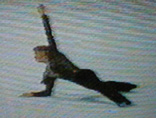
Trophy Lalique was not the most competitive event of the season. On the ladies side, Maria Butyrskaya won over Viktoria Volchkova and Jennifer Kirk. Butyrskaya was not perfect technically, but with the scores received by her closest competitors, she really didn't need to be. Volchkova suffered from a problem that always seems to plague her; although she started out great with a huge triple Lutz/double toe loop combo, but faded more and more as the program progressed. Jennifer Kirk, the young World Junior Champion, made a great senior debut, with a bronze medal. She did complete a triple toe/triple toe combo, but this didn't seem to raise her technical marks. Although Peter Caruthers seemed to think that she should have beaten Butyrskaya, I disagree. She hasn't developed a presence on the ice yet, although I do think that, based on her triple/triple, she should have been placed in second, above Volchkova. Although we didn't see the pairs competition, apparently Bereznaya and Sikuredlitze won over Selle and Pelltier. In dance, Anissina and Peizerat won the competition. I wasn't pulled into their music this time as much as last year's program, but that one was hard to top :-) The real highlight of the day came with the men. To be more specific, one of the men: Alexei Yagudin. Although Yagudin didn't have much more competition than Butyrskaya, he would have still beaten even the best in the world with his performance here. Comparing Yagudin with his closest competitors here was a laugh: there simply was no comparison. Stanick Jeanette (France, 2nd place) and Roman Serov (Russia, 3rd place) had little presence on the ice. Although you have to give Serov credit for trying a quadruple loop, which no one has done before, he doubled it. Frankly, I doubt Serov would have caught Yagudin even if his attempt had been successful (though he may have won the silver instead of the bronze). Yagudin keeps getting better and better every time we see him skate this program. His only minor flaws were a shaky landing on the triple in his quad toe/triple toe combination and popping what was supposed to be a triple loop in a triple flip/triple loop combination. But you know what? Who cares. Yagudin got all 5.8's and 5.9's for technical merit, and 5.9's and three 6.0's for presentation. But it was the way he skated it that was so eye-catching. Yagudin expressed his music with so much feeling and his presence on the ice was so strong that it made the other skaters look like amateurs. He used his spins very effectively, as always, with good positioning and a lot of variety. One move that caught the eyes of the commentators was a new move that has never been seen before: a very unusual and difficult slide, in which Yagudin supported his weight on one arm and slid down the ice on the sides of his boots (without the blades touching the ice). Here's a picture of it (sorry it's a bit fuzzy, but you get the gist of the move):
As I've said before, the Grand Prix Final promises to be very interesting.... |
|
12/16/00--The Hershey's Kisses Challenge
This was a fun little competition involving both eligible and professional skaters. It was, as usual, USA vs. the World, with pairs of skaters being matched up head to head. In each pairing, the winner gets 2 points, and the loser gets 1 point.
First match-up: Surya Bonaly vs. Kristi Yamaguchi
Second match-up: Michael Weiss vs. Kurt Browning
Third match-up: Yuka Sato vs. Sasha Cohen
Fourth match-up: Todd Eldridge vs. Brian Orser
Fifth match-up: Sarah Hughes vs. Maria Butyrskaya
Sixth match-up: Alexei Yagudin vs. Timothy Goebel
Seventh (and final) match-up: Irina Slutskaya vs. Michelle Kwan Final Score: USA 11, World 10. |
|
12/10/00--2000 Grand Prix Series: Cup of Russia
In the mens competition, Evgeny Plushenko easily won the title, defeating Ivan Dinev of Russia and Matt Savoie of the US by a wide margin. Plushenko included his quad toe/triple toe/double loop, and was nearly technically perfect, although he popped a triple Lutz into only a double. Plushenko still needs major work on his artistry; although it's a great improvement from last year, it still doesn't hold a candle to Yagudin, Stojko, or Eldridge. As for the ladies, Irina Slutskaya held onto the lead over Elena Sokalova and Sarah Hughes. Slutskaya did not do any triple/triple combinations, but she did plenty of triple/doubles, and even one double/triple. Sokalova managed a triple toe/triple toe/double loop combo, although with difficulties on the landings. Hughes popped her second jump on her planned triple/triple, turning it into a triple Salchow/single loop. Sasha Cohen placed fourth with a great skate in her second senior international competition. |
 |
12/9/00-12/10/00--World Professional Championships
Leonova and Khvalko won the pairs competition over Kazakova and Dimitriev. The latter pair might have faired better had she not badly two-footed the landing on their attempted quad throw in the technical program. If they had completed this move, they would have made history as the first pair to complete a quadruple throw jump. Americans Jenny Mino and Todd Sand placed third. Yuka Sato soared in the ladies competition, defeating Nicole Bobek, Lucinda Ruh, and Surya Bonaly. Bobek, though graceful, simply did not have the technical merit to defeat Sato. Ruh, with her remarkable spins, would have had a chance at winning if she'd been able to land a triple jump or two. Bonaly, with her fantastic split jump/triple toe/triple toe combination that would have made ISU judges sigh, was scored low artistically...it seems the judges still don't appreciate the remarkable talent of the woman. Phillipe Candeloro took the mens competition with a costume-packed skate to the soundtrack of Wild Wild West. Rudy Galindo, with a more traditional skate, placed second, with Ilia Kulik and Alexei Urmonov (the defending World Pro Champ) rounding out the top four. |
|
12/3/00--2000 Grand Prix Series: Nation's Cup
Evgeny Pluschenko dominated the men, regaining the confidence and perfection that had completely eluded him at the World Championships. (With both him and Yagudin skating well so far, this is going to be an interesting season). Timothy Goeble placed second, and Chengjiang Li, the Chinese National Champion, placed third. On the ladies side, Maria Butyrskaya won over Sarah Hughes despite mistakes on her jumps. Butyrskaya's artistry was superior. Tatiana Malinina of Uzbekistan placed third after a clean free skate. 16 year-old US Silver Medalist Sasha Cohen made her international debut, and placed 5th overall. In pairs, Sarah Abitbol and Stephan Bernadis defeated reigning World Champions Petrova and Tikhanov. In dance, Fusar-Poli and Margalio won over the Lithuanians Drobiazko and Vanagas; Bourne and Kraatz of Canada placed third. |
|
12/2/00--Ice Wars: USA vs. the World
The World Team had a lead after the technical program, but in the artistic program, after the World's Surya Bonaly, Phillipe Candeloro, and Katerina Witt were collectively tied with the USA's Nicole Bobek, Rudy Galindo, and Kristi Yamiguchi, it all came down to the final match-up. Brian Boitano skated an excellant program, and the World knew they had a tall order to fill. But Kurt Browning came through with even more power than Boitano, and brought the World Team a triumphant victory. The King of Footwork reigns.... |
|
Pro Super Teams
Bracket A: Round 1--Surya Bonaly and Rudy Galindo soared above the rest of the competition; for once both received the high marks and praise that they deserved. Behind them were the team of Lu Chen and Viktor Petrenko. Though Petrenko skated great, Chen had problems. Katerina Witt and Brian Orser didn't have the technical merit to defeat the top teams, and Oksana Baiul and Alexei Urmanov made too many errors. Bracket A: Round 2--The standings did not change. Again, Bonaly and Galindo came out ahead of the rest by a comfortable margin. Although Lu Chen faltered, Viktor Petrenko turned in a hilarious number with a fake "partner." Bracket B: Round 1--This was not televised, as far as I know, but the team of Brian Boitano and Yuka Sato is reportedly in the lead, followed by Candeloro/Bobek, Cousins/Cadavy, and Kulik/Gordeeva. Bracket B: Round 2 showed Boitano and Sato again dominating the night, though there were other good performances. Steven Cousins of Great Britain skated a clean and powerful program, as did his partner, Karen Cadavy, but it was not enough to pull them out of third place overall.
Final: After some very nice exhibition performances, and a lot of hype, we finally got down to business: four programs by four of the best in the world. After a coin toss, Rudy Galindo and Surya Bonaly elected to go first. Actually, if you ask me, the most fair way to do it would have been to alternate the skaters from the teams: for instance, have Surya, then Yuka, then Rudy, then Brian. But, that's just my humble opion.... |
|
2000 Grand Prix Series: Skate Canada
In the mens competition, Alexei Yagudin regained the form and perfection that had somewhat eluded him in the past season. Skating a powerful and flawless performance, with a quad toe/triple toe included, Yagudin claimed the gold medal. His performance was nearly flawless, and he received all 5.9's for technical merit and all 5.9's except for two perfect 6.0's for presentation. What caught my eye most about this performance was the incredible attack that he had from about 2/3 into the program all the way through to the end. His final footwork sequence was fast and furious, showing the intensity that we've come to expect from him...and then some. No altitude to bother him in Toronto. Todd Eldridge, with a hand down on his quad and a couple of other minor flaws, took the silver. His performance was good enough to force Yagudin to skate well, but nowhere near good enough to win. Matt Savoie took the bronze. As for the ladies, Michelle Kwan and Irina Slutskaya battled it out for the gold, with Slutskaya triumphing in the end. Both made mistakes: Kwan doubled the second jump in her planned triple toe/triple toe combination, while Slutskaya fell on the triple loop in her planned triple Lutz/triple loop. Bear in mind that, even though a fall is worse than a double, the combo that Slutskaya attempted was much harder than Kwan's. Kwan also doubled a planned triple flip jump and two-footed another jump, landing only 5 clean triples to Slutskaya's 6. Fumie Suguri of Japan captured the bronze medal. |
|
2000 Grand Prix Series: Skate America
On the ladies side, Michelle Kwan pulled ahead of Sarah Hughes, despite several small flaws in her program. Many thought that Hughes, with her triple Salchow/triple loop combination, should have won the title. There was an upset on the mens side: Timothy Goebel passed Alexei Yagudin in the long program to win gold. Goebel landed three quads, as he did in this competition last year, and had a clean performance despite his usual slow spins. Yagudin doubled both of his planned quads, though he managed to keep upright in all of his landings. Todd Eldridge placed third, after falling on his quad attempt and otherwise having a less than stellar skate. In the ice dance competition, Fusar-Poli and Margalio of Italy took the gold, the Lithuanians took second, and Bourne and Kraatz took third. In pairs, Shen and Zhao lost their lead to the Canadians in the long program, and the Chinese pair had to settle for second. Both teams had some minor errors, but the Canadians were more to the judges' liking stylistically. Frankly, I fail to see their charm. A Russian pair (Russian national bronze medalists) took third. This competition was held in Colorado Springs. It has been speculated that, since so many skaters had relatively poor performances at this competition, the altitude may be a very important factor. In particular, Yagudin, Eldridge, and Angela Nikodinov looked more exhausted than usual at the end of their free skates. Some may argue that it reflects conditioning, and didn't seem to affect Goebel or some of the others. Of course, there's much more to the story than that. Simply being used to the altitude helps a lot, obviously, but it's a known fact that some people simply have the genes to handle it, while others do not. To my mind, holding the first major international competition of the season at altitude is a form of discrimination. |
Figure Skating Polls:
Back To: