A good figure skating program is not just about the jumps. There are many other difficult elements in a program, such as fancy footwork, spirals, and spins. Good, fast, well-positioned spins are actually rarer than you might think, but they add a lot to a program. But how do you tell a good position? Ever wonder what a back spin is? What about a pancake, a camel, or a windmill? And have you ever wondered why some TV commentator is always complaining about poor layback positions?
In this guide, I'll tell you how to recognise the different spins, with as little technical jargon as possible; I'll just tell you what the different positions look like. (Pairs Spins are listed in other moves.)
Okay, first you have to understand that skaters tend to spin in the same direction as they spin in the air in a jump; for most skaters, this is counter-clockwise. For such a counterclockwise spin, a forward spin is done on the left foot, and a back spin on the right foot. Most skaters seem to have better sit spin positions in the forward spin than in the back spin. Layback spins are almost always forward spins.
|
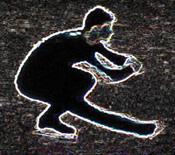
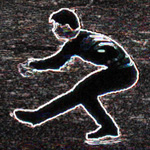
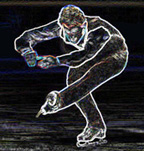
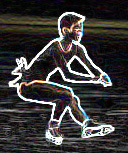
Sit Spin The sit spin is done by both men and women. The body is held low to the ground, in a sitting position with the free leg extended to some extent. The two on the left are forward sitspins (the top one is a clockwise spinner, and the bottom a counterclockwise spinner). On the right are back sitspins (both are CCW spinners). |
|
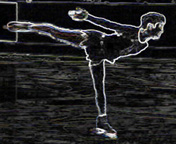 |
Camel Spin The camel spin is also done by both men and women. It's done in the 'airplane' position, meaning that the skating leg is straight, and the free leg and torso are both held parallel to the ice. There are several variations on this position, including one with a bent knee in the skating leg. |
Named after Dorothy Hamill. The skater starts out in a back camel spin and ends up in a back sit spin. From the camel position, the skater turns the hip and free leg out and drops into the sit position.
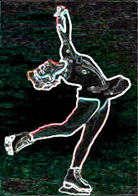 |
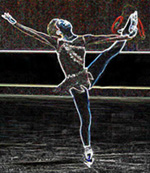
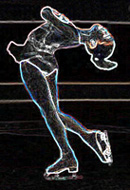
Layback Spin This is usually only done by women, although a few men (including Viktor Petrenko, Rudy Galindo, and Alexei Yagudin) also do this spin. This is the spin that TV commentators are most apt to complain about. The reason is basically that the position attained must be graceful and have good body line, as well as a good arch in the back. The free leg is supposed to be held out at the hip, with a slight knee bend, so that the foot is at the level of the knee of the skating leg, and the toe is supposed to be pointed and turned out. Many skaters make the mistake of lifting the leg only at the knee, rather than the hip, which can look awkward and ugly, as if the leg is just dangling there. There are variations of the free leg position, but the general rule is that the free leg is supposed to continue the curve formed by the arch in the skater's back. The picture on the right is one of these variants, with a very low free leg position. The back position itself is actually more important, though. Some skaters don't really lay back in the spin, and this is likely to be judged more harshly than a bad free leg position. There is also a variant of the layback called a 'sideways' layback. In this spin, the skater's torso leans to the side rather than back. |
|
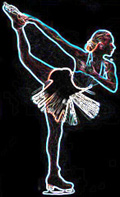
Also called an "illusion." This spin is entered from the camel position. The skater bobs his or her torso and free leg up and down. This is often done one 'bob' at a time, usually by women. There are a few men who sometimes do this spin, among them Alexei Yagudin (pictured in the sequence of pictures below). What's really neat is when the skater does several of these 'bobs' in a row, in phase with the spin, so that it really does look like a windmill. I've seen Lucinda Ruh, Irina Slutskaya, and Sarah Hughes do this.

 |
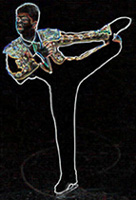
The name "Catchfoot" is used to refer to a variety of spins in which the skater pulls her foot or leg up above hip level. This can be done either in front or behind the skater. Catchfoot spins are most commonly by women, with a few exceptions. The first type of catchfoot spin sort of resembles a Biellman spin (the Biellman is actually a form of a catchfoot). But when the spin is called a catchfoot, the skater pulls her leg up behind her with only one hand, instead of both, as in the Biellman. As a result, the torso is turned out, and a lot less stretch is involved, when compared to the Biellman. When men do this spin, which is very rare, they usually catch the leg, rather than the foot, since most men aren't as flexible as most women. |
 |
|
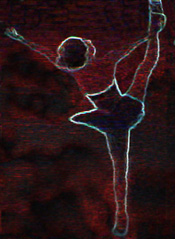
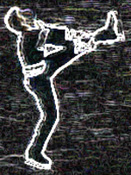
| A second type of catchfoot spin is when the leg is pulled up beside the torso, usually straightened. It can look kind of like a Y, and so is called the "Y-Spin" by some. Michelle Kwan and Sarah Hughes regularly do this, as well as Rudy Galindo. |
|
 |
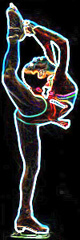
A third catchfoot is when the leg is pulled up straight in front of the body. This can be done either by catching the foot or by catching the leg. Sasha Cohen and Surya Bonaly do this well. Only a few men, such as Rudy Galindo, Alexei Yagudin, and Ilia Kulik, do this type of spin. |
 |
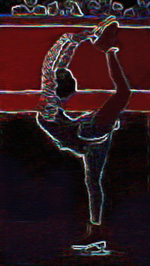
Biellman Spin This is probably the single most famous variant of the catchfoot spin; it was invented by Swiss skater Denise Biellman. It is commonly done only by women, with one exception: male Russian skater Evgeny Plushenko. In this spin, like the catchfoot, the skater grabs the free leg and pulls it up behind her. However, instead of using one hand to pull the leg up, both hands are used. This requires a lot of flexibility, since the torso must be straight. Quite a few skaters do this spin, including Irina Slutskaya, Nicole Bobek, Lucinda Ruh, Naomi Nari Nam, and Evgeny Plushenko. |
|
|
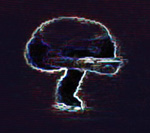
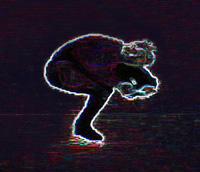
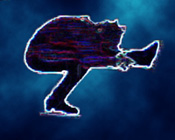
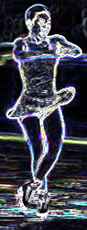
Pancake and Canonball Spins The pancake spin was invented by Lucinda Ruh of Switzerland, who is known as one of the best spinners of all time. In this spin, the skating leg is bent, as in the sit spin position, but the skater also leans forward, with the free leg tucked in next to the torso. It looks kind of like a pancake. Besides Lucinda Ruh, very few other skaters do this spin. Among them are Alexei Yagudin and Matt Savoie. There is a variant which looks almost like a high sitspin with the skating leg slightly straighter and the free leg held straight out with the torso bent over it. This is sometimes called a "canonball" and is done by several skaters, among them Todd Eldredge. Some comentators also refer to pancake spins as canonballs. |
|
 |
Scratch Spin This spin is done in the upright position, and done pretty frequently by both men and women. Todd Eldredge almost always ends his programs with one of these. The skater pulls his arms and legs up tight against his body, making him rotate faster and faster. The arms can either be stretched out about the head or held closely against the torso. There are many variations in arm and torso position, but the legs are always crossed, and held very tightly together. When the skater is able to pick up a lot of speed, this spin is very effective. |
In this spin, the skater does an Axel-like take-off, landing into a back camel spin.
This is one of the more popular spinning moves. Like the flying camel, the skater takes off like he's going to do an Axel, but this time drops all the way down into a back sit spin. It's very effective when done with good height.
The Butterfly takes off from a back edge, similar to a loop or a walley. The spin, usually a sit, follows afterward.
Back To:
Illani's Figure Skating Site
Commander Illani
TrekWars