
Okay, it's not a jump, not a spin...so what is it? I've gathered some of the other commonly used moves (including pairs moves) together here to clarify any questions you have.
|
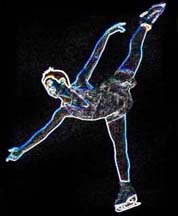
Spiral
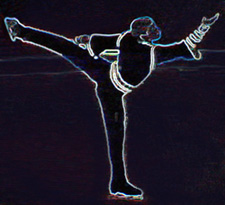
The skater skates a long arc on one foot, with or without a change of edge (inside to outside or vice versa). The free leg is usually extended, and held above hip level. Generally, the higher, straighter, and steadier that the free leg is held, the better the position is considered to be. Spirals with straight free legs are more difficult than if the leg is slightly bent. A slide spiral is when the skater slides around in the spiral position from forward to backward edges (or vice versa), and is quite difficult. Spirals are done by both men and women, but men usually don't get much extension in their free leg. Michelle Kwan, Sarah Hughes, and Sasha Cohen are known for nice free leg positions in their spirals. |
|
 |
Charlotte
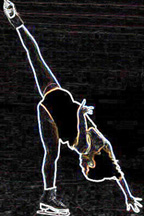
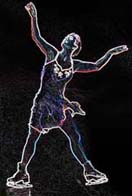
This is a variant on the spiral, where the skater's torso is leaning down to touch the skating leg, and the free leg is held nearly straight up in the air, creating a nearly vertical split. Michelle Kwan and Sasha Cohen do a back Charlotte spiral regularly, and Naomi Nari Nam does the difficult forward Charlotte spiral, seen in the picture on the right. This is a move that Dick Button cautions "you do not want to catch your toe on." The only man that does a Charlotte is the always flexible Rudy Galindo. |
|
 |
Spread Eagle
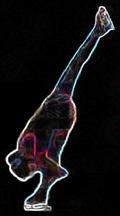
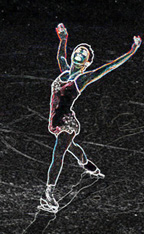
Both men and women do this move quite often. It is skated with both feet on the ice, facing opposite directions (outwards). Again, it can be done on one edge, or it can be a transition from one edge to another. There are a few variants of the spread eagle. One of them, called a Besti Squat, is skated with both legs bent at the knee. There are various degrees of the Besti Squat; shown here on the right is one of them. |

|
 |
Ina Bauer
This is another variant of the spread eagle, in which the forward leg is bent at the knee, and the trailing leg is straight and held behind the skater. It is usually done with an arched back. |
This is also called "Shoot the Duck." The skater crouches down on an exaggerated inside or outside edge, leaning so far that he brushes his hand against the ice as he skates backward in an arc. Timothy Goebel is famous for doing this on a left back inside edge, then straightening (without putting the other foot down) and performing a triple Salchow. Other skaters to do a hydroblade include Matt Savoie and Alexei Yagudin.
The description is always "the tracing of this move looks like the numeral 3," but I find this unhelpful and just plain confusing. The way to recognize it is when the skater takes a turn on the ice on one foot (pushing off with the other), just before a jump. For fans of the top two Russian skaters, both Alexei Yagudin and Evgeny Plushenko nearly always open their program with quad toe loops. The 3-turn comes just before the jump; they skate forward on the left foot (outside edge), and turn around on that foot, switching to an inside edge in the middle of the turn. After the 3-turn, they step onto the right foot (outside edge) and toe pick with the left foot for the toe loop. The 3-turn makes the jump more difficult; look for it before the toe loop, Salchow, and flip most of the time. You will not see the 3-turn before the Lutz or Axel. As I said above, for the toe loop, the skater usually does a 3-turn and then takes a step to take off, but for the flip and Salchow, the skater is already on the take-off edge at the end of the 3-turn, and therefore goes right up into the jump. The loop sometimes has a 3-turn or two in front of it--fans of Irina Slutskaya will know about her difficult entrance edge to the triple loop, with two 3-turns just before it. Confused yet? :-)
The Pairs Moves
The pairs throw and side-by-side jumps are mentioned in my jump guide. Please go there to get the descriptions and pictures.
 |
The Split Twist
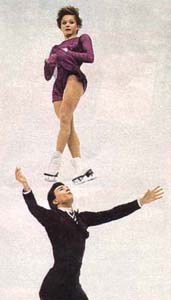
This is also called a "Hydrant Lift." It's a required element in both short and long programs of amateur pairs skaters. Nowadays it's usually a "Split Triple Twist," although a double is sometimes accomplished instead by mistake. The man lifts the woman up and throws her into the air. While in the air, she should be as close as possible to parallel with the ice. The woman does a split in the air and then spins three times in the air (if it's a triple), then is caught by the man, who then sets her down on one foot on the ice. When done properly, this move should look natural and graceful. A common fault is for the man to merely support his partner as she lands, rather than catch her before she lands and then setting her down. | 
|
The Side-By-Side Spin
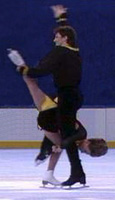
The partners are seperated by a certain amount of ice, both spinning in perfect syncronization. It is common to change feet or positions; the most common positions you'll see are the camel and sit positions, since both men and women commonly do them. Occasionally, you'll see side-by-side scratch spins, and very rarely, side-by-side laybacks. These spins must be fast, synchronised, and well centered. Generally, the less distance there is between the two skaters, the better the spins are considered to be. However, this can make the side-by-side spins a dangerous move; it was a side-by-side camel spin (with her previous partner) that gave Elena Berezhnaya a serious injury to her head.
|
Pairs Spin
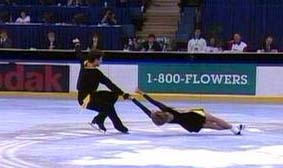
Not to be confused with the side-by-side spin, the pairs spin is when the two partners are in contact, in any number of different positions as they spin. Seen on the left is a particularly difficult and effective position invented by Oksana Kazakova and Artur Dmitriev. | 
|
 |
Death Spiral
Often one of the most fun moves to watch, the death spiral is a required element in pairs short and long programs. The man stays in place, while the woman glides around him in a circle. This can be done forward or backward, and on an inside or outside edge, and the appearance is quite different depending on the particular edge. The inside edge death spirals (as pictured) have the woman's body parallel to—and only inches from—the ice. The legs are crossed. In contrast, the outside edge death spirals have the woman farther up from the ice, with the skating leg bent and the free leg stuck up in the air. They don't want to get the blade at too acute of an angle here, or the woman will skide dangerously onto her backside. | 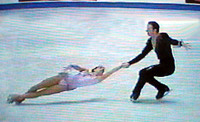
|
 |
|
Star Lift
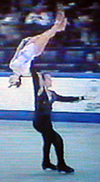
The easiest way to recognise this is to look for the man's hand supporting the woman on the hip,as she assumes the "star" position above his head.
Press Lift
The forward press lift has the woman facing downward (back), with her legs in front of the man's shoulders. The back press lift has the woman facing upward (forward) with her legs in front of the man's shoulders.
 |
Lasso Lift
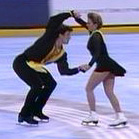
The only lift where the woman faces forward with her legs behind the man's shoulders. As you can see in the picture, the takeoff starts with the man and woman facing each other on the ice. The man takes both of her hands and swings her up over his head, turning her around in the process. |
Back To:
Illani's Figure Skating Site
Commander Illani: Personal Site
TrekWars
