-
Introduction
-
As a review of the previous unit and to set the scene
for this unit, show the PowerPoint presentation "Before
Lewis and Clark". There is also a link to the presentation on the
home page.
-
Beginning the expedition
-
Before reading Jefferson's Letter
to Congress, have the class create a web or list of things that
Jefferson might have wanted the expedition to accomplish. Include
ideas as to how many he would send, why would he choose them, etc.
-
Jefferson's actual letter may be viewed
here. The transcription is also on that site, but includes several
letters. They have been separated in this plan and are linked to
individually.
-
Read Jefferson's Letter to
Congress together as a class. Point out the use of language and
how it differs from what we use today. Stress the parts of the letter
that detail the things that Jefferson hopes the expedition will accomplish.
-
After reading have the students make a new web or list
from the reading. Then compare/contrast the earlier web to the later
one.
-
Jefferson contacts Lewis
-
Students should begin reading In Their Own Words:
Lewis and Clark at this point. The book actually starts after
Jefferson contacts Lewis, but gives background information in the
introduction. Chapters 1-3 should be read in this section.
-
The letter that Thomas Jefferson wrote to Meriwether
Lewis defining the expectations of the expedition is a lengthy one. It
is divided into thirteen sections. Students will read each section and
organize the information in that section into two lists. The first is
a list of tasks Jefferson is asking Lewis to complete. The second is a
list of support materials Jefferson has made available to Lewis and his
group. The letter from Thomas Jefferson to
Meriwether Lewis, April 27, 1803 can be found here.
-
Preparations for the Journey
-
Students will complete WebQuest
in groups of four. This activity asks them to predict what materials
will be needed for the expedition as well as a timeline.
-
Chapter 4 of In Their Own Words: Lewis and Clark
should be read at this point.
-
Meriwether Lewis wrote a letter to Thomas Jefferson
dated July 8, 1803 that describes the preparations and difficulties
associated with them. An
annotated version can be read at his link.
The
full original can be seen at this Library of Congress site.
-
You can see Jefferson's reply by
clicking here. It also has a link to the transcription.
-
These two links are letters from Lewis to Jefferson in
September of 1803 before the expedition gets truly underway. The first
is dated
September 8, 1803 and the second is
September 13,1803.
-
The Expedition Gets Underway
-
Chapters 5-11of In Their Own Words: Lewis and Clark
will be read in this section of the plan.
-
Students should be writing daily reading log entries
and should also write a letter back home. (see assessment section)
-
On July 7, 1805, Meriwether Lewis sent a letter to
Thomas Jefferson that contained an invoice of items sent from the
expedition. The
letter is a lengthy one and can be seen at the Library of Congress
website. This page also has a link to a transcription. The
timing of this letter places it in Chapter 8 of In Their Own Words: Lewis
and Clark.
-
Lewis also sent Jefferson an
"Estimate of Indian Warriors" in the Louisiana Territory. He has a
running total broken down by tribe.
-
The Journey Home
-
Chapters 12-14 of In Their Own Words: Lewis and
Clark will be read in this section.
-
Lewis wrote a letter to Jefferson telling of his safe
arrival in September of 1806.
Read that letter at this site.
-
Jefferson then responded to Lewis in a letter dated
October 20, 1806 which is
linked to here.
-
The Culmination
-
These culmination activities can be done in any order.
-
Graphic organizer: Students will complete a
graphic organizer that compares and contrasts
elements of the expedition as positive and negative. A Venn diagram could be used as some elements are both
positive and negative.
-
Biographical Sketch: Students will choose
one member of the expedition party and write a biographical sketch
in their reading log books. Encourage students to choose a member
other than Lewis or Clark. Have them infer information about some of
the lesser known members of the expedition.
-
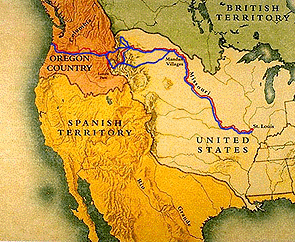
Tracing the Route: Looking at the maps from
Library of Congress website and comparing them to a current United States
road atlas, students will trace the route that Lewis and Clark took and then
come up with directions for a car to follow that approximates the trip as
closely as possible.
-
Map of NW United States territory
-
Map of Northwestern US