

 |

| Design Overview | ||||
|
During the late 2340's, Starfleet became increasingly worried about the average age of the ships in the fleet. Although vessels such as the Miranda and Excelsior classes were performing adequately as midsized cruisers and destroyers, these designs dated back between 50 and 100 years, and the spaceframes were simply becoming too old to keep up with the latest technology. Furthermore, the Ambassador class, slated to replace the Excelsior by 2350, was proving cost-ineffective in part due to advances in design rendering the spaceframe obsolete only a few years into its service lifetime, and the craft's large size made high-scale production difficult in any case. Rapid expansion of the Federation was also putting a great strain on both the exploratory and defense capacities of Starfleet, and although both the Galaxy and Nebula classes were under development, Starfleet predicted that neither would be able to completely replace the duties of the older ships until the mid-2360s at the soonest.
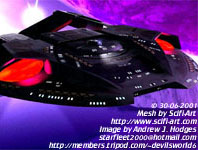
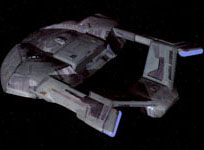
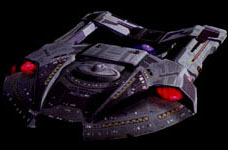
The Steamrunner-class design was fielded during this period as part of a major fleetwide drive for modernization. Essentially, the ship was to serve a similar function to the modern day Intrepid class - a smaller, faster counterpart to the cruiser class ships which would be deployed in large numbers to augment the more capable designs The small size of the craft would allow rapid production, allowing dozens of ships to be in active service as early as 2350. The first of the class was launched in 2342, and series production officially began six months later. The Steamrunner introduced several innovations into Starfleet; most noticeably, the ship's primary hull featured an angular formation which was thought to be both more compatible with contemporary structural integrity trends and better suited to high-warp travel - the class was also expected to reach a maximum speed of Warp 9.5. Additionally, the Stramrunner's warp nacelles themselves were unusually large for a ship its size, and were actually welded into the ship's saucer section; this is done both for ease of maintenance and to take full advantage of the new warp field configuration. The navigational deflector is situated at the extreme rear of the ship, connected to the primary hull only through the warp nacelles; under normal operations, it is powered directly with plasma bleedoff from the nacelles - an ingenious solution to a peculiar problem encountered with this particular nacelle design, where the engine requires a considerably greater plasma feed than is actually discharged in the warp field. Less obviously, the Steamrunner was the first class to be equipped with an isolinear computer system rather than the duotronic computers then in use. The craft's development was not an easy process. It would eventually become clear that the design was simply too far ahead of its time; the technology simply did not exist to take full advantage of the new hull configuration, and eventually persistent difficulties with the warp nacelles convinced the designers to reduce the craft's maximum speed from Warp 9.5 to Warp 8.8. Also, the configuration of the warp field occasionally caused problems for the ship while maneuvering at warp, if not carefully calibrated. These problems convinced Starfleet to abandon the new hull design for the time being, and it was not until the 2370s that certain starships, namely the Nova class, are beginning to follow the design trends set by the Steamrunners three decades before. Ironically, one of the ASDB's biggest concerns - plasma radiation from the warp nacelles - never surfaced. The Steamrunner is relatively capable of performing most scientific and exploratory functions, though naturally at a disadvantage when compared to a larger ship. Its real difficulties lie in the diplomatic area; like the Intrepid class which is now replacing it, the Steamrunner carries only limited diplomatic venues aboard ship. Despite this, the Steamrunners have proven their diplomatic worth over the years, helping to settle many matters in sparsely populated areas where Starfleet's "big guns" rarely make an appearance. Today, as the Intrepid class becomes more common, the Steamrunners are expected to be phased out in favor of the newer ships. The last few years have seen many units of this class moving from the outer territories to the core of the Federation. During the mid-2360s, all 436 starships in service underwent a massive refit, so they could finally take full advantage of their design. The maximum sustainable velocity was increased to the original specification of Warp 9.5, and a complete overhaul of the warp nacelles and structural integrity field resulted in the class becoming - according to pilots - one of the easiest ships in the fleet to handle at warp. The improvement in performance was so significant that the class remains in limited production, and Starfleet is considering a major extension to the class's fifty-year projected lifetime. It is possible that Steamrunners will remain a fixture in the frontier territories well into the next century. |
||||
|
||||
| General Information | ||||
| Category | Unit Run | Time Between Resupply | Time Between Refit | Expected Service Lifetime |
| Light Cruiser | 474 (337 in service) | 2 Terran Years | 5 Terran Years | 80 Terran Years |
| Dimensions | ||||
| Length | Beam | Depth | Mass | Crew Capacity |
| 244 m | 160 m | 40 m | 375,000 metric tons | 300 |
| Crew Compliment (Standard) | ||||
| Officers | Enlisted Crew | Marines | Civilians | Total |
| 45 | 140 | 20 | 15 | 220 |
| Armament | ||||
|
|
||||
| Defensive Systems | ||||
|
|
||||
| Warp Systems | ||||
| Standard Core Output | Maximum Core Output | Maximum Cruise Speed | Maximum Safe Speed | Maximum Speed |
| 1.15 x 10⁶ TW (Cruise Mode) | 3.47 x 10¹³ TW | Warp 8.80 | Warp 9.20 (36 hrs.) | Warp 9.50 (12 hrs.) |
| Impulse Systems | ||||
| Primary Fusion Output | Secondary Fusion Output | Impulse Engine Output | Impulse Engine Tolerance | Maximum Accelleration |
| 4.3 EJ/hr | 2.0 EJ/hr | 6.292 MeV/sec | 10.768 MeV/sec | 620,000 m/sec-2 |

Crew Manifest | Design Specifications | Ship's History | Shuttlebay | Sign up!

Back to Main
