
|

| Design Overview | ||||
|
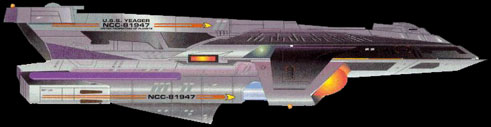
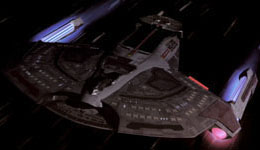
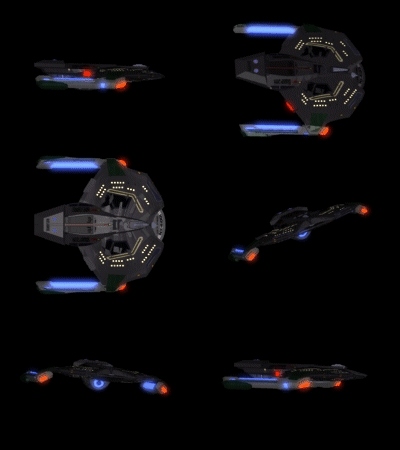
The Saber class was part of Starfleet's modernization program of the 2340's. They were designed to be a frigate counterpart to the Steamrunner class starship; much smaller, easier to build and hence considerably more numerous. The designers brought in many measures to ensure that the Saber class would be easy to build; like the much earlier Oberth class science vessels the Saber's design is highly modular in nature, allowing ten thousand ton sections to be constructed in small shipyards before final assembly in a larger facility. One requirement was for the Saber's to have a science and exploration capacity equal to 85% that of a Steamrunner class along with equal cruise and maximum speeds - a measure intended to allow the vessels to work together in co-ordinated operations. In addition, the ship was to mount a total of four torpedo tubes, a number unheard of for a ship it's size, and with a shield capacity nearly double that of the Excelsior class.
This proved an exceptionally difficult target to meet in a hull with only two thirds of the volume of a Steamrunner; indeed, most designers, including the renowned San Francisco fleet yards, felt the design would be completely impossible to create. After the project was initially closed due to unfeasability, a single design was produced which met nearly all the concept requirements. The craft was a radical departure from accepted design trends; many aspects of the hull configuration were taken from the equally experimental Steamrunner development; a considerable gamble considering that the engineering of that project was already overshadowed by questionable feasibility. The design was initially rejected by the ASDB; however, the project went forward anyway due to an unprecedented intervention by Starfleet Command. The Saber Class Development has been termed "one of the wierdest projects in Starfleet's history," and aptly so. The design team's unorthodox received more reprimands for breach of protocol than any other project before or since, and the ASDB's review of the completed prototype deemed it completely unspaceworthy, reassigned the design team and put the project on hold indefinitely. However, a small number of the designers, determined to prove the merits of their design, undertook the most unorthodox measure of all. The USS Saber had been made ready for trial runs, and was scheduled to be mothballed the next day, when the chief designer and a few of his engineers stole the ship from spacedock, kidnapping Starfleet's Admiral T'Kal by transporter before fleeing the system. In what would become known as the Saber proxy, three starships were mobilized to recover the ship, and, when attempts to bring the Saber to heel, opened fire. The ship absorbed significant phaser fire before escaping into warp; even a pair of photon torpedoes fired in a last-ditch effort by the Excelsior-class USS Sawyer. The event was a coup; the ASDB attempted to use the incident as an excuse to close the Saber project for good, but the success of the design could hardly be designed, and Admiral T'Kal himself vetoed the move, officially endorsing the project. The USS Saber was officially commissioned in 2343. The first production-model Sabers were completed with zero free room for expansion, with the hope that the modular construction would offset the limitations this would place on design flexibility, a prediction which largely proved accurate. A major refit in 2357 and advances in miniaturization technology remedied this shortcoming. While the torpedo armament was kept to the design requirements, limited available space necessitated a drastic reduction in the magazines; both forward and both aft launchers load from the same armory, each of which only holds sixty casings, including sensor probes. The six type-VII phaser arrays were at first to be reduced to only four, but the designers incorporated a single Type-VIII array into the leading edge of the saucer section, bringing the overall phaser power to some 91% of the initial planned phaser capacity. (These have since been upgraded to Type-VIII and Type-X, respectively.) The competition for internal volume also forced a reduction in the size of the warp core; as a result, the Saber pioneered a new high-pressure core assembly, which allows the ship to match the Steamrunner's then-maximum speed of Warp 8.8. After an overhaul of the warp systems in 2357, the ship's top speed was increased to Warp 9.2, and in 2368 the USS Yeager rated Warp 9.85. The original specifications of the Saber called for a crew of 130, but increased automation of the engineering systems allowed this to be cut to 102 and then 50. Conditions for the crew are relatively poor by the standards of the Steamrunner or Akira classes; crew quarters average 30 square meters and there are no holodecks. In addition, there are no personal replicator stations in crew quarters - instead three mess areas are provided with replicator systems for the whole crew. Regardless of the living conditions, the starships often operated for extended periods away from starbase in their companion role to the Steamrunner, and this produced in some ways a revival of the closed culture of the early star missions among the crew; many Saber crewmembers spent over a decade of their careers on board the same ship. Like the larger Akira and Steamrunner classes, Sabers have largely served in the frontier regions and have been an uncommon sight at the heart of the Federation. This has changed over the last three years, when many of the Saber class have been relocated near the core as part of Starfleets build-up of forces against the Dominion. Sabers featured heavily during the recent Borg incursion, where many of the ships involved in the Typhon and Earth battles were destroyed or severely damaged. Although the ships rarely receive much attention, ease of production and maintenance has caused the craft to form a silent backbone of the fleet; currently there are more than three hundred Sabers in service, and production continued through the Dominion War. |
||||
|
||||
| General Information | ||||
| Category | Unit Run | Time Between Resupply | Time Between Refit | Expected Service Lifetime |
| Tactical Scout | 722 (314 in service) | 2 Terran Years | 10 Terran Years | 80 Terran Years |
| Dimensions | ||||
| Length | Beam | Depth | Mass | Crew Capacity |
| 190 m | 250 m | 41 m | 250,000 metric tons | 200 |
| Crew Compliment (Standard) | ||||
| Officers | Enlisted Crew | Marines | Civilians | Total |
| 8 | 32 | 10 | 0 | 50 |
| Armament | ||||
|
|
||||
| Defensive Systems | ||||
|
|
||||
| Warp Systems | ||||
| Standard Core Output | Maximum Core Output | Maximum Cruise Speed | Maximum Safe Speed | Maximum Speed |
| 2.52 x 10⁵ TW (Cruise Mode) | 8.98 x 10¹² TW | Warp 8.80 | Warp 9.20 (36 hrs.) | Warp 9.85 (12 hrs.) |
| Impulse Systems | ||||
| Primary Fusion Output | Secondary Fusion Output | Impulse Engine Output | Impulse Engine Tolerance | Maximum Accelleration |
| 2.1 EJ/hr | 1.8 EJ/hr | 3.441 MeV/sec | 8.676 MeV/sec | 750,000 m/sec-2 |

Crew Manifest | Design Specifications | Ship's History | Shuttlebay | Sign up!
Back to Main
