Displaying exhibits is the most important features in a
museum, probably the only reason why it exist. Museum in the present days
has evolved to a stage whereby artifacts are
exhibited to provoke visitors and through the ‘material
culture’ as Kevin Moore had illustrated visitors are able to exploit deeper
meanings.
Kevin Moore exemplified that museum
nowadays
had diminished the boundaries
of ‘high’ and ‘low’ culture, evidently localizing
the institute itself. In order for Museum to
exist in low/popular-culture,
exhibits should project in its
‘fullest diversity, not just fragments which curators deem to be authentic.’
(Moore, 1997 :5) and that museums should reflect the history and culture of
all. What Curators tends to do however is make judgments trying to determine
the art and historical significance of the exhibits, Moore argued that museum should
display which in turn allow visitors to provoke into and to allow them to
judge for
themselves as to what is art and history and what is not.
Umbrellas
The Museum of Sydney is arguably a
heritage museum displaying not only the government house but also
exploiting the relationships
and the encounter between the colonial and the indigenous, hence we expect
to discover exhibits which depicts
the colonization of Sydney, exchange and relationship with the indigenous
people and the rise of
Sydney. Interestingly we
would find very little artifacts within the museum, alternatively pictures,
paintings and labels are obvious. What the museum is trying to do here, as
Virago mentioned is that using paintings, installations (edge
of trees) and quotes, the museums wants
have a more pro-active approach.
Moore particular emphasized 'oral history'
besides long intimidating quotes, which relates
directly to the 'talking
box'. Virago had
tremendously praised the technology not
only MOS was the first to employ such concepts but also
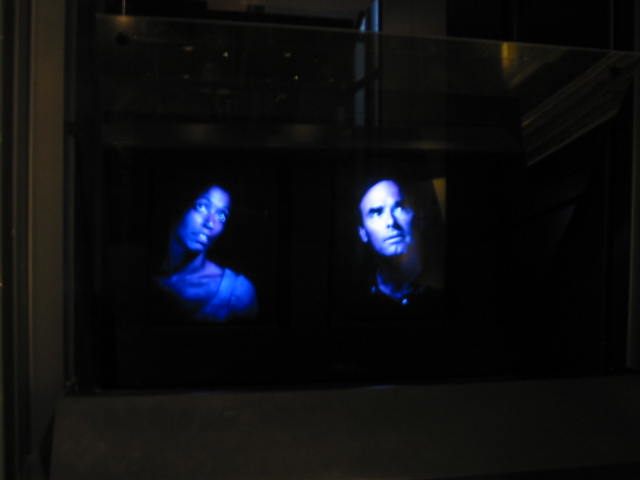 it
provides a modern audiovisual pleasure. Here Kevin
Moore argued explicitly saying that such museums are taking
objects and material culture to a second place consequently the museum
becomes ‘book on the wall’ (Moore, 1997: 39). Not only destroying the essence
of material culture but also the characteristics of a museum ‘the most
important and unique characteristic of a museum exhibition is that it
facilitates an encounter between visitor and three-dimensional object’
(Belcher in Moore, 1997:39).
it
provides a modern audiovisual pleasure. Here Kevin
Moore argued explicitly saying that such museums are taking
objects and material culture to a second place consequently the museum
becomes ‘book on the wall’ (Moore, 1997: 39). Not only destroying the essence
of material culture but also the characteristics of a museum ‘the most
important and unique characteristic of a museum exhibition is that it
facilitates an encounter between visitor and three-dimensional object’
(Belcher in Moore, 1997:39).
Powerhouse museum on the other hand has a
far more different approach. The museum itself is an applied arts and
science museum which means
not only that it has a different umbrella but it
also indicates that its operation and approach will be different to MOS. With regards to the artifacts, it ‘whisked back the swinging
60’s, the self satisfied 50’s and the irrepressibly cheerful 40’s’ (John
Cunningham, Sydney Morning Heralds, 22 January, 1988:18) meaning that PHM
covers Sydney Culture on a superficial manner to a practical level. In the
lights of Moore exemplification Powerhouse Museum had truly corresponds with
his notion, although there are signs of oral history and books on the walls
yet the amount of artifacts is significant, which somehow creates this
impression that objects comes first on the list,
rather than other forms of depiction to illustrate historical significance.
Coming back with regards to authenticity
and judgment, both museums although covers a different umbrella in its
nature however somehow it corresponds with Moore’s exemplification. Both
museums in their exhibition projects
curator’s perception on Sydney History, the rise of Sydney and the evolution
of the city in particular and assumes that visitors would correspond to it.
What they fail to identify is that visitors too has their own thoughts,
their own ‘authentic’ perceptions, which may oppose to the curator’s.
However it is rather difficult for curators to accommodate visitor’s
perception and authenticity as museum not only has to cover a wide
demographic span but since it is government funded which
due to political issues that consequently stops them to present
on a wide perspective. Nonetheless they are considered as a pop-cultured
museum, despite on a judgmental perspective, due to the fact that it
reflects history and culture, Sydney to be precise, all in one.




