|
||
|
|
       
|
Falk and Dierking (1992) mentioned that visitors put together three contexts in constructing its museum experience: Personal Context, Social Context and Physical Context. Personal context includes personal interest, motivations and expectation in visiting a museum, social context ‘strongly influence visitors’ (Falk and Dierking, 1992: 3) which deals with visits (alone or in a group?) to the museum and finally the physical context ‘includes the architecture and “Feel” of the building, as well as the objects and artifacts contained within’ (Falk and Dieking, 1992: 3). This three components forms a framework which is unique to each individual when visiting the museum, rather then identifying each visitors framework, it is far more important to identify how MOS and PHM creates these contexts for museums to put together their own museum experience. However Falk and Dierking mentioned that all three contribute significantly to visitor’s museum experience yet it is not necessarily equal and obvious in most cases. (In exemplifying this experiential section, a simple and informal interview were done on the public, by asking them a few questions)
MOS Through observation
and research, one has realized that MOS attracts mostly adults and student
in visiting the museum and most visitors comes in small groups or merely
alone. Interestingly,
results has revealed that visitors go in merely due to curiosity rather then
deep and thorough interpretation, they have no intention or whatsoever in
challenging or putting historical fragments together which somehow
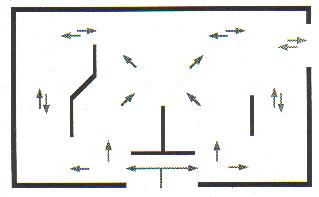
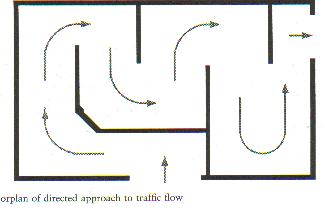
contradicts on what MOS is doing. Mark, the staff of MOS m unstructured approach (Dean, 1992: 54 fig. 3.15) PHM PHM however has a wider span on the demographic, through observations not only students but also families, big school groups and other big social groups, such as tourists visit the museum, very little case when visitor would visit the museum alone. This is a rather big contrast with MOS and it reflects the personality of both museums, to this we can interpret that MOS is a space for analyzing and inspirations, contrastingly PHM is a space for understanding, realization and learning on Sydney Culture and a leisure time activity. Falk and Dierking argued that an obvious amount of visitors are spending their leisure-time visiting the museum, ‘the overwhelming majority of museum visitors come during weekends and vacation periods. Most visitors have made the choice to spend their leisure time visiting a museum’ (Falk and Dierking, 1992: 12), however Jana Vythrhlik, the manager of Education and Visitors Services of PHM argued about that. She said overall visitations to museum as leisure activity had decreased from 45% to 34% in comparison to other activities, although there has been a tremendous decrease nonetheless the overall figure are still significant. Layout wise, although there are indications that it’s layout are similar to MOS, meaning that visitors can start anywhere when viewing exhibits, exhibitions exists in sections which spreads out within the gigantic space. However when you are in each section, there is a systematic arrangement which requires visitors to follow in a certain direction, similar to ‘directed approach’ that Dean mentioned. Dean mentioned that the advantage for this approach is visitors allows ‘a very structured, coherent and didactically oriented development of a subject’ (Dean, 1994: 55), conversely this method also promotes ‘exit-oriented behavior’ as visitors look for a way to leave the pathways as Dean explained.
directed approach (Dean, 1992: 54 fig. 3.16) |
This site was last updated 06/20/03

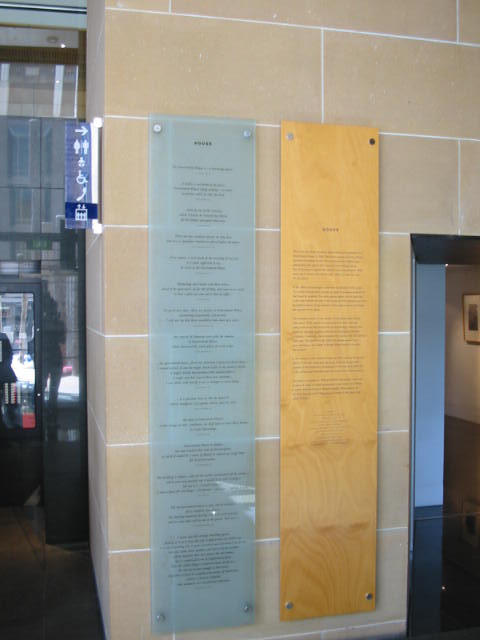 entioned
that it is gradually changing to suit the practical crowds, for example the
labels, rather than having long and inspirational quotes (the glass labels)
solid facts were put in (the wood labels) to give the visitors a clearer
understanding. What significantly needs to identified is the concept of the
exhibition that Virago has explicitly mentioned during the interview. MOS is
adapting so called a ‘non-linear’ approach, meaning that the exhibitions
does not follow anyway particular sequence which is equivalent to the
‘unstructured approach’ (Dean, 1994: 55) as Dean has identified.
entioned
that it is gradually changing to suit the practical crowds, for example the
labels, rather than having long and inspirational quotes (the glass labels)
solid facts were put in (the wood labels) to give the visitors a clearer
understanding. What significantly needs to identified is the concept of the
exhibition that Virago has explicitly mentioned during the interview. MOS is
adapting so called a ‘non-linear’ approach, meaning that the exhibitions
does not follow anyway particular sequence which is equivalent to the
‘unstructured approach’ (Dean, 1994: 55) as Dean has identified.