Of all the turnarounds I've done in my time, the biggest has been my turnaround to Clint Eastwood. I used to think he was the most arrogant pig out, one acting style only, no character. Was I wrong!!! Check out the following movies etc to see what I mean. Starred ones are movies I've seen already.
MOVIES
Actor
Director
Executive Producer
Producer
Other Movie Credits
MUSIC
TV
LIKE most superstars, Clint Eastwood's success can be attributed to equal parts good fortune, tenacity, and talent. On leave as a G.I., his plane crashed into the Pacific Ocean: he swam three miles to shore, was made boot camp swimming instructor, and missed out on action in Korea. Encouraged to try acting by two of his Army buddies, David Janssen and Martin Milner, he landed a contract at Universal Studios in 1954, earning 75 dollars a week playing bit parts in movies like Revenge of the Creature and Tarantula. He was dropped when some execs decided his Adam's apple was too big. He swallowed his pride and, over the next few years, he dug swimming pools between playing bit parts in movies and on TV.
While visiting a friend at CBS, Eastwood was spotted by a network exec who cast him as cattle driver Rowdy Yates in the long-running western series Rawhide. That, in turn, led to spaghetti stardom in a string of Sergio Leone westerns, beginning with A Fistful of Dollars. He made his directorial debut with Play Misty for Me in 1971, the same year he made his bow as Dirty Harry, the Magnum-toting cop who cemented his reputation as a superstar. Throughout the '70s, he was the world's biggest box-office draw, but his critical reputation didn't begin to turn until 1980, when New York's Museum of Modern Art honored him with a career retrospective. In 1985, he was decorated by the French, and, the year after that, he was elected mayor of a Northern California seaside community, Carmel.
In 1988, after a two-year hiatus, he returned to film: he starred in the fifth and seemingly final Dirty Harry adventure, The Dead Pool, and directed the critically acclaimed Charlie Parker biopic, Bird. In his sixties, Clint's chiseled cheeks and rugged, thin-lipped charm seemed as sexy as ever, and coupled with decades of professional efficiency, he was ripe for enshrinement. In 1992, he won Best Picture and Best Director Oscars for Unforgiven, an artful, existential Western in which he starred with Gene Hackman and Morgan Freeman. With In the Line of Fire, a 1993 thriller in which he plays an aging secret service agent, Eastwood proved that he was firmly on top of —
While Eastwood has tried to keep his personal life largely private, choosing to live out of the Hollywood limelight, in Carmel, he has seen his fair share of scandal. Married in 1954 to Maggie Johnson, he fathered a daughter, Kimber, by actress Roxanne Tunis in 1964. He and Maggie later had two kids of their own, but the couple split in the late '70s, when Eastwood took up with sometime co-star Sondra Locke. His split from Locke was even more traumatic, leading to multimillion-dollar lawsuits against Eastwood and his studio, Warner Bros. Eastwood and Locke finally settled out of court for an undisclosed amount. On a much happier note, Eastwood married television news journalist Dina Ruiz, 35 years his junior, and the couple had a baby daughter in December 1996.
Now closing in on 70, Eastwood shows little signs of slowing down: he produced, directed, and starred in the 1997 political thriller Absolute Power, and produced and directed an ambitious adaptation of Midnight in the Garden of Good and Evil, John Berendt's best-selling non-fiction account of a murder trial in Savannah, Ga. 1999 witnessed the release of the suspenseful and satisfying thriller True Crime, which he produced, directed, and starred in. As for upcoming projects, Eastwood has been mentioned to star in Henry in Love, a drama about an older man who marries a young woman, fathers a child, and then discovers that he has a terminal illness; and to direct Golf in the Kingdom, the story of a man who finds enlightenment while playing golf in Scotland. Speaking of golf, Eastwood is moving forward, despite the objections of environmentalists, to develop a golf course, hotel, and several exclusive homes in Monterey County, south of San Francisco.
CLINT'S ONE LINERS
Absolute Power
Dirty Harry
Fistful of Dollars
Heartbreak Ridge
High Planes Drifter
Magnum Force
Outlaw Josey Wales
Sudden Impact
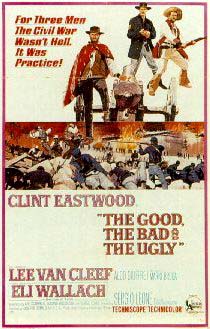
The Good, the Bad and the Ugly
Unforgiven
Misc
IN CLINT'S OWN WORDS
My family was too busy moving around, looking for work, for me to know what I wanted. Even after I got out of high school in Oakland, I had no idea what I wanted to do.
One of the biggest things when I was a kid -- I always liked jazz. A wide spectrum of jazz. Back in the forties and fifties, I listened to Brubeck and Mulligan. And I loved Ellington and Basie. I'd get books on everybody: Bix Beiderbecke, King Oliver, Buddy Bolden. I tried to enroll in Seattle University, where they had a good music program. I got my draft notice before I got in there, though, and ended up at Fort Ord [California].
I served my two years and went down to L.A. City College, where I enrolled in business administration. In the service I had met some guys who were actors -- Martin Milner, David Janssen -- and when we got out, a cinematographer got me a screen test. I got an offer to go under contract with Universal, seventy-five bucks a week to start. They threw me out a year and a half later. But it was a pretty good deal for a young guy. We had acting classes every day.
I'd done Rawhide for about five years. The agency called and asked if I was interested in doing a western in Italy and Spain. I said, "Not particularly." They said, "Why don't you give the script a quick look?" Well, I was kind of curious, so I read it, and I recognized it right away as Yojimbo, a Kurosawa film I had liked a lot. Over I went, taking the poncho with me -- yeah the cape was my idea.
There's a rebel lying deep in my soul. Anytime anybody tells me the trend is such and such, I go the opposite direction. I hate the idea of trends. I hate imitation; I have a reverence for individuality. I got where I am by coming off the wall. I've always considered myself too individualistic to be either right-wing or left-wing.
I think people jumped to conclusions about Dirty Harry without giving the character much thought, trying to attach right-wing connotations to the film that were never really intended. Both the director [Don Siegel] and I thought it was a basic kind of drama -- what do you do when you believe so much in law and order and coming to the rescue of people and you just have five hours to solve a case? That kind of impossible effort was fun to portray, but I think it was interpreted as a pro-police point of view, as a kind of rightist heroism, at a time in American history when police officers were looked down on as "pigs," as very oppressive people -- I'm sure there are some who are, and a lot who aren't. I've met both kinds.
I don't like the wimp syndrome. No matter how ardent a feminist may be, if she is a heterosexual female, she wants the strength of a male companion as well as the sensitivity. The most gentle people in the world are macho males, people who are confident in their masculinity and have a feeling of well-being in themselves. They don't have to kick in doors, mistreat women, or make fun of gays.
You don't play down to people, you don't say. "I'd better make this line a little simpler, a little more expository." For instance, in The Outlaw Josey Wales, when he rides off at the end of the picture, the editor and I had wanted [at one time] to superimpose the girl's face over him. He said, "We want the audience to know that he's going back to her." Well, we all know he's going back. The audience wills him back.
One of my favorite films was Pale Rider. I also liked Honkytonk Man. I feel very close to the western. There are not too many American art forms that are original. Most are derived from European art forms. Other than the western and jazz or blues, that's all that's really original. High Plains Drifter and Pale Rider both have elements of the classic westerns in them, mythological characters who drift in and have an effect on the people. In High Plains Drifter he is the bereaved brother who comes back and persecutes the people for their apathy or corruption. In Pale Rider the stranger comes to the aid of hard-working people, who are trying to eke out a living and are being harassed by the major corporate concern.
You have to trust your instincts. There's a moment when an actor has it, and he knows it. Behind the camera you can feel the moment even more clearly. And once you've got it, once you feel it, you can't second-guess yourself. If I would go around and ask everyone on the set how it looked, eventually someone would say, "Well, gee, I don't know, there was a fly 600 feet back." Somebody's always going to find a flaw, and pretty soon that flaw gets magnified and you're all back to another take. Meanwhile everyone's forgotten that there's a certain focus on things, and no one's going to see that fly because you're using a 100mm lens. But that's what you can do . You can talk yourself in and out of anything. You can find a million reasons why something didn't work. But if it feels right, and it looks right, it works. Without sounding like a pseudointellectual dipshit, it's my
responsibility to be true to myself. If it works for me, it;s right. When I start choosing wrong, I'll step back and let someone else do it for me.
Actors know the most difficult problem in acting is to act in a scene with a person you don't know while you're both playing characters who know each other very well. You have to break down your natural reserve in the presence of a stranger. As a director, I can help actors do that sometimes. The plan was, when I first started directing in the 1970's, to get more involved in production and directing so at some point in my life, when I decided I didn't want to act anymore, I didn't have to suit up.
None of the pictures I take a risk in cost a lot, so it doesn't take much for them to turn a profit. Bronco Billy, for example, cost five million. We sold it to TV for ten. We don't deal in big budgets. We know what we want and we shoot it and we don't waste anything. I never understand these films that cost twenty, thirty million dollars when they could be made for half that. Maybe it's because no one cares. We care.
But I do want mood. I guess Unforgiven is a good example. When we're in the saloon, and I want it to look like it's coal-lit. I don't want an electronic feel. I want it the way the light would pool. I liked this film because even the perpetrators of the violence are touched by it, and a lot of good people are victims.
In The Bridges of Madison County, Kincaid's a peculiar guy. Really, he's kind of a lonely individual. He's sort of a lost soul in Mid-America. I've been that guy.
Most people who'll remember me, if at all, will remember me as an action guy, which is OK. There's nothing wrong with that. But there will be a certain group which will remember me for the other films, the ones where I took a few chances. At least, I like to think so.
[Ma Soeur] [Quotes] [Namesake] [Monologues] [Poetry] [Home] [Chelsea Moments] [Links] [Clint]
True Crime — 1999*
Absolute Power — 1997*
The Bridges of Madison County — 1995
A Century of Cinema — 1994
In the Line of Fire — 1993*
A Perfect World — 1993*
Unforgiven — 1992*
White Hunter, Black Heart — 1990
The Rookie — 1990*
Pink Cadillac — 1989*
The Dead Pool — 1988*
Heartbreak Ridge — 1986
Pale Rider — 1985*
City Heat — 1984
Tightrope — 1984
Sudden Impact — 1983
Honkytonk Man — 1983
Firefox — 1982
Any Which Way You Can — 1980
Bronco Billy — 1980
Escape From Alcatraz — 1979
Every Which Way but Loose — 1978
The Gauntlet — 1977
The Enforcer — 1976*
The Outlaw Josey Wales — 1976*
The Eiger Sanction — 1975
Thunderbolt and Lightfoot — 1974
High Plains Drifter — 1973
Magnum Force — 1973*
Joe Kidd — 1972
The Beguiled — 1971
Dirty Harry — 1971
Play Misty for Me — 1971
Kelly's Heroes — 1970
Two Mules for Sister Sara — 1970
Where Eagles Dare — 1969
Paint Your Wagon — 1969*
Hang 'Em High — 1968*
Coogan's Bluff — 1968
For a Few Dollars More — 1967*
The Good, the Bad, and the Ugly — 1966*
A Fistful of Dollars — 1964*
Ambush at Cimarron Pass — 1958
Lafayette Escadrille — 1958
Escapade in Japan — 1957
The First Traveling Saleslady — 1956
Away All Boats — 1956
Never Say Goodbye — 1956
Star in the Dust — 1956
Tarantula — 1955
Lady Godiva — 1955
Francis in the Navy — 1955
Revenge of the Creature — 1955
True Crime — 1999*
Midnight in the Garden of Good and Evil — 1997
The Bridges of Madison County — 1995
A Perfect World — 1993*
Unforgiven — 1992*
White Hunter, Black Heart — 1990
The Rookie — 1990*
Pink Cadillac — 1989*
Bird — 1988
Heartbreak Ridge — 1986
Pale Rider — 1985*
Sudden Impact — 1983
Honkytonk Man — 1983
Firefox — 1982
The Gauntlet — 1977
The Outlaw Josey Wales — 1976*
The Eiger Sanction — 1975
High Plains Drifter — 1973
Breezy — 1973
Play Misty for Me — 1971
Thelonious Monk: Straight, No Chaser — 1989
True Crime — 1999*
Midnight in the Garden of Good and Evil — 1997
Absolute Power — 1997*
The Stars Fell on Henrietta — 1995
The Bridges of Madison County — 1995
A Perfect World — 1993*
Unforgiven — 1992*
White Hunter, Black Heart — 1990
Pink Cadillac — 1989*
Bird — 1988
Heartbreak Ridge — 1986
Pale Rider — 1985*
Sudden Impact — 1983
Honkytonk Man — 1983
Firefox — 1982
Casper — 1995 (Voice only)
Heartbreak Ridge — 1986 (Music)
City Heat — 1984 (Music)
Tightrope — 1984 (Co-Producer)
Any Which Way You Can — 1980 (Music)
Eastwood After Hours: Live at Carnegie Hall — 1997
Big Guns Talk: The Story of the Western — 1997 (Documentary)
Here's Looking at You, Warner Bros. — 1993 (Special; host)
Clint Eastwood--The Man From Malpaso — 1993 (Special)
Clint Eastwood's Favorite Films — 1993 (Special)
Clint Eastwood Talking With David Frost — 1993 (Guest)
Eastwood & Co. Making Unforgiven — 1992 (Special)
Gary Cooper: American Life, American Legend — 1989 (Host, Narrator)
All-Star Party for Joan Collins — 1987 (Host)
Fame, Fortune & Romance — 1986 (Series)
All-Star Party for Clint Eastwood — 1986 (Special)
Amazing Stories: Vanessa in the Garden — 1985 (Series; episode director)
Rawhide — 1959 - 1966 (Series)

"Tomorrow is promised to no one."
Tim Collin: "Mercy!"
Luther Whitney: "I'm fresh out."
"Go down a rope in the middle of the night? If I could do that, I'd be the star of my AARP meetings."
"I've got to go have my pacemaker checked, it has been so exciting talking to you."
"I know what you're thinking. Did he fire six shots or only five. Well to tell you the truth, in all this excitement, I kind have lost track myself. but bein' this is a 44 magnum, the most powerful handgun in the world, and would blow your head clean off, you've got to ask yourself one question.......do I feel lucky?... Well do ya... punk?"
"That ain't nice you laughin', you see, my mule don't like people laughin', he gets the crazy idea you're laughin' at him, so now if you'll apologize, like I know you're going to, I might convince him that you really didn't mean it."
This strikes the boys as even more funny, that is until five shots ring out from clints revolver.
"I'm mean nasty and tired, I eat concertina wire and I piss napalm, and I can put a round through a flea's ass at 200 meters so why don't you go hump someone else's leg muttface before I push yours in."
Clint says coolly, without turning around to the man standing behind him, "You'd look pretty silly with that knife up your ass." He then eases his beer glass down onto the rail and fires off 3 perfectly placed rounds from the hip at 3 practice dummies. Then he says to the astonished man, "You STILL there?"
"Man's got to know his limitations."
"Dying ain't much of a livin' boy."
After killing the bad guys, the kid asks Clint: "Aren't we gonna bury the bodies?" Clint, with a cheek full of chaw, squints down at the corpses, looks around, "To hell with them fellas. Buzzards gotta eat, same as worms."
"Looks like I got me a Josey Wales."
"I've noticed that when I get to liking someone they ain't around long."
Chief:"I've noticed that when you get to disliking someone they aint around long neither."
"Well, this is the 44 Magnum, and it can REMOVE the fingerprints..."
"There are two kinds of men in this world, those with loaded guns and those who dig. You dig."
"I've never seen so many men wasted so badly."
"..deserve's got nothin' to do with it."
"Funny thing killing a man...take away all he's got...and all he's ever gonna have."
"Yeah I killed women and children. I reckon I've killed everything that walks or crawls, at one point or another."
"Anybody who doesn't feel like dyin' should move on out the back... or I'll come back and kill all of ya."
Gene Hackman: "You just shot an unarmed man!"
Clint Eastwood: "Well he should have armed himself."
"Go ahead punk, make my day."
"He's got so much influence down town he could get a sodomy charge reduced to following too closely."
"I tried being reasonable, I didn't like it."
"Opinions are like assholes, everybody has one."